
viola organista
The viola organista is a musical instrument designed by Leonardo da Vinci. It uses a friction belt to vibrate individual strings (similar to how a violin produces sounds), with the strings selected by pressing keys on a keyboard (similar to an organ). Leonardo's design has intrigued instrument makers for more than 400 years, but though similar instruments have been built, no extant instrument constructed directly from Leonardo's incomplete designs is known.
viola organista

Gérard · CC BY-SA 4.0
- Field
- keyboard instrument and friction instrument.
VALÉORINE Encyclopedia
VALÉORINE documentary reading
Documentary summary
The viola organista is a musical instrument designed by Leonardo da Vinci. It uses a friction belt to vibrate individual strings (similar to how a violin produces sounds), with the strings selected by pressing keys on a keyboard (similar to an organ). Leonardo's design has intrigued instrument makers for more than 400 years, but though similar instruments have been built, no extant instrument constructed directly from Leonardo's incomplete designs is known.
Admitted source layer · organised and presented by VALÉORINE
Note VALÉORINE
No house-authored Note is published until its assertions and sources pass the VALÉORINE evidence contract. The documentary article remains available in full while that enrichment is being consolidated.
Documentary enrichment in progress · no unsupported statement published
Reference Check
Propose documentary evidence for viola organista. A contribution is never written directly as fact: identity, source, rights and evidence gates still decide.
Sign in to contribute
World of VALÉORINE
Documentary connections
Only confirmed graph relationships appear here. Images are shown only when their identity and reuse rights both pass the documentary gate.

Documentary evidence
Evidence Panel
wikipedia incomplete · checked 25 September 2026
- Identity
- resolved
- Independent source families
- 0
- Admitted assertions
- 0
- Open conflicts
- 0
Authority files
wikidata · Q2195783 · wikipedia · Viola organista
In this article
Construction
It is not known if Leonardo ever built a working prototype of this instrument. The first similar instrument actually to be constructed was the Geigenwerk of 1575 by Hans Heyden, a German instrument inventor. However, the Geigenwerk is not based on Leonardo's designs. It uses several friction wheels instead of a friction belt to vibrate the strings, and requires two people to play it: one to turn the crank to put the rosined wheels in motion, and the other to work the keys. Georg Gandi, an organist in Ilmenau, constructed a similar instrument with some improvements in 1709 and called it the piano viol. In 1741, two inventors – Le Voir in Paris and Hohlfeld in Berlin – independently constructed versions of a bowed piano, similar to Heyden's design. In 1754, a horsehair covering was added to the wheels of the bowed piano, which was termed the viola da gamba piano. Other instrument makers continued to improve the design through the remainder of the 18th and into the early 19th centuries, though it never became widespread or common. These instruments remained primarily museum curiosities until a few modern instrument builders began to take an interest in creating reconstructions of the Geigenwerk, but calling them viola organista. Akio Obuchi built several instruments as early as 1993. In 2013, Polish musician Sławomir Zubrzycki completed the construction of another modern replica of the Geigenwerk called viola organista and played it in performance at the Academy of Music in Kraków. Zubrzycki's instrument contains four bow-wheels (spun by a foot-pedal operated by the player), 61 keys, and a range extending from F1 to F6. In 2015, the musician Björk included this instrument – also played by Sławomir Zubrzycki – in a recording of the song "Black Lake" for the album Vulnicura Strings. Another modern instrument similar in concept, if not design, is the wheelharp, created by Jon Jones and Mitchell Manger in 2013, and debuted at the NAMM Show that year, in Anaheim, California. Another modern adaptation (a combination with a lute harp) is the Omniwerk, built by Prague-based harpsichord maker Jukka Ollika.

Sławomir Zubrzycki with his musical instrument "viola organista".
Ludek
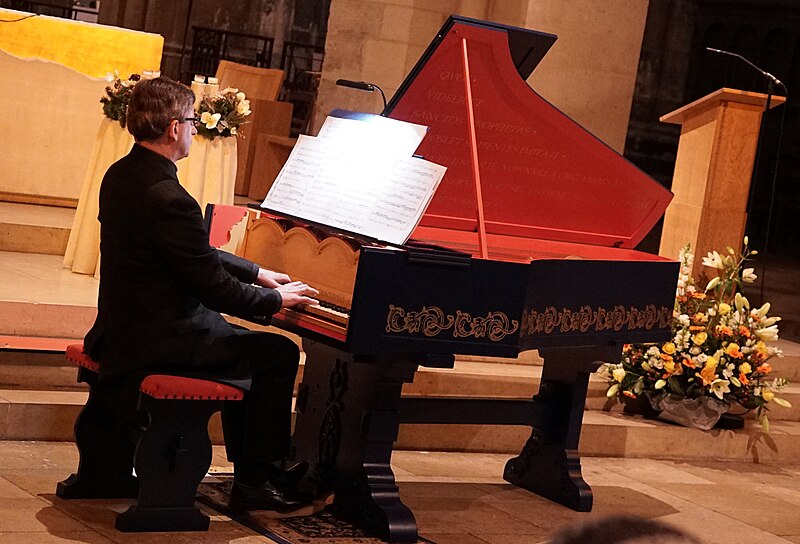
lors d'un concert à Reims.
G.Garitan
Description
Sometimes it is mistakenly referred to as the harpsichord viola, which is a different instrument.
Leonardo designed many different and elaborate models of viola organista, as preserved in his notebooks of 1488–1489 and in the drawings in the Codex Atlanticus and Manuscript H. The first known instrument actually constructed using Leonardo's concept, is Hans Heyden's Geigenwerk of 1575. While the concept is the same, the design is very different; modern versions of the instrument have been more or less based on Heyden's design. An etching of the Geigenwerk from 1620 shows an instrument of about the stature and shape of a harpsichord (i.e., a piano-shape with flat sides and hard angles). The fully chromatic keyboard appears to have 44 keys, extending about three-and-a-half octaves from low E to a high B (see illustration). This keyboard range is consistent with harpsichords of the day, although harpsichord keyboards more typically started on low C or low F. The number of strings can't be directly determined, but the design implies one string per key, or 44 strings. In the etching there appear to be five bow-wheels in the instrument, and a foot-pedal, presumably for turning the wheels. A scale given below the drawing has numbers from one to six; if it assumed these refer to feet, then the instrument is a bit over 6 feet long, which again is a scale in keeping with harpsichords of the day. The actual tuning of the instrument is not specified, but given the number of keys and the size of the instrument, it probably extended from around E2 to B5. Variations on this design have been produced over the past four centuries, with varying range, number of keys, and number of bow-wheels.
Notes from the source article
Cited by Wikipedia
Notes from the source article
These works are cited by the source article, in its own numbering. They are recorded as its citations, not as sources VALÉORINE has verified.
- 1.Edoardo Zanon, "Il Mondo di Leonardo da Vinci" e gli Strumenti Musicali. Blogfoolk.
- 2.Winternitz, Emanuel (1982). Leonardo Da Vinci As a Musician.
- 3.Preatorius, Michael; Oxford Early Music Series: Syntagma Musicum, Volume 3; Oxford University Press; London: 1620/2004. pg. 129.
- 4.Buchner, Alexander. Das Sostenente-Piano. Revue Belge de Musicologie / Belgisch Tijdschrift voor Muziekwetenschap. 34/35. 130–146. 1980. 10.2307/3685912.
- 5.Akio Obuchi's Workshop. Obuchi.music.coocan.jp.
- 6.Wiadomości - Wiadomości w Onet - Najnowsze i Najważniejsze Wiadomości z Kraju i Świata. Onet Wiadomości.
- 7.Gibsone, Harriet. Björk to release acoustic strings version of Vulnicura. The Guardian. Guardian News and Media. 6 October 2015.
- 8.Lewis, Randy. A hunt for tickets and celebrities, set to music. The Los Angeles Times.
- 9.Harpsichord maker Jukka Ollika on making the Omniwerk, inspired by Leonardo da Vinci. Radio Prague International. 2023-12-20.
Bibliography printed in the source article · 3
- Carolyn W. Simons, "Sostenente piano", and Emanuel Winternitz and Laurence Libin, "Leonardo da Vinci," Grove Music Online ed. L. Macy (Accessed April 2, 2005 at www.grovemusic.com), (subscription access)
- "Sostenente piano", The New Harvard Dictionary of Music, ed. Don Randel. Cambridge, Massachusetts, Harvard University Press, 1986.
- P. Innocenzi, Technology and Performance during the Renaissance: The Musical World of Leonardo da Vinci. Cambridge Scholars Publishing, 2023.
References
Citations
References
Each reference names the institution holding it, so a reader may go to the document itself.
reference work
Partially resolvedreference work
Partially resolved
The Encyclopedia exists whether or not anything is for sale. Corrections are recorded rather than overwritten, and every version of this record is kept. Published 14 August 2026.
Elsewhere in Collectables
20,755 published records in this field, each with its sources named.
- Viola de arameTerminology
- viola de buritiTerminology
- Viola de cochoTerminology
- Viola de QueluzTerminology
- viola pomposaTerminology
- viola sertanejaTerminology
- viola toeiraTerminology
- Violence FightWork
Best supported in this field
For owners
Own an object connected with viola organista?
A specialist will read what you send and tell you what the house can establish, what it cannot, and whether the object is suited to sale. There is no charge and no obligation. The object stays with you throughout; nothing is shipped to us unless it is arranged in writing beforehand.