
Villem Kapp
Villem Kapp (7 September 1913 – 24 March 1964) was an Estonian composer, organist and music teacher.
Villem Kapp

Rmir2 · CC BY-SA 4.0
- Name
- Villem Kapp
- Born
- 7 September 1913
- Birthplace
- Suure-Jaani, Governorate of Livonia, Russian Empire
- Died
- 24 March 1964
- Place of death
- Tallinn, then part of Estonian SSR, Soviet Union
- Nationality
- Russian Empire · Estonia · Soviet Union
- Occupation
- composer · organist · music educator · music teacher
- Education
- Estonian Academy of Music and Theatre
- Honours
- People's Artist of the Estonian SSR · Prize of Soviet Estonia
- Languages
- Estonian
VALÉORINE Encyclopedia
VALÉORINE documentary reading
Documentary summary
Villem Kapp (7 September 1913 – 24 March 1964) was an Estonian composer, organist and music teacher.
Admitted source layer · organised and presented by VALÉORINE
Note VALÉORINE
Villem Kapp (1913–1964) was a composer, music educator and music teacher, among other activities, of Estonian and Russian nationality. The composer was born in Suure-Jaani and died in Tallinn. Villem Kapp was educated at Estonian Academy of Music and Theatre.
Languages used include Estonian. Honours include People's Artist of the Estonian SSR and Prize of Soviet Estonia.
Composed from admitted, traceable facts · 01 October 2026
VALÉORINE
Reference Check
Propose documentary evidence for Villem Kapp. A contribution is never written directly as fact: identity, source, rights and evidence gates still decide.
Sign in to contribute
World of VALÉORINE
Documentary connections
Only confirmed graph relationships appear here. Images are shown only when their identity and reuse rights both pass the documentary gate.
Documentary evidence
Documentary basis
Authority files
wikidata · Q433494 · wikipedia · Villem Kapp
In this article
Key facts
Key facts
• Name — Villem Kapp • Born — 7 September 1913 • Birthplace — Suure-Jaani, Governorate of Livonia, Russian Empire • Died — 24 March 1964 • Place of death — Tallinn, then part of Estonian SSR, Soviet Union • Illustration — Villem Kapp's grave stone.
Life
Life
Born in Suure-Jaani, in the Governorate of Livonia of the Russian Empire (now Estonia), Villem Kapp was the son of Hans Kapp who was a sacristan, teacher and choir director. Villem Kapp graduated in 1938, having studied organ with August Topman and again in 1944 having studied composition with Heino Eller. In addition, Kapp studied with his uncle Artur Kapp at the Tallinn Conservatory. From 1938 Kapp was the organist in Tartu where he ran many famous choirs. After World War II he worked mainly as a composer and taught composition at the State Conservatory of Tallinn from 1944 until his untimely death in 1964. His students included Helmut Rosenvald, Lembit Veevo, Ülo Vinter, Veljo Tormis, Harri Otsa and others. Villem Kapp's works are characterized by rich melodies and he is strongly connected to the national romantic movement. In 1950, Kapp was awarded the State Prize of the Estonian SSR and, in 1963, he was awarded the People's Artist of the Estonian Soviet Socialist Republic. In 1971 a museum was opened in Suure-Jaani dedicated to the life and work of the Kapp family musicians, including Kapp, his uncle Artur Kapp and his cousin Eugen Kapp.
Works
Works
Incomplete List: • Ööpoeem (for Symphony Orchestra, 1942) • Põhjarannik (Heroic Choral Poem, 1958) • Lembitu (Opera, 1961) - Perhaps Kapp's Magnum Opus; An historical opera based on Estonia's fight for independence in the 13th century, including the Battle of St. Matthew's Day and the eponymous Estonian elder of Sakala County and military leader. The ancient Sakala County included the areas where Kapp grew up, so the themes were particularly close to his heart. • Kevadele (Cantata, 1963) In addition to these, Kapp also wrote two symphonies (In 1947 and 1955), as well as more than sixty choral and solo songs.
Life and career
Dated record
Life and career
The full dated record · 2 entries
1913
Villem Kapp born at Suure-Jaani.
1964
Villem Kapp died at Tallinn.
Places
Named by the record
Places
Only places the record itself states, plotted where the house gazetteer settles their coordinates. Nothing is inferred from a name or a nationality.
Suure-Jaani.
Birth place
Tallinn.
Death place
Partial discography
• Symphony No. 2 - on "Baltic Voyage: Heroic Symphonies From Estonia", Neeme Järvi and the BBC Philharmonic Orchestra. • Elegie - on "Silent Moods", Juha Kangas and the Ostrobothnian Chamber Orchestra. • Põhjarannik - on "Neeme Jarvi: 70th Birthday Jubilee", Neeme Järvi, Kristjan Järvi, Estonian National Male Choir & Symphony Orchestra.

Villem Kapp Gravestone 2
Rmir2
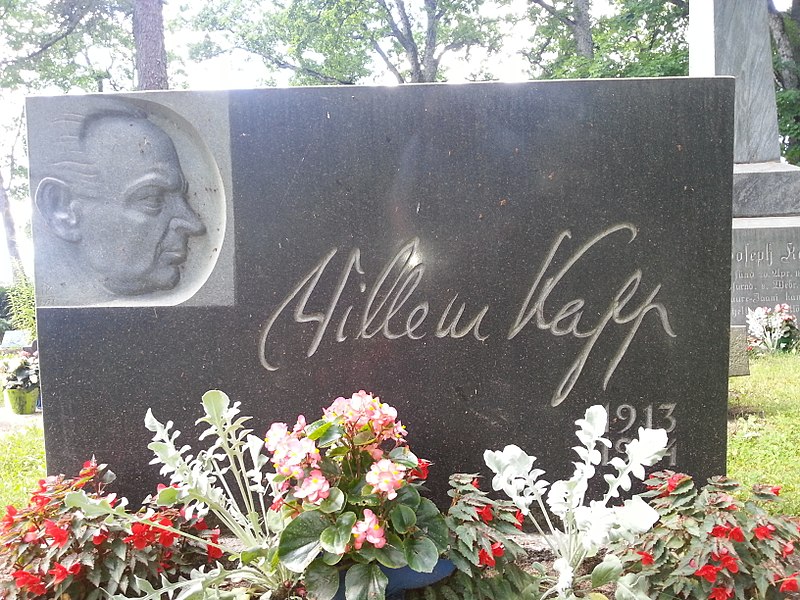
Villem Kapp Gravestone 1
Rmir2
Notes from the source article
Cited by Wikipedia
Notes from the source article
These works are cited by the source article, in its own numbering. They are recorded as its citations, not as sources VALÉORINE has verified.
- 1.Eesti Elulood. Tallinn: Eesti Entsüklopeediakirjastus 2000 (= Eesti Entsüklopeedia 14) , S. 139
- 2.Villem Kapp. Estonian Music Information Centre.
Bibliography printed in the source article · 1
- Helga Tõnson: Villem Kapp. Tallinn 1967
References
Citations
References
Each reference names the institution holding it, so a reader may go to the document itself.
reference work
Wikidata, structured authority record Q433494: Villem KappWikimedia Foundation
Secondary witnessreference work
Secondary witness
Further particulars
Held on the record
Further particulars
Open the remaining particulars
Villem Kapp is recorded as composer, organist, music educator and music teacher.
The Encyclopedia exists whether or not anything is for sale. Corrections are recorded rather than overwritten, and every version of this record is kept. Published 16 August 2026.
Elsewhere in Music memorabilia
42,934 published records in this field, each with its sources named.
- VillarOrganisation
- Ville LehtinenPerson
- Ville SorvaliPerson
- Ville ValoPerson
- Vilma MedgyaszayPerson
- Vilma von WebenauPerson
- Vilmos GryllusPerson
- Vilmos TátraiPerson
Best supported in this field
For owners
Own a work by Villem Kapp?
A specialist will read what you send and tell you what the house can establish, what it cannot, and whether the object is suited to sale. There is no charge and no obligation. The object stays with you throughout; nothing is shipped to us unless it is arranged in writing beforehand.