
Valentin de Boulogne
Valentin de Boulogne (before 3 January 1591 – 19 August 1632), sometimes referred to as Le Valentin, was a French painter in the tenebrist style.[1][2]
Also recorded as Jean Valentin · Le Valentin · Monsù Valentino · Monsù Valentin
Valentin de Boulogne
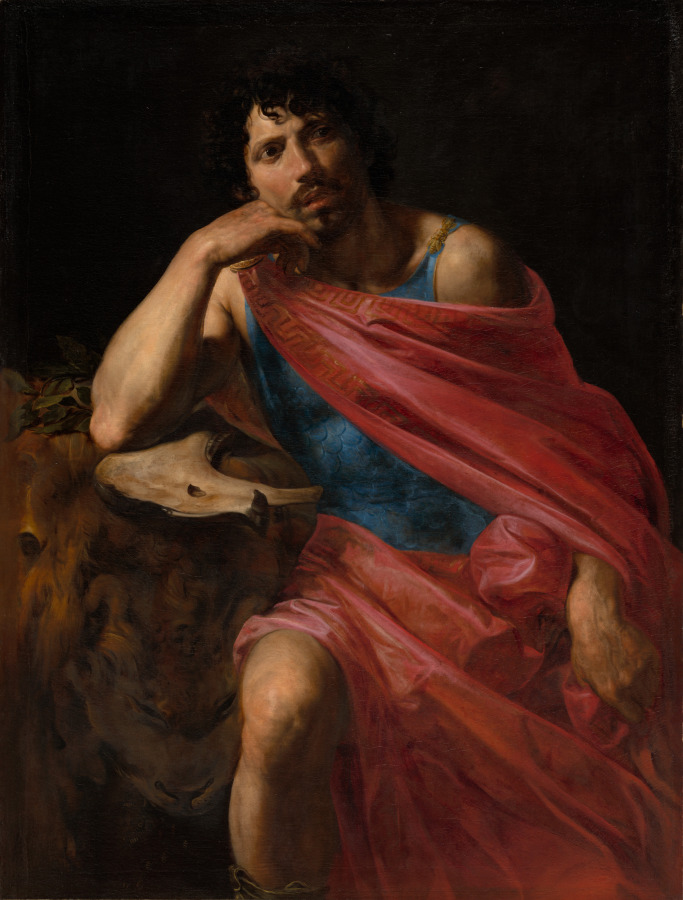
Valentin de Boulogne · The Cleveland Museum of Art · Mr. and Mrs. William H. Marlatt Fund · CC0
- Name
- Valentin de Boulogne
- Born
- 3 January 1591
- Birthplace
- Coulommiers, France
- Died
- 19 August 1632
- Place of death
- Rome, Italy
- Field
- Painting
- Movement
- Tenebrism
- Full name
- Jean Valentin.
- Nationality
- Kingdom of France
- Occupation
- painter
- Movements
- Caravaggisti · tenebrism
- Teachers
- Simon Vouet
VALÉORINE Encyclopedia
VALÉORINE documentary reading
Documentary summary
Valentin de Boulogne (before 3 January 1591 – 19 August 1632), sometimes referred to as Le Valentin, was a French painter in the tenebrist style.[1][2]
Admitted source layer · organised and presented by VALÉORINE
Note VALÉORINE
Valentin de Boulogne (1591–1632) was a painter, a national of the Kingdom of France. The painter was born Jean Valentin in Coulommiers and died in Rome. Valentin de Boulogne was also known as le Valentin.
Valentin de Boulogne worked in Rome. Activity centred on painting. Valentin de Boulogne was associated with Caravaggisti and tenebrism.
Among the works are Judith and Martyrdom of Saint Bartholomew. The work spans portrait. Languages used include French and Italian. Works are held at Groeningemuseum, Metropolitan Museum of Art and Museo del Prado, among others.
Composed from admitted, traceable facts · 26 September 2026
VALÉORINE
Reference Check
Propose documentary evidence for Valentin de Boulogne. A contribution is never written directly as fact: identity, source, rights and evidence gates still decide.
Sign in to contribute
World of VALÉORINE
Documentary connections
Only confirmed graph relationships appear here. Images are shown only when their identity and reuse rights both pass the documentary gate.
Documentary evidence
Evidence Panel
not yet certified
- Identity
- resolved
- Independent source families
- 0
- Admitted assertions
- 0
- Open conflicts
- 0
Authority files
gnd · 11896206X · wikidata · Q1337275 · wikipedia · Valentin de Boulogne
In this article
Biography
Biography
Training under Simon Vouet is recorded. Pietro Francavilla and Nicolas Tournier are recorded as having studied under Valentin de Boulogne. The recorded working language is French and Italian. The field of work recorded is painting. Subjects and genres recorded for the work are portrait. Caravaggio and Bartolomeo Manfredi are recorded as an influence. Places of work recorded in the authority are Rome. Works named in the authority record are Judith and Martyrdom of Saint Bartholomew. Work by Valentin de Boulogne is recorded in the collections of Museo del Prado, Thyssen-Bornemisza Museum, J. Paul Getty Museum, Metropolitan Museum of Art and Groeningemuseum.
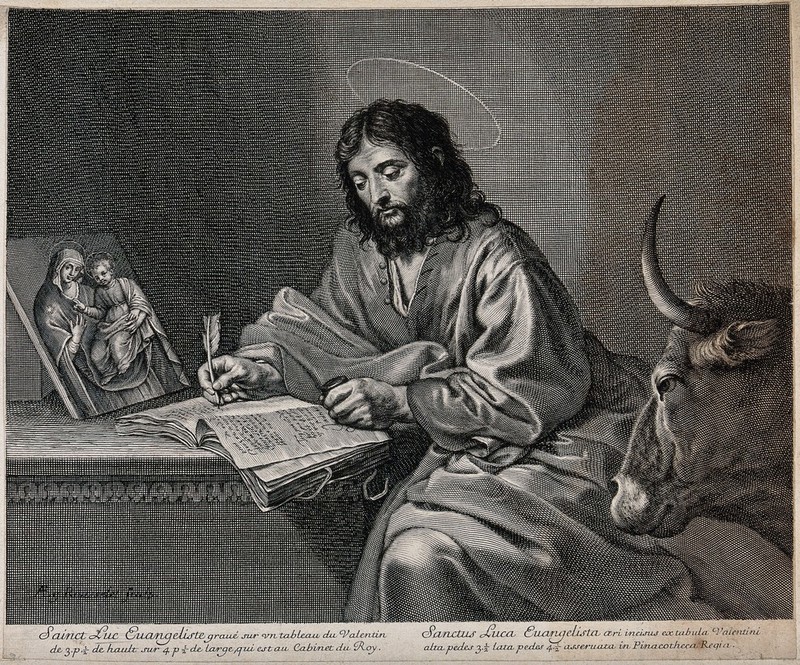
Saint Luke. Engraving by G. Rousselet after Valentin de Boulogne., 1600-1699, by Valentin de Boulogne
Valentin de Boulogne · Wellcome Collection, London · Wellcome Collection
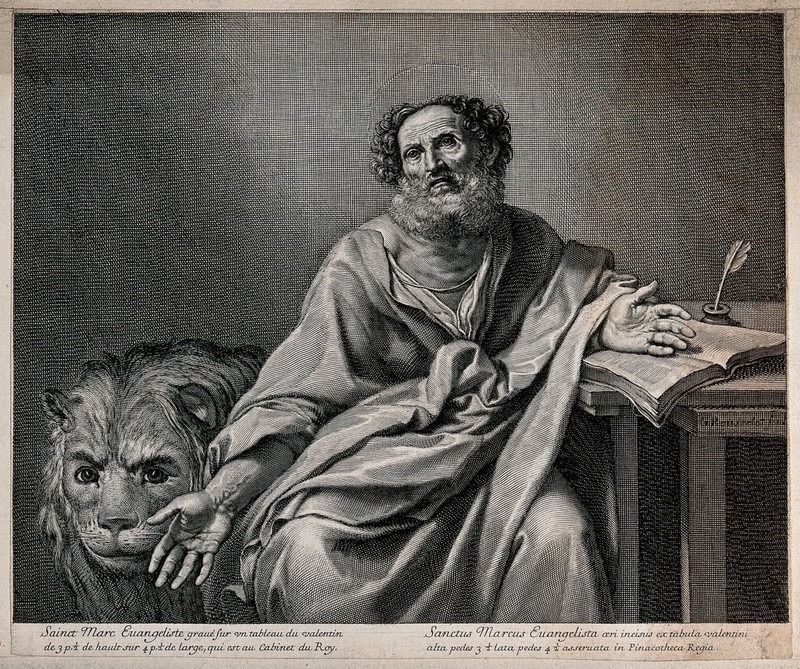
Saint Mark. Engraving by G. Rousselet after Valentin de Boulogne., by Valentin de Boulogne
Valentin de Boulogne · Wellcome Collection, London · Wellcome Collection
Key facts
Key facts
• Name — Valentin de Boulogne • Born — 3 January 1591 • Birthplace — Coulommiers, France • Died — 19 August 1632 • Place of death — Rome, Italy • Field — Painting • Movement — Tenebrism • Works — List of paintings by Valentin de Boulogne • Illustration — Soldiers Playing Cards and Dice (The Cheats), c. 1618–1620, by Valentin de Boulogne.
Origins
Origins
Valentin was born in Coulommiers, France, where he was baptised in the parish of Saint-Denys on 3 January 1591, making 1590 his likely year of birth. The family name, also spelled Boullogne and Boulongne, appears to originate from Boulogne-sur-Mer, a city in northern France in the colony of Pas-de-Calais, though the family had dwelt at Coulommiers since at least 1489. His father, also named Valentin, and his uncle Jean were both painters.
In Italy
In Italy
• Illustration — Fortune-teller with Soldiers It can be presumed that Valentin would have first started painting in his father's studio prior to moving to Paris or Fontainebleau, and before leaving for Italy. Valentin is recorded in Italy in the stati d'anime for 1620, when he was living in the parish of Santa Maria del Popolo. While studying in Italy under Simon Vouet, Valentin came under the influence of Caravaggio and Bartolomeo Manfredi. He also joined the Bentvueghels, a riotous unofficial group of expatriate, mostly Flemish, artists and was given the group nickname of "innamorato," no doubt in reference to his own name.[3] • Illustration — St. John and Jesus at the Last Supper (detail), 1625–1626 Caravaggio used a bold, naturalistic style, which emphasized the common humanity of the apostles and martyrs, flattered the aspirations of the Counter-Reformation Church, while his vivid chiaroscuro enhanced both three-dimensionality and drama, as well as evoking the mystery of the faith." Caravaggio "followed a militantly realist agenda, rejecting both Mannerism and the classicizing naturalism" and "in the first 30 years of the 17th century his naturalistic ambitions and revolutionary artistic procedures attracted a large following from all over Europe.[4] Manfredi, also an Italian painter, was known throughout Italy and beyond as Caravaggio's closest follower. In the dramatically lit canvases of his later period Manfredi adopted a common theme from Caravaggio—the tavern scene featuring ordinary people, even religious subjects, whose figures are depicted close to the surface of the picture to involve the viewer in the action. While Caravaggio and Manfredi may have influenced the style and themes that became common in Valentin's work, Valentin studied as well under Simon Vouet, considered a leading French painter by contemporaries. Vouet's earliest works exhibit the influence of Caravaggio and deploy dramatic contrasts of light with a restricted palette of blacks, browns and whites. Valentin had success with a type of composition invented by Caravaggio in which fortune tellers, drinkers, or gamblers are grouped around a table. Valentin himself was fond of carousing and fine wine. Approximately 75 of his works survive. Valentin's genius shows in the subtleness of psychological expression and interplay among his characters, as well as in the refinement and finesse of his painting technique. Valentin's painting Fortune Teller with Soldiers depicts a group of young soldiers, one of whom is mesmerized by the fortune teller reading his palm. Behind the gypsy a shadowy figure looks at the viewer with his finger to his lips in a conspiratorial gesture as he steals the fortune teller's purse from her pocket. At the same time the thief is pickpocketed in turn by a small child. While one person's fortune is told, another's is being stolen; and one thief falls victim to another. Valentin's pupils included Nicolas Tournier.[5]
Death
Death
Valentin de Boulogne is said to have died after bathing in the freezing cold waters of the Fontana del Tritone on Piazza Barberini, after having drunk too much.[6]
Gallery
Gallery
• Illustration — St John the Baptist in the Desert • Illustration — Rafaello Menicucci • Illustration — Denial of Saint Peter • Illustration — Christ and the Adulteress • Illustration — Last Supper • Illustration — Musicians and Soldiers • Illustration — The Martyrdom of Martinian and Processus (1629) • Illustration — St John the Baptist
Identity and origins
Identity and origins
Valentin de Boulogne was recorded at birth as Jean Valentin. He also worked under the names Valentin de Boulogne and le Valentin. The authorities additionally record the headings Jean Valentin, Le Valentin, Monsù Valentino, Monsù Valentin and Monsù Valentini. His recorded languages were French and Italian.
Identity
Identity
Valentin de Boulogne is recorded with the occupation painter. Recognition and collections. Paul Getty Museum and Metropolitan Museum of Art.
Life and career
Dated record
Life and career
The full dated record · 2 entries
1591
Valentin de Boulogne born at Coulommiers.
1632
Valentin de Boulogne died at Rome.
Places
Named by the record
Places
Only places the record itself states, plotted where the house gazetteer settles their coordinates. Nothing is inferred from a name or a nationality.
Coulommiers.
Birth place
Rome.
Death place
Primary material
Documents and archives
scholarly publication
- Valentin de Boulogne portraitiste, Revue de l'art, 1991
Scholarly · Crossref registry · 1991
- Valentin de Boulogne portraitiste, Revue de l'Art, 1991
Scholarly · Crossref registry · 1991
authority file
- Gemeinsame Normdatei 11896206X, Valentin, de Boulogne.
Unverified · Deutsche Nationalbibliothek
- VIAF cluster 120746211 for Valentin de Boulogne, aggregating national library name authorities.
Unverified · OCLC
reference work
- Wikidata, structured authority record Q1337275: Valentin de Boulogne
Reputable secondary · Wikimedia Foundation
- “Valentin de Boulogne”, English Wikipedia, consulted as further reading
Reputable secondary · Wikipedia
Notes from the source article
Cited by Wikipedia
Notes from the source article
These works are cited by the source article, in its own numbering. They are recorded as its citations, not as sources VALÉORINE has verified.
- 1.Metropolitan Museum of Art. Valentin de Boulogne: Beyond Caravaggio.
- 2.'Valentin de Boulogne,' Bright Star in Caravaggio's Orbit. The New York Times. 6 October 2015.
- 3.Valentin de Boulogne, biography : National Gallery of Art, USA.
- 4.Gash, John M. Caravaggio, Michelangelo Merisi da : Oxford Art Online – oi. Oxford University Press. 2003. 978-1-884446-05-4.
- 5.Valentin de Boulogne in the RKD
- 6.express.ca. Valentin de Boulogne, une vieille connaissance. 15 June 2015.
References
Citations
References
Each reference names the institution holding it, so a reader may go to the document itself.
scholarly publication
Valentin de Boulogne portraitiste, Revue de l'art, 1991Crossref registry
Verifiedscholarly publication
Valentin de Boulogne portraitiste, Revue de l'Art, 1991Crossref registry
Verifiedauthority file
Gemeinsame Normdatei 11896206X, Valentin, de Boulogne.Deutsche Nationalbibliothek
Partially resolvedauthority file
Partially resolvedreference work
Wikidata, structured authority record Q1337275: Valentin de BoulogneWikimedia Foundation
Partially resolvedreference work
Partially resolved
Further particulars
Held on the record
Further particulars
Open the remaining particulars
He trained under Simon Vouet. His recorded influences include Caravaggio and Bartolomeo Manfredi. Each of those relationships is stated by the authority record rather than inferred from style.
The Encyclopedia exists whether or not anything is for sale. Corrections are recorded rather than overwritten, and every version of this record is kept. Published 14 August 2026.
Elsewhere in Paintings
18,717 published records in this field, each with its sources named.
- Valdemar IrmingerArtist
- Valentijn BingArtist
- Valentin BouchéArtist
- Valentin Carderera y SolanoArtist
- Valentin DržkovicArtist
- Valentin KhrushchArtist
- Valentin MetzingerArtist
- Valentin SerovArtist
Best supported in this field
For owners
Own a work by Valentin de Boulogne?
A specialist will read what you send and tell you what the house can establish, what it cannot, and whether the object is suited to sale. There is no charge and no obligation. The object stays with you throughout; nothing is shipped to us unless it is arranged in writing beforehand.