
Utagawa Toyohiro
Utagawa • Illustration — Returning Sails at Tsukuda from one of the Eight Views of Edo series by Toyohiro Utagawa Toyohiro, birth name Okajima Tōjiro (1773–1828), was a Japanese ukiyo-e artist and painter. He was a member of the Utagawa school and studied under Utagawa Toyoharu, the school's founder. His works include a number of ukiyo-e landscape series, as well as many depictions of the daily activities in the Yoshiwara entertainment quarter; many of his stylistic features led to Hokusai and Hiroshige (the latter a prodigy who studied under Toyohiro, becoming one of the very finest of all landscape artists), as well as producing an important series of ukiyo-e triptychs in collaboration with Toyokuni, and numerous book and e-hon illustrations, which occupied him in his later years.
Also recorded as Toyohiro Utagawa · Okajima Tojiro · Ichiryusai · Toyohiro
Utagawa Toyohiro
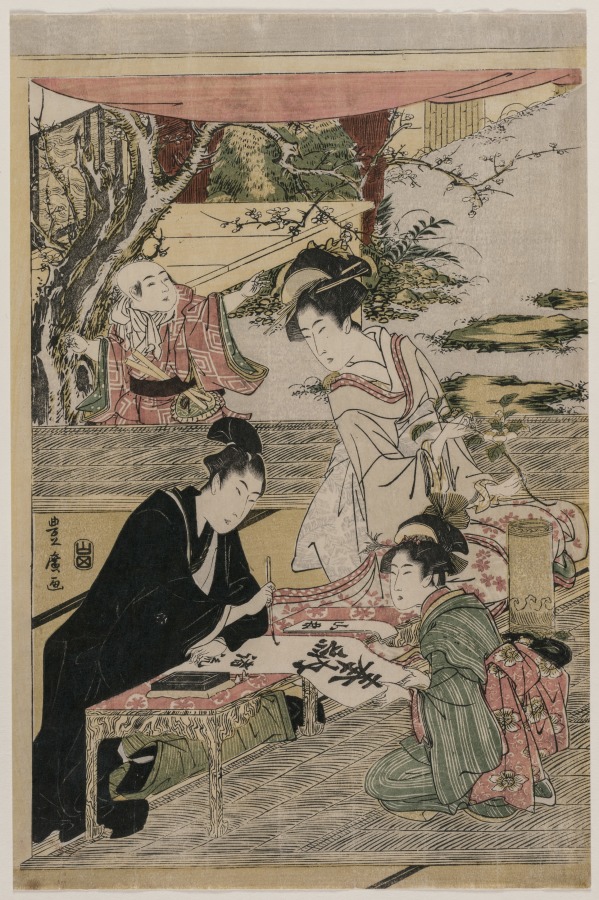
Utagawa Toyohiro · The Cleveland Museum of Art · Gift from J. H. Wade · CC0
- Born
- 1773
- Died
- 1828
- Nationality
- Japan
- Occupation
- painter · engraver · artist
- Movements
- Utagawa school
- Teachers
- Utagawa Toyoharu
VALÉORINE Encyclopedia
VALÉORINE documentary reading
Documentary summary
Utagawa • Illustration — Returning Sails at Tsukuda from one of the Eight Views of Edo series by Toyohiro Utagawa Toyohiro, birth name Okajima Tōjiro (1773–1828), was a Japanese ukiyo-e artist and painter. He was a member of the Utagawa school and studied under Utagawa Toyoharu, the school's founder. His works include a number of ukiyo-e landscape series, as well as many depictions of the daily activities in the Yoshiwara entertainment quarter; many of his stylistic features led to Hokusai and Hiroshige (the latter a prodigy who studied under Toyohiro, becoming one of the very finest of all landscape artists), as well as producing an important series of ukiyo-e triptychs in collaboration with Toyokuni, and numerous book and e-hon illustrations, which occupied him in his later years.
Admitted source layer · organised and presented by VALÉORINE
Note VALÉORINE
Utagawa Toyohiro (1773–1828) was an artist, engraver and painter, among other activities, of Japanese nationality.
The artist worked in Japan and Shiba. Utagawa Toyohiro was associated with Utagawa school. Works are held at Art Institute of Chicago, Auckland Art Gallery and Finnish National Gallery, among others.
Composed from admitted, traceable facts · 26 September 2026
VALÉORINE
Reference Check
Propose documentary evidence for Utagawa Toyohiro. A contribution is never written directly as fact: identity, source, rights and evidence gates still decide.
Sign in to contribute
Documentary evidence
Documentary basis
Authority files
getty · 500334461 · wikidata · Q2625013 · wikipedia · Toyohiro
In this article
Life and career
Life and career
The ukiyo-e series he produced include the following: • Eight Views of Edo (several series) • Eight Views of Ōmi (several series) • Newly Published Perspective Pieces (Shinpan uki-e) • Twelve Months by Two Artists, Toyokuni and Toyohiro (Toyokuni Toyohiro ryōga jūnikō), with Toyokuni • Untitled series of A Day in the Life of a Geisha • Untitled series of Eight Views of Edo in the Snow • The Six Great Poets • The Twelve Hours • The Four Accomplishments • The Three Cities
Training under Utagawa Toyoharu is recorded. Utagawa Hiroshige is recorded as having studied under Utagawa Toyohiro. Places of work recorded in the authority are Japan and Shiba. Work by Utagawa Toyohiro is recorded in the collections of Minneapolis Institute of Art, Art Institute of Chicago, The Nelson-Atkins Museum of Art, Auckland Art Gallery and Finnish National Gallery.
Toyohiro entered the studio of Utagawa Toyoharu in 1782, together with his contemporary Toyokuni; Toyoharu gave him the name Toyohiro and allowed him to also use the gō Ichiryūsai.[1] Toyohiro is regarded as a highly talented artist who never fully realised his potential: although Toyokuni's equal in talent, he chose to leave the flashier, more popular side of ukiyo-e to his fellow pupil, dedicating himself instead to a quieter and less hurried vision of life and beauty. His surviving output is consequently relatively rare. Having studied both ukiyo-e and Kanō-school painting, he worked mainly in the hosoban and surimono formats, producing his first surimono in 1788 and his first book illustrations, in kyōkabon, in 1793. It was during this period that Toyohiro became more active and well known for bijinga genre paintings in the Kansei era (1789-1801), working in a style that approached that of Utamaro and Eishi; his figures of beautiful women were notably taller than Toyokuni's, revealing an affinity with Eishi in their understated grace. From 1802 to 1806 Toyohiro illustrated numerous kibyōshi, and later turned to illustrating gōkan and yomihon, producing more than one hundred and fifty books in total in collaboration with authors including Takizawa Bakin, Santō Kyōden and Jippensha Ikku. His landscape (fūkeiga) print series paved the way stylistically for Hokusai and Hiroshige, and he also produced an important series of triptychs in collaboration with Toyokuni. Toyohiro died in 1828; an elegant and graceful artist, he is best remembered as the teacher of Hiroshige, whose art would have been entirely different without his patient and understated guidance.
Gallery
Gallery
• Illustration — Cock, 1804 • Illustration — Flower Arrangement of Narcissus in a Flat Green Dish • Illustration — Woman Putting on Finger Plectrums to Play the Koto, hanging scroll (detail) • Illustration — Print of Mt. Fuji, 1800
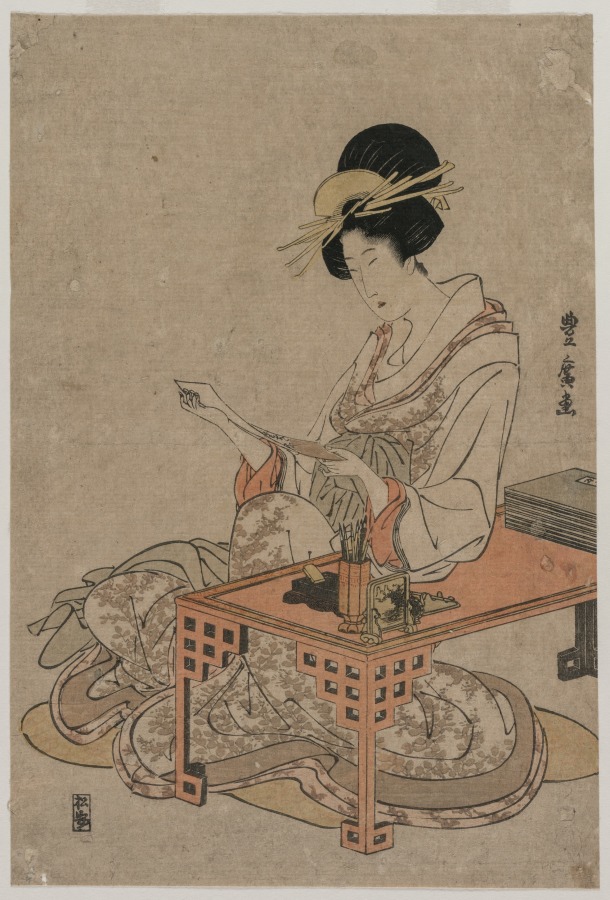
Courtesan Seated at a Writing Table, c. late 1790s, by Utagawa Toyohiro
Utagawa Toyohiro · The Cleveland Museum of Art · Bequest of James Parmelee
Life and career
Dated record
Life and career
The full dated record · 2 entries
1773
Utagawa Toyohiro born.
1828
Utagawa Toyohiro died.
Primary material
Documents and archives
authority file
- Getty Union List of Artist Names 500334461, Utagawa Toyohiro.
General reference · The Getty Research Institute
reference work
- Wikidata, structured authority record Q2625013: Utagawa Toyohiro
Reputable secondary · Wikimedia Foundation
Notes from the source article
Cited by Wikipedia
Notes from the source article
These works are cited by the source article, in its own numbering. They are recorded as its citations, not as sources VALÉORINE has verified.
- 1.Milone, Marco. Ukiyo-e. L'Erudita. 206–207. 2022. 9788867707270.
References
Citations
References
Each reference names the institution holding it, so a reader may go to the document itself.
authority file
Getty Union List of Artist Names 500334461, Utagawa Toyohiro.The Getty Research Institute
Secondary witnessreference work
Wikidata, structured authority record Q2625013: Utagawa ToyohiroWikimedia Foundation
Secondary witness
Further particulars
Held on the record
Further particulars
Open the remaining particulars
The authorities additionally record the headings Toyohiro Utagawa, Okajima Tojiro, Ichiryusai, Toyohiro and Ichiriusai Toyohiro. One child is recorded: Utagawa Toyokiyo. Formation and teaching. He trained under Utagawa Toyoharu. Each of those relationships is stated by the authority record rather than inferred from style.
Identity and origins
Recognition and collections
Work by Utagawa Toyohiro is
Minneapolis Institute of Art, Art Institute of Chicago, The Nelson-Atkins Museum of Art and Auckland Art Gallery
The Encyclopedia exists whether or not anything is for sale. Corrections are recorded rather than overwritten, and every version of this record is kept. Published 16 August 2026.
Elsewhere in Prints
4,138 published records in this field, each with its sources named.
- Ursula WoodEngraver
- Urushibara MokuchuEngraver
- Ushio ShinoharaEngraver
- Utagawa KunisadaEngraver
- Utagawa YoshitsuyaEngraver
- Uzo EgonuEngraver
- Václav RabasEngraver
- Vaclav VytlacilEngraver
Best supported in this field
For owners
Own a work by Utagawa Toyohiro?
A specialist will read what you send and tell you what the house can establish, what it cannot, and whether the object is suited to sale. There is no charge and no obligation. The object stays with you throughout; nothing is shipped to us unless it is arranged in writing beforehand.