
trestle support
In structural engineering, a trestle support (or simply trestle) is a structural element with rigid beams forming the equal sides of two parallel isosceles triangles, joined at their apices by a plank or beam. Sometimes additional rungs are stretched between the two beams. A pair of trestle legs can support one or several boards or planks, forming a trestle table or trestle desk.
Also recorded as trestle leg · fixed trestle · folding trestle · trestle
trestle support
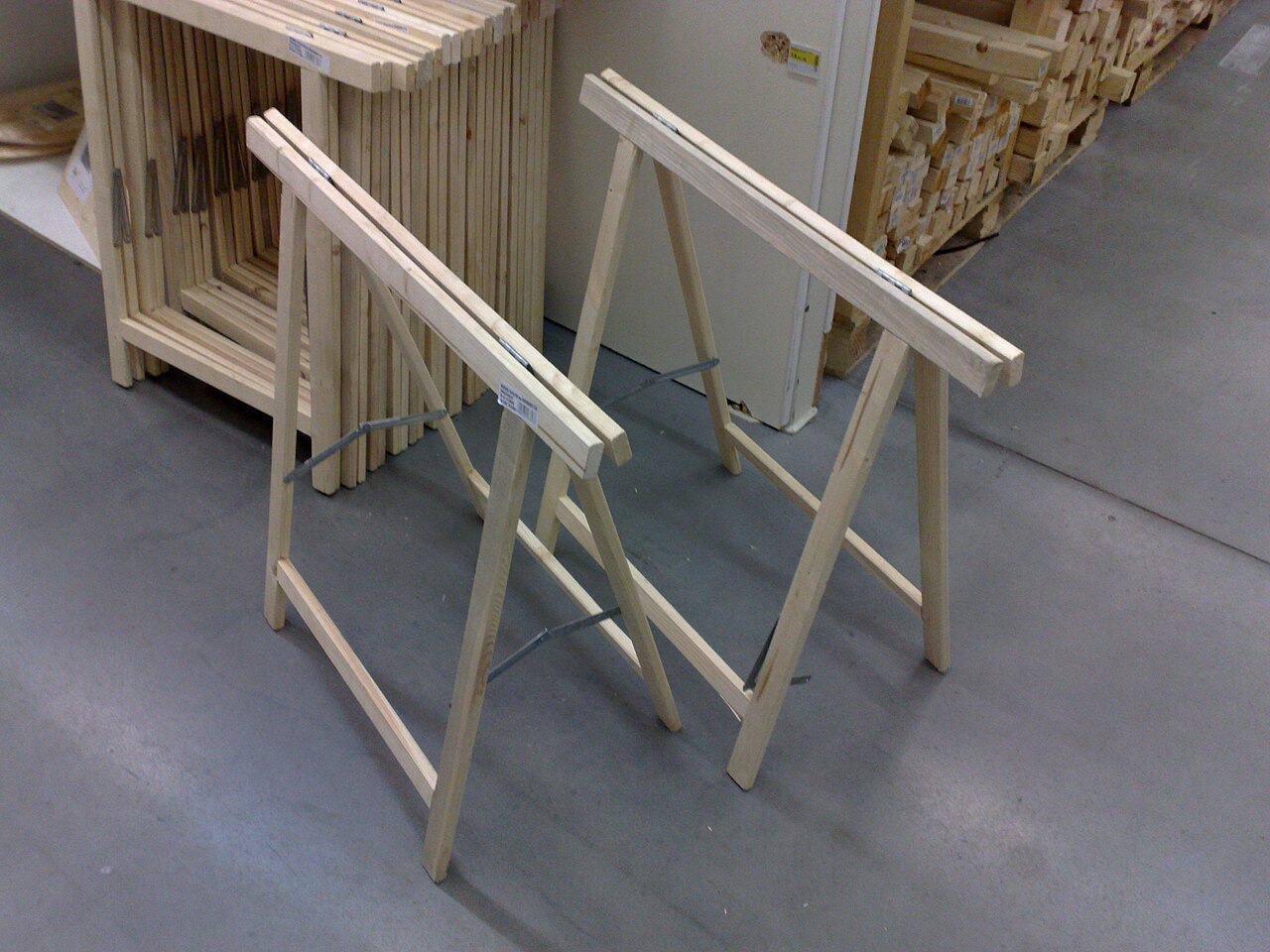
ABX · CC BY-SA 4.0
- Field
- furniture component
Reference Check
Propose documentary evidence for trestle support. A contribution is never written directly as fact: identity, source, rights and evidence gates still decide.
Sign in to contribute
Documentary evidence
Documentary basis
Authority files
wikidata · Q14928267 · wikipedia · Trestle support
In this article
Trestle table
Trestle table
A network of trestle supports can serve as the framework for a trestle bridge, and a trestle of appropriate size to hold wood for sawing is known as a sawhorse. • Illustration — Folding trestles • Illustration — Fixed trestle
A trestle table is a table with trestle legs. In shape and manufacture, it sometimes resembles variations of the antique field desk, which were used by officers close to the battlefield. Trestle legs come in two kinds: • Fixed trestle legs, where the angle between the legs is a fixed joint. • Folding trestle legs, where the angle is hinged, to make them more compact and portable. In the United States, a table or desk supported by X-shaped trestles is usually called a sawbuck table.
Trestle bridge
Trestle bridge
• Illustration — Railway trestle bridge in Dawson Creek, British Columbia A trestle bridge is composed of a number of short spans supported by closely spaced trestle frames. Each supporting frame is a bent. A trestle differs from a viaduct in that viaducts have towers that support much longer spans and typically have a higher elevation. Timber and iron trestles (i.e. bridges) were extensively used in the 19th century, particularly for railroads. In the 21st century, steel and sometimes concrete trestles are occasionally used to bridge particularly deep valleys, while timber trestles remain common in certain areas. Timber trestles remain common in some applications, most notably for bridge approaches crossing floodways, where earth fill would dangerously obstruct floodwater. Many timber trestles were built in the 19th and early 20th centuries with the expectation that they would be temporary. Timber trestles were used to get the railroad to its destination. Once the railroad was running, it was used to transport the material to replace trestles with more permanent works, transporting and dumping fill around some trestles and transporting stone or steel to replace others with more permanent bridges.
Primary material
Documents and archives
authority record
- Wikidata, structured authority record Q14928267: trestle support
General reference · Wikidata
reference work
- “Trestle support”, English Wikipedia, consulted as further reading
Reputable secondary · Wikipedia
Text attribution
Licensing
Text attribution
Part of the biographical narrative on this page reuses licensed material. Its origin, revision and licence are recorded here.
The biographical narrative on this page is based on the Wikipedia article Trestle support, revision 1341283957 (EN edition), by its contributors. VALÉORINE has edited that text and built its own documentary record around it. The reused material is available under CC BY-SA 4.0, and this page's reuse of it is offered under the same licence. Everything else on this page — the chronology, the holdings, the evidence, the plates and the connections — is VALÉORINE's own record. Sources and licences.
Notes from the source article
Cited by Wikipedia
Notes from the source article
These works are cited by the source article, in its own numbering. They are recorded as its citations, not as sources VALÉORINE has verified.
- 1.Dutton, Ron. Railroad bridges, viaducts and trestles Trains Magazine. TrainsMag.com. January 2018.
- 2.Walter Loring Webb, Railroad Construction – Theory and Practice, 6th Ed., Wiley, New York, 1917; Chapter IV – Trestles, pages 194–226.
- 3.Charles Lee Crandall and Fred Asa Barnes, Railroad Construction, McGraw-Hill, New York, 1913; Section 96 – Wooden Trestles, pages 212–213.
References
Citations
References
Each reference names the institution holding it, so a reader may go to the document itself.
authority record
Secondary witnessreference work
Secondary witness
The Encyclopedia exists whether or not anything is for sale. Corrections are recorded rather than overwritten, and every version of this record is kept. Published 14 August 2026.
Elsewhere in Furniture
924 published records in this field, each with its sources named.
- trapezeTerminology
- travel cotTerminology
- Třeboň AltarpieceTerminology
- Treetrunk coffinTerminology
- trestle tableTerminology
- Trinity AltarpieceTerminology
- Tripp TrappTerminology
- trundle bedTerminology
Best supported in this field
For owners
Own an object connected with trestle support?
A specialist will read what you send and tell you what the house can establish, what it cannot, and whether the object is suited to sale. There is no charge and no obligation. The object stays with you throughout; nothing is shipped to us unless it is arranged in writing beforehand.