
predella
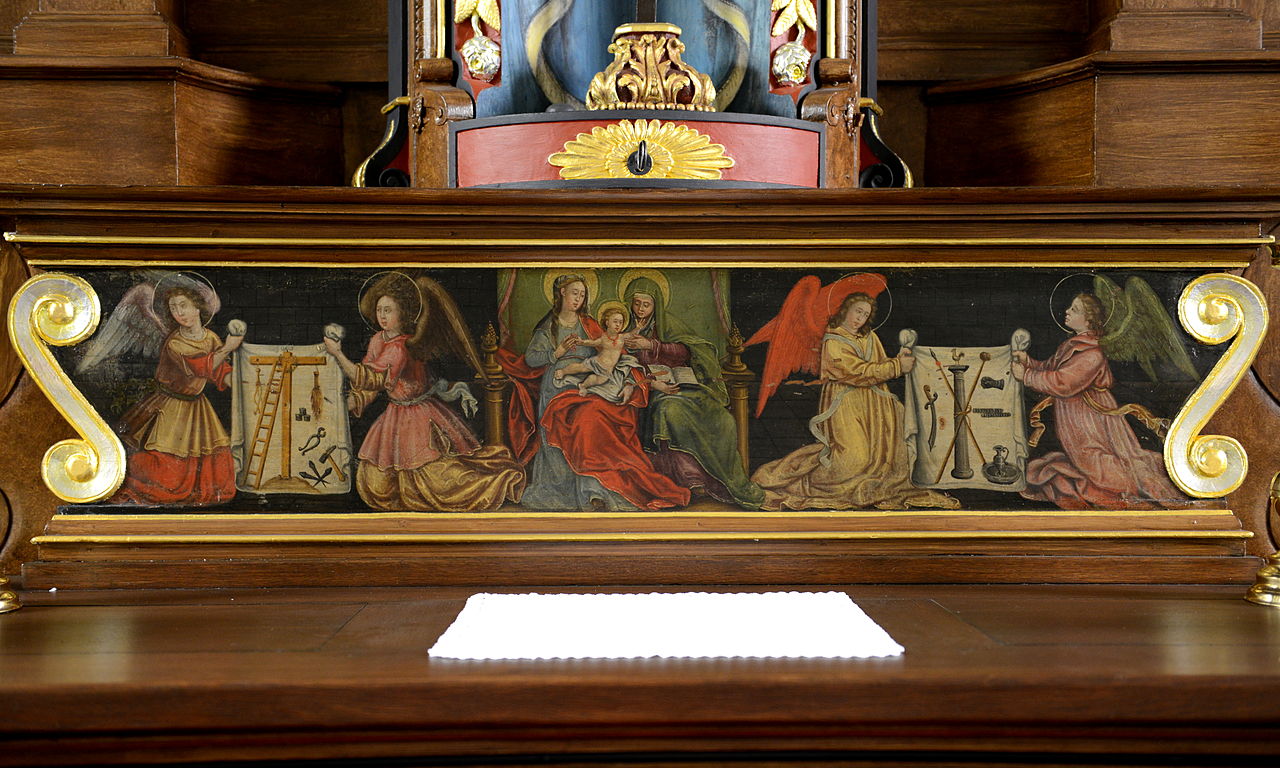
Illustration — Altarpiece by Carlo Crivelli, 1468. The predella has four scenes from the Passion of Christ. The predella runs along the base, framed below • Illustration — Altarpiece with carved and painted predella at Marienkirche Stralsund, Germany.
predella
Jwh · CC BY-SA 3.0 lu
- Field
- furniture component
VALÉORINE Encyclopedia
VALÉORINE documentary reading
Documentary summary
Illustration — Altarpiece by Carlo Crivelli, 1468. The predella has four scenes from the Passion of Christ. The predella runs along the base, framed below • Illustration — Altarpiece with carved and painted predella at Marienkirche Stralsund, Germany.
Admitted source layer · organised and presented by VALÉORINE
Note VALÉORINE
No house-authored Note is published until its assertions and sources pass the VALÉORINE evidence contract. The documentary article remains available in full while that enrichment is being consolidated.
Documentary enrichment in progress · no unsupported statement published
Reference Check
Propose documentary evidence for predella. A contribution is never written directly as fact: identity, source, rights and evidence gates still decide.
Sign in to contribute
Documentary evidence
Evidence Panel
not yet certified
- Identity
- resolved
- Independent source families
- 0
- Admitted assertions
- 0
- Open conflicts
- 0
Authority files
getty · 500085550 · gnd · 4175599-6 · wikidata · Q1411766 · wikipedia · Predella
In this article
Examples
In art, a predella (plural predelle) is the lowest part of an altarpiece, sometimes forming a platform or step, and the painting or sculpture along it, at the bottom of an altarpiece, sometimes with a single much larger main scene above, but often (especially in earlier examples), a polyptych or multipanel altarpiece. In late medieval and Renaissance altarpieces, where the main panel consisted of a scene with large figures, it was normal to include a predella below with a number of small-scale narrative paintings depicting events from the life of the dedicatee, whether the Life of Christ, the Life of the Virgin or a saint. Typically there would be three to five small scenes, in a horizontal format. Sometimes a single space shows different scenes in continuous representation. • Illustration — Flemish altarpiece of the 1550s, still with three predella scenes They are significant in art history, as the artist had more freedom from iconographic conventions than in the main panel as they could only be seen from close up. In this case he is thought to have only done the underdrawing for the main scene, leaving the painting to his workshop assistants. But he is thought to have painted the predella scenes himself. They had fallen out of fashion in Italy by the mid 16th century, but continued for a while further north. Reuniting, at least conceptually, predella panels with the rest of their original settings gave 20th-century art historians a large task, which continues into the 21st century. More generally, and not usually in the English language, a predella is an altar-step, a shelf above and behind an altar, or a piece of furniture with a lower part to kneel on, for prayer, and often a higher part to support the arms. In English the French term prie-dieu is normally used for this. Predel or pretel, was Langobardic for "a low wooden platform that serves as a basis in a piece of furniture". In English this step is referred to as a gradin, which may include a predella in it. A predella is also the lower part of a stained-glass window. Similar small reliefs are sometimes placed under a larger piece of sculpture. Donatello placed a narrow scene of Saint George Freeing the Princess on the base of his Saint George for Orsanmichele.
Examples of predellas include: • Duccio – the predella of his Maestà – one of the earliest predellas. • Lorenzo Monaco – Incidents in the Life of Saint Benedict (c. 1407–1409) • Luca Signorelli – The Adoration of the Shepherds (c. 1496) • Andrea Mantegna – San Zeno Altarpiece (1459) • Stanley Spencer – Sandham Memorial Chapel, Burghclere, Hants. • Pre-Raphaelite Dante Rossetti revisited the predella in his second Beata Beatrix (1871-1872). • Leigh Behnke – a 20th-century realist, she has made use of the predella format in numerous works (c. 1981–2019)
Primary material
Documents and archives
reference work
- Wikidata, structured authority record Q1411766: predella
Reputable secondary · Wikidata
- “Predella”, English Wikipedia, consulted as further reading
Reputable secondary · Wikipedia
authority file
- Gemeinsame Normdatei 4175599-6, Predella.
Unverified · Deutsche Nationalbibliothek
Notes from the source article
Cited by Wikipedia
Notes from the source article
These works are cited by the source article, in its own numbering. They are recorded as its citations, not as sources VALÉORINE has verified.
References
Citations
References
Each reference names the institution holding it, so a reader may go to the document itself.
authority file
Gemeinsame Normdatei 4175599-6, Predella.Deutsche Nationalbibliothek
Partially resolvedreference work
Partially resolvedreference work
Partially resolved
The Encyclopedia exists whether or not anything is for sale. Corrections are recorded rather than overwritten, and every version of this record is kept. Published 14 August 2026.
Elsewhere in Furniture
924 published records in this field, each with its sources named.
- potting benchTerminology
- potty chairTerminology
- power seatTerminology
- Prague AltarTerminology
- prie-dieuTerminology
- priority seatTerminology
- Privileged AltarTerminology
- Proserpina sarcophagusTerminology
Best supported in this field
For owners
Own an object connected with predella?
A specialist will read what you send and tell you what the house can establish, what it cannot, and whether the object is suited to sale. There is no charge and no obligation. The object stays with you throughout; nothing is shipped to us unless it is arranged in writing beforehand.