
Tomioka Tessai
Also recorded as Tetsujin · Tesshi · Yūken · Tetsugai
Tomioka Tessai
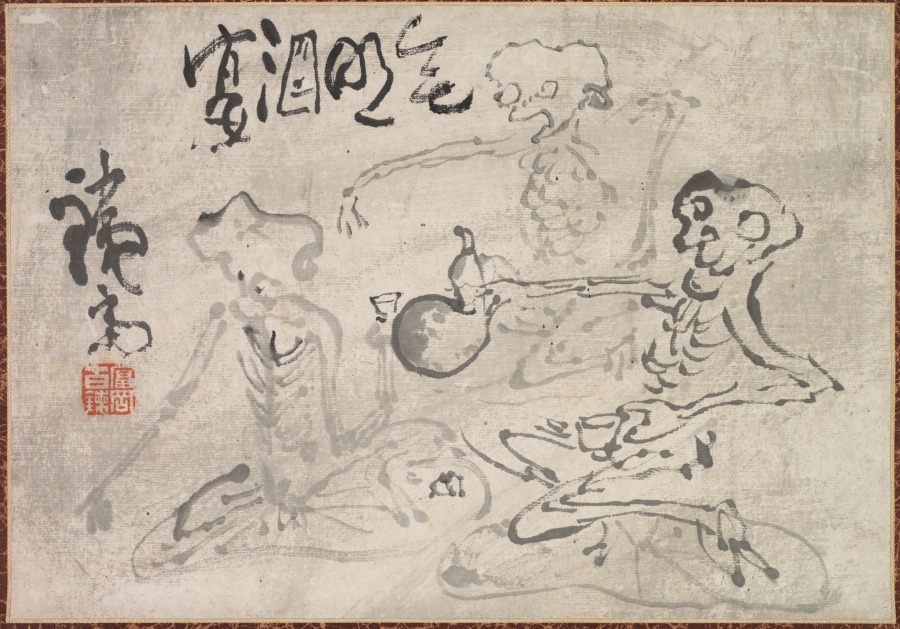
Tomioka Tessai · The Cleveland Museum of Art · Edward L. Whittemore Fund · CC0
- Name
- Tomioka Tessai
- Birth Name
- Tomioka Yusuke, Tomioka Hyakuren
- Born
- 25 January 1836 or 1837 1 27
- Birthplace
- Kyoto, Japan
- Died
- 31 December 1924
- Field
- Painter, calligrapher
- Movement
- Bunjinga, Nihonga 25 January 1836 or 27 January 1837 – 31 December 1924 was the pseudonym for a painter and calligrapher in imperial Japan.
- Nationality
- Japan
- Occupation
- painter · calligrapher
- Fields
- painting
- Movements
- Nanga
- Teachers
- Ōkuni Takamasa · Ōtagaki Rengetsu · Oda Kaisen · Ukita Ikkei
Reference Check
Propose documentary evidence for Tomioka Tessai. A contribution is never written directly as fact: identity, source, rights and evidence gates still decide.
Sign in to contribute
World of VALÉORINE
Documentary connections
Only confirmed graph relationships appear here. Images are shown only when their identity and reuse rights both pass the documentary gate.
Documentary evidence
Documentary basis
Authority files
getty · 500121336 · gnd · 119379902 · wikidata · Q1377454 · wikipedia · Tomioka Tessai
In this article
Biography
Biography
Training under Ōkuni Takamasa, Ōtagaki Rengetsu and Oda Kaisen is recorded. The recorded working language is Japanese. The field of work recorded is painting. Places of work recorded in the authority are Kansai region. Employment is recorded with Isonokami Jingū, Ōtori Taisha and Ritsumeikan. Positions recorded include Imperial Household Artist. Work by Tomioka Tessai is recorded in the collections of Minneapolis Institute of Art, The Nelson-Atkins Museum of Art, Vanderbilt Museum of Art, Cleveland Museum of Art and Museum of Fine Arts Boston.
Key facts
Key facts
• Name — Tomioka Tessai • Birth Name — Tomioka Yusuke, Tomioka Hyakuren • Born — 25 January 1836 or 1837 1 27 • Birthplace — Kyoto, Japan • Died — 31 December 1924 • Field — Painter, calligrapher • Movement — Bunjinga, Nihonga 25 January 1836 or 27 January 1837 – 31 December 1924 was the pseudonym for a painter and calligrapher in imperial Japan. He is regarded as the last major artist in the Bunjinga tradition and one of the first major artists of the Nihonga style. His real name was Yusuke, which he later changed to Hyakuren.
Biography
Biography
Tessai was born in either 1836 or 1837 in Kyoto, as the second son of Tomioka Korenobu, who sold sacerdotal robes. Because his hearing was not good his parents decided he should be a scholar, rather than a merchant. He was educated as a scholar in classical Chinese philosophy and literature and the ancient Japanese classics under noted kokugaku scholar Okuni Tadamasa. Tessai's father died in 1843, when he was only seven. The family fortunes declined, and young Tessai became a page at a Shinto shrine. Twelve years later, he came to be lodged with the now-famous Buddhist poet and nun Ōtagaki Rengetsu, who would become his greatest scholarly mentor and supporter. He developed his own style over the next decade or so, studying under a number of accomplished painters. In 1861, Tessai opened a private school in Rengetsu's house to teach painting; he went on to become a teacher at the newly inaugurated Ritsumeikan University in 1868. He also did some work for the new Meiji government, contributing maps and topographical charts he created. Throughout the Meiji period, Tessai traveled extensively, visiting famous and scenic places that would later become subjects of his paintings. He was able to see many different sides of the country all the way from Nagasaki to Hokkaidō. He also served as a Shinto priest at a number of different shrines, but ultimately resigned from his final post when his brother died, so that he could look after his mother. After Tessai settled back in Kyoto in 1882, he championed the old styles of Japanese traditional painting against the new influences of Western art (yōga), then becoming more and more popular, and was thus a participant in the early nihonga movement. Tessai's early works followed the bunjinga styles of the early 19th century, although he also worked in almost all of the styles associated with Kyoto: Rimpa, Yamato-e, Otsu-e, etc. However, his mature style concentrated on Nanga, or Chinese style paintings based on the late Ming dynasty artists from Suzhou and Jiangsu Provinces, which had been introduced to Japan by Sakaki Hyakusen. Tessai tended towards use of rich colors to portray scenes of people in landscapes, with a composition intended to evoke or illustrate a historical or literary episode. He also sometimes made use of religious imagery, combining depictions of Buddhist bodhisattva with Daoist or Confucian figures to symbolize the unity of Asian religious traditions. Tessai's final works either use very brilliant colors, or else were monochrome ink with dense, rough brushwork and occasional slight jarring touches of bright pigments.
Key facts
Key facts
• Title — Two Divinities Dancing • Other Language 1 — Japanese • Other Title 1 — 二神会舞図 • Artist — Tomioka Tessai • Year — 1924 • Type — Nihonga watercolor on silk • Height Metric — 169 • Width Metric — 86 • City — Tokyo • Museum — Tokyo National Museum • Italic Title — no In the 1890s, he was appointed a judge of the Young Men's Society of Painting, and became a professor at the Kyoto Fine Arts School soon afterwards. He also took part in the founding of several other art associations, including the Nanga Association of Japan. His mother died in 1895, but Tessai continued to have close relations with his family and gained a granddaughter several years later. In 1907, he was appointed official painter to Emperor Meiji, who so liked his works that his commission was extended to cover the Imperial Household Agency as a court painter in 1917. He was also appointed a member of the Imperial Fine Arts Academy (Teikoku Bijutsu-in) in 1919. Throughout his life, Tessai served as a Shinto priest and a scholar. He was an extremely prolific painter, and it is estimated that he painted approximately 20,000 paintings in the course of his career. On one occasion he completed 70 paintings in a single day. Tessai's best works were created in the last years of his life, from age 80 to his death in 1924 at age 88. The largest collection of Tessai's works is at the Tessai Memorial Museum, a private art museum within the grounds of the Kiyoshikojin Seicho-ji, a Buddhist temple in Takarazuka, Hyogo. His art is also kept in the Princeton University Art Museum, University of Michigan Museum of Art, the National Museum of Asian Art, the British Museum, the Seattle Art Museum, the Metropolitan Museum of Art, the Nelson-Atkins Museum of Art, the Birmingham Museum of Art, the Minneapolis Institute of Art, and the Museum of Fine Arts, Boston.
Important works
Important works
• 「阿倍仲麻呂明州望月図」「円通大師呉門隠栖図 (1914, Important Cultural Property) Hakutaka Museum • 「二神会舞図」Tokyo National Museum • 「旧蝦夷風俗図」(1896) Tokyo National Museum • 「不尽山頂全図」 • 「蓬莱仙境図」 • 「弘法大師像図」 • 「蘇東坡図」 • 「武陵桃源図」 (1923) • 「瀛洲遷境図」 (1923) • 「阿倍仲麻呂在唐詠和歌図」Adachi Art Museum
Identity and origins
Identity and origins
The authorities additionally record the headings Tetsujin, Tesshi, Yūken, Tetsugai and Tessai Tomioka. His recorded language was Japanese.
Career and activity
Career and activity
Tomioka Tessai worked in painting. His work is associated with Nanga. He was employed by Isonokami Jingū, Ōtori Taisha, Ritsumeikan and Kyoto City University of Arts. Recorded position is Imperial Household Artist. He worked at Kansai region.
Life and career
Dated record
Life and career
The full dated record · 2 entries
1837
Tomioka Tessai born at Sanjō Street.
1924
Tomioka Tessai died at Muromachi Street.
Places
Named by the record
Places
Only places the record itself states, plotted where the house gazetteer settles their coordinates. Nothing is inferred from a name or a nationality.
Sanjō Street.
Birth place
Muromachi Street.
Death place
Primary material
Documents and archives
authority file
- Gemeinsame Normdatei 119379902, Tomioka, Tessai.
General reference · Deutsche Nationalbibliothek
- Getty Union List of Artist Names 500121336, Tomioka Tessai.
General reference · The Getty Research Institute
scholarly publication
- Tomioka Tessai, The Metropolitan Museum of Art Bulletin, 1957
Scholarly · Crossref registry · 1957
Institutional database
- Wikidata, structured authority record Q1377454: Tomioka Tessai
Scholarly · Wikimedia Foundation
Citations
References
Each reference names the institution holding it, so a reader may go to the document itself.
scholarly publication
Tomioka Tessai, The Metropolitan Museum of Art Bulletin, 1957Crossref registry
Institutional witnessInstitutional database
Wikidata, structured authority record Q1377454: Tomioka TessaiWikimedia Foundation
Institutional witnessauthority file
Gemeinsame Normdatei 119379902, Tomioka, Tessai.Deutsche Nationalbibliothek
Secondary witnessauthority file
Getty Union List of Artist Names 500121336, Tomioka Tessai.The Getty Research Institute
Secondary witnessreference work
Secondary witness
The Encyclopedia exists whether or not anything is for sale. Corrections are recorded rather than overwritten, and every version of this record is kept. Published 17 August 2026.
Elsewhere in Paintings
18,623 published records in this field, each with its sources named.
- Tomás PovedanoArtist
- Tomás YepesArtist
- Tomasz BudzyńskiArtist
- Tomaž PerkoArtist
- Tomislav KrizmanArtist
- Tomita KeisenArtist
- Tomma AbtsArtist
- Tommaso AldrovandiniArtist
Best supported in this field
For owners
Own a work by Tomioka Tessai?
A specialist will read what you send and tell you what the house can establish, what it cannot, and whether the object is suited to sale. There is no charge and no obligation. The object stays with you throughout; nothing is shipped to us unless it is arranged in writing beforehand.