
Thubten Choekyi Nyima, 9th Panchen Lama
Also recorded as Thubten Choekyi Nyima
Thubten Choekyi Nyima, 9th Panchen Lama

State Library of New South Wales · No known copyright restrictions
- Name
- Thubten Choekyi Nyima
- Born
- 19 February 1883
- Birthplace
- Dagpo, Tibet, Qing dynasty
- Died
- 1 December 1937
- Place of death
- Gyêgu, Qinghai, Republic of China
- Nationality
- Qing dynasty and Tibet.
- Occupation
- buddhist monk and writer.
- Fields
- Tibetan Buddhism.
- Teachers
- Ṅag-dbaṅ-tshul-khrims-don-ldan, Thubten Gyatso and Yongdzin Pön Drang.
- Languages
- Chinese.
VALÉORINE Encyclopedia
VALÉORINE documentary reading
Note VALÉORINE
Thubten Choekyi Nyima, 9th Panchen Lama (1883–1937) was a buddhist monk and writer and a national of Qing dynasty and Tibet. Born in Dakpo, the buddhist monk died in Gyêgu Subdistrict.
Thubten Choekyi Nyima, 9th Panchen Lama held the position of Panchen Lama. The buddhist monk was active in Tibetan Buddhism. Languages used include Chinese.
Composed from admitted, traceable facts · 26 September 2026
VALÉORINE
Reference Check
Propose documentary evidence for Thubten Choekyi Nyima, 9th Panchen Lama. A contribution is never written directly as fact: identity, source, rights and evidence gates still decide.
Sign in to contribute
World of VALÉORINE
Documentary connections
Only confirmed graph relationships appear here. Images are shown only when their identity and reuse rights both pass the documentary gate.
Documentary evidence
Evidence Panel
original value insufficient · checked 25 September 2026
- Identity
- resolved
- Independent source families
- 0
- Admitted assertions
- 0
- Open conflicts
- 0
Authority files
wikidata · Q717400 · wikipedia · Thubten Choekyi Nyima, 9th Panchen Lama
In this article
Biography
Biography
Training under Ṅag-dbaṅ-tshul-khrims-don-ldan, Thubten Gyatso and Yongdzin Pön Drang is recorded. Ṅag-dbaṅ-tshul-khrims-don-ldan, Pema Chok Palzangpo and Lobzang Chopel Gyatso are recorded as having studied under Thubten Choekyi Nyima, 9th Panchen Lama. The recorded working language is Chinese. The field of work recorded is Tibetan Buddhism. Positions recorded include Panchen Lama.

9th Panchen Lama and Sir William Frederick Travers O'Connor, taken in Calcutta. According to a paper by Braham Norwick in PIATS 2000, this photo was published in 1924 in Charles Bell's Tibet Past and Present(1924), p. 84 in an oval crop-up
Johnston Hoffmann · https: pg=PA298. From Swann Galleries auction catalog for the Rockhill collection
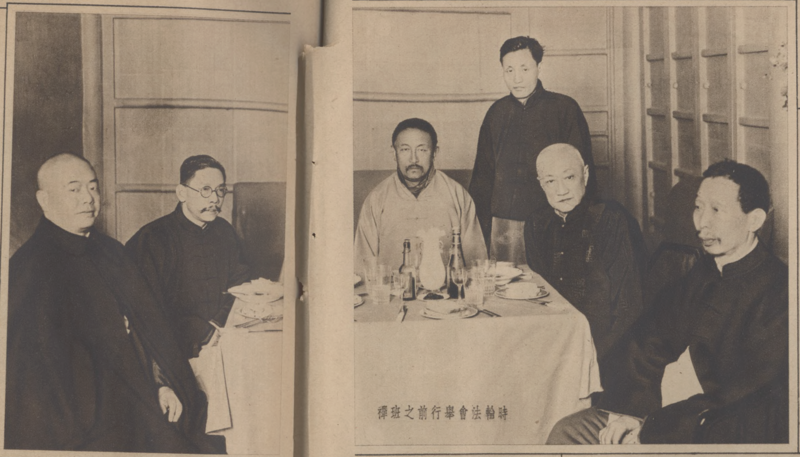
時輪法會舉行前之班禪
《新中华》第2卷第9期(1934年)
Key facts
Key facts
• Name — Thubten Choekyi Nyima • Title — 9th Panchen Lama • Religion — Tibetan Buddhism • Predecessor — Tenpai Wangchuk • Successor — Choekyi Gyaltsen • Born — 19 February 1883 • Birthplace — Dagpo, Tibet, Qing dynasty • Died — 1 December 1937 • Place of death — Gyêgu, Qinghai, Republic of China • Resting Place — Tashi Lhunpo Monastery, Shigatse, Tibet Autonomous Region, China
Key facts
Key facts
• Title — Thubten Choekyi Nyima • S — 图丹曲吉尼玛 • T — 圖丹曲吉尼瑪 • P — Túdān Qūjí Nímǎ • Tib — ཐུབ་བསྟན་ཆོས་ཀྱི་ཉི་མ་ • Wylie — Thub-bstan Chos-kyi Nyi-ma • Zwpy — Tubdain Qoigyi Nyima • Illustration — The Republic of China awarded Panchen Lama the Guarding the National Master • Illustration — Panchen Lama during his final stay in China 1934 Thubten Choekyi Nyima (1883–1937), often referred to as Choekyi Nyima, was the ninth Panchen Lama of Tibet. Thubten Choekyi Nyima is the 9th in his lineage, as recognized by Tashi Lhunpo Monastery, the traditional seat of Panchen Lamas.[1] In 1901, Choekyi Nyima was visited by the Mongolian Lama, Agvan Dorzhiev. Although he only stayed for two days at Tashilhunpo, Dorzhiev received some secret teachings from the Panchen Lama, as well as readings of the Prayer of Shambhala, written by Lobsang Palden Yeshe, the sixth (or third) Panchen Lama, concerning the Buddhist kingdom of Shambhala, which were of great importance to Dorzhiev's developing understanding of the Kalachakra ('Wheel of Time') tantric teachings. Choekyi Nyima also gave Dorzhiev gifts including some golden statues.[2] In 1906, Sir Charles Alfred Bell, was invited to visit the 9th Panchen Lama at Tashilhunpo, where they had friendly discussions on the political situation.[3] He fled to Inner Mongolia, China in 1924 after a dispute with the thirteenth Dalai Lama when he sensed that he might face threat after his own monastery’s monks were prohibited from holding any office in the Central Tibetan government and his officials were locked up in Lhasa.[4][5] Among the Mongols, the 9th Panchen Lama became a well liked figure.[6] At the same time, study of documents did not confirm widespread claims that rebellions in the 1930s Mongolia were inspired or supported by the 9th Panchen Lama.[7] The Dalai Lama was attempting to collect revenue from the Panchen Lama's estate to cover a fourth of Tibet's military expenses, and to reduce the power of the Panchen Lama, who at the time enjoyed rule over an effectively autonomous region around Shigatse.[8] In China, the ninth Panchen Lama worked on plans to develop Tibet along modern lines.[9] He also held a position in the Mongolian and Tibetan Affairs Commission. The Panchen Lama was considered extremely "pro-Chinese", according to official Chinese sources.[10] Choekyi adopted the ideas of Sun Yat-sen like the Kham revolutionary Pandatsang Rapga.[13] It has been suggested he read the works of Sun Yatsen which were translated by Rapga.[14] In 1936, a team of monks from Lhasa were on the way to north-eastern Tibet to search for the new reincarnation of the 13th Dalai Lama, who had died in 1933. First, because of the historical close relationship between the Dalai Lama and the Panchen Lama, they visited the Panchen Lama in Kham, eastern Tibet, to seek his advice. He was staying in Jyekundo, a district of eastern Kham that had been annexed from Tibetan government control by the Chinese "during their invasion".[15] The Panchen Lama, being under Chinese power, was being held up there in his attempt to return to Central Tibet due to Chinese interference and insistence that he must be accompanied by a force of 500 armed Chinese soldiers;[16] naturally this condition was not at all acceptable to the Tibetan Government in Lhasa. While negotiations were going on between the Lhasa Government, the Panchen Lama and the Chinese authorities about this escort issue, he was stuck in Jyekundo.[17] He had therefore been busy investigating reports of unusual children born in the area, who might be the reincarnation of the 13th Dalai Lama; the deep spiritual link between the two Lamas had never wavered despite apparent political difficulties and attempted Chinese interference.[18] In fact, when the search team arrived to see him, the Panchen Lama had already identified three potential candidates. He gave their details to the search party leader, Kewtsang Rinpoche, who then investigated further. One of these three candidates was already dead and another ran away crying when shown the objects belonging to the late Dalai Lama. The third candidate, who lived in Taktser, was characterised as "fearless" and he was indeed found to be the true incarnation. Thus, it was this Panchen Lama Thubten Choekyi Nyima who first discovered and identified the 14th Dalai Lama.[19] In 1937, the Panchen Lama died in Gyêgu (Tibetan: Jyekundo; Chinese: Yushu) in Qinghai Province without being able to return to Tsang.[20][21] The tombs of the fifth through the ninth Panchen Lamas were destroyed during the Cultural Revolution and have been rebuilt by the tenth Panchen Lama with a huge tomb at Tashilhunpo Monastery in Shigatse, known as the Tashi Langyar.[23] • Illustration — Panchen Lama and entourage in Calcutta, 1906
Life and career
Dated record
Life and career
The full dated record · 2 entries
1883
Thubten Choekyi Nyima, 9th Panchen Lama born at Dakpo.
1937
Thubten Choekyi Nyima, 9th Panchen Lama died at Gyêgu Subdistrict.
Places
Named by the record
Places
Only places the record itself states, plotted where the house gazetteer settles their coordinates. Nothing is inferred from a name or a nationality.
Dakpo.
Birth place
Gyêgu Subdistrict.
Death place
Notes from the source article
Cited by Wikipedia
Notes from the source article
These works are cited by the source article, in its own numbering. They are recorded as its citations, not as sources VALÉORINE has verified.
- 1.Tashilhunpo Monastery. Who is Panchen Rinpoche?. tashilhunpo.org.
- 2.Snelling 1993, p. 77.
- 3.Chapman 1940, p. 141
- 4.Tuttle 2006
- 5.Office for the Journal China Tibetology. China Tibetology. 16. 2006.
- 6.Znamenski, Andrei. Red Shambhala: Magic, Prophecy, and Geopolitics in the Heart of Asia. Quest Books. 35. 2011. 978-0835608916.
- 7.Kuzmin S. The Activity of the 9th Panchen Lama in Inner Mongolia and Manchuria. – Far Eastern Affairs, no 1, 2014, pp. 123-137
- 8.Powers 2004, p. 99.
- 9.Jagou, pp. 156-159, 206-208.
- 10.Chinese Materials Center. Who's who in China, 1918-1950: 1931-1950. 3 of Who's who in China, 1918-1950: With an Index, Jerome Cavanaugh. 1982.
- 11.Millard Publishing House. The China weekly review, Volume 54. 406. 1930.
- 12.Millard Publishing Co., Inc. China monthly review, Volume 56. 306. 1931.
- 13.Gray Tuttle. Tibetan Buddhists in the Making of Modern China. Columbia University Press. 153. 2007. 978-0-231-13447-7.
- 14.Gray Tuttle. Tibetan Buddhists in the Making of Modern China. Columbia University Press. 152. 2007. 978-0-231-13447-7.
- 15.Bell 1946, p. 397.
- 16.Shakabpa 1984, pp. 280-283.
- 17.Richardson 1984, pp. 143-146.
- 18.Laird 2006, p. 265.
- 19.Bell 1946, p. 398.
- 20.Shakabpa 1984, p. 283.
- 21.Bell 1946, p. 365.
- 22.Richardson 1984, p. 146 http://www.xuehuile.com/thesis/Gelek Surkhang Wangchen (Tibet Journal Vol. 8 No. 1 Spring 1983 Tibet: The Critical Years (part 2) "The 6th Panchen Lama")
- 23.Mayhew 2005, p. 175.
Bibliography printed in the source article · 11
- Bell, Sir Charles. Portrait of the Dalai Lama (1946) Wm. Collins, London, 1st edition. (1987) Wisdom Publications, London. .
- Chapman, Spencer. Lhasa: The Holy City (1940) Readers Union Ltd., London.
- Jagou, Fabienne. Le 9e Panchen Lama (1883–1937): Enjeu des relations Sino-Tibetaines.
- Laird, Thomas. The Story of Tibet : Conversations with the Dalai Lama. Grove Press. 2006. 978-0-8021-1827-1.
- Goldstein "A History of Modern Tibet 1913–1951" University of California Press 1989.
- Mayhew, Bradley and Kohn, Michael. Tibet 6th Edition (2005) Lonely Planet Publications. .
- Powers, John. History as Propaganda: Tibetan Exiles versus the People's Republic of China (2004) Oxford University Press. .
- Richardson, Hugh E. Tibet and its history. Shambhala. 1984. 978-0877733768.
- Shakabpa, Tsepon W.D. (1984), Tibet: A Political History. Singapore: Potala Publications. .
- Snelling, John. Buddhism in Russia: The Story of Agvan Dorzhiev: Lhasa's Emissary to the Tsar (1993) Element Books. .
- Tuttle, Gray. Review of Le 9e Panchen Lama (1883–1937): Enjeu des relations Sino-Tibetaines, JIATS, no. 2 (August 2006) Columbia University. THDL #T2726.
References
Citations
References
Each reference names the institution holding it, so a reader may go to the document itself.
reference work
Partially resolvedreference work
Partially resolved
Further particulars
Held on the record
Further particulars
Open the remaining particulars
Each of those relationships is stated by the authority record rather than inferred from style.
The authorities additionally record the heading Thubten Choekyi Nyima. His recorded language was Chinese. His recorded confession was Buddhism. He was the child of Tamdrin and Damchö Tsomo. Recorded as buddhist monk and writer.
Identity and origins
The Encyclopedia exists whether or not anything is for sale. Corrections are recorded rather than overwritten, and every version of this record is kept. Published 15 August 2026.
Elsewhere in Books
38,661 published records in this field, each with its sources named.
- Thorsten JonssonAuthor
- Thorsten KayeAuthor
- Thorvald SteenAuthor
- Thrasyvoulos TsakalotosAuthor
- Thubten GyatsoAuthor
- Thubten Zopa RinpocheAuthor
- ThucydidesAuthor
- Thulani DavisAuthor
Best supported in this field
For owners
Own a work by Thubten Choekyi Nyima, 9th Panchen Lama?
A specialist will read what you send and tell you what the house can establish, what it cannot, and whether the object is suited to sale. There is no charge and no obligation. The object stays with you throughout; nothing is shipped to us unless it is arranged in writing beforehand.