
Thomas Jones Barker
Thomas Jones Barker (19 April 1813 – 29 March 1882) was an English historical, military, and portrait painter.
Thomas Jones Barker

Thomas Jones Barker · Public domain
- Name
- Thomas Jones Barker
- Born
- 19 April 1813
- Birthplace
- Bath
- Died
- 29 March 1882
- Place of death
- Haverstock Hill, Hampstead
- Education
- Studio of Horace Vernet
- Nationality
- United Kingdom of Great Britain and Ireland
- Occupation
- painter
- Languages
- English
VALÉORINE Encyclopedia
VALÉORINE documentary reading
Documentary summary
Thomas Jones Barker (19 April 1813 – 29 March 1882) was an English historical, military, and portrait painter.
Admitted source layer · organised and presented by VALÉORINE
Note VALÉORINE
Thomas Jones Barker (1815–1882) was a painter, of British nationality. The painter was born in Bath and died in London. Thomas Jones Barker worked in Great Britain and Paris.
Languages used include English. Works are held at Auckland Art Gallery, Hermitage Museum and Holburne Museum, among others.
Composed from admitted, traceable facts · 27 September 2026
VALÉORINE
Reference Check
Propose documentary evidence for Thomas Jones Barker. A contribution is never written directly as fact: identity, source, rights and evidence gates still decide.
Sign in to contribute
World of VALÉORINE
Documentary connections
Only confirmed graph relationships appear here. Images are shown only when their identity and reuse rights both pass the documentary gate.

Documentary evidence
Documentary basis
Authority files
wikidata · Q1550144 · wikipedia · Thomas Jones Barker
In this article
Biography
Biography
The recorded working language is English. Places of work recorded in the authority are Paris and Great Britain. Work by Thomas Jones Barker is recorded in the collections of Auckland Art Gallery, Musée de la civilisation, National Galleries Scotland, Hermitage Museum and National Portrait Gallery.
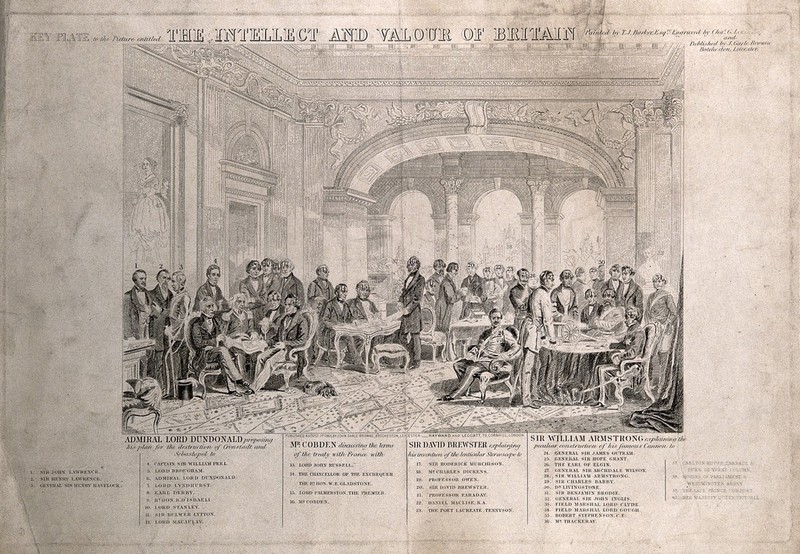
British inventors, politicians and military men: a key to the identities of the sitters. Engraving by C.G. Lewis, 1863, after T.J. Barker., 10 August 1863, by Thomas Jones Barker
Thomas Jones Barker · Wellcome Collection, London · Wellcome Collection
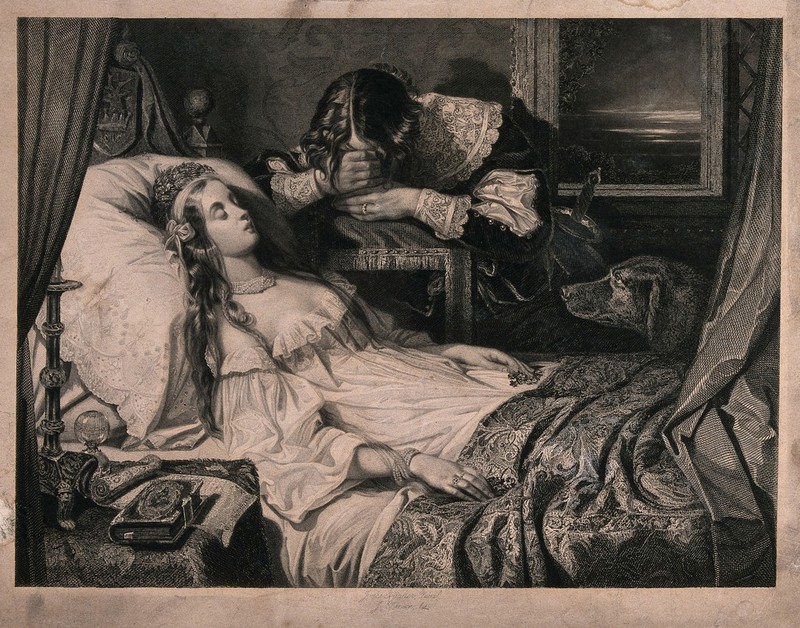
A young man laments the death of a young woman. Engraving by J. Brown after T. J. Barker, c.1834., by Thomas Jones Barker
Thomas Jones Barker · Wellcome Collection, London · Wellcome Collection
Key facts
Key facts
• Name — Thomas Jones Barker • Born — 19 April 1813 • Birthplace — Bath • Died — 29 March 1882 • Place of death — Haverstock Hill, Hampstead • Father — Thomas Barker • Mother — Pricilla Jones Barker • Education — Studio of Horace Vernet • Works — The Bride of Death (1839), Parisina (1842), The Secret of England's Greatness (c. 1862–1863), The Battle of Waterloo (undated)
The Barkers of Bath
The Barkers of Bath
Thomas Jones Barker was born at Bath in 1815, into a family of artists. His grandfather, Benjamin Barker, was "a failed barrister…who painted horses with limited success" and eventually became "foreman and enamel painter at the japan works, Pontypool, expert at painting sporting and animal figures." His father was the prominent painter Thomas Barker, also called Barker of Bath. His uncles Benjamin Barker Jr., and Joseph Barker were also painters, as was his younger brother, John Joseph Barker, and his cousin, Marianne A. Barker, daughter of his uncle Benjamin.
Career in France
Career in France
After studying under his father, in 1834, at age 19, he moved to Paris and became a student of Horace Vernet. He made his debut at the Paris Salon of 1836 with three paintings, including Beauties of the Court of Charles II, which received a bronze medal. (His father also exhibited in the Salon of 1836.) From 1836 to 1850, Barker showed 28 paintings at the annual Paris exhibition. A dozen of those paintings depicted hunters, poachers, dogs, and game. Barker's earliest known work, a collaboration with his father from 1834, depicted a boy guarding game while his father, in the distance, goes about hunting with a rifle and dog. This early and enduring interest in hunting and in dogs provides a rare glimpse into Barker's personal life. In Paris, Barker had a dog named Mentor who appears in some of his paintings. Barker's work was so well received in France that he was invited to meet King Louis Philippe I and was given two royal commissions. For these works, the king conferred on Barker the Cross of the Legion of Honour. The first royal commission was a large painting depicting the death of Louis XIV at Versailles; this painting disappeared in the sack of the Palais Royal in the French Revolution of 1848. An oil on cardboard sketch for the work, made on the spot for the king, is in the collection of the Musée Antoine Lécuyer in Saint-Quentin, France.
The Bride of Death
The Bride of Death
• Illustration — The Bride of Death, 1839, Victoria Art Gallery. Barker's second royal commission was for the king's daughter, Princess Marie; the painting La fiancée de la mort (The Bride of Death) was completed in 1839 and was shown at Paris Salon of 1841. Princess Marie, an artist in her own right, declared it "to be a revival of the intellectual" in art. The contemporary French poet J-F. Destigny described it as "a dark memory, an intimate pain, a thrilling drama of love and misfortune that bears the stamp of a noble character. It is a work where the heart has surpassed the mind, an endearing mirror for every broken soul." The painting's exhibition in Bath in 1845 occasioned the publication of Charles Empson's Memoranda Relative to The Bride of Death, a Picture Painted by Thomas Jones Barker, an effusive appreciation with a compendium of verses written in homage. Noting the presence of a dog in the picture (modeled on Barker's own dog), Empson noted that "the only living eye in the picture's composition is that of Mentor, and it is indeed wonderfully life-like." The Bride of Death is now in the collection of the Victoria Art Gallery in Bath. Before the more recent revival of interest in The Secret of England's Greatness, it was considered Barker's most famous painting. The entry for The Bride of Death in the catalogue for the Salon of 1841 includes the ancienne ballade that inspired Barker's painting:
Parisina
Parisina
• Illustration — Parisina, 1842, private collection. Barker's Parisina, one of three paintings he exhibited at the Paris Salon of 1842, exemplifies several of the influences on his work while in France—the historical drama and vivid detail of his teacher, Vernet; the Style troubadour, with its idealized depictions of the Middle Ages and the Renaissance; and literary inspiration, in this case the long poem Parisina by Lord Byron. (Vernet had similarly drawn inspiration from Byron with his painting of 1826, Mazepa and the Wolves.) The entry for Barker's Parisina in the catalogue for the Paris Salon of 1842 quotes (in French translation) the lines that inspired the painting: And heedless as the dead are they Of aught around, above, beneath; As if all else had passed away, They only for each other breathe... Of guilt, of peril, do they deem In that tumultuous tender dream? • Illustration — Ford Madox Brown's painting of Parisina is lost, but a few studies exist. Byron's poem tells the story of a deadly love triangle involving an Italian nobleman, Azo, his young bride, Parisina, and Azo's bastard son, Hugo. Barker chose to illustrate a passage in which "the two adulterers are lost in each other, oblivious to the danger of their love. By choosing these lines, Barker focuses on the intensity of their love, picking up the broader theme of illicit lovers but also highlighting Byron's homage to Dante's Paolo and Francesca." Barker's imagery is chaste—the lovers are fully dressed—but does include some subtle symbolism: a bejeweled sword with a bit of blood at the tip and a bejeweled cap to represent the carnal congress of the lovers, and the silhouette of an alert stag in the far distance to represent the cuckolded Azo. The dog in the painting may be Barker's dog Mentor, who also appears in The Bride of Death, here seen averting his gaze from the lovers. The next year, another painting inspired by the poem, by another Englishman in Paris, Ford Madox Brown, was rejected by the Salon with "a polite accompanying note stating that the subject was too improper for the walls of the French gallery under Louis Philippe." Brown ran afoul of the Salon committee by concentrating on the moment an enraged Azo hears Parisina murmur words of love to Hugo in her sleep. Brown's focus on Azo's fury "aligns the work to broader themes of violence and murder, perhaps less palatable in France than romance." Barker's homage to reckless love was more attuned to Parisian taste. Nevertheless, a contemporary critic cautioned that mothers entering the gallery should avert the eyes of their daughters from the sight of "a swooning Parisina on a gentleman's knees." The whereabouts and precise imagery of Barker's Parisina were long unknown to scholars, until the painting appeared at an auction in New York in 2020.
Career in England: War paintings
Career in England: War paintings
• Illustration — The Charger of Captain Nolan Bearing Back his Dead Master to the British Lines, 1855, National Gallery of Ireland. In 1870, Barker observed on the spot the Franco-Prussian War, including the Battle of Sedan and the surrender of Napoleon III. It is unclear whether he was a first-hand witness of the Crimean War, but he also exhibited a number of paintings depicting this conflict. An incident from India, The Relief of Lucknow, 1857, completed in 1859, was shown to Queen Victoria in May 1860; heightening the realism were numerous portraits of the chief actors, which Barker based on sketches by Swedish artist Egron Lundgren, who had traveled to India in 1858. Barker made a speciality of painting panoramic images with many figures whose faces were reproduced from actual portraits; when sold as engravings, these would be accompanied by a numbered key identifying the various persons. A contemporary critic noted that it was such "scenes of modern warfare by which Mr. Barker has chiefly made his reputation, and that have become popular by means of the engraver's aid; many of these pictures have never been exhibited except in the galleries of the printsellers for whom they were painted….the majority are on canvas of very large dimensions." Despite his popularity and commercial success, and the fact that he "contributed regularly to the Royal Academy and the British Institution….Barker was not favoured by the art critics of his day, nor was he rewarded with membership of the Royal Academy." He nevertheless occupied a pre-eminent place in a particular niche of British art; a retrospective on his 40-year career written in 1878 began, "If England possessed, what France has at Versailles, a gallery almost expressly devoted to a pictorial record of her military exploits, the artist whose works would find the most prominent place in such a collection would assuredly be Mr. T. Jones Barker, who is certainly the Horace Vernet of England.…We can scarcely pay Mr. Baker a greater compliment…he remains master of the battlefield among English artists." • Illustration — The Faithful Knight, n.d., Museums Sheffield • Illustration — News of Battle: Edinburgh after Flodden, by 1850, St Andrews Museum, Fife • Illustration — The Relief of Lucknow, 1857, 1859, National Portrait Gallery, London • Illustration — The Capitulation of Kars, 1860, National Army Museum • Illustration — The Dawn of Victory, 1862, National Army Museum • Illustration — Departure of a Troop of 11th Hussars for India aka The Girls We Left Behind, 1866, HorsePower: The Museum of the King's Royal Hussars • Illustration — Surrender of Napoleon III at Sedan, 1870, Blackburn Museum and Art Gallery. • Illustration — Riderless Horse After the Battle of Sedan, c. 1870, Southampton City Art Gallery • Illustration — The Charge of the Light Brigade, 1877, Defence Academy of the United Kingdom, Shrivenham
Career in England: Portraits
Career in England: Portraits
Throughout his career in England, Barker painted portraits. These included notables such as Disraeli and Garibaldi, but also less exalted figures, as long as they could afford his fees. Barker also specialized in panoramic historical or imaginary gatherings which featured scores of recognizable officials and celebrities, such as The Spa Promenade of 1871. • Illustration — The Spa Promenade, 1871, Scarborough Town Hall • Illustration — Portrait of Dr. John Snow (detail), 1847, private collection • Illustration — Portrait of Benjamin Disraeli, 1862, Hughenden Manor • Illustration — Portrait of a gentleman and his horse, 1870s, private collection • Illustration — Portrait of a hunter with dogs, 1873, private collection • Illustration — Marie Effie (née Wilton), Lady Bancroft, c. 1870s-1882, National Portrait Gallery, London • Illustration — Portrait of John Newton Mappin (1800–1884) 1877, Museums Sheffield • Illustration — Portrait of a woman, two children, and terrier, 1878, private collection
The Secret of England's Greatness
The Secret of England's Greatness
• Illustration — The Secret of England's Greatness, c. 1862–1863, National Portrait Gallery, London. Painted c. 1862–1863, The Secret of England's Greatness "toured northern England and Ulster…Though popular in its day, subsequently it was virtually forgotten. Following its purchase by the National Portrait Gallery in 1974, it became a favourite late twentieth-century icon of Victorianism, much reproduced in books, and Barker's best-known painting." The painting stirred fresh popular and scholarly interest when it was presented in 2005 and 2006 as part of the exhibit Black Victorians: Black People in British Art, 1800–1900 at the Manchester Art Gallery and the Birmingham Museum and Art Gallery. In the exhibition's catalogue and companion book, an essay by Jan Marsh, "Icon of the Age: 'Africa', Victoria and The Secret of England's Greatness," examined the painting at length, and prompted other art historians and social scientists to do likewise. It has become Barker's most discussed, deconstructed, and controversial painting work. • Illustration — Oil on cardboard study for The Secret of England's Greatness, c. 1861, The Hermitage. Lynda Nead in the Journal of Victorian Culture wrote: "Both the image and its title are emphatic and unambiguous…should there be any remaining traces of uncertainty, however, there is a sub-title: Queen Victoria Presenting a Bible in the Audience Chamber at Windsor….although the subject depicted can be related to various colonial visits during Victoria’s reign, it is unlikely that the specific event that is depicted ever took place. It is an 'apocryphal anecdote'…." Barker may have been inspired by an image that appeared in 1859 on the front page of the British Workman, in a story that purported to recount the visit of an African ambassador sent by his monarch to discover the secret of England's greatness. Victoria "did not…show the ambassador her diamonds and her jewels, and her rich ornaments, but handing him a beautifully bound copy of the Bible, she said, 'Tell the Prince that THIS IS THE SECRET OF ENGLAND’S GREATNESS.'" On a formal level, "the arrangement in the painting of the two protagonists recalls a number of iconic visual precedents such as the visit of the Magi to the Virgin and Child, whilst the kneeling black figure is reminiscent of the typical Abolitionist depiction of the freed slave.…Everything in the painting converges at the point where white hands and black hands nearly, but never, must never meet, over the transference of the Bible." The painting stirred more discussion when it was prominently included in the exhibition Artist and Empire: Facing Britain's Imperial Past at the Tate Britain in 2015 and 2016. A set of figurines based on the image was produced by the toy company Royal Express.
Death
Death
• Illustration — Family grave of Thomas Jones Barker in Highgate Cemetery (west side) Barker died at his Hampstead home, 32 Steeles Road, on 27 March 1882 at the age of 68, and was buried in a family grave on the western side of Highgate Cemetery (plot no 15902).
At auction
At auction
• Illustration — The Battle of Waterloo, undated, private collection. An auction record for a Barker painting was set in 2015, when Barker's Battle of Waterloo sold for £50,000 at Bonham's in London. The Bonham's catalogue reiterated Barker's primacy as a depicter of military history: Right in the centre of Barker's composition Wellington is instantly identifiable giving his famous order with an authoritative wave of his cockade whilst Maitland, pictured to the Duke's left, is echoing the order with an upward slash of his sword. It's a dramatic scene that captures the swirling maelstrom of battle whilst at the same time depicting with utter clarity the moment when the decisive command was issued, the artist offering the viewer an opportunity to witness this significant moment first hand. Waterloo is a battle remembered in popular consciousness for a number of significant moments—the charge of the Union Brigade, the defence of Hougoumont and the repeated attacks of the French cavalry—all of which have been celebrated in famous paintings of national importance. Barker's monumental work can be adjudged to be in the same class and is certainly the most significant artistic depiction of one of Waterloo's most significant moments.
Gallery of the Barker Family
Gallery of the Barker Family
• Illustration — Thomas Barker (father of Thomas Jones Barker), Self-Portrait, c. 1794, Holburne Museum • Illustration — Thomas Barker, Self-Portrait, c. 1796, No. 1 Royal Crescent, Bath • Illustration — Thomas Barker, Self-Portrait, n.d., Victoria Art Gallery • Illustration — Thomas Barker, Portrait of Priscilla Jones (later his wife and the mother of Thomas Jones Barker), c. 1802, Holburne Museum • Illustration — Benjamin Barker Jr. (uncle of Thomas Jones Barker), Self-Portrait, n.d., Victoria Art Gallery • Illustration — Benjamin Barker, Jr., Portrait of Joseph Barker (both were uncles of Thomas Jones Barker), c. 1800, Victoria Art Gallery • Illustration — Thomas Barker, portrait of his son Thomas Jones Barker, c. 1820, Victoria Art Gallery • Illustration — Thomas Jones Barker, Self-Portrait, 1848, National Portrait Gallery, London • Illustration — Thomas Jones Barker, Self-Portrait, n.d., Victoria Art Gallery
Life and work
Life and work
Thomas Jones Barker was born on 1 January 1815 in Bath. Barker held the nationality of United Kingdom of Great Britain and Ireland. Recorded father: Thomas Barker. Recorded sibling: John Joseph Barker. Barker died on 27 March 1882 in London. Barker is buried at Highgate Cemetery.
Places
Named by the record
Places
Only places the record itself states, plotted where the house gazetteer settles their coordinates. Nothing is inferred from a name or a nationality.
Bath.
Birth place
London.
Death place
Paintings, drawings and prints, 1820–1882
Catalogued output
Paintings, drawings and prints, 1820–1882
These are objects catalogued as visual works, each held or recorded by the institution named against it. 35 works carry dates between 1820 and 1882. The 1870s are the densest part of the run, with 11 titles, and that concentration is a fact about what the registers have catalogued rather than a judgement on the work itself. They belong to a run of 52 titles in all, from 1820 to 1882. A selection is set out below and the complete run may be opened beneath it.
The run opens with Devonshire and closes with Portrait of Napoleon
Devonshire
1820
The Bride of Death
1839
News of Battle: Edinburgh after Flodden
1850
Quelle Guerre
1853
Wellington at Sorauren, 27 July 1813
1853
Devereux Cockburn (1828–1850), Royal Scots Guard, and His Sister Anne Russell
1854
The Charger of Captain Nolan Returning with his Dead Master
1855
Colin Campbell (1792–1863), Baron Clyde
1857
Sir Edward Cockburn (1834–1903), and Colonel George Cockburn (1838–1924)
1858
The Relief of Lucknow, 1857
1859
Colin Campbell, 1st Baron Clyde, 1792 - 1863
The complete catalogue · 35
The run opens with Devonshire and closes with Portrait of Napoleon
Devonshire
1820
The Bride of Death
1839
News of Battle: Edinburgh after Flodden
1850
Quelle Guerre
1853
Wellington at Sorauren, 27 July 1813
1853
Devereux Cockburn (1828–1850), Royal Scots Guard, and His Sister Anne Russell
1854
The Charger of Captain Nolan Returning with his Dead Master
1855
Colin Campbell (1792–1863), Baron Clyde
1857
Sir Edward Cockburn (1834–1903), and Colonel George Cockburn (1838–1924)
1858
The Relief of Lucknow, 1857
1859
Colin Campbell, 1st Baron Clyde, 1792 - 1863
Field-Marshal
1860
The Capitulation of Kars, Crimean War, 28 November 1855
1860
Queen Victoria Giving the Bible to an African Chief (The Secret of England’s Greatness)
1861
Benjamin Disraeli, 1st Earl of Beaconsfield (1804-1881)
1862
'The Secret of England's Greatness' (Queen Victoria presenting a Bible in the Audience Chamber at Windsor)
1862
Benjamin Disraeli, Earl Beaconsfield, MP, PC, FRS, KG (1804-1881)
1862
The Dawn of Victory – Lord Clyde (1792–1863) Reconnoitring the Position of the Enemy, in Advance of the Relief of Lucknow, 1857
1862
The Secret of England's Greatness
1862
'The Girls We Left Behind', the Departure of a Troop of 11th Hussars for India
1866
Edward Hopper Hebden
1868
Marie Effie (née Wilton), Lady Bancroft
1870
Surrender of Napoleon III at the Battle of Sedan
1870
The Spa Promenade
1871
Riderless War Horses After the Battle of Sedan
1873
Riderless Horse after the Battle of Sedan
1873
Portrait of a hunter with dogs
1873
The Charge of the Light Brigade
1877
John Newton Mappin (1800–1883)
1877
Portrait of John Newton Mappin (1800-1884)
1877
Arthur Clutton-Brock (1868-1924), aged 10
1878
Napoleon at Waterloo
1879
Faithful Knight
1881
Portrait of Napoleon
1882
Paintings, drawings and prints without a settled date
Catalogued output
Paintings, drawings and prints without a settled date
17 further works are catalogued under Barker's name without a date the collections agree on, which is why they are set apart from the dated run rather than placed in it.
The Intellect and Valour of Great Britain
Sir Henry Ripley (1813–1882)
The Prince of Wales (Edward VII, 1841–1910)
Mark Firth (1819–1880), Mayor of Sheffield (1874)
Charles Henry and Mary Crompton-Roberts and Their Children at Field House, Clent
An Incident in the Napoleonic Wars
The Faithful Knight
Scene in the Piazza del Popolo, Rome
Interior with British Army Officers
Angel with a Child
Landscape with Figures
Landscape with Cattle
Primary material
Documents and archives
reference work
- “Thomas Jones Barker”, English Wikipedia, consulted as further reading
Reputable secondary · Wikipedia
authority record
- Wikidata, structured authority record Q1550144: Thomas Jones Barker
General reference · Wikidata
Authority records
Notes from the source article
Cited by Wikipedia
Notes from the source article
These works are cited by the source article, in its own numbering. They are recorded as its citations, not as sources VALÉORINE has verified.
- 1.Thomas Jones Barker obituary, La Liberté, Paris, 1 April 1882. p. 3.
- 2.The catalogues for the Paris Salon from 1836 to 1850 repeatedly give his full name as Thomas Jones Henry Barker; the name "Henry" is not attested elsewhere. See for example "Barker (Thomas-Jones-Henry)" in Explication des ouvrages… (1842), p. 10 and Database of Salon Artists 1827–1850: Barker, Thomas Jones Henry
- 3.Belsey, Hugh. Thomas Barker of Bath: imitator, copyist and chameleon. artuk.org.
- 4.BARKER family, of Pontypool, etc., artists.
- 5.The Barkers of Bath (1986) p. 16.
- 6."The Rescue Dog – A Staffordshire Earthenware Group & Its Possible Original Source" posted 13 March 2018 at harryprogger.com: "Marianne A. Barker (b.1802-d.1888)…married naval officer Captain George Wallace in 1826 and is known to have exhibited a total of fourteen works at, amongst other, the Royal Academy and the British Institution between 1820 and 1848."
- 7.Database of Salon Artists 1827–1850: Barker, Thomas Jones Henry [Barker fils]. humanities-research.exeter.ac.uk/.
- 8.Empson (1845) pp. 5 and 9.
- 9.Destigny (1841) p. 123.
- 10.Bénézit (1939) p. 368.
- 11.Cabezas (2016).
- 12.This work was prominently displayed in the exhibit Le Roi es mort (The King is Dead) at the Palace of Versailles, 27 October 2015 to 21 February 2016; reviewed here.
- 13.The Bride of Death. artuk.org.
- 14.Empson (1845) p. 3.
- 15.Destigny (1841) p. 121: "C'est un noir souvenir, une intime douleur,/Un drame palpitant d'amour et de malheur,/Qui porte le cachet d'un noble charactère./C'est une œuvre où le cœur a surpassé l'esprit,/Un miroir attachant pour toute âme brisée."
- 16.Empson (1845) p. 5.
- 17.The Barkers of Bath (1986) p. 5.
- 18."Barker" in Explication des ouvrages… (1841), p. 18.
- 19.File:Vernet, Horace - Mazeppa and the Wolves - 1826.jpg. (16 June 2019). Wikimedia Commons, the free media repository. Retrieved 20:25, 10 November 2020 from https://commons.wikimedia.org/w/index.php?title=File:Vernet,_Horace_-_Mazeppa_and_the_Wolves_-_1826.jpg&oldid=354983278.
- 20.Inspired by another poem by Byron about a love triangle, and perhaps by Vernet, Barker would paint Mazeppa, a work of uncertain date known only from an engraving of 1878: File:Barker--Mazeppa--nd--engraving--Art Journal 1878 article.jpg. (12 November 2020). Wikimedia Commons, the free media repository. Retrieved 21:03, 12 November 2020 from https://commons.wikimedia.org/w/index.php?title=File:Barker--Mazeppa--nd--engraving--Art_Journal_1878_article.jpg&oldid=512223606.
- 21."Barker" in Explication des ouvrages… (1842), p. 10.
- 22.The temporal proximity of two paintings on the same subject may suggest that the two artists were in contact at this time; The Barkers of Bath (1986) p. 18 notes that Brown painted Barker's portrait, but gives no location or date for that painting.
- 23.Hueffer (1911), p. 30.
- 24.Karr (April 1842), p. 27: "Il y a de M. Barker une Parisina pâmée sur les genoux d'un monsieur,—dont je recommande aux mères de famille de détourner les regards de leur fille."
- 25.MacCulloch (2017), p. 124.
- 26.Thomas Jones Barker (1815–1882). liveauctioneers.com.
- 27.Graves (1905), pp. 114–115.
- 28.Dafforne (1878).
- 29.Nilsson (1970).
- 30.Thomas Jones Barker. npg.org.uk.
- 31.The Surrender of Napoleon III at Sedan relates the rediscovery of this painting after years of neglect in a storeroom.
- 32.Sarony Exhibition Part 2 includes the story "Sarony the Shark" that tells how Barker's 1871 paintingThe Spa Promenade came to be, and a key to 82 people in the picture.
- 33.Thomas Jones Barker at the John Snow site, UCLA Dept. of Epidemiology, tells how this portrait came to be attributed to Barker.
- 34.Stone p. 898.
- 35.Marsh (2005).
- 36.Nead (June 2014).
- 37."Queen Victoria…" (1 December 1859).
- 38.Zetterström-Sharp (2105).
- 39.Royal Express Queen Victoria Presenting Bible. liveauctioneers.com.
- 40.Lot 140, Thomas Jones Barker (British, 1815–1882), The Battle of Waterloo. bonhams.com.
Bibliography printed in the source article · 23
- Anchor, Rachel. "Fidelity or Fiction? Elizabeth Thompson's Balaclava and the Art of Re-construction", The British Art Journal, Vol. 12, No. 2 (Autumn 2011), pp. 58–62.
- "Barker" entry in Explication des ouvrages de peinture, sculpture, architecture, gravure et lithographie des artistes vivants, exposé au Musée Royal le 15 Mars 1841 (catalogue of the Paris Salon), Paris: Vinchon, 1841, p. 18.
- "Barker (Thomas-Jones-Henry)" entry in Explication des ouvrages de peinture et dessins, sculpture, architecture et gravure des artistes vivants, exposé au Musée Royal le 15 Mars 1842 (catalogue of the Paris Salon), Paris: Vinchon, 1842, p. 10.
- The Barkers of Bath, catalogue of an exhibition held at the Victoria Art Gallery, Bath, 17 May-28 June 1986; introduction by Ian Fleming-Williams; Bath: Bath Museums Service, 1986.
- Barryte, Bernard. "History and Legend in T.J. Barker's The Studio of Salvator Rosa in the Mountains of the Abruzzi, 1865", The Art Bulletin, Vol. 71, No. 4 (Dec. 1989), pp. 660–673.
- Bénézit, Emmanuel. "BARKER (Thomas-Jones)" in Dictionnaire des peintres, sculpteurs, dessinateurs et graveurs, Paris: Librairie Gründ, 1939, vol. I, p. 368.
- Cabezas, Hervé. "La Mort de Louis XIV au palais de Versailles, par Thomas Jones Barker (1813–1882). L'esquisse d'un tableau offert à Louis-Philippe, au musée Antoine-Lécuyer de Saint-Quentin," La Revue des musées de France. Revue du Louvre, number 4, (2016), pp. 75–84.
- Dafforne, James. "British Artists: Thomas Jones Barker", The Art Journal, New Series, Vol. 4 (1878), pp. 97–100.
- Destigny, J.-F. Revue poétique du Salon de 1841, Paris, 1841, pp. 121–124.
- Empson, Charles. Memoranda Relative to The Bride of Death, a Picture Painted by Thomas Jones Barker, of Paris (Son of Thomas Barker, Esq., of Bath). Bath: The Museum, Terrace Walk, Orange Grove, 1845.
- Graves, Algernon. "Barker, Thomas Jones" (entry on pp. 114–115) in The Royal Academy of Arts; a Complete Dictionary of Contributors and Their Work from Its Foundation in 1769 to 1904, Vol. I, London: H. Graves and Co. Ltd. and George Bell and Sons, 1905.
- Harrington, Peter. "The Defence of Kars: Paintings by William Simpson and Thomas Jones Barker", Journal of the Society for Army Historical Research, Vol. LXIX, No. 277 (Spring 1991), pp. 22–28.
- Hueffer, Ford Madox (aka Ford Madox Ford). Ancient Lights and Certain New Reflections, Being the Memories of a Young Man, London: Chapman and Hall, Ltd., 1911.
- Karr, Alphonse. Les Guêpes, Paris: Longe Lévy & Cie., April 1842.
- Harrington, Peter. British Artists and War: The Face of Battle in Paintings and Prints, 1700–1914, London: Greenhill, 1993.
- MacCulloch, Laura. "Re-evaluating the 'Outsider': Ford Madox Brown and Cultural Dialogues in Mid-Nineteenth Century Europe" in Artists and Migration 1400–1850: Britain, Europe, and Beyond, ed. Wagner, David, and Klemenčič, Newcastle upon Tyne: Cambridge Scholars Publishing, 2017, pp. 112–126.
- McCallum, Iain. Thomas Barker of Bath: The Artist and His Circle, Bath: Millstream Books, 2003.
- Marsh, Jan. "Icon of the Age: 'Africa', Victoria and The Secret of England's Greatness" in Black Victorians: Black People in British Art, 1800–1900, exhibition catalogue and essays edited by Jan Marsh, published in conjunction with an exhibition held at the Manchester Art Gallery 1 October 2005 – 6 January 2006, and the Birmingham Museum and Art Gallery 28 January – 2 April 2006; Aldershot, Hampshire and Burlington, Vermont: Lund Humphries, 2005, pp. 57–67.
- Nead, Lynda. "The Secret of England’s Greatness"," Journal of Victorian Culture, vol. 19, issue 2 (June 2014), pp. 161–182.
- Nilsson, Sten. "Egron Lundgren, Reporter of the Indian Mutiny," Apollo, Vol. XCII, No. 102 (August 1970), pp. 138–143.
- "Queen Victoria and the Bible," British Workman, no. 60, 1 December 1859, p. 237.
- Stone, Roger T. "Barker, Thomas Jones (1813–1882)" in Oxford Dictionary of National Biography, Oxford University Press, 2004.
- Zetterström-Sharp, Johanna. "Gallery & Exhibition Reviews: Artist and Empire: Facing Britain's Imperial Past", Journal of Museum Ethnography, 29 November 2016, pp. 152–157.
References
Citations
References
Each reference names the institution holding it, so a reader may go to the document itself.
reference work
Secondary witnessauthority record
General reference
The Encyclopedia exists whether or not anything is for sale. Corrections are recorded rather than overwritten, and every version of this record is kept. Published 17 August 2026.
Elsewhere in Paintings
18,717 published records in this field, each with its sources named.
- Thomas HowardArtist
- Thomas HudsonArtist
- Thomas JenkinsArtist
- Thomas JonesArtist
- Thomas KinkadeArtist
- Thomas Kirby Van ZandtArtist
- Thomas KovachevichArtist
- Thomas LawrenceArtist
Best supported in this field
For owners
Own a work by Thomas Jones Barker?
A specialist will read what you send and tell you what the house can establish, what it cannot, and whether the object is suited to sale. There is no charge and no obligation. The object stays with you throughout; nothing is shipped to us unless it is arranged in writing beforehand.