
Thomas Jeckyll
Thomas Jeckyll (1827 Wymondham, Norfolk – 1881 Norwich) (baptised on 20 June 1827) was an English architect who excelled in the creation of metalwork and furniture strongly influenced by Japanese design, and is best known for his planning in 1876 of the ‘Peacock Room’ at 49 Princes Gate, London.
Also recorded as Thomas Jeckell
Thomas Jeckyll
Wmpearl · CC0
- Name
- Thomas Jeckyll
- Born
- 20 June 1827
- Birthplace
- Norfolk, United Kingdom of Great Britain and Ireland
- Died
- 1 January 1881
- Occupation
- Architect, Anglo-Japanese style Designer
- Nationality
- United Kingdom of Great Britain and Ireland
VALÉORINE Encyclopedia
VALÉORINE documentary reading
Documentary summary
Thomas Jeckyll (1827 Wymondham, Norfolk – 1881 Norwich) (baptised on 20 June 1827) was an English architect who excelled in the creation of metalwork and furniture strongly influenced by Japanese design, and is best known for his planning in 1876 of the ‘Peacock Room’ at 49 Princes Gate, London.
Admitted source layer · organised and presented by VALÉORINE
Note VALÉORINE
Thomas Jeckyll (1827–1881) was an architect, of British nationality. The architect was born in Norfolk. Works are held at Art Institute of Chicago, Freer Gallery of Art and Hunterian Museum and Art Gallery, among others.
Composed from admitted, traceable facts · 29 September 2026
VALÉORINE
Reference Check
Propose documentary evidence for Thomas Jeckyll. A contribution is never written directly as fact: identity, source, rights and evidence gates still decide.
Sign in to contribute
World of VALÉORINE
Documentary connections
Only confirmed graph relationships appear here. Images are shown only when their identity and reuse rights both pass the documentary gate.
Documentary evidence
Documentary basis
Authority files
wikidata · Q29014707 · wikipedia · Thomas Jeckyll
In this article
Key facts
Key facts
• Name — Thomas Jeckyll • Born — 20 June 1827 • Birthplace — Norfolk, United Kingdom of Great Britain and Ireland • Died — 1 January 1881 • Occupation — Architect, Anglo-Japanese style Designer
Biography
Biography
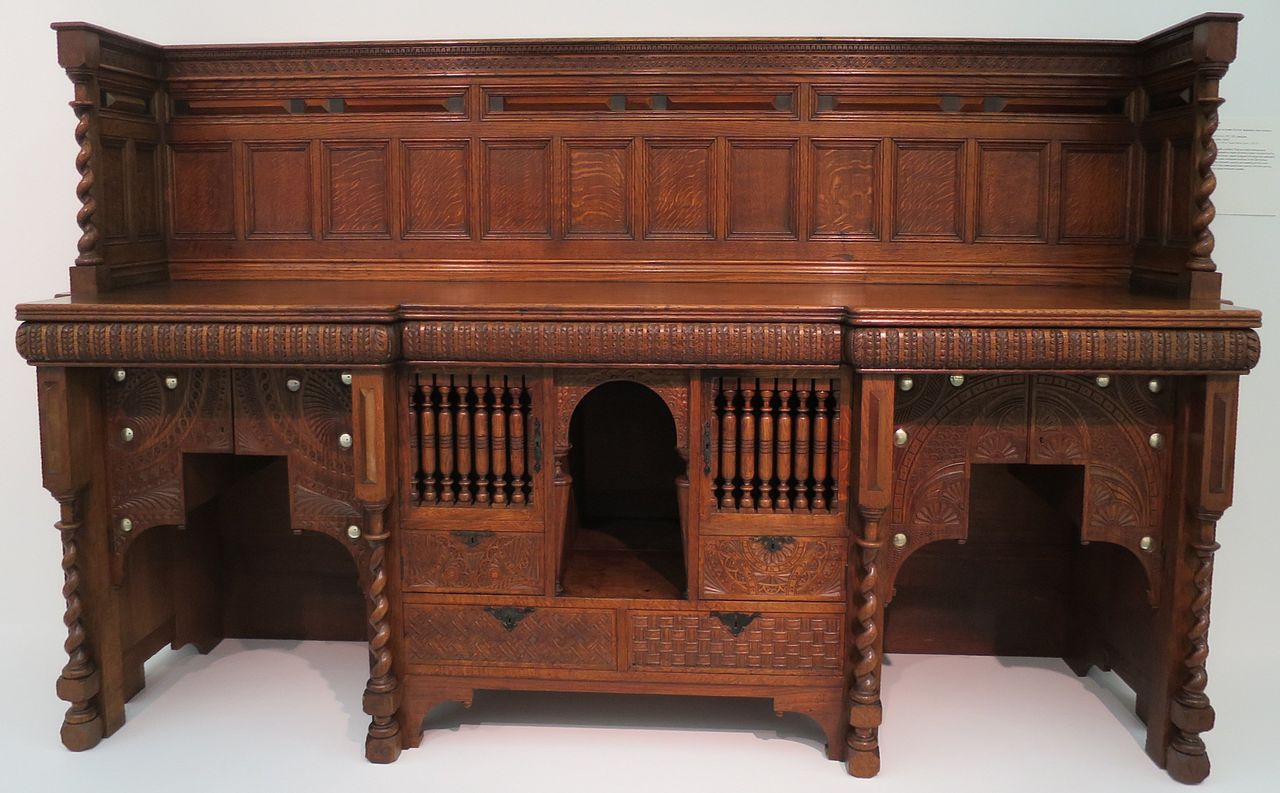
• Illustration — Signature medallion used by Thomas Jeckyll • Illustration — Sideboard designed for the Oak Parlour at Heath Old Hall Thomas Jeckyll was a son of George Jeckell, a Nonconformist clerk who had taken holy orders, was curate of the Abbey Church in Wymondham and was married to Maria Ann Balduck. Thomas later changed his surname to 'Jeckyll.' His brother Henry was a brass founder in Dudley. He became ill in 1877 and later died at St Andrew's Hospital, Norwich.
Career
Career
He is regarded as an important figure in the Aesthetic Movement. The Tate states "the Arts and Crafts movement... was a key direct influence on the Aesthetic Movement and Art Nouveau", the V&A sees the Aesthetic Movement as having "sparked a revolution in the architecture and interior decoration of houses that led to a widespread recognition of the need for beauty in everyday life". His ecclesiastical architecture was often controversial, for example the remarkable polychrome pointed Methodist Church in Holt, Norfolk (1862–3), and the plain Great Hautbois Holy Trinity Church (1864), both in Norfolk. Between the 1850s and 1870s he extensively rebuilt the medieval church at Brome, Suffolk including adding a North transept and a rose window in Eastern end of the North aisle. Jeckyll started his career as a Gothic Revival architect in 1850 in Wymondham, planning rectories and schools, designing and restoring historic homes, such as Elsing Hall near Dereham, Gothic Revival churches, such as at Sculthorpe, and constructing and improving farmhouses and agricultural buildings. By 1858 he was working in Norwich and was elected a Fellow of the Royal Institute of British Architects. Shortly thereafter he settled in London, his friend Frederick Sandys introducing him to the so-called Chelsea aesthetes, du Maurier, Swinburne, Rossetti, Burne-Jones, William Eden Nesfield, Edward William Godwin and Whistler, causing a change of direction in his artistic vision. Jeckyll pioneered the use of Anglo-Japanese style furnishings. In 1859 he started associating with the Norwich ironworks firm of Barnard, Bishop & Barnards, a relationship which endured until 1881. One of his first projects was the design of the Norwich Gates, which were displayed at the 1862 International Exhibition. These were then presented by the people of Norwich and Norfolk as a wedding present to the Prince of Wales, later King Edward VII, and may still be seen at the Sandringham Estate. Jeckyll produced an enormous number of designs for the front panels of Barnard's very popular range of slow combustion fireplaces. These featured a deep grate, and allowed air through the front rather than below, reducing the inflow of air and consequently burning more slowly. Jeckyll started decorating these with designs inspired by Japanese art in 1873. In the 1870s he designed interiors for clients such as Alexander Constantine Ionides and the 'Peacock Room' for Frederick Richards Leyland. Jeckyll's behaviour had become quite erratic, and in his absence Whistler took over the decorating. Whistler painted over Jeckyll's leather-covered walls, shelving and sideboard. “While the result was undoubtedly splendid it effectively overwrote Jeckyll's contribution to art history.” Whistler described Jeckyll in 1877 as “one of my intimate comrades”. His early death at fifty-four was brought about by a mental breakdown and severe depression. He became ill in 1877 and died in a Norwich asylum in 1881.
List of Works
List of Works
• Church of the Holy Trinity, Coltishall, Norfolk • Elsing Hall, Elsing, Norfolk (Restoration, 1850s) • St. Andrew's Church, Little Massingham, Norfolk • The Parish Church of St Peter Horningsea near Cambridge..(partial restoration 1865 - 66).
Reception
An exhibition of his life's work was held by the Bard Graduate Center, New York in 2003. The exhibitoion was titled Thomas Jeckyll, Architect and Designer, July 17 – October 19, 2003
Notes from the source article
Cited by Wikipedia
Notes from the source article
These works are cited by the source article, in its own numbering. They are recorded as its citations, not as sources VALÉORINE has verified.
- 1.The Correspondence of James McNeill Whistler :: Biography. www.whistler.arts.gla.ac.uk.
- 2.“Thomas Jeckyll Architect and Designer, 1827-1881” by Susan Weber Soros and Catherine Arbuthnott
- 3.Thomas Jeckyll. Oxford Reference.
- 4.The Round Tower Churches Society. Thomas Jeckyll and St Mary, Brome. The Round Tower. XL1. 2. 6–11.
- 5.Elsing Hall. Elsing Hall Gardens: History.
- 6.Thomas Jeckyll. www.bgc.bard.edu.
- 7.Unthank, Reggie. Butterfly signature. COLONEL UNTHANK'S NORWICH.
- 8.Weber Soros, Susan. Thomas Jeckyll Exhibition 2003. Bard Graduate Centre.
- 9.CHURCH OF HOLY TRINITY, Coltishall - 1050886 Historic England. historicengland.org.uk.
- 10.mnf3009 - Norfolk Heritage Explorer. www.heritage.norfolk.gov.uk.
- 11.Norfolk Churches. www.norfolkchurches.co.uk.
- 12.The Parish Church of St Peter Horningsea. A Short History and Guide'. Available in the church book stall 2025
References
Citations
References
Each reference names the institution holding it, so a reader may go to the document itself.
reference work
Secondary witnessreference work
Secondary witness
The Encyclopedia exists whether or not anything is for sale. Corrections are recorded rather than overwritten, and every version of this record is kept. Published 18 August 2026.
Elsewhere in Design
11,558 published records in this field, each with its sources named.
- Thomas HubkaDesigner
- Thomas IvoryDesigner
- Thomas J. CampanellaDesigner
- Thomas J. CaulfieldDesigner
- Thomas JellyDesigner
- Thomas JohnsonDesigner
- Thomas Joseph ByrneDesigner
- Thomas KarstenDesigner
Best supported in this field
For owners
Own a work by Thomas Jeckyll?
A specialist will read what you send and tell you what the house can establish, what it cannot, and whether the object is suited to sale. There is no charge and no obligation. The object stays with you throughout; nothing is shipped to us unless it is arranged in writing beforehand.