
Teun Roosenburg
Jacob Martijn Roosenburg (9 July 1916 – 15 July 2004), better known as Teun Roosenburg, was a Dutch sculptor. The son of the architect Dirk Roosenburg, he attended the Royal Academy of Art in the Hague and the Académie Ranson in Paris. He worked with several materials, depicting various subjects in a figurative style.
Also recorded as Jacob Martijn Roosenburg
Teun Roosenburg

A. J. van der Wal · Rijksdienst voor het Cultureel Erfgoed · CC BY-SA 4.0
- Name
- Teun Roosenburg
- Birth Name
- Jacob Martijn Roosenburg
- Born
- 9 July 1916
- Birthplace
- The Hague, Netherlands
- Died
- 15 July 2004
- Place of death
- Eijsden, Limburg, Netherlands
- Education
- Royal Academy of Art, The Hague
- Spouse
- Jopie Roosenburg-Goudriaan
- Nationality
- Kingdom of the Netherlands
- Occupation
- sculptor · ceramicist
- Teachers
- Albert Termote
VALÉORINE Encyclopedia
VALÉORINE documentary reading
Documentary summary
Jacob Martijn Roosenburg (9 July 1916 – 15 July 2004), better known as Teun Roosenburg, was a Dutch sculptor. The son of the architect Dirk Roosenburg, he attended the Royal Academy of Art in the Hague and the Académie Ranson in Paris. He worked with several materials, depicting various subjects in a figurative style.
Admitted source layer · organised and presented by VALÉORINE
Reference Check
Propose documentary evidence for Teun Roosenburg. A contribution is never written directly as fact: identity, source, rights and evidence gates still decide.
Sign in to contribute
World of VALÉORINE
Documentary connections
Only confirmed graph relationships appear here. Images are shown only when their identity and reuse rights both pass the documentary gate.
Documentary evidence
Documentary basis
Authority files
wikidata · Q2803358 · wikipedia · Teun Roosenburg
In this article
Biography
Biography
He and his wife Jopie occupied the Oost Castle from 1941, from which they led an art colony.
![The photographical reproduction of this work is covered under the article 18 of the Dutch copyright law, which states that “it is not an infringement of copyright to reproduce and publish pictures of a work, as meant in article 10, first paragraph, under 6°[1] or of an architectural work as meant in article 10, first paragraph, under 8°[2], which are made to be permanently located in a public pla](https://upload.wikimedia.org/wikipedia/commons/thumb/4/4c/Aalsmeer_kunstwerk_flora.jpg/800px-Aalsmeer_kunstwerk_flora.jpg)
The photographical reproduction of this work is covered under the article 18 of the Dutch copyright law, which states that “it is not an infringement of copyright to reproduce and publish pictures of a work, as meant in article 10, first paragraph, under 6°[1] or of an architectural work as meant in article 10, first paragraph, under 8°[2], which are made to be permanently located in a public pla
Wikifrits
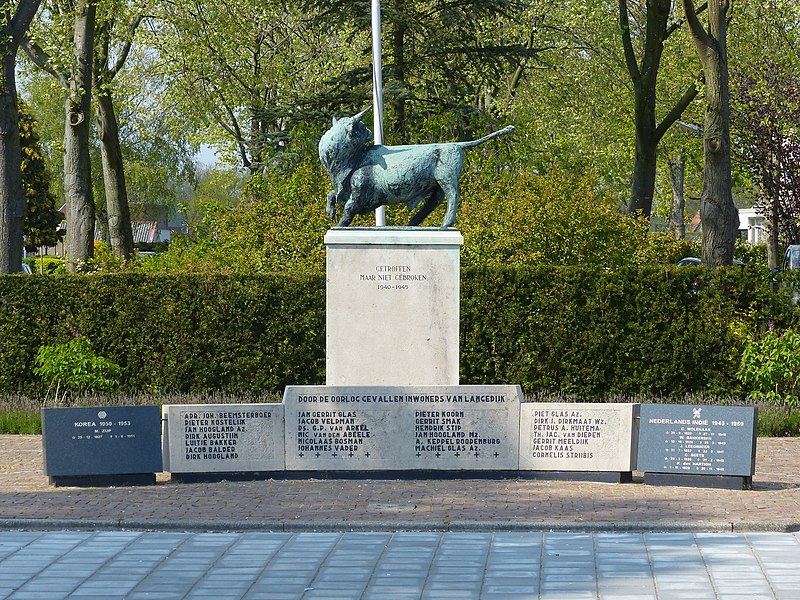
This is an image of a war memorial in the Netherlands, number:
Casper Meijn
Key facts
Key facts
• Name — Teun Roosenburg • Birth Name — Jacob Martijn Roosenburg • Born — 9 July 1916 • Birthplace — The Hague, Netherlands • Died — 15 July 2004 • Place of death — Eijsden, Limburg, Netherlands • Education — Royal Academy of Art, The Hague • Spouse — Jopie Roosenburg-Goudriaan • Father — Dirk Roosenburg
Early life
Early life
Roosenburg was born in the Hague on 9 July 1916. The son of the architect Dirk Roosenburg, he initially studied architecture and furniture-making. One day, a teacher discovered a caricature he had drawn. Initially fearing that he would be punished, Roosenburg was instead brought to a drawing club. In 1936, he enrolled at the Royal Academy of Art in the Hague, where he apprenticed under Albert Termote. By 1939 he was living in the Jordaan neighbourhood of Amsterdam, often working with glass or terracotta to create figurative works; these included several ornaments for his father's buildings. He later attended the Académie Ranson in Paris, studying under Charles Malfray and Aristide Maillol. Following the Nazi occupation of the Netherlands in 1940, Roosenburg sought a means of practising his art without registering with the newly established Nederlandsche Kultuurkamer (Chamber of Dutch Culture). With his peers Hanni Rädecker and Piet Damsté, he thus travelled in 1942 to Eijsden in South Limburg. After two weeks wandering the countryside seeking lodgings, he was able to rent Oost Castle for fifty guilders per month. An art colony developed at the castle, under the leadership of Roosenburg and his girlfriend Jopie Goudriaan, whom he married in 1943. Seeking to protect the community, which was transporting money for the Resistance and using the castle's proximity to Belgium to facilitate the emigration of Jewish refugees, Roosenburg urged residents of the castle to dress as crazily as possible. As narrated by Nicolaas Wijnberg, a resident during the period, members of the colony "put on strange hats and caps, painted our shoes, and when we went outside we deliberately stared a lot and dreamily at the landscape and the cloudy sky". Food for the community, as well as those it assisted, was obtained in exchange for art. After the liberation of Eijsden, the colony hosted some two hundred American soldiers, who put on a pancake breakfast.
Later career
Later career
The Roosenburgs bought Oost Castle in 1957. and Teun sought to protect the landscapes that his wife often painted. He opposed, for instance, the construction of a refinery in Ternaaien. Over the ensuing decades, he and Jopie often hosted parties for their fellow artists, writers, and musicians, with guests including the painter Hermanus Berserik, the journalist Anton Koolhaas (Teun's brother-in-law), and the writer Cola Debrot. At the same time, he continued to work. In March 1957, Roosenburg contributed several sculptures to an exhibition of Limburger artists in Heerlen. A reviewer for De Maasbode noted that Roosenburg excelled in garden sculpture, highlighting his standing and reclining nudes; also mentioned were the "humorous" Spaanse Ruiters ("Spanish Riders") and the metaphoric war memorial De Stier ("The Bull"). That year, Roosenburg also completed a relief for the new H. J. Lovink Pumping Station. Titled Land en Water ("Land and Water"), it depicts a landward farmer and seaward fisherman shaking hands over a dyke. In its description of the rijksmonument, the Ministry of Education, Culture and Science describes this tableau as highlighting the station's significance in creating new agricultural land from the seabed. After the Doctor J.H. Hansen Hospital began construction in Emmeloord in 1962, Roosenburg was commissioned to create a sculpture for its main entrance. He thus completed Thuiskomst ("Homecoming"), which depicts a male patient, supported by a doctor, being discharged to his wife and dog. Roosenburg held several joint exhibitions with Jopie. One, at the Heerlen City Hall in April 1960, included more than sixty sculptures and paintings by the couple, as well as some ceramics. By 1982, he had held expositions in Paris, Aachen, Amsterdam, Maastricht, and Heerlen. In his sculpture, Roosenburg employed a figurative approach that Jos Bloemkolk of Het Parool described as "old-fashioned in the best sense of the word: classic". He was critical of more abstract approaches to art, disliking the works of Alberto Giacometti. He sought to maintain balance, arguing that "realism without interpretation is death in art, but without figurativism there is little but empty aesthetic." Roosenburg was made a knight in the Order of Orange-Nassau in 1994; by this time, he had served as the chairman of the Limburg Association of Visual Artists. He died in Eijsden on 15 July 2004 and was buried at Tongerseweg Cemetery in Maastricht. He was predeceased by Jopie, who died in 1996. They had three children: Joost, Albert, and Olivier. The latter two became artists.
Gallery
Gallery
• Illustration — Land en Water ("Land and Water", Biddinghuizen, 1957) • Illustration — De Stier ("The Bull", Noord-Scharwoude, 1957) • Illustration — Flora (Aalsmeer, 1962) • Illustration — Bever ("Beaver", Groningen, 1964) • Illustration — Meisje in Mini ("Girl in a Mini", Smallingerland, 1971)
Identity
Identity
Teun Roosenburg is recorded as sculptor and ceramicist. Identity and origins. The authorities additionally record the heading Jacob Martijn Roosenburg.
Life and career
Dated record
Life and career
The full dated record · 2 entries
1916
Teun Roosenburg born at The Hague.
2004
Teun Roosenburg died at Eijsden.
Places
Named by the record
Places
Only places the record itself states, plotted where the house gazetteer settles their coordinates. Nothing is inferred from a name or a nationality.
The Hague.
Birth place
Eijsden.
Death place
Primary material
Documents and archives
authority record
- Wikidata, structured authority record Q2803358: Teun Roosenburg
General reference · Wikidata
reference work
- “Teun Roosenburg”, English Wikipedia, consulted as further reading
Reputable secondary · Wikipedia
Citations
References
Each reference names the institution holding it, so a reader may go to the document itself.
authority record
Secondary witnessreference work
Secondary witness
The Encyclopedia exists whether or not anything is for sale. Corrections are recorded rather than overwritten, and every version of this record is kept. Published 16 August 2026.
Elsewhere in Ceramics
1,104 published records in this field, each with its sources named.
- Tatsuzō ShimaokaArtist
- Taxile DoatArtist
- Tecla TofanoArtist
- Teddy SandovalArtist
- Th.A.C. ColenbranderArtist
- Theaster GatesArtist
- Theo DobbelmanArtist
- Theo MolkenboerArtist
Best supported in this field
For owners
Own a work by Teun Roosenburg?
A specialist will read what you send and tell you what the house can establish, what it cannot, and whether the object is suited to sale. There is no charge and no obligation. The object stays with you throughout; nothing is shipped to us unless it is arranged in writing beforehand.