
Tani Bunchō
Tani Bunchō (谷 文晁; October 15, 1763 – January 6, 1841) was a Japanese literati (bunjin) painter and poet.
Also recorded as Bunchō · Tankai · Masayasu Tani · Tani Masayasu
Tani Bunchō
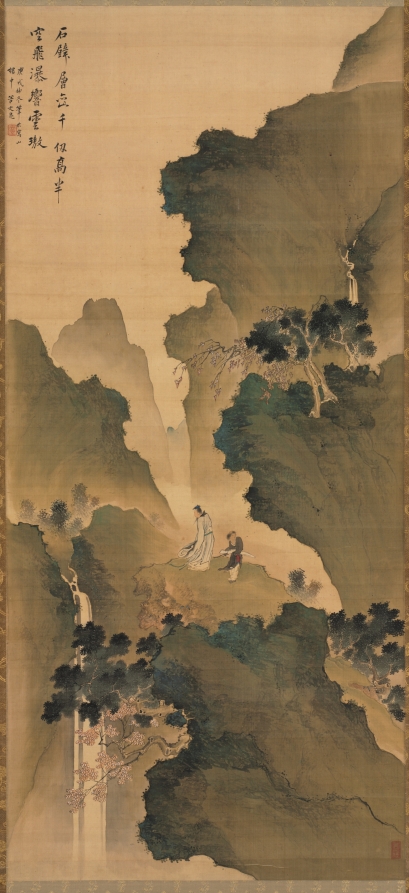
Tani Bunchō · The Cleveland Museum of Art · John L. Severance Fund · CC0
- Born
- 1763. · Negishi.
- Died
- 1841. · Shitaya.
- Nationality
- Japan.
- Occupation
- painter and writer.
- Teachers
- Katō Bunrei, Watanabe Gentai, Kitayama Kangan and Kushiro Unzen.
- Languages
- Japanese.
VALÉORINE Encyclopedia
VALÉORINE documentary reading
Documentary summary
Tani Bunchō (谷 文晁; October 15, 1763 – January 6, 1841) was a Japanese literati (bunjin) painter and poet.
Admitted source layer · organised and presented by VALÉORINE
Reference Check
Propose documentary evidence for Tani Bunchō. A contribution is never written directly as fact: identity, source, rights and evidence gates still decide.
Sign in to contribute
Documentary evidence
Documentary basis
Authority files
getty · 500121188 · gnd · 128523964 · wikidata · Q1375891 · wikipedia · Tani Bunchō
In this article
Biography
Biography
Training under Katō Bunrei, Watanabe Gentai and Kitayama Kangan is recorded. Egawa Hidetatsu, Tanomura Chikuden and Mochizuki Gyokusen are recorded as having studied under Tani Bunchō. The recorded working language is Japanese. Places of work recorded in the authority are Tokyo. Employment is recorded with Tayasu House and Shirakawa Domain. Work by Tani Bunchō is recorded in the collections of Minneapolis Institute of Art, The Nelson-Atkins Museum of Art, Ashmolean Museum, National Museum of World Cultures and Metropolitan Museum of Art.
He was the son of the poet Tani Rokkoku (1729–1809). As his family were retainers of the Tayasu Family of descendants of the eighth Tokugawa shōgun, Bunchō inherited samurai status and received a stipend to meet the responsibilities this entailed. In his youth he began studying the painting techniques of the Kanō school under Katō Bunrei (1706–82). After Bunrei's death, Bunchō worked with masters of other schools, such as the literati painter Kitayama Kangen (1767–1801), and developed a wide stylistic range that included many Chinese, Japanese and European idioms. He rose to particular prominence as the retainer of Matsudaira Sadanobu (1759–1829), genetic son of the Tayasu who was adopted into the Matsudaira family before becoming chief senior councilor (rōjū shuza; 老中首座) of the Tokugawa Shogunate in 1787. Bunchō is best known for his idealized landscapes in the literati style (Nanga or Bunjinga).
Style
Style
Unlike most bunjinga painters of his time, however, Bunchō was an extremely eclectic artist, painting idealized Chinese landscapes, actual Japanese sites, and poetically inspired traditional scenery. He also painted portraits of his contemporaries (such as Ono Ranzan and Kimura Kenkadō), as well as imagined images of such Chinese literati heroes as Su Shi and Tao Yuanming. Since travel outside Japan was forbidden under the Tokugawa shogunate, Bunchō was unable to study in China; he spent many years traveling around Japan, studying Chinese, Japanese, and Western art (洋画, Yōga). Watanabe Kazan, Sakai Hōitsu and Takaku Aigai were among his disciples. One of his pupils was the renowned painter Okuhara Seiko.

Hydrangea, Design Seventeen from Shazanrō Picture Book, 1816, by Tani Bunchō
Tani Bunchō · The Cleveland Museum of Art · The Kelvin Smith Collection, given by Mrs. Kelvin Smith

Grapevine, Design Ten from Shazanrō Picture Book, 1816, by Tani Bunchō
Tani Bunchō · The Cleveland Museum of Art · The Kelvin Smith Collection, given by Mrs. Kelvin Smith
Life and career
Dated record
Life and career
The full dated record · 2 entries
1763
Tani Bunchō born at Negishi.
1841
Tani Bunchō died at Shitaya.
Places
Named by the record
Places
Only places the record itself states, plotted where the house gazetteer settles their coordinates. Nothing is inferred from a name or a nationality.
Negishi.
Birth place
Shitaya.
Death place
Primary material
Documents and archives
authority file
- Gemeinsame Normdatei 128523964, Tani, Bunchō.
General reference · Deutsche Nationalbibliothek
- Getty Union List of Artist Names 500121188, Tani Bunchō.
General reference · The Getty Research Institute
- VIAF cluster 96575357 for Tani Bunchō, aggregating national library name authorities.
General reference · OCLC
reference work
- Wikidata, structured authority record Q1375891: Tani Bunchō
Reputable secondary · Wikimedia Foundation
- “Tani Bunchō”, English Wikipedia, consulted as further reading
Reputable secondary · Wikipedia
scholarly publication
Notes from the source article
Cited by Wikipedia
Notes from the source article
These works are cited by the source article, in its own numbering. They are recorded as its citations, not as sources VALÉORINE has verified.
- 1.Frank L. Chance, "Tani Bunchō and the Edo School of Japanese Painting", Ph.D. Dissertation, University of Washington, 1986.
- 2.Jordan, Brenda G. Copying the Master and Stealing His Secrets: Talent and Training in Japanese Painting. University of Hawaii Press. 4, 7, 116–118. 2003. 0824826086.
References
Citations
References
Each reference names the institution holding it, so a reader may go to the document itself.
scholarly publication
Institutional witnessauthority file
Gemeinsame Normdatei 128523964, Tani, Bunchō.Deutsche Nationalbibliothek
Secondary witnessauthority file
Getty Union List of Artist Names 500121188, Tani Bunchō.The Getty Research Institute
Secondary witnessauthority file
Secondary witnessreference work
Wikidata, structured authority record Q1375891: Tani BunchōWikimedia Foundation
Secondary witnessreference work
Secondary witness
The Encyclopedia exists whether or not anything is for sale. Corrections are recorded rather than overwritten, and every version of this record is kept. Published 14 August 2026.
Elsewhere in Paintings
19,183 published records in this field, each with its sources named.
- Tang ChangArtist
- Tang DiArtist
- Tang MuliArtist
- Tang YifenArtist
- TaniaArtist
- Tania BrugueraArtist
- Tania WillardArtist
- Tanja OstojićArtist
Best supported in this field
For owners
Own a work by Tani Bunchō?
A specialist will read what you send and tell you what the house can establish, what it cannot, and whether the object is suited to sale. There is no charge and no obligation. The object stays with you throughout; nothing is shipped to us unless it is arranged in writing beforehand.