
Super Game Boy
The Super Game Boy is a peripheral that allows Game Boy cartridges to be played on a Super Nintendo Entertainment System console. Released on June 14, 1994 in Japan, on July 22, 1994 in North America, and on September 24, 1994 in Europe, it retailed for in the United States and in the United Kingdom. In South Korea, it is called the Super Mini Comboy and was distributed by Hyundai Electronics.
Super Game Boy

TheUncleBob at English Wikipedia · Public domain
- Name
- Super Game Boy
- Field
- video game accessory · video game console
VALÉORINE Encyclopedia
VALÉORINE documentary reading
Documentary summary
The Super Game Boy is a peripheral that allows Game Boy cartridges to be played on a Super Nintendo Entertainment System console. Released on June 14, 1994 in Japan, on July 22, 1994 in North America, and on September 24, 1994 in Europe, it retailed for in the United States and in the United Kingdom. In South Korea, it is called the Super Mini Comboy and was distributed by Hyundai Electronics.
Admitted source layer · organised and presented by VALÉORINE
Note VALÉORINE
No house-authored Note is published until its assertions and sources pass the VALÉORINE evidence contract. The documentary article remains available in full while that enrichment is being consolidated.
Documentary enrichment in progress · no unsupported statement published
Reference Check
Propose documentary evidence for Super Game Boy. A contribution is never written directly as fact: identity, source, rights and evidence gates still decide.
Sign in to contribute
World of VALÉORINE
Documentary connections
Only confirmed graph relationships appear here. Images are shown only when their identity and reuse rights both pass the documentary gate.

Documentary evidence
Evidence Panel
not yet certified
- Identity
- resolved
- Independent source families
- 0
- Admitted assertions
- 0
- Open conflicts
- 0
Authority files
wikidata · Q1190117 · wikipedia · Super Game Boy
In this article
Overview
Overview
A revised model, the Super Game Boy 2, was released in Japan in January 1998.

Expanded Game Boy Family with major accessories from Left to Right, Top to
TheUncleBob at English Wikipedia
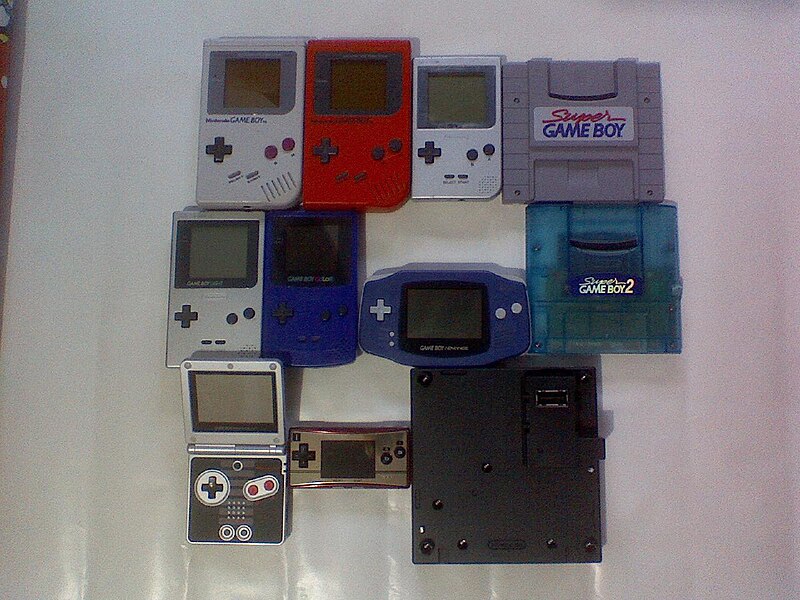
Expanded Game Boy Family from Left to Right, Top to
TheUncleBob at English Wikipedia
Key facts
Key facts
• Name — Super Game Boy • Developer — Nintendo • Manufacturer — * Hori • Nintendo • Type — Adapter cartridge • Generation — Fourth • Release Date — Super Game Boy Super Game Boy 2 January 30, 1998 • Discontinued — Super Game Boy • Media — Game Boy Game Pak • Successor — Game Boy Player • Related — Game Boy, Super NES • Platform — Super NES
Functionality
Functionality
• Illustration — The Super Game Boy cartridge, Super Famicom version The Super Game Boy is compatible with the same cartridges as the original Game Boy: original Game Boy cartridges, the Game Boy Camera, and dual-mode Game Boy Color cartridges (in Game Boy-mode). The unit could map the four shades of green to various colors on the screen. Later Game Boy games that were optimized to use the Super Game Boy had additional color information and could override the on-screen colors, display a graphical border around the screen, and display special background sprites, as seen in the Mario's Picross title screen. Those games would have printed a small "Super Game Boy Game Pak" logo on the box and cartridge. The adaptor could support up to 64 colors for the border, and 12 colors for the screen. Static screens could display all 10 colors. Certain games can load multiple borders depending on the player's location in the game, such as Dragon Warrior I & II. It is also possible for Super Game Boy games to make use of the Super NES hardware for extra effects, as demonstrated in Contra: The Alien Wars, Donkey Kong, Kirby's Dream Land 2, A Bug's Life, FIFA 98: Road to World Cup, Madden '97, Animaniacs and Toy Story; these games had expanded sound when used with the Super Game Boy. Wario Blast, the Game Boy version of Primal Rage, the Game Boy version of Killer Instinct and several other titles even allowed the second Super NES controller to be used for two-player action. The title screen changed to show that these games had a two-player option, rather than a connection status. Using the Super Multitap, some games even supported four players. The original Super Game Boy does not support game link multiplayer because, according to a Nintendo spokesman, a two-player configuration would interfere with the RF signal from the television. The Game Boy version of Space Invaders allowed players to access Space Invaders DX (a Super NES version of the game) as well as a colored version of the Game Boy game. Space Invaders DX is copied into and run from the console's internal 256KB work RAM. Some black Game Boy Color cartridge games also have Super Game Boy enhancements, although there is not any logo indicating this on the cartridge or on the front of the box as there are for original Game Boy releases. Several Game Boy Color titles do have a small Super Game Boy compatibility icon located on the back of their packaging, such as for 2001's Dragon Warrior Monsters 2: Cobi's Journey & Tara's Adventure. The final commercially released black cartridge Game Boy Color game, the Japan-exclusive From TV Animation One Piece: Maboroshi no Grand Line Boukenki! from June 2002, has a custom Super Game Boy border.
Hardware
Hardware
Because the Super NES cannot emulate the Game Boy hardware, the Super Game Boy actually consists of the same hardware as the original handheld; inside the cartridge is a separate CPU that processes the games while the Super NES only provided means for user-input, output of graphics to the screen, and the additional coloring. The original Super Game Boy is known to play the game program and its audio 2.4% (NTSC) or 1.5% (PAL) faster than other Game Boy hardware. This is due to the use of the Super NES's clock speed divided by 5, which ends up being 4.295 MHz (NTSC) or 4.256 MHz (PAL) instead of 4.194 MHz.
Super Game Boy 2
Super Game Boy 2
• Illustration — The Super Game Boy 2 The Super Game Boy 2 was released only in Japan in January 1998. Additions included a link port to allow a user to access two-player mode via the link cable, the green game link LED, and the red power LED indicator, and it runs at the exact speed of the Game Boy (the original model runs slightly faster than a Game Boy, see above). In addition, it came with eight new default borders, which replaced those in the original model (though the old borders are still accessible via a code); however, it retained the same built-in palettes and coloring tools as on the original model. Also, this version of the SGB does not allow one to change borders in some games that have built-in borders. Some games have features only available through the Super Game Boy 2, such as a special Tetris DX border.
System menu
Predecessors and successors
Predecessors and successors
The Super Game Boy is the successor to Intelligent Systems' Wide Boy (which connected to the Famicom or NES). One difference between the Wide Boy and the Super Game Boy is that the former did not use any part of the Famicom/NES other than the video memory. Even the controller (a single Famicom controller) is hardwired directly into the Wide Boy. The Wide Boy would continue running even if the reset button is held down on the Famicom/NES. The Game Boy had twice as many tiles as could fit in the Famicom/NES's video memory, so the Wide Boy had to refresh the Famicom/NES's video memory halfway down the screen. Camerica had a Game Boy to NES adaptor developed by Biederman Design Labs, which appeared similar to the Super Game Boy. The Super Game Boy was followed by the Transfer Pak for the Nintendo 64, which allowed one to play the six (seven in Japan) Game Boy and Game Boy Color Pokémon titles in Pokémon Stadium and Pokémon Stadium 2 in a Super Game Boy-like fashion, complete with the Super Game Boy enhanced borders and palettes. The games were played via the use of a software emulator on the Nintendo 64. However, the main role of the Transfer Pak was to transfer data from Game Boy Color to Nintendo 64 games, not to play games. The Wide-Boy64 was released for the N64 in two major versions, the CGB version which allowed Game Boy and Game Boy Color titles to be played on a television, and the AGB version which also allowed Game Boy Advance games to be played. It cost $1400, and like the original Wide Boy, it was only available to developers and the gaming press. These devices were used to take screenshots of Nintendo handheld video games to be in retail media. Datel developed a Game Boy player for the Nintendo 64 called the GameBooster, which was licensed and sold in the US by EMS Production Ltd. under the name GB Hunter. It was released for the Nintendo 64 halfway through the console's lifespan. It was not officially licensed by Nintendo; to circumvent the system's lockout technology, the device included a slot at the back for an N64 game with a 6102 CIC. Like the Super Game Boy, it connects to the N64's cartridge slot, and allows the console to play Game Boy games. However, it could not play back the game's sound; instead, the GB Hunter's built-in theme song is looped endlessly during use. There is also a cheating device programmed into it, called the "Golden Finger" (like the Game Shark), along with a trainer option to determine the RAM values that decrement, increment, change, or stay the same. This can provide certain cheat codes to try out in the game. Holding the 'L' and 'R' buttons simultaneously will cause the game to freeze at that point and the GB Hunter Menu to appear. The game screen can be maximized or minimized from this menu, allowing the player to play the game in fullscreen. The color palette can also be changed from the menu, to view the game in a custom variation of the 3 different palettes available to the Game Boy PPU, using RGB values. These palettes correspond to the background and two sprite palettes. There are also 4 preset borders to place around the game, with the added support of SGB borders. Datel also made a version of the GameBooster for Sony's PlayStation console, which uses the Parallel I/O port on the back of the console, not found on the Series 9000 models of the system or the slimline PSone system. This version has a graphically better theme, lacks the song that is played in the N64 version, has battery save support, and has a built-in game titled Rebound Mission, although the palette customizer only has one palette as opposed to three. However, it has a built-in music CD player which can be used to mimick the original Game Boy game audio. The GameBooster was also rebranded as the PowerFlash, though many differences are unknown other than the name change. On the GameCube, the Game Boy Player was released in 2003, which could play Game Boy, Game Boy Color, and Game Boy Advance games. It allowed these games to be played on a full television screen. The GBP attaches to the bottom of the console and a boot disc must be running in the GameCube disc drive in order to boot it, although the disc can be removed afterwards. The Game Boy Player functions just like a Game Boy Advance, letterboxing the games' display on a standard television set. Some GBA games were programmed with consideration for the Player, including activating the vibration feature in GameCube controllers and special color palettes which accounted for a TV's brightness and resolution. However, the Game Boy Player will not activate Super Game Boy options on a Super Game Boy enhanced cartridge. Also, when playing a Game Boy or Game Boy Color game on the Game Boy Player, a black border will appear between the main border and the gameplay area; this is a carry-over from the Game Boy Advance.
Peripherals
Peripherals
• Illustration — Hori's SGB Commander controller In Japan, Hori released a special Super Game Boy controller called the SGB Commander. The controller, aside from the 4 Game Boy buttons (A, B, Start and Select), also has 4 Super Game Boy specific buttons which can enable the user to mute the sound, reduce the speed of the game, change the colors and modify the display window. An additional switch is provided to alternate between Super Game Boy mode and regular Super Famicom Mode.
Guide
Guide
In 1994, shortly after the Super Game Boy release, Nintendo sent the Nintendo Power magazine subscribers the "Super Game Boy Player's Guide", a 72-page instruction book / guide to using the features of the Super Game Boy. The first 15 pages were instructional, followed by 55 pages of very brief overview style walkthrough of several games. These walkthroughs highlighted various points of the games and often pointed out color schemes to set that area's intended mood. Games included Super Mario Land, Super Mario Land 2: 6 Golden Coins, Wario Land: Super Mario Land 3, the newly released Donkey Kong (which had a special "Super Game Boy" border and color palette), Metroid II: Return of Samus, The Legend of Zelda: Link's Awakening, Kirby's Dream Land, Kirby's Pinball Land, Tennis, Nintendo World Cup, Alleyway, Dr. Mario, and Yoshi.
Chronology
Dated record
Chronology
The full dated record · 1 entries
1994
The Super Game Boy Player's Guide (1994) is digitised and catalogued by Open Library.
Primary material
Documents and archives
institutional register
- Internet Archive holdings naming Super Game Boy
Unverified · Internet Archive
- Wikidata, structured authority record Q1190117: Super Game Boy
Unverified · Wikimedia Foundation
reference work
- “Super Game Boy”, English Wikipedia, consulted as further reading
Reputable secondary · Wikipedia
References
Citations
References
Each reference names the institution holding it, so a reader may go to the document itself.
institutional register
Internet Archive holdings naming Super Game BoyInternet Archive
Partially resolvedinstitutional register
Wikidata, structured authority record Q1190117: Super Game BoyWikimedia Foundation
Partially resolvedreference work
Partially resolved
Further particulars
Held on the record
Further particulars
Open the remaining particulars
Super Game Boy is connected to 1 other published record in the VALÉORINE Encyclopedia.
Within the Encyclopedia
The Encyclopedia exists whether or not anything is for sale. Corrections are recorded rather than overwritten, and every version of this record is kept. Published 14 August 2026.
Elsewhere in Collectables
20,755 published records in this field, each with its sources named.
- Super Formation Soccer 94Work
- Super Formation Soccer IIWork
- Super Foul EggWork
- Super Fruit FallWork
- Super Gem Fighter Mini MixWork
- Super Genjin 2Work
- Super Ghouls 'n GhostsWork
- Super Glove BallWork
Best supported in this field
For owners
Own an object connected with Super Game Boy?
A specialist will read what you send and tell you what the house can establish, what it cannot, and whether the object is suited to sale. There is no charge and no obligation. The object stays with you throughout; nothing is shipped to us unless it is arranged in writing beforehand.