
sundial cannon
Illustration — A small brass cannon mounted on a marble sundial base, manufactured by Rousseau of Paris A sundial cannon, sundial gun, noon cannon or meridian cannon, also noonday gun is a device consisting of a sundial incorporating a cannon with a fuse that is lit by an overhanging lens, concentrating the rays of the sun, and causing the cannon to fire at noon, when properly oriented along a north–south axis. The cannon sizes ranged from large to small depending on the location of their use. The household variety was used in estates to signal the time for the midday meal.
Also recorded as sundial gun · noon cannon · meridian cannon
sundial cannon
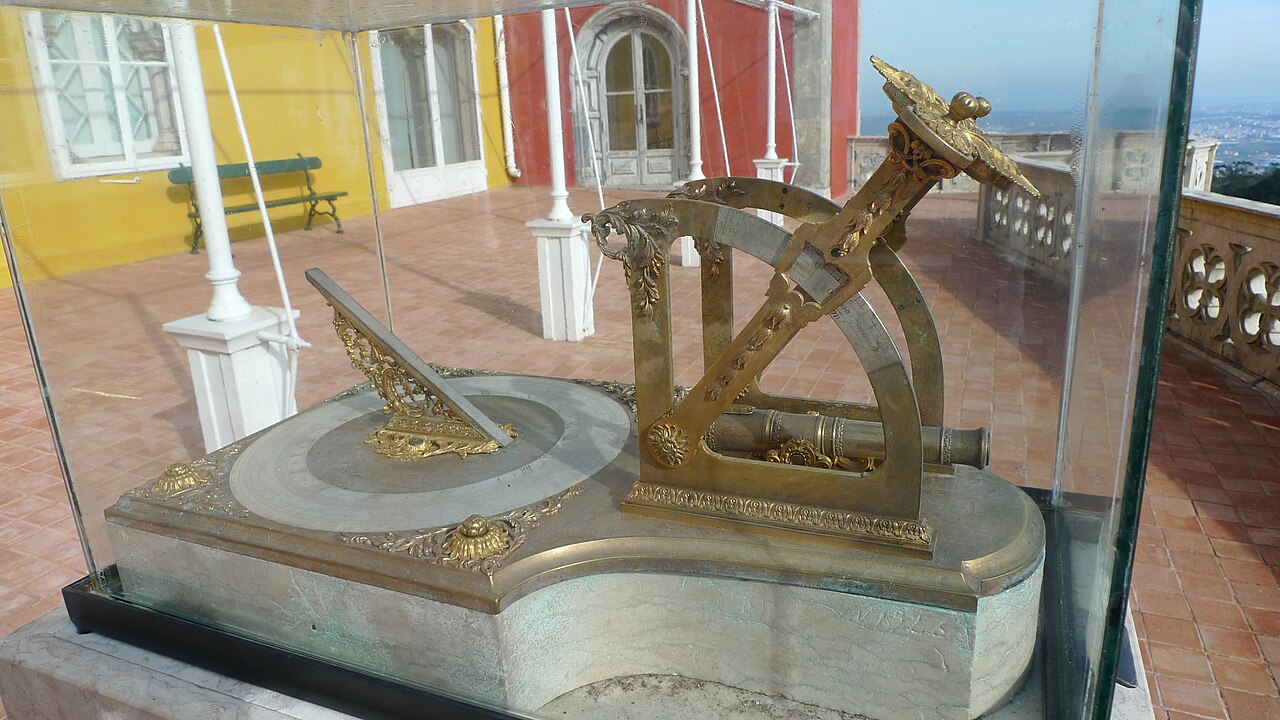
tak.wing · L1190259 · CC BY-SA 2.0
- Field
- sundial · cannon
VALÉORINE Encyclopedia
VALÉORINE documentary reading
Documentary summary
Illustration — A small brass cannon mounted on a marble sundial base, manufactured by Rousseau of Paris A sundial cannon, sundial gun, noon cannon or meridian cannon, also noonday gun is a device consisting of a sundial incorporating a cannon with a fuse that is lit by an overhanging lens, concentrating the rays of the sun, and causing the cannon to fire at noon, when properly oriented along a north–south axis. The cannon sizes ranged from large to small depending on the location of their use. The household variety was used in estates to signal the time for the midday meal.
Admitted source layer · organised and presented by VALÉORINE
Note VALÉORINE
No house-authored Note is published until its assertions and sources pass the VALÉORINE evidence contract. The documentary article remains available in full while that enrichment is being consolidated.
Documentary enrichment in progress · no unsupported statement published
Reference Check
Propose documentary evidence for sundial cannon. A contribution is never written directly as fact: identity, source, rights and evidence gates still decide.
Sign in to contribute
World of VALÉORINE
Documentary connections
Only confirmed graph relationships appear here. Images are shown only when their identity and reuse rights both pass the documentary gate.

Documentary evidence
Evidence Panel
original value insufficient · checked 25 September 2026
- Identity
- resolved
- Independent source families
- 0
- Admitted assertions
- 0
- Open conflicts
- 0
Authority files
wikidata · Q28146106 · wikipedia · Sundial cannon
In this article
History
History
Larger sizes were used in European parks to signal noon. The cannons were used by European royalty in the 18th century. Cannons of this type are exhibited at the National Maritime Museum in Greenwich. The Hamilton Watch Company has a sundial cannon manufactured by Rousseau of Paris ca. The Rousseau cannon is mounted on a marble sundial and is made of brass. The Sultan of Morocco also owns one that was manufactured by Baker & Sons of London. Currently the only sun cannon in regular operation was installed in 1853 in a tower in the park of Adelsnäs Manor in Åtvidaberg, Sweden. Its 6-pounder gun fires daily from May through August (manually lit on cloudy days).
The earliest sundial cannons were used in Europe in the 1600s. They were also used in European parks during the 18th and early 19th centuries. The cannon-lens combination was mounted on a sundial. Sundial guns were also used to mark noon. Miniaturized toy versions of the guns were sold in 1979 as unassembled kits by Dixie Gun Works.
Operation
Operation
• Illustration — A sundial cannon manufactured by Victor Chevalier of Paris ca. 1800. The linear ignition groove is in the same direction as the north–south axis of the sundial The gun and the linear ignition groove of the fuse were aligned on a north–south axis, parallel to that of the sundial, while the lens concentrated the sun rays on the fuse when the sun was directly above. Subsequently, the burning fuse ignited the powder placed in the barrel of the cannon. The lens was mounted on an adjustable frame, which enabled its position to be changed depending on the season. During winter, in December for example, for the small brass cannon manufactured by Rousseau of Paris, the lens had to be lowered by four inches, compared to its position in June as the position of the sun in the sky is lower in winter than during the summer. In naval operations, the gun had to be mounted on a rotating base because its orientation had to be in the north–south direction. The directional axis of the gun was determined using the ship's compass. In such operation, the gun was frequently referred to as the "noonday gun" because it fired at noon. This practice became obsolete when the ship chronometer was invented. The use of the sundial cannon was subsequently confined to substandard ships.
Benjamin Franklin
Benjamin Franklin
Benjamin Franklin wrote the following review about the cannons in Poor Richard's Almanack:
Popular Mechanics
Popular Mechanics
• Illustration — A farmer shown adjusting the lens position for a sundial cannon. From an article titled "Women 'Insurgents' in the Farming Business" in the July 1911 issue of Popular Mechanics. The original caption is: "Adjusting the Sundial which Sets Off the Cannon Automatically at Noon" In a section of the July 1911 issue of Popular Mechanics titled "Women 'Insurgents' in the Farming Business" the writer comments regarding the picture to the right:
Primary material
Documents and archives
authority record
- Wikidata, structured authority record Q28146106: sundial cannon
Unverified · Wikidata
reference work
- “Sundial cannon”, English Wikipedia, consulted as further reading
Reputable secondary · Wikipedia
In literature
A sundial gun is mentioned in Ellery Queen's Mystery Magazine.
Notes from the source article
Cited by Wikipedia
Notes from the source article
These works are cited by the source article, in its own numbering. They are recorded as its citations, not as sources VALÉORINE has verified.
- 1.Sirene, Walt H. Goldsmith Chandlee, Sundial Maker – Setting Time 1790: Solar Time; Sun; North Star; Noon Mark; Sundial. Walt H. Sirene. 131–. 12 December 2016.
- 2.Wills, Chuck. The Illustrated History of Guns: From First Firearms to Semiautomatic Weapons. Skyhorse Publishing Company, Incorporated. 41–42. 25 November 2014. 978-1-63220-003-7.
- 3.Courier Corporation. Sundials: Their Construction and Use. 227. 14 June 2012. 978-0-486-15707-8.
- 4.Hearst Magazines. Popular Mechanics. 1. July 1911. 0032-4558.
- 5.MotorBoating. 11. May 1972. 1531-2623.
- 6.hrnick. Åtvidaberg Sun Cannon. Atlas Obscura. December 30, 2016.
- 7.The World's Only Functioning Sun Cannon. solkanonklubben.se.
- 8.Hearst Magazines. Popular Mechanics. 82–83. July 1979. 0032-4558.
- 9.Queen, Ellery. Ellery Queen's Mystery Magazine. Davis Publications, Incorporated. 14. 1950.
References
Citations
References
Each reference names the institution holding it, so a reader may go to the document itself.
authority record
Partially resolvedreference work
Partially resolved
The Encyclopedia exists whether or not anything is for sale. Corrections are recorded rather than overwritten, and every version of this record is kept. Published 14 August 2026.
Elsewhere in Scientific instruments
736 published records in this field, each with its sources named.
- Submillimeter ArrayTerminology
- Submillimetre Common-User Bolometer ArrayTerminology
- Suffa RT-70 radio telescopeTerminology
- sundialTerminology
- Sundial, TaganrogTerminology
- Sunyaev–Zel'dovich ArrayTerminology
- Super-LOTISTerminology
- supersonic wind tunnelTerminology
Best supported in this field
For owners
Own an object connected with sundial cannon?
A specialist will read what you send and tell you what the house can establish, what it cannot, and whether the object is suited to sale. There is no charge and no obligation. The object stays with you throughout; nothing is shipped to us unless it is arranged in writing beforehand.