
Sultan Muhammad
Sultan Mohammad was an Iranian painter at the Safavid court in Tabriz under Shah Ismail I and Shah Tahmasp I. He served as the director of Shah Ismail's artists’ workshop and as the first project director of the Shahnameh of Shah Tahmasp. He gave painting lessons to Tahmasp when he was the crown prince. Secure attribution of miniatures to Sultan Mohammed is limited: only two miniatures are directly signed by him, Celebration of Id and Allegory of drunkenness from the 1531 Cartier Hafiz, and one miniature is attributed to him by his contemporary Dust Muhammad: The Court of Gayumars.
Also recorded as Sultan Mohammed · Sultan-Muhammad
Sultan Muhammad
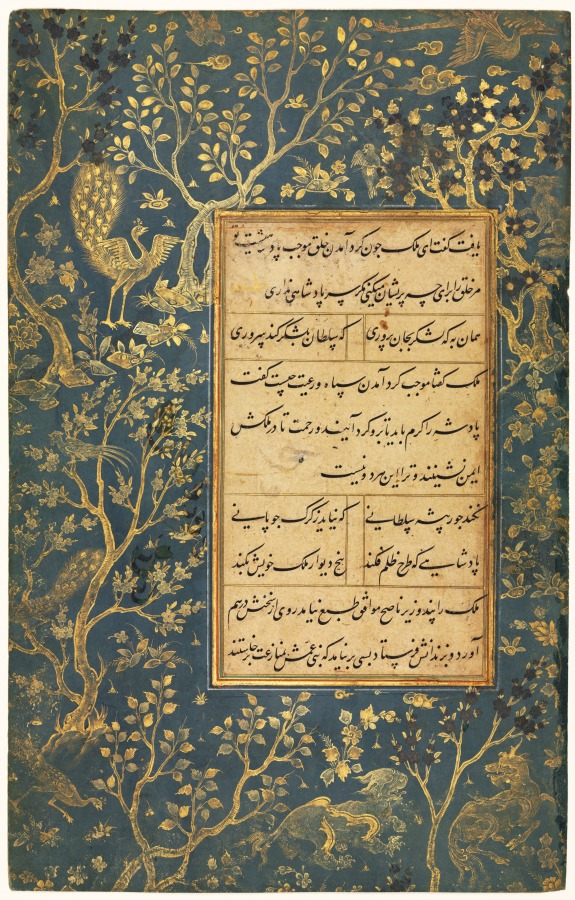
Sultan Muhammad · The Cleveland Museum of Art · Gift of William Kelly Simpson in memory of his wife Marilyn M. Simpson and her grandparents Mr. and Mrs. John D. Rockefeller Jr. · CC0
- Born
- 1470
- Died
- 1555
- Nationality
- Safavid Iran
- Occupation
- painter · illustrator
- Fields
- manuscript illumination
VALÉORINE Encyclopedia
VALÉORINE documentary reading
Documentary summary
Sultan Mohammad was an Iranian painter at the Safavid court in Tabriz under Shah Ismail I and Shah Tahmasp I. He served as the director of Shah Ismail's artists’ workshop and as the first project director of the Shahnameh of Shah Tahmasp. He gave painting lessons to Tahmasp when he was the crown prince. Secure attribution of miniatures to Sultan Mohammed is limited: only two miniatures are directly signed by him, Celebration of Id and Allegory of drunkenness from the 1531 Cartier Hafiz, and one miniature is attributed to him by his contemporary Dust Muhammad: The Court of Gayumars.
Admitted source layer · organised and presented by VALÉORINE
Reference Check
Propose documentary evidence for Sultan Muhammad. A contribution is never written directly as fact: identity, source, rights and evidence gates still decide.
Sign in to contribute
Documentary evidence
Documentary basis
Authority files
wikidata · Q6712884 · wikipedia · Sultan Mohammed
In this article
Khamsa of Nizami (1481)
Khamsa of Nizami (1481)
The other miniatures are attributed to him based on stylistic similarities and other circumstantial evidence. Sultan Mohammad was a native of Tabriz. He was the father of the artist Mirza Ali, who also contributed to the Shahnameh of Shah Tahmasp, and the grandfather of the painter and illuminator Mir Zayn al-'Abidin, who was active in the last quarter of the sixteenth century. He died before 1555.
Around 1505, while in Tabriz, Sultan Mohammed was asked by Ismail I (r. 1501-24) to complete a Turkoman manuscript, the Khamsa of Nizami (Tabriz, 1481), with eleven new miniatures. The miniatures created by Sultan Mohammed are on folios 12, 38v, 46, 89 v, 192, 196, 233, 244 and 285 of the manuscript. The criteria used to differentiate the Safavid miniatures from the Turkoman ones in this manuscript is for a great part iconographic, as the protagonists in Sultan Mohammed's paintings generally wear Shah Isma'il's signature turban, the Taj-i Haydari, which he introduced when he occupied Tabriz in 1501-1502. • Illustration — Bahram Gur in the White Pavilion, Khamsa of Nizami. Sultan Mohammed circa 1505, Tabriz (Topkapi H. 762). • Illustration — The Mir'aj of Prophet Muhammad, Khamsa of Nizami. Sultan Mohammed circa 1505, Tabriz (Keir Collection, III. 207)
Shahnameh of Shah Tahmasp (c.1520-1535)
Shahnameh of Shah Tahmasp (c.1520-1535)
Sultan Mohammad’s style was initially based in the Turkman courtly idiom. Sheila R. Canby writes that around 1515, he was perfecting scenes of “man and animal inhabiting a natural world of roaring winds, lush and frenzied vegetation and rocks resembling grotesque faces”, of which his painting “Rustam Sleeping while Rakhsh Fights a Lion” from an unfinished Shahnameh is an example. In the 1520s however, Sultan Mohammad was influenced by the more sedate and subtle late Timurid mode practiced at Herat; his compositions became more orderly and architectonic. Sultan Mohammad’s painting “The Court of Gayumars” is widely considered the “crowning achievement” of the Shahnameh of Shah Tahmasp. It has been estimated that the artist worked on the painting for three years. In 1544, Dust Muhammad described it as “such that the lion-hearted of the jungle of depiction and the leopards and crocodiles of the workshop of ornamentation quail at the fangs of his pen and bend their necks before the awesomeness of his pictures,” making it one of the few individual paintings to be referenced in any sixteenth century text. Other than the Shahnameh of Shah Tahmasp, Sultan Mohammad may have contributed to an illustrated manuscript of the Story of Jamal and Jalal of Muhammad Asafi that was copied by the scribe Sultan Ali Qayini in 1502–3 at Herat but then travelled west. • Illustration — "The Feast of Sada", Folio 22v from the Shahnameh of Shah Tahmasp; c. 1525; opaque watercolor, ink, silver, and gold on paper; painting is 24.1 cm (height) x 23 cm (width), entire page is 47 cm (height) x 31.8 cm (width); the Metropolitan Museum of Art. The painting is attributed to Sultan Mohammad. • Illustration — "Tahmuras Defeats the Divs", Folio 23v from the Shahnameh of Shah Tahmasp; c. 1525; opaque watercolor, ink, silver, and gold on paper; painting is 28.3 cm (height) x 18.6 cm (width), entire page is 47 cm (height) by 32.1 cm (width); the Metropolitan Museum of Art. The painting is attributed to Sultan Mohammad. • Illustration — "Zahhak is Told His Fate", Folio 29v from the Shahnameh of Shah Tahmasp; c. 1524; opaque watercolor, ink, silver, and gold on paper; painting is 18.7 cm (height) x 32.9 cm (width), entire page is 31.9 cm (height) x 47 cm (width); the Metropolitan Museum of Art. The painting is attributed to Sultan Mohammad.
Cartier Hafiz (1531)
Cartier Hafiz (1531)
Around 1531, while at the court in Tabriz, Sultan Mohammed contributed three miniatures to the Cartier Hafiz, a magnificent copy of the Diwan of Hafez. The three miniatures are Celebration of Id, one of the rare miniatures to bear his signature, the Allegory of drunkenness, and also probably The lovers picnicking, which is in the same style. In Celebration of Id, on the throne, at the feet of the ruler Shah Tahmasp at the center of the composition, Sultan Muhammad added his signature: "The work (amal) of Sultan Muhammad of 'Eraq". Various adjectives fit for a king surround the signature: victory (fatḥ), [divine] assistance (nuṣrat), good fortune (dawlat), triumph (pirūzī), and [long] life (`umr). • Illustration — Binding, front cover attributed to Sultan Muhammad • Illustration — Shah Tahmasp and his court at the Celebration of Id. Cartier Hafiz, circa 1531. Signed by Sultan Mohammad. • Illustration — Allegory of drunkenness. Hafez appears in the window over the jars, painted and signed by Sultan Mohammed circa 1531. • Illustration — The lovers picnicking, attributed to Sultan Mohammed
Other works
Other works
Sultan Mohammed was also among the few distinguished artists to contribute to an illustrated manuscript of the Khamseh of Nizami that was copied by the scribe Shah Mahmud of Nishapur at Tabriz and produced between 1539 and 1543. Furthermore, he decorated the borders of many other fine Safavid manuscripts. A presumed equestrian portrait of Shah Tahmasp, now in the Louvre Museum is also attributed to Sultan Mohammed.
Life and career
Dated record
Life and career
The full dated record · 2 entries
1470
Sultan Muhammad was born in 1470.
1555
Sultan Muhammad died at Tabriz.
Literature
Literature
Literature
THE MOVEMENT OF ISLAMIC EDUCATIONAL INSTITUTIONS IN THE ERA OF THE RULE OF SULTAN MUHAMMAD SHAFIUDDIN II BIN SULTAN ABU BAKAR TAJUDDIN II (1866 - 1924) SAMBAS, International Journal of Modern Education, 2024
Scholarly footprint
Literature
Scholarly footprint
A count of publications is evidence of attention, not of standing, and is given here only as a measure.
References
Citations
References
Each reference names the institution holding it, so a reader may go to the document itself.
reference work
Wikidata, structured authority record Q6712884: Sultan MuhammadWikimedia Foundation
Secondary witnessreference work
Secondary witness
Further particulars
Held on the record
Further particulars
Open the remaining particulars
Sultan Muhammad was born in 1470. Muhammad died in 1555. Recorded as painter and illustrator.
The Encyclopedia exists whether or not anything is for sale. Corrections are recorded rather than overwritten, and every version of this record is kept. Published 14 August 2026.
Elsewhere in Illustration
5,224 published records in this field, each with its sources named.
- Suehiro MaruoIllustrator
- Sukumar RayIllustrator
- Sukumo AdabanaIllustrator
- Sulamith WülfingIllustrator
- Sumana RoyIllustrator
- Sumomo YumekaIllustrator
- Sunaho TobeIllustrator
- Sunao HariIllustrator
Best supported in this field
For owners
Own a work by Sultan Muhammad?
A specialist will read what you send and tell you what the house can establish, what it cannot, and whether the object is suited to sale. There is no charge and no obligation. The object stays with you throughout; nothing is shipped to us unless it is arranged in writing beforehand.