
street furniture
Illustration — A postbox, litter bin and bench on a street in Warminster, England • Illustration — Street furniture can reflect local culture or famous aspects of where they are located, as here at Lyme Regis, where the ammonite-design streetlamps reflect the town's location on the Jurassic Coast, a World Heritage site. A collective term for objects and pieces of equipment installed along streets and roads for various purposes, such as benches, post boxes, streetlamps and traffic signs.
Also recorded as outdoor furniture
street furniture

Denis Apel · First upload to de.wikipedia.org: 16:45, 10. Aug 2005.. Stardado (Diskussion).. 1600 x 1200 (488634 Byte) · CC BY-SA 2.0 de
- Field
- furniture · fixed construction
VALÉORINE Encyclopedia
VALÉORINE documentary reading
Documentary summary
Illustration — A postbox, litter bin and bench on a street in Warminster, England • Illustration — Street furniture can reflect local culture or famous aspects of where they are located, as here at Lyme Regis, where the ammonite-design streetlamps reflect the town's location on the Jurassic Coast, a World Heritage site. A collective term for objects and pieces of equipment installed along streets and roads for various purposes, such as benches, post boxes, streetlamps and traffic signs.
Admitted source layer · organised and presented by VALÉORINE
Note VALÉORINE
No house-authored Note is published until its assertions and sources pass the VALÉORINE evidence contract. The documentary article remains available in full while that enrichment is being consolidated.
Documentary enrichment in progress · no unsupported statement published
Reference Check
Propose documentary evidence for street furniture. A contribution is never written directly as fact: identity, source, rights and evidence gates still decide.
Sign in to contribute
World of VALÉORINE
Documentary connections
Only confirmed graph relationships appear here. Images are shown only when their identity and reuse rights both pass the documentary gate.

Broader Term · incoming
beach furniture
Term
Own work

Broader Term · incoming
bench
Term
Wikimedia Commons

Broader Term · incoming
bicycle parking station
Term
https://web.archive.org/web/20161017215949/http://www.panoramio.com/photo/43463466

Broader Term · incoming
bicycle stand
Term
Own work

Broader Term · incoming
Camden bench
Term
Own work

Broader Term · incoming
coal hole
Term
Transferred from en.wikipedia to Commons by Kobac using CommonsHelper .

Broader Term · incoming
grit bin
Term
Own work

Broader Term · incoming
hostile architecture
Term
Own work

Broader Term · incoming
impact attenuator
Term
Own work

Broader Term · incoming
jungle gym
Term
Own work

Broader Term · incoming
mounting block
Term
Own work

Broader Term · incoming
portable toilet
Term
Own work

Broader Term · incoming
post box
Term
Transferred from en.wikipedia to Commons by Common Good using CommonsHelper .

Broader Term · incoming
Public menorah
Term
Own work

Broader Term · incoming
street clock
Term
Own work

Broader Term · incoming
streetlight
Term
Own work
Documentary evidence
Evidence Panel
not yet certified
- Identity
- resolved
- Independent source families
- 0
- Admitted assertions
- 0
- Open conflicts
- 0
Authority files
wikidata · Q13397636 · wikipedia · Street furniture
In this article
Items
Items
• Illustration — The signage systems of Metz, France, were created by Swiss designer Ruedi Baur. • Illustration — Various street furniture in Toronto including a bus shelter, advertising displays, wastebins, historical plaque and bicycle stand • Street name signs identify streets for the unfamiliar, especially benefiting visitors, postal workers and the emergency services. They may also indicate the district in which a street lies. • Benches are usually found in central parts of settlements, such as plazas and parks. They are often provided by the local councils or contributors to serve as a place to rest and admire views. Armrests in between are sometimes provided to discourage lying down and unwanted closeness, which can be seen or intended as hostile architecture. • Anti sit-lie dispositives, another type of hostile architecture intended to prevent people (i.e. rough sleepers) from sitting or lying down. • Bollards are posts, short poles, or pillars placed to prevent vehicle movement into areas where they are not desired, and to protect buildings and other site features. • Litter bins or garbage cans, are strategically placed to try to entice people into not littering on the streets. • Post boxes, also known as mail boxes, are found throughout the world, and have a variety of forms. • Phone boxes or telephone booths or phone booths are prominent in most cities. While they range drastically in the amount of cover they offer users (e.g. many only cover the phone itself while others provide full booths) they are typically easy to spot. The widespread use of mobile phones has resulted in a decrease in their numbers. • Streetlamps or street lights are designed to illuminate the surrounding area at night, serving not only as a deterrent to criminals but more importantly to allow people to see where they're going. The colour of streetlamp bulbs differ, but are generally white or yellow. • Traffic lights (or traffic signals) usually include three colours: green indicates vehicles should proceed through an intersection; amber indicates vehicles should prepare to stop; and red indicates vehicles should not enter the intersection. They are generally mounted on poles or gantries or hung from wires. • Traffic signs communicate road conditions to inform safe driver behaviours. Postings may specify aspects such as speed limits, intersection protocols, slippery road conditions or reduced visibility. Direction signs tell the reader the way to a location through diagrams or written instructions. Signs may be illuminated to aid nighttime users. • Public lavatories offer restroom facilities, either for free or for a fee. • Fire hydrants. • Parking meters. • Poster poles or advertising columns provide space for advertising. • Waste containers or litter bins are receptacles for public garbage disposal. Collection and separation of recyclable materials is becoming more common in urban centers. • Emergency telephone boxes allow members of the public to directly contact emergency service operators. • Street curbstones. • Paving stones, brick rosettes or granite cobbles, sometimes even wood. • Defunct village pump spouts and village lock-ups, both common in the United Kingdom • Outdoor vending machines, such as newspaper vending machines • Planter boxes and other apparatuses for plant life and landscaping
Outdoor advertising
Outdoor advertising
• Posters are a part of out-of-home media (also referred to as OOH). The presentation of backlit posters is done in display boxes or street furniture components like mega-displays or billboards. To install these street furniture components on public ground, city councils have to approve them. To get these permissions (Europe, Asia and part of the US) services and fees are offered to the cities by the outdoor advertisers. • In Europe there is a heavy competition to advertise in public spaces. This is due to the high potential for exposure and influence. • Public advertising amenities must fit the broader architecture and urban planning rules of their cities. These requirements lead to interesting design approaches for poster presentation in different formats. • Street furniture families were designed to fit these needs. Over the years they were completed with additional components like restrooms and automatic toilet facilities and kiosks to name a few. • To finance this infrastructure long-term contracts (10 to 15 years) are signed between cities and outdoor advertising companies. • Cities are often put in a situation to decide on new concepts when they are not familiar with the issues, since new contracts occur only very seldom. This knowledge gap is closed by a special advisor—the street furniture report. • This advisor gives cities some independent ideas on how to act in this surrounding (rather than reacting) since public grounds can not be enlarged.
Local significance
Local significance
• Illustration — K2 and K6 (left) Red telephone boxes on St John's Wood High Street, London, England Street furniture itself has become as much a part of many nations' identities as dialects and national events, so much so that one can usually recognise the location by their design; famous examples of this include: • The red telephone boxes and pillar boxes of Britain • The residential mail boxes of the United States • The street lights and metro entrances of Paris.
Historical street furniture
Historical street furniture
• Illustration — Sidewalk valve for long defunct gas lighting company, in Uptown New Orleans Since most items of street furniture are of a utilitarian nature, authorities generally keep them up-to-date and replace them regularly (usually to conform to regulations, safety codes, etc.). Because of this, old, outdated, obsolete, or even non-functional street furniture can be rare sights and hold a special fascination and inspire nostalgia for many people. The Tiergarten park in Berlin has a collection of antique streetlamps from around the world, both gas and electric.
Telecommunication
Telecommunication
Some concealed cell sites disguise the tower with a structure that can fit into street furniture. Large displays in central streets can provide information, advertise events or products, or warn citizens about potential problems. Interactive displays can show information on key places and monuments and allow parking payments. They can serve as a cell site with low visual impact. Some cell sites have a structure that make it look pleasant. In this case it is not concealed but highlighted, becoming a part of the street furniture that can be admired by citizens. The use of power from renewable sources may be a design criterion.

Power box at the Domgasse, Münster, North Rhine-Westphalia, Germany
Dietmar Rabich
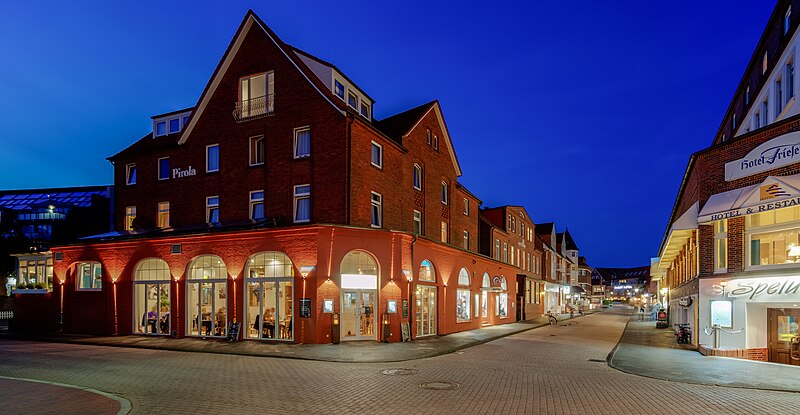
Bahnhofstraße (corner of Wilhelmstraße) in the blue hour, Juist, Lower Saxony, Germany
Dietmar Rabich
Description and use
Street furniture is a collective term used in the United States, United Kingdom, Australia, Canada, and Ireland. It refers to objects and pieces of equipment installed along streets and roads for various purposes. The design and placement of furniture should take into account aesthetics, visual identity, function, pedestrian mobility and road safety. For example, street furniture can be positioned to control overspill parking in addition to its primary purpose; for example a bench and a number of bollards may be used to block access to a sidewalk or verges for vehicles. • Illustration — A parkour practitioner vaults over a rail. Street furniture is used unofficially as sports equipment for skateboarding, parkour and street workout.
Primary material
Documents and archives
reference work
- “Street furniture”, English Wikipedia, consulted as further reading
Reputable secondary · Wikipedia
authority record
- Wikidata, structured authority record Q13397636: street furniture
Unverified · Wikidata
References
Citations
References
Each reference names the institution holding it, so a reader may go to the document itself.
reference work
Partially resolvedauthority record
Unverified
Connections
Knowledge graph
Connections
Each connection was recorded deliberately, with the basis for it kept on the internal record.
Broader subject
4- bicycle standTerminology
Established from a fact already recorded on a verified source.
- hostile architectureTerminology
Established from a fact already recorded on a verified source.
- jungle gymTerminology
Established from a fact already recorded on a verified source.
- mounting blockTerminology
Established from a fact already recorded on a verified source.
Further particulars
Held on the record
Further particulars
Open the remaining particulars
Street furniture is connected to 16 other published records in the VALÉORINE Encyclopedia.
The Encyclopedia exists whether or not anything is for sale. Corrections are recorded rather than overwritten, and every version of this record is kept. Published 14 August 2026.
Elsewhere in Furniture
924 published records in this field, each with its sources named.
- stoolTerminology
- storage bedTerminology
- StrandkorbTerminology
- street clockTerminology
- Street furniture in BarcelonaTerminology
- street pianoTerminology
- streetlightTerminology
- subselliumTerminology
Best supported in this field
For owners
Own an object connected with street furniture?
A specialist will read what you send and tell you what the house can establish, what it cannot, and whether the object is suited to sale. There is no charge and no obligation. The object stays with you throughout; nothing is shipped to us unless it is arranged in writing beforehand.