
Camden bench
Illustration — A Camden bench • Illustration — Camden benches outside Freemasons' Hall in Great Queen Street, London The Camden bench is a type of concrete street furniture. It was commissioned by the London Borough of Camden and installed at a site in Holborn in 2012. It is designed specifically to influence the behaviour of the public by restricting certain uses and behaviours and instead to be usable only as a bench, a principle known as hostile architecture.
Camden bench

Eluveitie · CC BY-SA 3.0
- Field
- bench · roadblock · street furniture
- Period
- 2010
- Region
- United Kingdom
- Related practice
- concrete · galvanized steel
VALÉORINE Encyclopedia
VALÉORINE documentary reading
Documentary summary
Illustration — A Camden bench • Illustration — Camden benches outside Freemasons' Hall in Great Queen Street, London The Camden bench is a type of concrete street furniture. It was commissioned by the London Borough of Camden and installed at a site in Holborn in 2012. It is designed specifically to influence the behaviour of the public by restricting certain uses and behaviours and instead to be usable only as a bench, a principle known as hostile architecture.
Admitted source layer · organised and presented by VALÉORINE
Note VALÉORINE
No house-authored Note is published until its assertions and sources pass the VALÉORINE evidence contract. The documentary article remains available in full while that enrichment is being consolidated.
Documentary enrichment in progress · no unsupported statement published
Reference Check
Propose documentary evidence for Camden bench. A contribution is never written directly as fact: identity, source, rights and evidence gates still decide.
Sign in to contribute
World of VALÉORINE
Documentary connections
Only confirmed graph relationships appear here. Images are shown only when their identity and reuse rights both pass the documentary gate.


Documentary evidence
Evidence Panel
not yet certified
- Identity
- resolved
- Independent source families
- 0
- Admitted assertions
- 0
- Open conflicts
- 0
Authority files
wikidata · Q17986229 · wikipedia · Camden bench
In this article
History
History
The bench has been called "the pinnacle of hostile architecture". Produced by UK company Factory Furniture, the bench is designed to deter use for sleeping, littering, skateboarding, drug dealing, graffiti and theft. Per design critic Kurt Kohlstedt, author of The 99% Invisible City: It attempts to achieve this primarily through angular surfaces (deterring sleepers and skateboarders), an absence of crevices or hiding places, and non-permeable materials (via a waterproof anti-paint coating). It is not secured to the ground and can be moved by a crane attaching to built-in anchor points. Due to its weight, it is also designed to function as a roadblock.
Municipalities such as Camden were removing benches from public spaces because they were seen as enabling behaviour considered anti-social, including skateboarding, sleeping, loitering, and criminal behaviour such as drug dealing. Camden commissioned the design of a bench that would discourage such behaviours, and the first Camden benches were installed in 2012.
Rationale
Rationale
According to Factory Furniture founder Dean Harvey, the primary purpose of the bench is to influence behaviour by "minimis[ing] the amount of time people spend in an area. With a perched or sloped surface, people can't loiter for too long." One of Factory Furniture's precursor products, the Serpentine Bench, was marketed in the 1990s as being uncomfortable to sleep on. The designers contend that "Homelessness should never be tolerated in any society and if we start designing in to accommodate homeless then we have totally failed as a society. Proximity to homelessness unfortunately makes us uncomfortable so perhaps it is good that we feel that and recognise homelessness as a problem rather than design to accommodate it."
Installations
Installations
In addition to Camden the bench has been installed at the 16th and Mission BART plaza in California. A Camden bench has been used as part of an installation artwork by Roger Hiorns. "Feature sites" for introduction of the bench were on Great Queen Street and High Holborn.
Specifications
Specifications
The technical specifications are: • Length, 270 cm • Width, 55 cm • Height, 65 cm • Mass, approx. 1,765 kg • Materials, exposed aggregate concrete with a galvanised steel frame
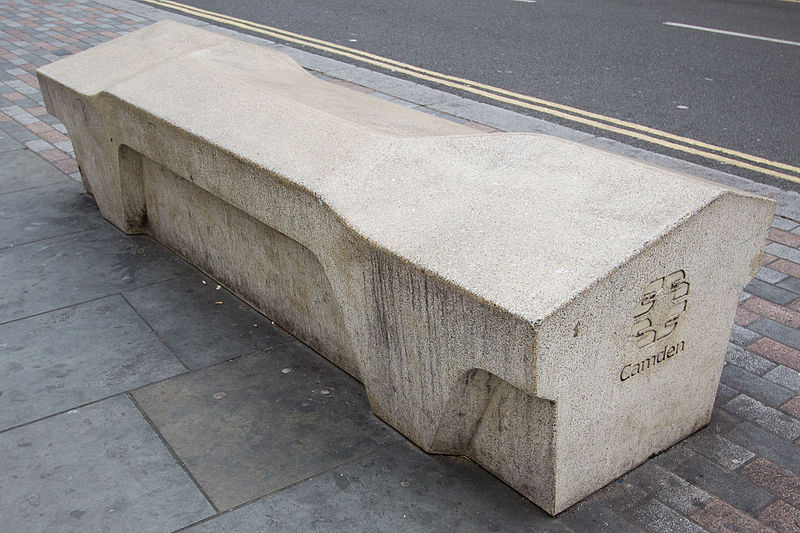
A Camden bench outside Freemasons' Hall on Great Queen Street, London
The wub
Chronology
Dated record
Chronology
Explore 2010
The full dated record · 3 entries
2010
Camden bench first recorded.
2010
Camden bench is recorded from 2010.
2010
Camden bench was established or created in 2010.
Places
Named by the record
Places
Only places the record itself states, plotted where the house gazetteer settles their coordinates. Nothing is inferred from a name or a nationality.
- United Kingdom
Criticism
The Camden bench received criticism as being a prime example of a wider trend of urban design that is anti-homeless, known as hostile architecture. Critics claim it is emblematic of a society where freedom in public space has been curtailed and deviance from accepted forms of behaviour has been made impossible. The style of the bench can be related to 'Secret city design tricks to manipulate your behaviour', which relates to the idea that things may be designed to encourage a type of behaviour without it being either obvious or ugly. Another common design of this is modest 'pig ears', which are placed on walls and benches. Because the design is "defined far more by what it is not than what it is", the bench has been called the "perfect anti-object", a "masterpiece of unpleasant design", and "the pinnacle of hostile architecture". Other recent names have included 'defensive' or 'disciplinary' architecture. These terms describe many sculptures which are designed and attached or installed in public spaces, in an attempt to render them unusable in certain ways by certain people or groups. As a prime example of urban design and hostile architecture, Rowland Atkinson, the co-director of the Centre for Urban Research at the University of York argues that the idea of the implication of spikes and other related architecture are a part of a broader pattern of hostility and indifference based towards social difference and poverty produced within cities. He views these implications as an assault on the poor, and an attempt to displace their distress which the general public seem to agree with. The argument begins by summarising how different processes overlap and come together, such as economic processes which result in creating people to become vulnerable. Popular criticism focused on subverting restrictions imposed by the bench, such as by attempting to skateboard on it or sleep on it, and allowing its use only as a bench.
Primary material
Documents and archives
reference work
- “Camden bench”, English Wikipedia, consulted as further reading
Reputable secondary · Wikipedia
authority record
- Wikidata, structured authority record Q17986229: Camden bench
Unverified · Wikidata
Awards
The design has achieved several awards: • Keep Britain Tidy "Best practice street cleansing" (2010) • Design Council "Best practice for reducing crime" (2012) It has also been accredited as: • Home Office "PAS68 approved" (a classification for vehicle security barriers) for counter-terrorism use.
Citations
References
Each reference names the institution holding it, so a reader may go to the document itself.
reference work
Partially resolvedauthority record
Unverified
The Encyclopedia exists whether or not anything is for sale. Corrections are recorded rather than overwritten, and every version of this record is kept. Published 14 August 2026.
Elsewhere in Furniture
924 published records in this field, each with its sources named.
- cabriolet (furniture)Terminology
- cage bedTerminology
- Cairo FlagpoleTerminology
- California CoolerTerminology
- camp bedTerminology
- campaign deskTerminology
- campaign furnitureTerminology
- Campeche chairTerminology
Best supported in this field
For owners
Own an object connected with Camden bench?
A specialist will read what you send and tell you what the house can establish, what it cannot, and whether the object is suited to sale. There is no charge and no obligation. The object stays with you throughout; nothing is shipped to us unless it is arranged in writing beforehand.