
commode
Illustration — French commode, by Gilles Joubert, circa 1735, made of oak and walnut, veneered with tulipwood, ebony, holly, other woods, gilt bronze and imitation marble, in the Museum of Fine Arts (Boston, United States) • Illustration — A British commode, circa 1772, marquetry of various woods, bronze and gilt-bronze mounts, overall: 95.9 x, in the Metropolitan Museum of Art (New York City) A commode is any of many pieces of furniture. The Oxford English Dictionary has multiple meanings of "commode". The first relevant definition reads: "A piece of furniture with drawers and shelves; in the bedroom, a sort of elaborate chest of drawers (so in French); in the drawing room, a large (and generally old-fashioned) kind of chiffonier." Another meaning attested is a washstand, a piece of furniture equipped with basin, jug, and towel rail, and often with space to store the chamber pot behind closed doors.
commode

sailko · I, Sailko · Self-photographed · CC BY 2.5
- Field
- furniture
- Region
- France
VALÉORINE Encyclopedia
VALÉORINE documentary reading
Documentary summary
Illustration — French commode, by Gilles Joubert, circa 1735, made of oak and walnut, veneered with tulipwood, ebony, holly, other woods, gilt bronze and imitation marble, in the Museum of Fine Arts (Boston, United States) • Illustration — A British commode, circa 1772, marquetry of various woods, bronze and gilt-bronze mounts, overall: 95.9 x, in the Metropolitan Museum of Art (New York City) A commode is any of many pieces of furniture. The Oxford English Dictionary has multiple meanings of "commode". The first relevant definition reads: "A piece of furniture with drawers and shelves; in the bedroom, a sort of elaborate chest of drawers (so in French); in the drawing room, a large (and generally old-fashioned) kind of chiffonier." Another meaning attested is a washstand, a piece of furniture equipped with basin, jug, and towel rail, and often with space to store the chamber pot behind closed doors.
Admitted source layer · organised and presented by VALÉORINE
Note VALÉORINE
No house-authored Note is published until its assertions and sources pass the VALÉORINE evidence contract. The documentary article remains available in full while that enrichment is being consolidated.
Documentary enrichment in progress · no unsupported statement published
Reference Check
Propose documentary evidence for commode. A contribution is never written directly as fact: identity, source, rights and evidence gates still decide.
Sign in to contribute
World of VALÉORINE
Documentary connections
Only confirmed graph relationships appear here. Images are shown only when their identity and reuse rights both pass the documentary gate.


Documentary evidence
Evidence Panel
wikipedia incomplete · checked 25 September 2026
- Identity
- resolved
- Independent source families
- 0
- Admitted assertions
- 0
- Open conflicts
- 0
Authority files
gnd · 10296466-X · wikidata · Q622360 · wikipedia · Commode
In this article
France
France
A washstand in the bedroom pre-dates indoor bathrooms and running water. In British English, "commode" is the standard term for a commode chair, often on wheels, enclosing a chamber pot—as used in hospitals and assisted living homes. In the United States, a "commode" is now a colloquial synonym for a flush toilet. The word commode comes from the French word for "convenient" or "suitable", which in turn comes from the Latin adjective commodus, with similar meanings.
The term originates in the vocabulary of French furniture from about 1700. At that time, a commode meant a cabinet or chest of drawers, low enough so that it sat at the height of the dado rail (à hauteur d'appui). It was a piece of veneered case furniture much wider than it was high, raised on high or low legs. Commodes were made by ébénistes; the French word for "cabinet-maker" is derived from ebony, a black tropical hardwood notable as a foreign luxury. The beautiful wood was complemented with ormolu (gilt-bronze drawer pulls). The piece of furniture would be provided with a marble slab top selected to match the marble of the chimneypiece. A commode occupied a prominent position in the room for which it was intended: it stood against the pier between the windows, in which case it would often be surmounted by a mirror glass, or a pair of identical commodes would flank the chimneypiece or occupy the center of each end wall. Bombé commodes, with surfaces shaped in three dimensions, were a feature of the rococo style called Louis Quinze. Rectilinear neoclassical, or Louis Seize, commodes might have such deep drawers or doors that the feet were en toupie—in the tapering turned shape of a child's spinning top. Both rococo and neoclassical commodes might have cabinets flanking the main section, in which case such a piece was a commode à encoignures; pairs of encoignures or corner-cabinets might also be designed to complement a commode and stand in the flanking corners of a room. If a commode had open shelves flanking the main section it was a commode à l'anglaise; if it did not have enclosing drawers it was a commode à vantaux. Before the mid-eighteenth century the commode had become such a necessary article of furniture that it might be made in menuiserie (carpentry), of solid painted oak, walnut or fruitwoods, with carved decoration, typical of French provincial furniture.
England
England
• Illustration — A washstand with pitcher (jug) and towel rack, sometimes known as a commode. In the English-speaking world, commode passed into cabinet-makers' parlance in London by the mid-eighteenth century to describe chests of drawers with gracefully curved fronts, and sometimes with shaped sides as well, perceived as being in the "French" taste. Thomas Chippendale employed the term "French Commode Tables" to describe designs in The Cabinet-Maker and Upholsterer's Director (1753), and Ince and Mayhew illustrated a "Commode Chest of drawers", plate xliii, in their Universal System of Household Furniture, 1759–62. John Gloag notes that Commode expanded to describe any piece of furniture with a serpentine front, such as a dressing table, or even a chair seat. Gloag points out that Thomas Shearer's designs for two "commode dressing chests" illustrated in The Cabinet-Makers' London Book of Prices, 1788, plate 17, are repeated, but as "serpentine dressing chests", in The Prices of Cabinet Work, 1797 edition.
Toilet
Toilet
In British English, "commode" is the standard term for a commode chair, often on wheels, enclosing a chamber pot—as used in hospitals and the homes of disabled persons. (The historic equivalent is the close stool, hence the coveted and prestigious position Groom of the Stool for a courtier close to the monarch.) This piece of furniture is termed in French a chaise percée ("pierced chair"); similar items were made specifically as moveable bidets for washing. In the United States, a "commode" is a colloquial synonym for a flush toilet particularly in the American South. • Illustration — A commode chair from Pakistan • Illustration — Museum collection of toilets, bed pans, hip baths, etc. The modern toilet commode is on the right. • Illustration — 19th century heavy wooden toilet commode

Giuseppe maggiolini, cassettone, 1773 circa
sailko · I, Sailko · Self-photographed
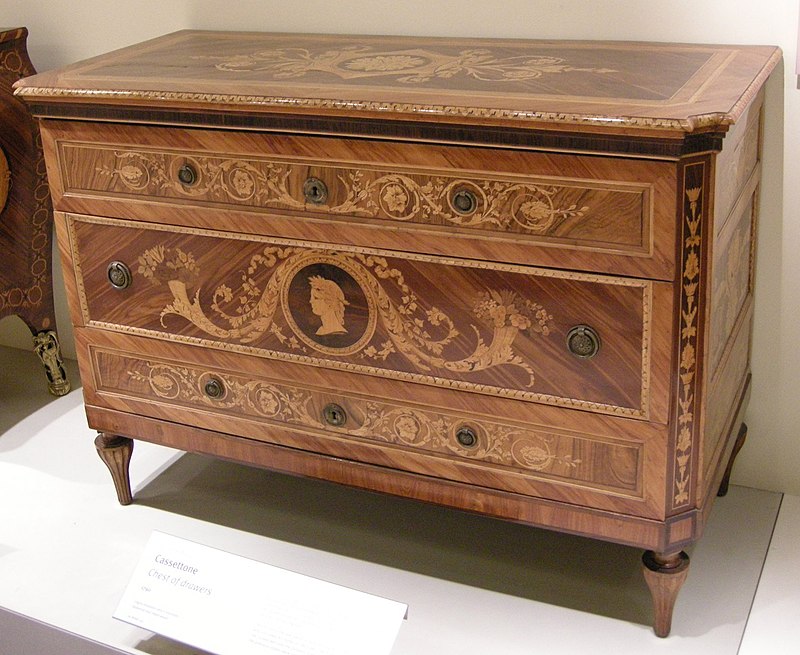
Giuseppe maggiolini, cassettone, 1790
sailko · I, Sailko · Self-photographed
Places
Named by the record
Places
Only places the record itself states, plotted where the house gazetteer settles their coordinates. Nothing is inferred from a name or a nationality.
- France
Named but not plotted · 1
commode is associated with France.
Country
Primary material
Documents and archives
institutional register
- Internet Archive holdings naming commode
Unverified · Internet Archive
- Wikidata, structured authority record Q622360: commode
Unverified · Wikimedia Foundation
reference work
- “Commode”, English Wikipedia, consulted as further reading
Reputable secondary · Wikipedia
References
Citations
References
Each reference names the institution holding it, so a reader may go to the document itself.
institutional register
Internet Archive holdings naming commodeInternet Archive
Partially resolvedreference work
Partially resolvedinstitutional register
Wikidata, structured authority record Q622360: commodeWikimedia Foundation
Unverified
Connections
Knowledge graph
Connections
Each connection was recorded deliberately, with the basis for it kept on the internal record.
Broader subject
1- chiffonierTerminology
Established from a fact already recorded on a verified source.
The Encyclopedia exists whether or not anything is for sale. Corrections are recorded rather than overwritten, and every version of this record is kept. Published 14 August 2026.
Elsewhere in Furniture
924 published records in this field, each with its sources named.
- coffee tableTerminology
- coffinTerminology
- Coffin of NedjemankhTerminology
- combat vehicle turretTerminology
- commode chairTerminology
- communion benchTerminology
- Communion tableTerminology
- computer deskTerminology
Best supported in this field
For owners
Own an object connected with commode?
A specialist will read what you send and tell you what the house can establish, what it cannot, and whether the object is suited to sale. There is no charge and no obligation. The object stays with you throughout; nothing is shipped to us unless it is arranged in writing beforehand.