
Stendhal
Marie-Henri Beyle (lang; 23 January 1783 – 23 March 1842), better known by his pen name Stendhal (lang), was a French writer. Best known for the novels Le Rouge et le Noir (The Red and the Black, 1830) and La Chartreuse de Parme (The Charterhouse of Parma, 1839), he is highly regarded for the acute analysis of his characters' psychology and considered one of the early and foremost practitioners of realism. Stendhal proclaimed himself an egotist; the neologism for the same characteristic in his characters was "Beylism".
Also recorded as Henri Beyle · Marie Henri Beyle
Stendhal
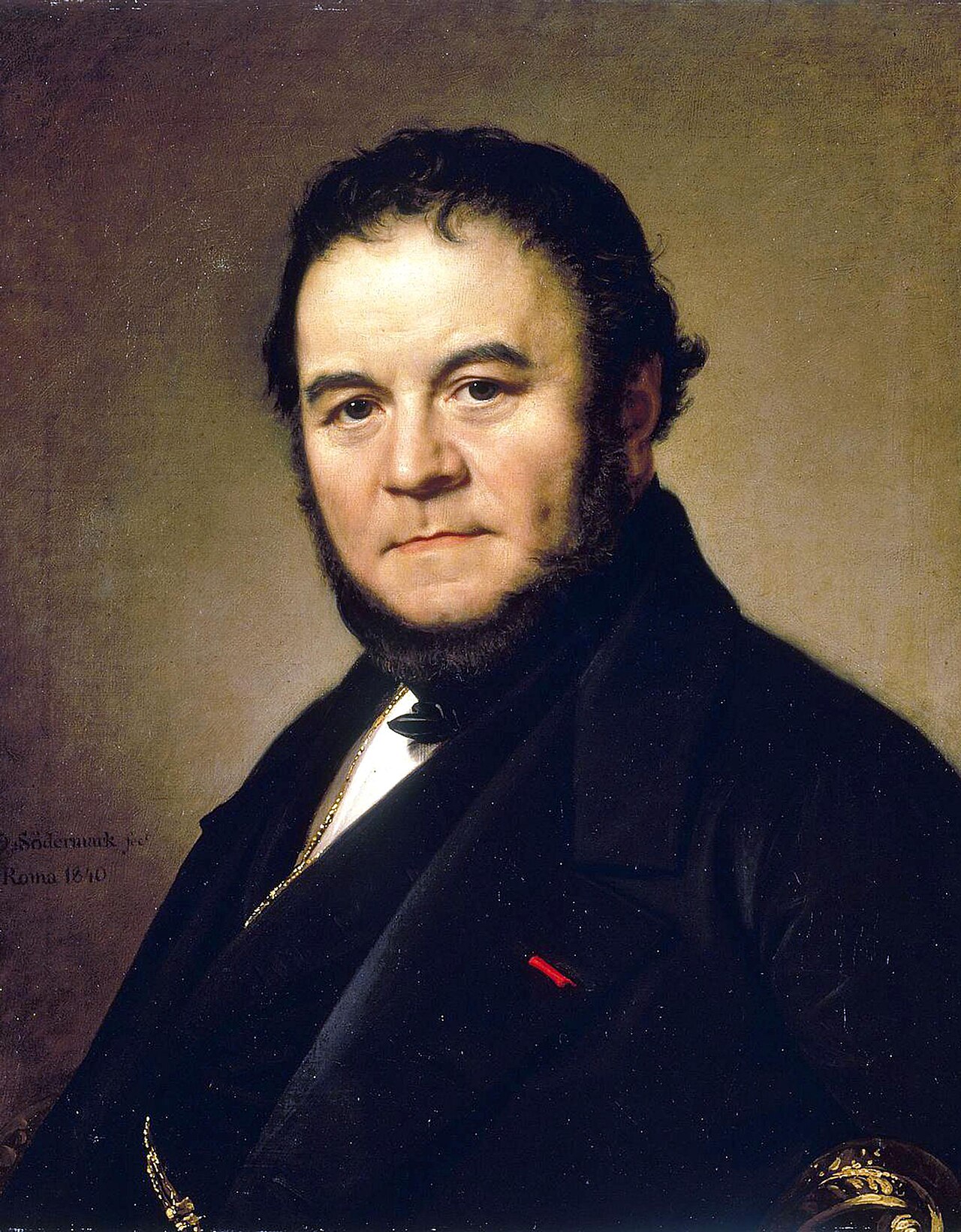
Olof Johan Södermark · [1] · Public domain
- Name
- Marie-Henri Beyle
- Born
- 23 January 1783
- Birthplace
- Grenoble, Kingdom of France
- Died
- 23 March 1842
- Place of death
- Paris, Kingdom of France
- Occupation
- Writer
- Movement
- Romanticism, Realism
- Nationality
- France
- Fields
- psychological novel
- Movements
- literary realism · Romanticism
- Known for
- The Red and the Black · The Charterhouse of Parma · On Love · Memoirs of an Egotist · Mémoires d'un touriste · Vanina Vanini
VALÉORINE Encyclopedia
VALÉORINE documentary reading
Documentary summary
Marie-Henri Beyle (lang; 23 January 1783 – 23 March 1842), better known by his pen name Stendhal (lang), was a French writer. Best known for the novels Le Rouge et le Noir (The Red and the Black, 1830) and La Chartreuse de Parme (The Charterhouse of Parma, 1839), he is highly regarded for the acute analysis of his characters' psychology and considered one of the early and foremost practitioners of realism. Stendhal proclaimed himself an egotist; the neologism for the same characteristic in his characters was "Beylism".
Admitted source layer · organised and presented by VALÉORINE
Reference Check
Propose documentary evidence for Stendhal. A contribution is never written directly as fact: identity, source, rights and evidence gates still decide.
Sign in to contribute
Documentary evidence
Documentary basis
Authority files
getty · 500306928 · gnd · 118617648 · wikidata · Q502 · wikipedia · Stendhal
In this article
Biography
Biography
Also known for De l'amour, his work on "passionate love" in which the concept of "crystallization" was invented. The book was mostly ignored after publishing, but has been lauded posthumously as one of the first "modern" attempts at understanding love. Sharon Brehm, a president of the American Psychological Association, has called Stendhal "a first-rate psychologist before the official term was coined".

Journal tenu par Stendhal pendant son séjour en Russie en septembre 1812, où il décrit l’incendie de Moscou, page 5
Archives nationales (France) · Archives nationales

Journal tenu par Stendhal pendant son séjour en Russie en septembre 1812, où il décrit l’incendie de Moscou, page 6
Archives nationales (France) · Archives nationales
Key facts
Key facts
• Name — Marie-Henri Beyle • Born — 23 January 1783 • Birthplace — Grenoble, Kingdom of France • Died — 23 March 1842 • Place of death — Paris, Kingdom of France • Occupation — Writer • Resting Place — Montmartre Cemetery, Paris • Movement — Romanticism, Realism
Life
Life
Marie-Henri Beyle was born in Grenoble, Isère, on 23 January 1783, into the family of the advocate and landowner Chérubin Beyle and his wife Henriette Gagnon. He was an unhappy child, disliking his "unimaginative" father and mourning his mother, whom he loved fervently, and who died in childbirth in 1790, when he was seven. He spent his childhood at the Beyle country house in Claix near Grenoble. His closest friend was his younger sister, Pauline, with whom he maintained a steady correspondence throughout the first decade of the 19th century. His family was part of the bourgeois class of the Ancien Régime, which explains his ambiguous attitude toward Napoleon, the Bourbon Restoration, and the monarchy later on. • Illustration — Plaque on a house in Vilnius where Stendhal stayed in December 1812 during Napoleon's retreat from Russia The military and theatrical worlds of the First French Empire were a revelation to Beyle. As an assistant war commissioner, he served in the administration of the Kingdom of Westphalia, one of Napoleon's client states in Germany. From 1807 to 1808, Beyle lived in Braunschweig (Brunswick), where he fell in love with Wilhelmine von Griesheim, whom he called Minette, and for whose sake he remained in the city. "I have no inclination, now, except for Minette, for this blonde and charming Minette, this soul of the north, such as I have never seen in France or Italy." He was named an auditor with the Conseil d'État on 3 August 1810, and thereafter took part in the French administration and in the Napoleonic Wars in Italy. He travelled extensively in Germany and was part of Napoleon's army in the 1812 invasion of Russia. Upon arriving, Stendhal witnessed the burning of Moscow from just outside the city as well as the army's winter retreat. He was appointed Commissioner of War Supplies and sent to Smolensk to prepare provisions for the returning army. He crossed the Berezina River by finding a usable ford rather than the overwhelmed pontoon bridge, which probably saved his life and those of his companions. He arrived in Paris in 1813, largely unaware of the general fiasco that the retreat had become. Stendhal became known, during the Russian campaign, for keeping his wits about him, and maintaining his "sang-froid and clear-headedness." He also maintained his daily routine, shaving each day during the retreat from Moscow. After the 1814 Treaty of Fontainebleau, and the fall of Napoleon, he left for Italy, where he settled in Milan. He stayed there until June 1821; "... only leaving after these, the happiest, years of his life, through fear of being implicated in the Carbonari troubles." He then went to Paris, "with a sum of 3,500 francs, I believe, seeing my only happiness in blowing my brains out as soon as that sum was exhausted." In 1830, he was appointed as French consul at Trieste and Civitavecchia. He formed a particular attachment to Italy, where he spent much of the remainder of his career. His novel The Charterhouse of Parma, written in 52 days, is set in Italy, which he considered a more sincere and passionate country than Restoration France. An aside in that novel, referring to a character who contemplates suicide after being jilted, speaks about his attitude towards his home country: "To make this course of action clear to my French readers, I must explain that in Italy, a country very far away from us, people are still driven to despair by love." Stendhal identified with the nascent liberalism and his sojourn in Italy convinced him that Romanticism was essentially the literary counterpart of liberalism in politics. When Stendhal was appointed to a consular post in Trieste in 1830, Metternich refused his exequatur on account of Stendhal's liberalism and anti-clericalism. • Illustration — List of the women that he had loved, inserted in Life of Henry Brulard, in 1835: "I dreamed deeply of these names, and of the astonishing follies and stupidities they made me commit." (From left to right: Virginie Kubly, Angela Pietragrua, Adèle Rebuffel, Mina de Griesheim, Mélanie Guilbert, Angelina Bereyter, Alexandrine Daru, Angela Pietragrua, Matilde Dembowski, Clémentine Curial, Giulia Rinieri, Madame Azur-Alberthe de Rubempré) Stendhal was a dandy and wit about town in Paris, as well as an obsessive womaniser. His genuine empathy towards women is evident in his books; Simone de Beauvoir spoke highly of him in The Second Sex. She credited him for perceiving a woman as not a woman but simply a human being. Citing Stendhal's rebellious heroines, she maintained that he was a feminist writer. One of his early works is De l'amour (On Love), a rational analysis of romantic passion that was based on his unrequited love for Mathilde, Countess Dembowska, whom he met while living at Milan. Later, he would also suffer "restlessness in spirit" when one of his childhood friends, Victorine got married. In a letter to Pauline, he described her as the woman of his dreams and wrote that he would have discovered happiness if he became her husband. This fusion of, and tension between, clear-headed analysis and romantic feeling is typical of Stendhal's great novels; he could be considered a Romantic realist. Stendhal suffered miserable physical disabilities in his final years as he continued to produce some of his most famous work. He contracted syphilis in December 1808. As he noted in his journal, he was taking iodide of potassium and quicksilver to treat his sexual disease, resulting in swollen armpits, difficulty swallowing, pains in his shrunken testicles, sleeplessness, giddiness, roaring in the ears, racing pulse and "tremors so bad he could scarcely hold a fork or a pen". Modern medicine has shown that his health problems were more attributable to his treatment than to his syphilis. He is said to have sought the best treatment in Paris, Vienna and Rome. Stendhal died on 23 March 1842, a few hours after collapsing with a seizure in the street in Paris. He is interred in the Cimetière de Montmartre.
Pseudonyms
Pseudonyms
Before settling on the pen name Stendhal, he published under many pen names, including "Louis Alexandre Bombet" and "Anastasius Serpière". The only book that Stendhal published under his own name was The History of Painting (1817). From the publication of Rome, Naples, Florence (September 1817) onwards, he published his works under the pseudonym "M. de Stendhal, officier de cavalerie". He borrowed this pen name from the German city of Stendal, birthplace of Johann Joachim Winckelmann, an art historian and archaeologist famous at the time. However, it is not clear whether he chose the name in honour of Winckelmann or simply knew the place as a centre of communications between Berlin and Hanover. Stendhal added an additional "H" to make the Germanic pronunciation more clear. Stendhal used many aliases in his autobiographical writings and correspondence, and often assigned pseudonyms to friends, some of whom adopted the names for themselves. Stendhal used more than a hundred pseudonyms, which were astonishingly diverse. Some he used no more than once, while others he returned to throughout his life. "Dominique" and "Salviati" served as intimate pet names. He coins comic names "that make him even more bourgeois than he really is: Cotonnet, Bombet, Chamier." He uses many ridiculous names: "Don phlegm", "Giorgio Vasari", "William Crocodile", "Poverino", "Baron de Cutendre". One of his correspondents, Prosper Mérimée, said: "He never wrote a letter without signing a false name." Stendhal's Journal and autobiographical writings include many comments on masks and the pleasures of "feeling alive in many versions." "Look upon life as a masked ball," is the advice that Stendhal gives himself in his diary for 1814. In Memoirs of an Egotist he writes: "Will I be believed if I say I'd wear a mask with pleasure and be delighted to change my name?... for me the supreme happiness would be to change into a lanky, blonde German and to walk about like that in Paris."
Works
Works
• Illustration — Second volume of the 1831 edition of The Red and the Black, considered to be Stendhal's most notable and well-known work Contemporary readers did not fully appreciate Stendhal's realistic style during the Romantic period in which he lived. He was not fully appreciated until the beginning of the 20th century. He dedicated his writing to "the Happy Few" (in English in the original). This can be interpreted as a reference to Canto 11 of Lord Byron's Don Juan, which refers to "the thousand happy few" who enjoy high society, or to the "we few, we happy few, we band of brothers" line of William Shakespeare's Henry V, but Stendhal's use more likely refers to The Vicar of Wakefield by Oliver Goldsmith, parts of which he had memorized in the course of teaching himself English. In The Vicar of Wakefield, "the happy few" refers ironically to the small number of people who read the title character's obscure and pedantic treatise on monogamy. As a literary critic, such as in Racine and Shakespeare, Stendhal championed the Romantic aesthetic by unfavorably comparing the rules and strictures of Jean Racine's classicism to the freer verse and settings of Shakespeare, and supporting the writing of plays in prose. According to the literary theorist Kornelije Kvas: "In his novel The Red and the Black, Stendhal refers to a novel as a mirror being carried in a basket. The metaphor of the realistic novel as a mirror of contemporary reality, accessible to the narrator, has certain limitations, which the artist is aware of. A valuable realistic work exceeds the Platonic meaning of art as a copy of reality. A mirror does not reflect reality in its entirety, nor is the artist's aim to document it fully. In The Red and the Black, the writer emphasizes the significance of selection when it comes to describing reality, with a view to realizing the cognitive function of a work of art, achieved through the categories of unity, coherence and typicality". Stendhal was an admirer of Napoleon and his novel Le Rouge et le Noir is considered his literary tribute to the emperor. Today, Stendhal's works attract attention for their irony and psychological and historical dimensions. Stendhal was an avid fan of music, particularly the works of the composers Domenico Cimarosa, Joseph Haydn, Wolfgang Amadeus Mozart and Gioacchino Rossini. He wrote a biography of Rossini, Vie de Rossini (1824), now more valued for its wide-ranging musical criticism than for its historical content. He also idealized aristocracy, noting its antiegalitarianism but appreciating how it is liberal in its love of liberty. In his works, Stendhal reprised excerpts appropriated from Giuseppe Carpani, Théophile Frédéric Winckler, Sismondi and others.
Novels
Novels
• Armance (1827) • Le Rouge et le Noir (The Red and the Black, 1830) • Lucien Leuwen (1835, unfinished, published 1894) • The Pink and the Green (1837, unfinished) • La Chartreuse de Parme (1839) (The Charterhouse of Parma) • Lamiel (1839–1842, unfinished, published 1889) • Illustration — Melancholy portrait of Stendhal by Ducis, 1835, in Milan
Novellas
Novellas
• Vanina Vanini (1829) • Mina de Vanghel (1830, later published in the Paris periodical La Revue des Deux Mondes) • Italian Chroniques, 1837–1839 • Vittoria Accoramboni • The Cenci (Les Cenci, 1837) • The Duchess of Palliano (La Duchesse de Palliano) • The Abbess of Castro (L'Abbesse de Castro, 1832)
Biography
Biography
• A Life of Napoleon (1817–1818, published 1929) • A Life of Rossini (1824)
Autobiography
Autobiography
Stendhal's brief memoir, Souvenirs d'Égotisme (Memoirs of an Egotist), was published posthumously in 1892. Also published was a more extended autobiographical work, thinly disguised as the Life of Henry Brulard. • The Life of Henry Brulard (1835–1836, published 1890) • Souvenirs d'égotisme (written in 1832 and published in 1892) • Journal (1801–1817) (The Private Diaries of Stendhal)
Non-fiction
Non-fiction
• Illustration — Manuscript of A Life of Napoleon annotated by Stendhal • Rome, Naples et Florence (1817) • De l'amour (1822) • Racine et Shakespéare (1823–1825) (Racine and Shakespeare) • Voyage dans le midi de la France (1838; though first published posthumously in 1930) (Travels in the South of France) His other works include short stories, journalism, travel books (A Roman Journal), a famous collection of essays on Italian painting, and biographies of several prominent figures of his time, including Napoleon (A Life of Napoleon), Haydn, Mozart, Rossini and Metastasio.
Crystallization
Crystallization
In Stendhal's 1822 De l'amour he describes or compares the "birth of love", in which the love object is 'crystallized' in the mind, as being a process similar or analogous to a trip to Rome. In the analogy, the city of Bologna represents indifference and Rome represents perfect love: • Illustration — Stendhal's depiction of "crystallization" in the process of falling in love When we are in Bologna, we are entirely indifferent; we are not concerned to admire in any particular way the person with whom we shall perhaps one day be madly in love; even less is our imagination inclined to overrate their worth. In a word, in Bologna "crystallization" has not yet begun. When the journey begins, love departs. One leaves Bologna, climbs the Apennines, and takes the road to Rome. The departure, according to Stendhal, has nothing to do with one's will; it is an instinctive moment. This transformative process actuates in terms of four steps along a journey: • Admiration – one marvels at the qualities of the loved one. • Acknowledgement – one acknowledges the pleasantness of having gained the loved one's interest. • Hope – one envisions gaining the love of the loved one. • Delight – one delights in overrating the beauty and merit of the person whose love one hopes to win. This journey or crystallization process (shown above) was detailed by Stendhal on the back of a playing card while speaking to Madame Gherardi, during his trip to the Salzburg salt mine.
Critical appraisal
Critical appraisal
Hippolyte Taine considered the psychological portraits of Stendhal's characters to be "real, because they are complex, many-sided, particular and original, like living human beings." Émile Zola concurred with Taine's assessment of Stendhal's skills as a "psychologist", and although emphatic in his praise of Stendhal's psychological accuracy and rejection of convention, he deplored the various implausibilities of the novels and Stendhal's clear authorial intervention. The German philosopher Friedrich Nietzsche refers to Stendhal as "France's last great psychologist" in Beyond Good and Evil (1886). He also mentions Stendhal in the Twilight of the Idols (1889) during a discussion of Dostoevsky as a psychologist, saying that encountering Dostoevsky was "the most beautiful accident of my life, more so than even my discovery of Stendhal". Ford Madox Ford, in The English Novel, asserts that to Diderot and Stendhal "the Novel owes its next great step forward... At that point it became suddenly evident that the Novel as such was capable of being regarded as a means of profoundly serious and many-sided discussion and therefore as a medium of profoundly serious investigation into the human case." Erich Auerbach considers modern "serious realism" to have begun with Stendhal and Balzac. In Mimesis, he remarks of a scene in The Red and the Black that "it would be almost incomprehensible without a most accurate and detailed knowledge of the political situation, the social stratification, and the economic circumstances of a perfectly definite historical moment, namely, that in which France found itself just before the July Revolution." In Auerbach's view, in Stendhal's novels "characters, attitudes, and relationships of the dramatis personæ, then, are very closely connected with contemporary historical circumstances; contemporary political and social conditions are woven into the action in a manner more detailed and more real than had been exhibited in any earlier novel, and indeed in any works of literary art except those expressly purporting to be politico-satirical tracts." Simone de Beauvoir uses Stendhal as an example of a feminist author. In The Second Sex de Beauvoir writes "Stendhal never describes his heroines as a function of his heroes: he provides them with their own destinies." She furthermore points out that it "is remarkable that Stendhal is both so profoundly romantic and so decidedly feminist; feminists are usually rational minds that adopt a universal point of view in all things; but it is not only in the name of freedom in general but also in the name of individual happiness that Stendhal calls for women's emancipation." Yet, Beauvoir criticises Stendhal for, although wanting a woman to be his equal, her only destiny he envisions for her remains a man. Even Stendhal's autobiographical works, such as The Life of Henry Brulard or Memoirs of an Egotist, are "far more closely, essentially, and concretely connected with the politics, sociology, and economics of the period than are, for example, the corresponding works of Rousseau or Goethe; one feels that the great events of contemporary history affected Stendhal much more directly than they did the other two; Rousseau did not live to see them, and Goethe had managed to keep aloof from them." Auerbach goes on to say: Vladimir Nabokov was dismissive of Stendhal, in Strong Opinions calling him "that pet of all those who like their French plain". In the notes to his translation of Eugene Onegin, he asserts that Le Rouge et le Noir is "much overrated", and that Stendhal has a "paltry style". In Pnin Nabokov wrote satirically, "Literary departments still labored under the impression that Stendhal, Galsworthy, Dreiser, and Mann were great writers." Michael Dirda considers Stendhal "the greatest all round French writer – author of two of the top 20 French novels, author of a highly original autobiography (Vie de Henry Brulard), a superb travel writer, and as inimitable a presence on the page as any writer you'll ever meet."
Stendhal syndrome
Stendhal syndrome
In 1817 Stendhal was reportedly overcome by the cultural richness of Florence he encountered when he first visited the Tuscan city. As he described in his book Naples and Florence: A Journey from Milan to Reggio: As I emerged from the porch of Santa Croce, I was seized with a fierce palpitation of the heart (that same symptom which, in Berlin, is referred to as an attack of the nerves); the well-spring of life was dried up within me, and I walked in constant fear of falling to the ground. The condition was diagnosed and named in 1979 by Italian psychiatrist Graziella Magherini, who had noticed similar psychosomatic conditions (racing heart beat, nausea and dizziness) amongst first-time visitors to the city. In homage to Stendhal, Trenitalia named their overnight train service from Paris to Venice the Stendhal Express.
Primary material
Documents and archives
reference work
- “Stendhal”, English Wikipedia, consulted as further reading
Reputable secondary · Wikipedia
- Wikidata, structured authority record Q502: Stendhal
Reputable secondary · Wikidata
authority file
- Gemeinsame Normdatei 118617648, Stendhal.
General reference · Deutsche Nationalbibliothek
Notes from the source article
Cited by Wikipedia
Notes from the source article
These works are cited by the source article, in its own numbering. They are recorded as its citations, not as sources VALÉORINE has verified.
- 1.Oxforddictionaries.com. Stendhal: definition of Stendhal in Oxford dictionary (British & World English) (US). 2014-01-23.
- 2.Oxforddictionaries.com. Stendhal: definition of Stendhal in Oxford dictionary (American English) (US). 2014-01-23.
- 3.Merriam-webster.com. Stendhal – Definition and More from the Free Merriam-Webster Dictionary. 2012-08-31.
- 4.Stendhal. Pronny the pronouncer.
- 5.Zaretsky, Robert. Crystallized Desire: On Stendhalian Love. Los Angeles Review of Books. 17 May 2021.
- 6.Brehm, Sharon. The Psychology of Love. Yale University Press. 233, 234, 239. 1988. 9780300045895.
- 7.Tallis, Frank. Love Sick: Love as a Mental Illness. Thunder's Mouth Press. 144. January 2005. 978-1-56025-647-2.
- 8.Sharon Stephens Brehm, PhD. American Psychological Association. 2007.
- 9.Nemo, August. Essential Novelists – Stendhal: modern consciousness of reality. Tacet Books. 2020. 978-3-96799-211-3.
- 10.litencyc.com. Literary Encyclopedia – Stendhal.
- 11.Brombert, Victor. Stendhal: Fiction and the Themes of Freedom. University of Chicago Press. 11. 2018. 978-0-226-53829-7.
- 12.Richardson, Joanna. Stendhal. Coward, McCann & Geoghegan. 68. 1974.
- 13.Haig, Stirling. Stendhal: The Red and the Black. Cambridge University Press. 9. 1989. 0-521-34189-2.
- 14.Markham, J. David. Following in the Footsteps of Glory: Stendhal's Napoleonic Career. Napoleonic Scholarship: The Journal of the International Napoleonic Society. 1. April 1997.
- 15.Sartre, Jean-Paul. War Diary. New Left Review. 2. 59. 88–120. September–October 2009. 10.64590/3gx.
- 16.Bamforth, Iain. Stendhal's Syndrome. The British Journal of General Practice. 60. 581. 945–946. 2010-12-01. 0960-1643.
- 17.Stendhal. On Love. The Mayflower Press. xii. 1915.
- 18.Stendhal, Henri Beyle. Souvenirs d'égotisme. Le Divan. 1950.
- 19.St. Martin's Publishing Group. The New York Times Guide to Essential Knowledge: A Desk Reference for the Curious Mind. 1334. 2011. 978-0-312-64302-7.
- 20.LaPointe, Leonard L. Paul Broca and the Origins of Language in the Brain. Plural Publishing. 135. 2012. 978-1-59756-604-9.
- 21.Leighton, Jean. Simone de Beauvoir on Woman. Fairleigh Dickinson Univ Press. 218. 1975. 978-0-8386-1504-1.
- 22.Rass, Rebecca. Study Guide to The Second Sex by Simone de Beauvoir. Influence Publishers. 2020. 978-1-64542-393-5.
- 23.Pearson, Roger. Stendhal: The Red and the Black and The Charterhouse of Parma. Routledge. 261. 2014. 978-0-582-09616-5.
- 24.Chapman and Hall. The Fortnightly Review. 74. 1913.
- 25.Green, 2011, page=67
- 26.Starobinski, Jean. The Living Eye. Harvard University Press. 1989. 0-674-53664-9.
- 27.Di Maio, Mariella. Aux âmes sensibles, Lettres choisies. Gallimard. 19. 2011.
- 28.Stendhal. Memoirs of an Egotist. Horizon. 63. 1975. 9780818002243.
- 29.Kvas, Kornelije. The Boundaries of Realism in World Literature. Lexington Books. 8. 2020. 978-1-7936-0910-6.
- 30.Clarke, Stephen. How the French Won Waterloo – or Think They Did. Random House. 2015. 978-1-4735-0636-7.
- 31.Goodheart, Eugene. Modernism and the Critical Spirit. Routledge. 2018. 978-1-351-30910-3.
- 32.Randall, Marilyn. Pragmatic Plagiarism: Authorship, Profit, and Power. University of Toronto Press. 199. 2001. 9780802048141.
- 33.Victor Del Litto in Stendhal (1986) p. 500, quote (translation by Randall 2001 p. 199): "used the texts of Carpani, Winckler, Sismondi et 'tutti quanti', as an ensemble of materials that he fashioned in his own way. In other words, by isolating his personal contribution, one arrives at the conclusion that the work, far from being a cento, is highly structured such that even the borrowed parts finally melt into a whole a l'allure bien stendhalienne."
- 34.Hazard, Paul. Les plagiats de Stendhal. 1921.
- 35.Dousteyssier-Khoze, Catherine. Poétiques de la parodie et du pastiche de 1850 à nos jours. Peter Lang. 34. 2006. 9783039107438.
- 36.Wood, James. How Fiction Works. Macmillan. 165. 2008. 9780374173401.
- 37.Wood, Michael. What is concrete?. London Review of Books. 37. 5. 19–21. 5 March 2015.
- 38.Auerbach, Erich. Mimesis: The Representation of Reality in Western Literature. Princeton University Press. 454–464. May 2003. 069111336X.
- 39.De Beauvoir, Simone. The Second Sex. Vintage. 1997. 9780099744214.
- 40.Wilson, Edmund. The Strange Case of Pushkin and Nabokov. The New York Review of Books. 15 July 1965.
- 41.Dirda, Michael. Dirda on Books. The Washington Post. 1 June 2005.
- 42.Stendhal. Naples and Florence: A Journey from Milan to Reggio.
Bibliography printed in the source article · 15
- Green, F. C. An Amharic Reader. Cambridge University Press. 16 June 2011. 978-1-107-60072-0.
- Martin, Brian Joseph. Napoleonic Friendship: Military Fraternity, Intimacy, and Sexuality in Nineteenth-century France. UPNE. 2011. 978-1-58465-944-0.
- Nietzsche, Friedrich Wilhelm. Beyond Good and Evil: Prelude to a Philosophy of the Future. Penguin. 1973. 978-0-14-044267-0.
- Nietzsche, Friedrich Wilhelm. Twilight of the Idols and the Antichrist. Courier Corporation. 1 January 2004. 978-0-486-43460-5.
- Talty, Stephan. The Illustrious Dead: The Terrifying Story of How Typhus Killed Napoleon's Greatest Army. Crown. 2 June 2009. 978-0-307-45975-6.
- Adams, Robert M., Stendhal: Notes on a Novelist. New York, Noonday Press; London, Merlin Press, 1959.
- Alter, Robert, A Lion for Love: A Critical Biography of Stendhal. Basic Books, 1979 (USA); Stendhal. A Biography. George Allen & Unwin, 1980 (UK). written in collaboration with Carol Cosman.
- Blum, Léon, Stendhal et le beylisme. Paris, Paul Ollendorf, 1914.
- Dieter, Anna-Lisa, Eros – Wunde – Restauration. Stendhal und die Entstehung des Realismus, Paderborn: Wilhelm Fink, 2019 (Periplous. Münchener Studien zur Literaturwissenschaft).
- Jefferson, Ann. Reading Realism in Stendhal (Cambridge Studies in French). Cambridge University Press, 1988.
- Jameson, Storm, Speaking of Stendhal. London, Victor Gollancz, 1979.
- Keates, Jonathan. Stendhal. London, Sinclair-Stevenson, 1994.
- Levin, Harry. Toward Stendhal. New York, 1945.
- Stendhal. Vies de Haydn, de Mozart et de Métastase. le Cercle du bibliophile. 41. 1970.
- Tillett, Margaret. Stendhal: The Background to the Novels. Oxford University Press, 1971.
References
Citations
References
Each reference names the institution holding it, so a reader may go to the document itself.
reference work
Secondary witnessauthority file
Gemeinsame Normdatei 118617648, Stendhal.Deutsche Nationalbibliothek
Secondary witnessreference work
Secondary witness
The Encyclopedia exists whether or not anything is for sale. Corrections are recorded rather than overwritten, and every version of this record is kept. Published 14 August 2026.
Elsewhere in Books
39,427 published records in this field, each with its sources named.
- Stella SierraAuthor
- Stelvio MestrovichAuthor
- Sten SelanderAuthor
- StencilTerminology
- Stenio VincentAuthor
- Stepan NechayevAuthor
- Stepan ProtsiukAuthor
- Stepan RudanskyiAuthor
Best supported in this field
For owners
Own a work by Stendhal?
A specialist will read what you send and tell you what the house can establish, what it cannot, and whether the object is suited to sale. There is no charge and no obligation. The object stays with you throughout; nothing is shipped to us unless it is arranged in writing beforehand.