
spotting scope
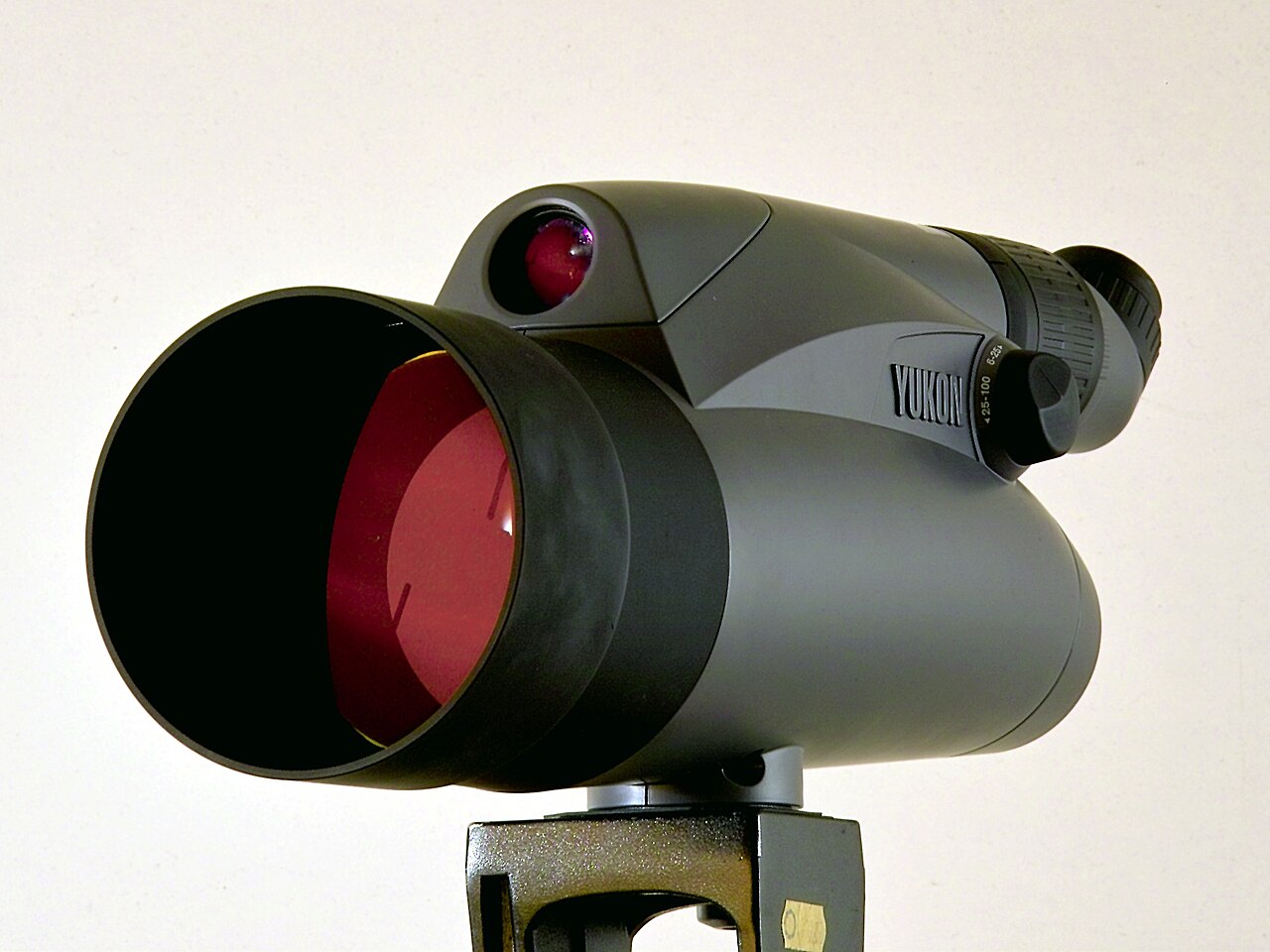
Illustration — A 100mm spotting scope with a paraxial 30mm finderscope • Illustration — A compact spotting scope with 8-24x magnification, (corresponds to 400-1200 mm on a camera lens). The front lens is 40 mm in diameter and when fully extended, it has a length of 18 cm. A spotting scope is a compact lightweight portable telescope optimized for detailed observation of distant objects.
spotting scope
Thuringius · CC BY-SA 3.0
- Field
- telescope · optical instrument · monocular
VALÉORINE Encyclopedia
VALÉORINE documentary reading
Documentary summary
Illustration — A 100mm spotting scope with a paraxial 30mm finderscope • Illustration — A compact spotting scope with 8-24x magnification, (corresponds to 400-1200 mm on a camera lens). The front lens is 40 mm in diameter and when fully extended, it has a length of 18 cm. A spotting scope is a compact lightweight portable telescope optimized for detailed observation of distant objects.
Admitted source layer · organised and presented by VALÉORINE
Note VALÉORINE
No house-authored Note is published until its assertions and sources pass the VALÉORINE evidence contract. The documentary article remains available in full while that enrichment is being consolidated.
Documentary enrichment in progress · no unsupported statement published
Reference Check
Propose documentary evidence for spotting scope. A contribution is never written directly as fact: identity, source, rights and evidence gates still decide.
Sign in to contribute
World of VALÉORINE
Documentary connections
Only confirmed graph relationships appear here. Images are shown only when their identity and reuse rights both pass the documentary gate.


Documentary evidence
Evidence Panel
not yet certified
- Identity
- resolved
- Independent source families
- 0
- Admitted assertions
- 0
- Open conflicts
- 0
Authority files
wikidata · Q1752914 · wikipedia · Spotting scope
In this article
Gallery
They are used as tripod mounted optical enhancement devices for various outdoor activities such as birdwatching, skygazing and other naturalist activities, for hunting and target shooting to verify a marksman's shot placements, for tactical ranging and surveillance, and for any other application that requires higher magnification than ordinary binoculars (typically 20× to 60×). The light-gathering power and resolution of a spotting scope is determined by the diameter of the objective lens, typically between. The larger the objective, the more massive and expensive the telescope. The optical assembly has a small refracting objective lens, an internal image-erecting system, and an eyepiece that is usually removable. The image-erecting system may use relay lenses, prisms such as Porro or roof prisms, or a catadioptric system of the Schmidt or Maksutov design. Spotting scopes may have a ruggedized design, a mounting interface for attaching to a tripod, and an ergonomically designed and located control knob for focus adjustment. Some spotting scopes also have in-built reticles for stadiametric rangefinding. scope eyepieces are usually interchangeable to adapt for different magnifications, or may have variable zoom to give a range of magnifications. Magnifications less than 20× are unusual, as are magnifications more than 60× since the latter can lead to poorer image brightness, a narrow field of view and too much image shaking, even on a tripod. The eyepiece mount layout can be "straight-through" (the eyepiece is on the same axis as the scope body), or "angled" (the eyepiece is at an angle to the scope body—usually 45 degrees). The high magnification of spotting scopes makes them prone to image disturbance from vibrations, so they are often stabilized with tripods or (less commonly) monopods, which provide a stationary and steady platform. Tripod heads can be used to control any required movements of the scope.
• Illustration — An ornithologist uses a spotting scope at Rossitten Bird Observatory in 1939. This spotting scope has no zoom eyepiece, but three interchangeable eyepieces with different magnifications • Illustration — A spotter (right) uses a spotting scope to assist a marksman. Spotting scopes are used on target ranges to avoid walking to the target to verify the placement of hits • Illustration — Biathlon coaches use spotting scopes to verify and optimize competitors shot placement • Illustration — Spotting scope on its tripod
Notes from the source article
Cited by Wikipedia
Notes from the source article
These works are cited by the source article, in its own numbering. They are recorded as its citations, not as sources VALÉORINE has verified.
References
Citations
References
Each reference names the institution holding it, so a reader may go to the document itself.
reference work
Partially resolvedreference work
Partially resolved
The Encyclopedia exists whether or not anything is for sale. Corrections are recorded rather than overwritten, and every version of this record is kept. Published 14 August 2026.
Elsewhere in Scientific instruments
736 published records in this field, each with its sources named.
- Spectro-Polarimetric High-Contrast Exoplanet ResearchTerminology
- Spektr-RTerminology
- SPHERExTerminology
- Spitzer Space TelescopeTerminology
- Stanford Dish (Stanford Radio Telescope)Terminology
- star trackerTerminology
- STARS-AOTerminology
- stillTerminology
Best supported in this field
For owners
Own an object connected with spotting scope?
A specialist will read what you send and tell you what the house can establish, what it cannot, and whether the object is suited to sale. There is no charge and no obligation. The object stays with you throughout; nothing is shipped to us unless it is arranged in writing beforehand.