
spinthariscope
Illustration — A low quality toy spinthariscope taken from a 1950s Chemcraft brand "Atomic energy" chemistry experimentation set • Illustration — A spinthariscope crafted by Robert Drosten in Belgium in 1905 and used in the University of Mons Faculty of Engineering ("Polytech Mons") at the beginning of the 20th century. A spinthariscope is a device for observing individual nuclear disintegrations caused by the interaction of ionizing radiation with a phosphor (see radioluminescence) or scintillator.
spinthariscope
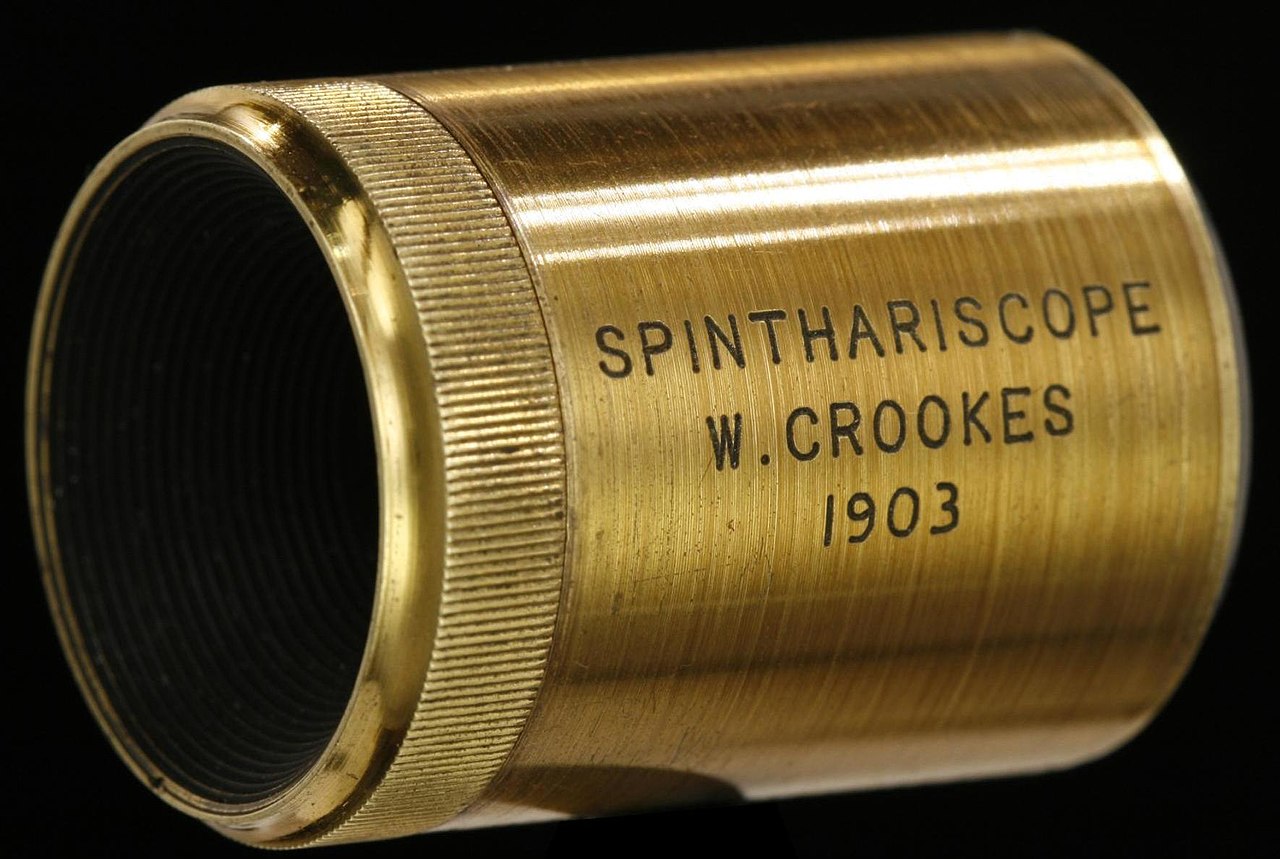
Theodore Gray · CC BY 2.5
- Field
- particle detector · educational toy · radiation detector
VALÉORINE Encyclopedia
VALÉORINE documentary reading
Documentary summary
Illustration — A low quality toy spinthariscope taken from a 1950s Chemcraft brand "Atomic energy" chemistry experimentation set • Illustration — A spinthariscope crafted by Robert Drosten in Belgium in 1905 and used in the University of Mons Faculty of Engineering ("Polytech Mons") at the beginning of the 20th century. A spinthariscope is a device for observing individual nuclear disintegrations caused by the interaction of ionizing radiation with a phosphor (see radioluminescence) or scintillator.
Admitted source layer · organised and presented by VALÉORINE
Note VALÉORINE
No house-authored Note is published until its assertions and sources pass the VALÉORINE evidence contract. The documentary article remains available in full while that enrichment is being consolidated.
Documentary enrichment in progress · no unsupported statement published
Reference Check
Propose documentary evidence for spinthariscope. A contribution is never written directly as fact: identity, source, rights and evidence gates still decide.
Sign in to contribute
World of VALÉORINE
Documentary connections
Only confirmed graph relationships appear here. Images are shown only when their identity and reuse rights both pass the documentary gate.

Documentary evidence
Evidence Panel
not yet certified
- Identity
- resolved
- Independent source families
- 0
- Admitted assertions
- 0
- Open conflicts
- 0
Authority files
wikidata · Q2165889 · wikipedia · Spinthariscope
In this article
Invention
Invention
The spinthariscope was invented by William Crookes in 1903. While observing the apparently uniform fluorescence on a zinc sulfide screen created by the radioactive emissions (mostly alpha radiation) of a sample of radium bromide, he spilled some of the sample, and, owing to its extreme rarity and cost, he was eager to find and recover it. Upon inspecting the zinc sulfide screen under a microscope, he noticed separate flashes of light created by individual alpha particle collisions with the screen. Crookes took his discovery a step further and invented a device specifically intended to view these scintillations. It consisted of a small screen coated with zinc sulfide affixed to the end of a tube, with a tiny amount of radium salt suspended a short distance from the screen and a lens on the other end of the tube for viewing the screen. Crookes named his device from (spinthḗr) "spark". Crookes debuted the spinthariscope at a meeting of the Royal Society, London on 15 May 1903.
Toy spinthariscopes
Toy spinthariscopes
Spinthariscopes were quickly replaced with more accurate and quantitative devices for measuring radiation in scientific experiments, but enjoyed a modest revival in the mid 20th century as children's educational toys. In 1947, Kix cereal offered a Lone Ranger atomic bomb ring that contained a small one, in exchange for a box top and US$0.15. Spinthariscopes can still be bought today as instructional novelties, but they now use americium or thorium. Looking into a properly focused toy spinthariscope, one can see many flashes of light spread randomly across the screen. Almost all are circular, with a very bright pinpoint centre surrounded by a dimmer circle of emission.
In museums
In museums
The American History Museum of the Smithsonian has several spinthariscopes in its collections, and an article discussing them. However, As of 2022 none are currently on display.
Notes from the source article
Cited by Wikipedia
Notes from the source article
These works are cited by the source article, in its own numbering. They are recorded as its citations, not as sources VALÉORINE has verified.
- 1.AXIOCOM.be. Le spinthariscope, un petit objet à l'histoire étonnante !. MUMONS.
- 2.cite Merriam-Webster spinthariscope access-date=2022-01-18
- 3.cite LPD 3
- 4.Crookes, William. Certain Properties of the Emanations of Radium. Chemical News. 87. 2269. 241. 1903.
- 5.Frame, Paul W. The Crookes Spinthariscope. Oak Ridge Associated Universities.
- 6.Alfred Romer. The Restless Atom: The Awakening of Nuclear Physics. Anchor Books. 1960.
- 7.Spinthariscopes.
- 8.Santos, Lucy Jane. Half Lives: The Unlikely History of Radium. Icon Books Ltd. 2020. 978-1-78578-608-2.
- 9.Bonnier Corporation. Popular Science. The Popular Science Monthly. 86–. June 2007. 0161-7370.
- 10.Reif, Rita. "ARTS/ARTIFACTS; Trivia Long Ago, Serious Treasures Now". The New York Times. 11 June 1995.
- 11.Miklós, Vincze. The Terrifying Age of Radioactive Toys for Kids. 15 January 2014.
- 12.Lone Ranger Atom Bomb Ring Spinthariscope (1947 - early 1950s). 5 October 2011.
- 13.The Spinthariscope and the Smithsonian.
- 14.Collections Search Results.
References
Citations
References
Each reference names the institution holding it, so a reader may go to the document itself.
reference work
Partially resolvedreference work
Partially resolved
The Encyclopedia exists whether or not anything is for sale. Corrections are recorded rather than overwritten, and every version of this record is kept. Published 14 August 2026.
Elsewhere in Collectables
20,755 published records in this field, each with its sources named.
- SpineWork
- spinetTerminology
- SpinettoneTerminology
- SpinmasterWork
- SpintiresWork
- spintoTerminology
- spinto sopranoTerminology
- Spiral KnightsWork
Best supported in this field
For owners
Own an object connected with spinthariscope?
A specialist will read what you send and tell you what the house can establish, what it cannot, and whether the object is suited to sale. There is no charge and no obligation. The object stays with you throughout; nothing is shipped to us unless it is arranged in writing beforehand.