
Solarium Augusti
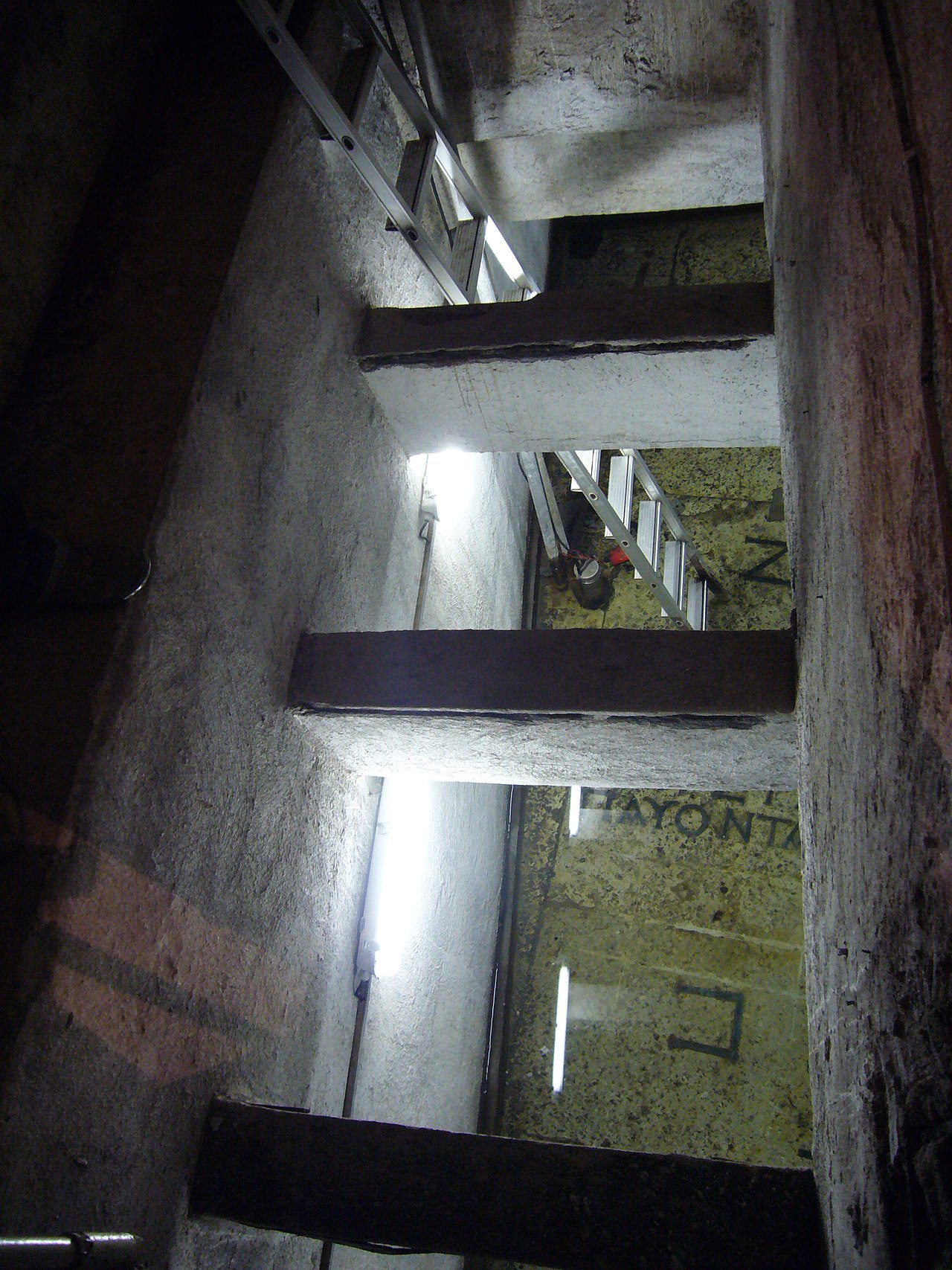
Illustration — Part of the meridian under the cellar of a stable building in the Campus Martius. • Illustration — The Obelisk of Montecitorio gnomon, in present Piazza di Montecitorio location. The Solarium Augusti or Horologium Augusti (both Latin for "Sundial of Augustus"; Orologio di Augusto) was a monument in the Campus Martius of ancient Rome constructed in 10 BCE under the Roman emperor Augustus. It included an Egyptian obelisk that had first been erected under the pharaoh Psamtik II used in some fashion as a gnomon.
Also recorded as Horologium Augusti · Horologium of Augustus · Horologium Solare Augusti
Solarium Augusti
Lalupa · CC BY-SA 3.0
- Region
- Solarium Augusti is situated in Italy.
VALÉORINE Encyclopedia
VALÉORINE documentary reading
Documentary summary
Illustration — Part of the meridian under the cellar of a stable building in the Campus Martius. • Illustration — The Obelisk of Montecitorio gnomon, in present Piazza di Montecitorio location. The Solarium Augusti or Horologium Augusti (both Latin for "Sundial of Augustus"; Orologio di Augusto) was a monument in the Campus Martius of ancient Rome constructed in 10 BCE under the Roman emperor Augustus. It included an Egyptian obelisk that had first been erected under the pharaoh Psamtik II used in some fashion as a gnomon.
Admitted source layer · organised and presented by VALÉORINE
Reference Check
Propose documentary evidence for Solarium Augusti. A contribution is never written directly as fact: identity, source, rights and evidence gates still decide.
Sign in to contribute
Documentary evidence
Documentary basis
Authority files
gnd · 4224567-9 · wikidata · Q1233638 · wikipedia · Solarium Augusti
In this article
History
History
Once believed to have been a massive sundial, it is now more commonly understood to have been used with a meridian line used to track the solar year. It served as a monument of Augustus having brought Egypt under Roman rule and was also connected with the Altar of Augustan Peace commemorating the Pax Romana established by his ending the numerous civil wars that ended the Roman Republic. The Solarium was destroyed at some point during the Middle Ages. Its recovered obelisk is now known as the Obelisk of Montecitorio.
It was erected by the emperor Augustus, with the 30-meter Egyptian red granite Obelisk of Montecitorio, that he had brought from Heliopolis in ancient Egypt. The obelisk was employed as a gnomon that cast its shadow on a marble pavement inlaid with a gilded bronze network of lines, by which it was possible to read the time of day according to the season of the year. The solarium was dedicated to the Sun in 10 BCE, 35 years after Julius Caesar's calendar reform. It was the first solar dedication in Rome. The Solarium Augusti was integrated with the Ara Pacis in the Campus Martius, aligning with Via Flaminia, in such a way that the shadow of the gnomon fell across the center of the marble altar on 23 September, the birthday of Augustus himself. The obelisk itself was set up to memorialize Augustus' subordination of Egypt to the control of the Roman empire. The two monuments must have been planned together, in relation to the pre-existing Mausoleum of Augustus, to demonstrate that Augustus was "born to bring peace", that peace was his destiny. According to the Cambridge Ancient History, "the collective message dramatically linked peace with military authority and imperial expansion." In his Natural History, Pliny remarks that in the monument had stopped accurately reflecting the solar year by about 40 CE and offers several explanations for the shift, including that the sun, the earth, or both might not be as fixed in their position and movement as was usually believed at the time. The obelisk was illustrated, supported by a reclining figure, on the base of the Column of Antoninus Pius. The obelisk gnomon was still standing in the 8th century CE, but was thrown down and broken, then covered in sediment; it was rediscovered in 1512, but not excavated. In a triumphant rededication, the 'Montecitorio obelisk' was re-erected in Piazza di Montecitorio by Pius VI in 1789. • Illustration — 18th Century Depiction of the horologium of Augustus on an engraving dating by Giovanni Battista In 1979, a section of the ancient paving of the square was found at a depth of 8 metre pit inside a series of vaults in the Campo Marzio, bearing a calibrated line and inscriptions in Greek referring to zodiac symbols. The ancient consecration inscription has been maintained and reads: • IMP CAESAR DIVI F AUGUST PONTIFEX MAXIMUS IMP XII COS XI TRIB POT XIV AEGUPTO IN POTESTATEM POPULI ROMANI REDACTA SOLI DONUM DEDIT — Imperator Caesar son of a deified Augustus pontifex maximus 12 times imperator, 11 times consul, 14 times (clothed with) tribunicia potestas. After Egypt was brought under the authority of the Roman people he gave (this obelisk) to the sun • Illustration — Fragment of the meridian, in a cellar at no. 48, Via di Campo Marzio.
Archaeology
Archaeology
Edmund Buchner excavated some sections of the calibrated marble pavement of the Solarium Augusti under the block of houses between Piazza del Parlamento and Piazza San Lorenzo in Lucina. Recent studies have challenged Buchner's reconstruction of the Solarium as a full sundial, maintaining that the archaeological and textual evidence indicates a simple meridian line, marking the changing noontime position of the Sun in the course of the year.
Places
Named by the record
Places
Only places the record itself states, plotted where the house gazetteer settles their coordinates. Nothing is inferred from a name or a nationality.
Solarium Augusti is situated in Italy.
Country
Solarium Augusti is associated with Italy.
Country
Primary material
Documents and archives
reference work
- Wikidata, structured authority record Q1233638: Solarium Augusti
Reputable secondary · Wikidata
- “Solarium Augusti”, English Wikipedia, consulted as further reading
Reputable secondary · Wikipedia
authority file
- Gemeinsame Normdatei 4224567-9, Rom / Solarium Augusti.
General reference · Deutsche Nationalbibliothek
Citations
References
Each reference names the institution holding it, so a reader may go to the document itself.
authority file
Gemeinsame Normdatei 4224567-9, Rom / Solarium Augusti.Deutsche Nationalbibliothek
Secondary witnessreference work
Secondary witnessreference work
Secondary witness
The Encyclopedia exists whether or not anything is for sale. Corrections are recorded rather than overwritten, and every version of this record is kept. Published 16 August 2026.
Elsewhere in Scientific instruments
736 published records in this field, each with its sources named.
- solar telescopeTerminology
- Solar Wind Composition ExperimentTerminology
- Solar Wind SpectrometerTerminology
- solar-powered calculatorTerminology
- Sondrestrom Upper Atmospheric Research FacilityTerminology
- South Pole TelescopeTerminology
- Southern African Large TelescopeTerminology
- Southern Astrophysical Research TelescopeTerminology
Best supported in this field
For owners
Own an object connected with Solarium Augusti?
A specialist will read what you send and tell you what the house can establish, what it cannot, and whether the object is suited to sale. There is no charge and no obligation. The object stays with you throughout; nothing is shipped to us unless it is arranged in writing beforehand.