
slave clock
Illustration — Diagram of electric time system used around 1910 to keep time in factories, schools, and other large institutions. The master clock (bottom center), controlled by a temperature-compensated mercury pendulum, is wired to slave clocks throughout the building. In addition to wall clocks, it also controls time stamps that are used to stamp documents with the time, and a turret clock used in a clock tower.
slave clock

JuergenG · made by JuergenG · CC BY-SA 3.0
- Field
- clock
VALÉORINE Encyclopedia
VALÉORINE documentary reading
Documentary summary
Illustration — Diagram of electric time system used around 1910 to keep time in factories, schools, and other large institutions. The master clock (bottom center), controlled by a temperature-compensated mercury pendulum, is wired to slave clocks throughout the building. In addition to wall clocks, it also controls time stamps that are used to stamp documents with the time, and a turret clock used in a clock tower.
Admitted source layer · organised and presented by VALÉORINE
Note VALÉORINE
No house-authored Note is published until its assertions and sources pass the VALÉORINE evidence contract. The documentary article remains available in full while that enrichment is being consolidated.
Documentary enrichment in progress · no unsupported statement published
Reference Check
Propose documentary evidence for slave clock. A contribution is never written directly as fact: identity, source, rights and evidence gates still decide.
Sign in to contribute
World of VALÉORINE
Documentary connections
Only confirmed graph relationships appear here. Images are shown only when their identity and reuse rights both pass the documentary gate.
Documentary evidence
Evidence Panel
not yet certified
- Identity
- resolved
- Independent source families
- 0
- Admitted assertions
- 0
- Open conflicts
- 0
Authority files
wikidata · Q7539183 · wikipedia · Slave clock
In this article
Pictures
The "program clock" is a timer that can be programmed with punched paper tape to ring bells or turn machines on and off at preprogrammed times. In telecommunication and horology, a slave clock is a clock that depends on another clock, the master clock. Modern clocks are synchronized through the Internet or by radio time signals, to Coordinated Universal Time. UTC is based on a network of atomic clocks in many countries. For scientific purposes, precision clocks can be synchronized to within nanoseconds by dedicated satellite channels. clock synchronization is usually achieved by phase-locking the slave clock signal to a signal received from the master clock. To adjust for the transit time of the signal from the master clock to the slave clock, the phase of the slave clocks are adjusted so that both clocks are in phase. Thus, the time markers of both clocks, at the output of the clocks, occur simultaneously. The predecessors of atomic clocks, computer clocks, and digital clocks, these electric clocks (or pneumatic clocks) were synchronized by an electrical pulse, wired to their master clock in the same facility. (In the case of pneumatic clocks, pneumatic tubing was used instead of electrical wiring.) Hence the terms "master" and "slave." From the late 19th to the mid 20th centuries, electrical master/slave clock systems were installed, all clocks in a building or facility synchronized through electric wires to a central master clock. Slave clocks either kept time by themselves, and were periodically corrected by the master clock, or required impulses from the master clock. Many slave clocks of these types were in operation, most commonly in schools, offices, military bases, hospitals, railway networks, telephone exchanges and factories the world over. School bells of elementary schools, high schools, and others were able to be synchronized across an entire campus, connected to the system. In schools, the master clock was in the principal's office, with slave units in classrooms which were in other buildings on campus. In factories, a system with a bell or horn could signal the end of a shift, lunchtime or break time. Very few relics of this electrical, analogue system operate in the 21st century. Most 21st century systems of the type are digital.
Mechanical slave clocks from the 1950s and 1960s era. • Illustration — Slave clock • Illustration — Synchronome slave clock • Illustration — Early G.P.O. type 6, manufactured by Synchronome • Illustration — Slave clock drive mechanism • Illustration — A slave clock driven by a quartz clock module
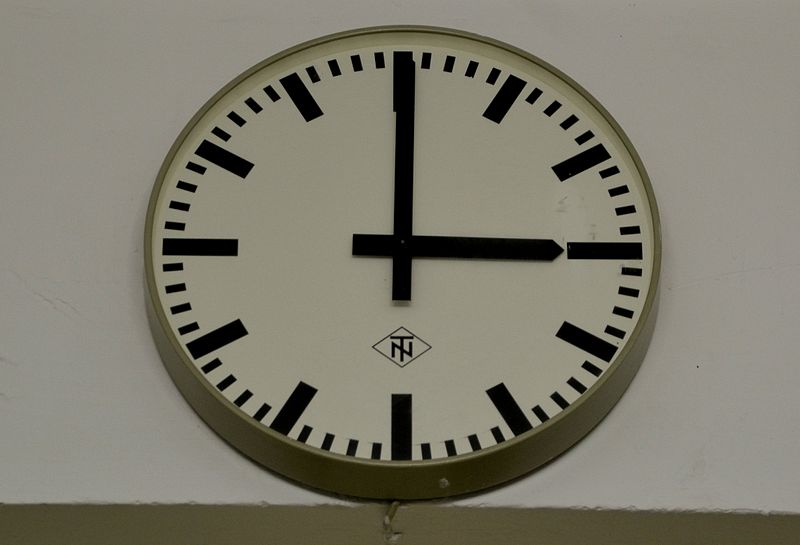
Wanduhr in Deutschland. Es ist 15:00 Uhr.
High Contrast

Slave cock type 6 G.P.O.
User:Alphaboi1 · Alphaboi1
Primary material
Documents and archives
reference work
- “Slave clock”, English Wikipedia, consulted as further reading
Reputable secondary · Wikipedia
authority record
- Wikidata, structured authority record Q7539183: slave clock
Unverified · Wikidata
Citations
References
Each reference names the institution holding it, so a reader may go to the document itself.
reference work
Partially resolvedauthority record
Unverified
The Encyclopedia exists whether or not anything is for sale. Corrections are recorded rather than overwritten, and every version of this record is kept. Published 14 August 2026.
Elsewhere in Clocks
110 published records in this field, each with its sources named.
- Rolex MilgaussTerminology
- rolling ball clockTerminology
- Rostock astronomical clockTerminology
- Sion astronomical clockTerminology
- Slovak Astronomical Clock in Stará BystricaTerminology
- Sony Dream MachineTerminology
- speaking clockTerminology
- St Mark's ClockTerminology
Best supported in this field
For owners
Own an object connected with slave clock?
A specialist will read what you send and tell you what the house can establish, what it cannot, and whether the object is suited to sale. There is no charge and no obligation. The object stays with you throughout; nothing is shipped to us unless it is arranged in writing beforehand.