
Shijō school
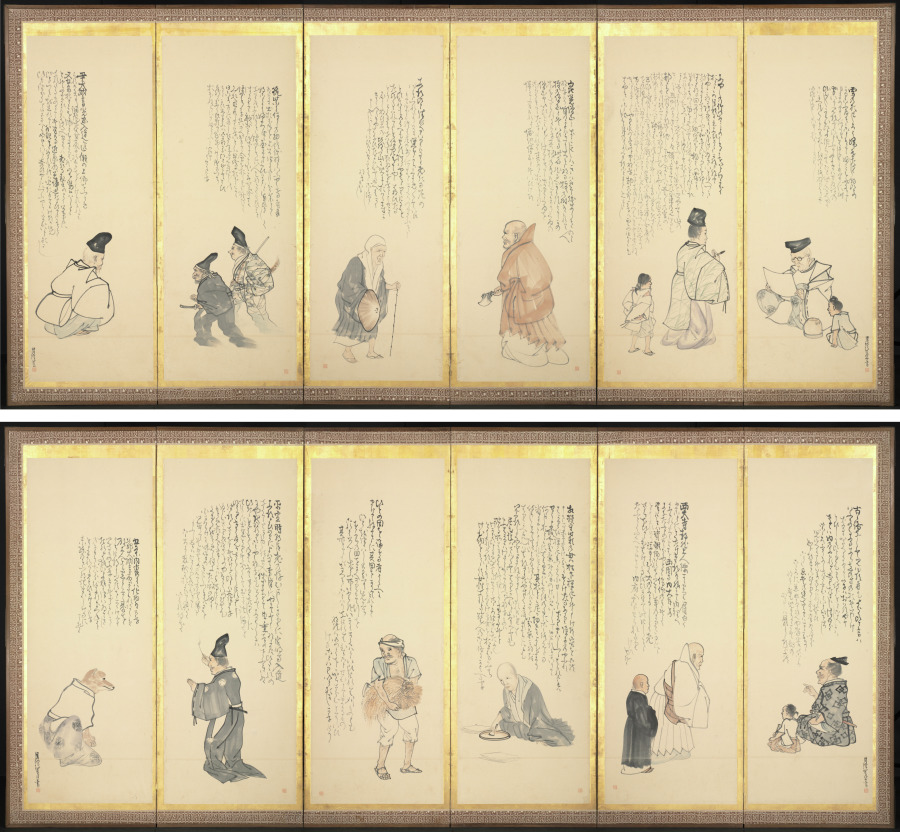
Illustration — Pine, Bamboo, Plum, by Maruyama Ōkyo. One of two sixfold screens. • Illustration — Quail Feeding Amidst Susuki and Kikyo, by Matsumura Keibun (1830) • Illustration — Shōka arrangement by the 40th headmaster Ikenobō Senjō, from the Sōka Hyakki, by Matsumura Keibun and Yokoyama Seiki (1820) The Shijō school, also known as the Maruyama–Shijō school, was a Japanese school of painting.
Shijō school

Nagasawa Rosetsu · Google Arts Culture — roses-butterfly-and-puppies-rosetsu-nagasawa/QAFwwhgZFfsLAA · Public domain
- Field
- Maruyama–Shijō school
VALÉORINE Encyclopedia
VALÉORINE documentary reading
Documentary summary
Illustration — Pine, Bamboo, Plum, by Maruyama Ōkyo. One of two sixfold screens. • Illustration — Quail Feeding Amidst Susuki and Kikyo, by Matsumura Keibun (1830) • Illustration — Shōka arrangement by the 40th headmaster Ikenobō Senjō, from the Sōka Hyakki, by Matsumura Keibun and Yokoyama Seiki (1820) The Shijō school, also known as the Maruyama–Shijō school, was a Japanese school of painting.
Admitted source layer · organised and presented by VALÉORINE
Note VALÉORINE
No house-authored Note is published until its assertions and sources pass the VALÉORINE evidence contract. The documentary article remains available in full while that enrichment is being consolidated.
Documentary enrichment in progress · no unsupported statement published
Reference Check
Propose documentary evidence for Shijō school. A contribution is never written directly as fact: identity, source, rights and evidence gates still decide.
Sign in to contribute
World of VALÉORINE
Documentary connections
Only confirmed graph relationships appear here. Images are shown only when their identity and reuse rights both pass the documentary gate.
Documentary evidence
Evidence Panel
not yet certified
- Identity
- resolved
- Independent source families
- 0
- Admitted assertions
- 0
- Open conflicts
- 0
Authority files
wikidata · Q3577704 · wikipedia · Shijō school
In this article
History
History
It was an offshoot school of the Maruyama school of Japanese painting founded by Maruyama Ōkyo, and his former student Matsumura Goshun in the late 18th century. This school was one of several that made up the larger Kyoto school. The school is named after the Shijō Street ("Fourth Avenue") in Kyoto where many major artists were based. Its primary patrons were rich merchants in and around Kyoto/Osaka and also appealed to the kamigata who were of the established aristocrat and artisan families of the Imperial capital during the late 18th/19th centuries.
Style
Style
Stylistically, the Shijō style can best be described as a synthesis of two rival styles of the time. Maruyama Ōkyo was an experienced and expert painter of sumi-e ink paintings, and accomplished a great degree of realism in his creations, emphasizing direct observation of depicted subjects which was a direct contravention of the officially sponsored schools of the time, Kanō and Tosa, which emphasized decorativeness with highly formalized and stylized figures taught to its students via copying paintings of past masters. The Kanō and Tosa schools had become bywords for rigid formalism by this time. Meanwhile, a number of artists, rebelling against Ōkyo's realism, formed the nanga ("southern pictures") school, basing their style largely on the Southern school of Chinese painting. The artists of the Shijō school sought to reconcile the differences between these two styles, creating works that synthesized the best elements of both. The school's style focuses on a Western-influenced objective realism, but achieved with traditional Japanese painting techniques. It concentrates less on the exact depiction of its subject, but rather on expressing the inner spirit and usually has an element of playfulness and humor compared to the Maruyama school. Popular motifs include tranquil landscapes, kachō (bird and flower), animals, and traditional subjects from Chinese poetic and Confucian lore, but there is generally little or no interest in legends, history, or classical literature.
Artists
Artists
One of the most well-known Shijō artists in the West is Mori Sosen, who is known for his great number of paintings of monkeys. Shibata Zeshin is also closely associated with the Shijō school, though he worked in many other styles and mediums, most notably lacquer objects and lacquer painting. • Matsumura Goshun • Matsumura Keibun • Maruyama Ōkyo • Mori Sosen • Kikuchi Yōsai • Ohara Shoson (Koson) • Shibata Zeshin • Watanabe Kazan

Bird on a branch by Oda Kaisen from a concertina album of 26 paintings, color on paper, 11 x 13 in (28 x 33 cm)
Oda Kaisen · Richard Kruml Ukiyo-e, London

Finger citron and peach by Oda Kaisen from a concertina album of 26 paintings, color on paper, 11 x 13 in (28 x 33 cm).
Oda Kaisen · Richard Kruml Ukiyo-e, London
Primary material
Documents and archives
reference work
- “Shijō school”, English Wikipedia, consulted as further reading
Reputable secondary · Wikipedia
- Wikidata, structured authority record Q3577704: Shijō school
Reputable secondary · Wikidata
scholarly index
- OpenAlex bibliographic index, 12 indexed publications naming Shijō school.
Unverified · OpenAlex
Notes from the source article
Cited by Wikipedia
Notes from the source article
These works are cited by the source article, in its own numbering. They are recorded as its citations, not as sources VALÉORINE has verified.
- 1.L'Art du Japon. Éditions LGF - Livre de Poche. 1996. 2-253-13054-0.
- 2.Japanese Paintings and Prints of the Shijō School. New York: The Brooklyn Museum, 1981.
- 3.harvsp Christine Guth, 1996 p=78
Bibliography printed in the source article · 10
- La peinture japonaise contemporaine. La Manufacture. 1991. 2-7377-0293-3.
- L'art japonais de la période Edo. Flammarion. 1996. 2-08-012280-0.
- Chibbett, David. The History of Japanese Printing and Book Illustration. New York: Kodansha International Ltd, 1977.
- Japanese Paintings and Prints of the Shijo School. New York: The Brooklyn Museum, 1981.
- Munsterberg, Hugo (1957). The Arts of Japan: An Illustrated History. Tokyo: Charles E. Tuttle Company.
- Splendors of Imperial Japan: Arts of the Meiji Period from the Khalili Collection. London: The Khalili Family Trust, 2002.
- Zeshin and Related Artists. London: Milne Henderson, 1976.
- Wada, Stephanie (2003). Discovering the arts of Japan : a historical overview. New York : Kodansha International. .
- Deal, William (2007). Handbook to life in medieval and early modern Japan. New York: Oxford University Press. .
- Paine, Robert, AlexanderSoper, et David Waterhouse (1981). The art and architecture of Japan. New Haven : Yale University Press. .
References
Citations
References
Each reference names the institution holding it, so a reader may go to the document itself.
scholarly index
Partially resolvedreference work
Partially resolvedreference work
Partially resolved
The Encyclopedia exists whether or not anything is for sale. Corrections are recorded rather than overwritten, and every version of this record is kept. Published 14 August 2026.
Elsewhere in Terminology
620 published records in this field, each with its sources named.
- SeicentoMovement
- Seiz BreurMovement
- serialismMovement
- SestigersMovement
- shin-hangaMovement
- ShinkankakuhaMovement
- Shinkō shashinMovement
- shock artMovement
Best supported in this field
For owners
Own an object connected with Shijō school?
A specialist will read what you send and tell you what the house can establish, what it cannot, and whether the object is suited to sale. There is no charge and no obligation. The object stays with you throughout; nothing is shipped to us unless it is arranged in writing beforehand.