
Salvador Espriu
Salvador Espriu i Castelló (Catalan pronunciation: [səlβəˈðo əsˈpɾiw]; 10 July 1913 – 22 February 1985) was a Catalan poet from Spain.
Salvador Espriu

Jordiferrer · CC BY-SA 3.0
- Born
- 1913. · Santa Coloma de Farners.
- Died
- 1985. · Barcelona.
- Nationality
- Spain.
- Occupation
- poet, writer and playwright.
- Education
- University of Barcelona.
- Known for
- Cementiri de Sinera and Laia.
- Honours
- Premi d'Honor de les Lletres Catalanes, Gold Letter, Serra d'Or Critics' Prize for Literature and Essays, honorary doctorate of Barcelona University, Gold Medal of the Generalitat of Catalonia and Knight Grand Cross with Collar of the Order of Alfonso X.
- Languages
- Catalan and Spanish.
VALÉORINE Encyclopedia
VALÉORINE documentary reading
Documentary summary
Salvador Espriu i Castelló (Catalan pronunciation: [səlβəˈðo əsˈpɾiw]; 10 July 1913 – 22 February 1985) was a Catalan poet from Spain.
Admitted source layer · organised and presented by VALÉORINE
Note VALÉORINE
No house-authored Note is published until its assertions and sources pass the VALÉORINE evidence contract. The documentary article remains available in full while that enrichment is being consolidated.
Documentary enrichment in progress · no unsupported statement published
Reference Check
Propose documentary evidence for Salvador Espriu. A contribution is never written directly as fact: identity, source, rights and evidence gates still decide.
Sign in to contribute
World of VALÉORINE
Documentary connections
Only confirmed graph relationships appear here. Images are shown only when their identity and reuse rights both pass the documentary gate.

Documentary evidence
Evidence Panel
not yet certified
- Identity
- resolved
- Independent source families
- 0
- Admitted assertions
- 0
- Open conflicts
- 0
Authority files
gnd · 1092375120 · wikidata · Q372549 · wikipedia · Salvador Espriu
In this article
Biography
Biography
Salvador Espriu studied at University of Barcelona. The recorded working language is Catalan and Spanish. Joaquim Ruyra and Ramón María del Valle-Inclán are recorded as an influence. Positions recorded include member of the Reial Acadèmia de Bones Lletres de Barcelona. Works named in the authority record are Cementiri de Sinera and Laia. Distinctions recorded are Premi d'Honor de les Lletres Catalanes, Gold Letter, Serra d'Or Critics' Prize for Literature and Essays and honorary doctorate of Barcelona University.
Espriu was born in Santa Coloma de Farners, Catalonia, Spain. He was the son of an attorney. He spent his childhood between his home town, Barcelona, and Arenys de Mar, a village on the Maresme coast. At the age of sixteen, he published his first book, Israel, written in Spanish. In 1930 he entered the University of Barcelona, where he met his lifelong friend Bartomeu Rosselló-Pòrcel. He studied law and ancient history. While traveling (1933) to Egypt, Greece and Palestine, he became acquainted with the countries that originated the great classical myths, and which would be so influential in his work. During the Spanish Civil War he was mobilised and served in military accounting. Translated into several languages, Espriu's work has obtained international recognition, most notably the Montaigne prize (1971). He was also given the Award of Honour of Catalan Letters (1972), the Ignasi Iglesias prize (1980), the City of Barcelona Prize (1982) and the Gold Medal of the Generalitat de Catalunya (1982). He was awarded honorary doctor's degrees by the universities of Toulouse and Barcelona. He died in Barcelona in 1985, and was buried in the Arenys de Mar cemetery, which gives name to his poem Cementiri de Sinera.
First works
First works
In 1931 he published El doctor Rip, and the following year, Laia, novels that move away from the then-fashionable theoretical formulas of the aesthetics of the Catalan Noucentisme movement. The publication of Aspectes (1934), Ariadna al laberint grotesc (1935) and Miratge a Citera (1935), established him as the most original narrator of his generation. In these books, Espriu's prose alternately shifts from grotesque distortion to an aestheticising lyricism, probably under the influence of Spanish-language modernists Valle-Inclán and Gabriel Miró). He elaborated a synthetic realism under the linguistic tutelage of certain Catalan writers, such as Víctor Català and Joaquim Ruyra.
The civil war
The civil war
In 1937, during the Civil War, he published Letizia i altres proses. In 1939, in occupied Barcelona and before the military conflict ended, he wrote a play, Antígona (published in 1955 and opened in 1958), on the subject of fratricidal war and compassion for the losers.
Poetry
Poetry
Espriu, who had begun to write poetry before the war, did not publish his first volume of poems until 1946: Cementiri de Sinera, an elegy with a great formal sobriety. With this book and with the play Primera història d'Esther (published in 1948 and opened in 1957) —linguistically creative and original— began his post-war popularity, which grew as the rest of his work, essentially poetical, was published. In Les cançons d'Ariadna (1949) he collected a series of poems from various periods that contrasted satire and distortion with elegy and lyricism and in which the mythological subjects can be found that were to appear in subsequent works. The four books of poems that followed —Les hores and Mrs. Death (1952), El caminant i el mur (1954) and Final del laberint (1955)—compose, together with Cementiri de Sinera, a specific formal unity, on the one hand, given the symmetrical number of poems included in each volume and, on the other, the strict development of a very complex spiritual process that culminates in a mystical experience in the last book of the cycle. The musicality of Espriu's poetry has been stressed by Andreas Dorschel.
Popular success
Popular success
The tremendous public success of La pell de brau (1960) signified the popular recognition of Espriu: the author posed the historical drama of Sepharad (poet's nickname for Spain after the Jewish usage) in poems with a high spiritual, moral and political resonance. Llibre de Sinera (1963), one of his most hermetic books, ties in with subjects from the two previous works and again circumscribes the civil ambit of his poetry to the "homeland" mythicized in Sinera, a word phonetically formed by spelling backwards Arenys. In Setmana Santa (1971), through the images of the ritual procession, the author presents the myth of the Catholic Passion from a metaphysical perspective. The bibliography of Espriu contains two more poems, included in the first volume of his Complete works (1968) (Per al llibre de salms d'aquests vells cecs and Fragments. Versots. Intencions. Matisos), and a selection of critical works, Evocació de Rosselló-Pòrcel i altres notes (1957). Beginning in 1968, with the publication of his Complete works I. Poetry, he dedicated himself to a minute revision of his entire work. In narrative, the novels El doctor Rip (1931) and Laia (1932) were practically re-written when they were again published (1979 and 1968, respectively). The same occurred with his collection of narrations Aspectes (1934) and Ariadna al laberint grotesc (1935), published again in 1981 and 1975, respectively. The last examples of his production were, with respect to theatre, Una altra Fedra si us plau... (1978), the prose volume Les roques i el mar, el blau (1981) and, in poetry, the poem D'una vella i encerclada terra (1979) and the collection Per a la bona gent (1984). Several theatral stagings of this work were made by Ricard Salvat, who also composed, based on texts by Espriu from various origins, Ronda de mort a Sinera (1966), a work with a broad theatrical audience. The Valencian songwriter and singer Raimon has set to music Espriu's poems including Les cançons de la roda del temps (Songs on the Passing of Time), Inici de càntic en el temple (Beginning of the Canticle in the Temple) and Indesinenter.
A meditation on death
A meditation on death
The author generically described his work as a "meditation on death", but this term is too restrictive to comprehend its complexity and cultural point of view. Actually, Espriu proposes to assume the literary tradition of humanity in a personal re-creation situated in a specific geographical and historical context, Catalonia after the defeat of the Spanish Republic in the Spanish civil war, of which he sings its failings and hope.
International acclaim
International acclaim
During his acceptance of the International Catalonia prize, renowned literary critic Harold Bloom called Espriu 'an extraordinary poet by any international standard', and later said 'The Nobel committee is guilty of many errors, and one of those was not to have given the prize to Salvador Espriu. I believe he deserved it'.

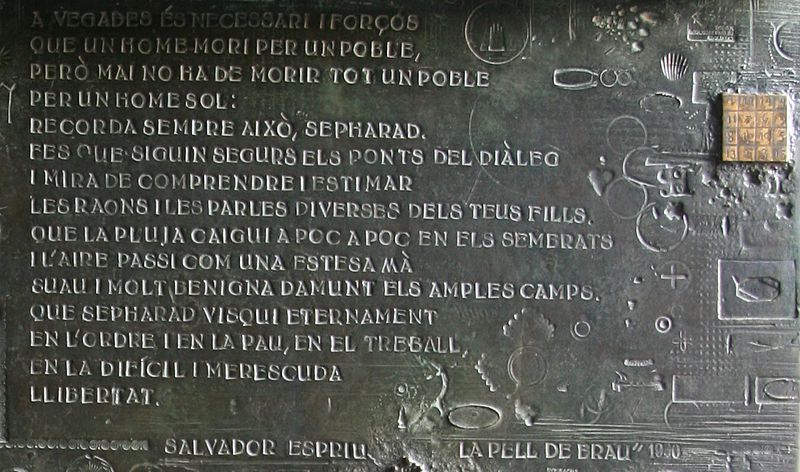
Monument to Pau Casals, in Barcelona. It includes verses from poet Salvador Espriu
Jordiferrer
Door of the Crowning with Thorns at the Passion Facade of the Sagrada Família.
Till Niermann
Life and career
Dated record
Life and career
The full dated record · 2 entries
1913
Salvador Espriu born at Santa Coloma de Farners.
1985
Salvador Espriu died at Barcelona.
Places
Named by the record
Places
Only places the record itself states, plotted where the house gazetteer settles their coordinates. Nothing is inferred from a name or a nationality.
Santa Coloma de Farners.
Birth place
Barcelona.
Death place
Primary material
Documents and archives
scholarly publication
- SALVADOR ESPRIU, Anthology of Catalan Lyric Poetry, 1953
Scholarly · Crossref registry · 1953
- SALVADOR ESPRIU, Anthology of Catalan Lyric Poetry, 2023
Scholarly · Crossref registry · 2023
- The Poetry of Salvador Espriu, 2006
Scholarly · Crossref registry · 2006
- The voice of the cypresses: Cyrus Cassells and the poetry of Salvador Espriu, Language Value, 2019
Scholarly · Crossref registry · 2019
reference work
- Wikidata, structured authority record Q372549: Salvador Espriu
Reputable secondary · Wikimedia Foundation
- “Salvador Espriu”, English Wikipedia, consulted as further reading
Reputable secondary · Wikipedia
Notes from the source article
Cited by Wikipedia
Notes from the source article
These works are cited by the source article, in its own numbering. They are recorded as its citations, not as sources VALÉORINE has verified.
- 1.Andreas Dorschel, Lieder der Ariadne. Der große katalanische Lyriker Salvador Espriu. In: Süddeutsche Zeitung, 15 October 2007. Aspects of Dorschel's text have been discussed by Ramon Farrés in Fritz Vogelgsang: Salvador Esprius Übersetzer ins Deutsche. In: Zeitschrift für Katalanistik 23 (2010), pp. 39–52.
References
Citations
References
Each reference names the institution holding it, so a reader may go to the document itself.
scholarly publication
SALVADOR ESPRIU, Anthology of Catalan Lyric Poetry, 1953Crossref registry
Verifiedscholarly publication
SALVADOR ESPRIU, Anthology of Catalan Lyric Poetry, 2023Crossref registry
Verifiedscholarly publication
The Poetry of Salvador Espriu, 2006Crossref registry
Verifiedscholarly publication
The voice of the cypresses: Cyrus Cassells and the poetry of Salvador Espriu, Language Value, 2019Crossref registry
Verifiedreference work
Wikidata, structured authority record Q372549: Salvador EspriuWikimedia Foundation
Partially resolvedreference work
Partially resolved
A further 1 witness is held back from this article because the person or object named in it is not yet resolved to this record. They are kept, not discarded, and return once the identity is established.
People, houses and institutions
Knowledge graph
People, houses and institutions
Teachers, collaborators, publishers and institutions recorded against this person, each on a stated basis.
Studied at
1- University of BarcelonaOrganisation
Established from a fact already recorded on a verified source.
The Encyclopedia exists whether or not anything is for sale. Corrections are recorded rather than overwritten, and every version of this record is kept. Published 14 August 2026.
Elsewhere in Books
38,661 published records in this field, each with its sources named.
- Salvador de MadariagaAuthor
- Salvador de MendonçaAuthor
- Salvador Díaz MirónAuthor
- Salvador ElizondoAuthor
- Salvador García-BodañoAuthor
- Salvador Garmendia GraterónAuthor
- Salvador Jorge BlancoAuthor
- Salvador NovoAuthor
Best supported in this field
For owners
Own a work by Salvador Espriu?
A specialist will read what you send and tell you what the house can establish, what it cannot, and whether the object is suited to sale. There is no charge and no obligation. The object stays with you throughout; nothing is shipped to us unless it is arranged in writing beforehand.