
Sakai Hōitsu
August 1, 1761 – January 4, 1829 was a Japanese painter of the Rinpa school. He is known for having revived the style and popularity of Ogata Kōrin, and for having created a number of reproductions of Kōrin's work.
Also recorded as Sakai Hoitsu · Hōitsu · Keikyo-dōjin · Ukaan
Sakai Hōitsu
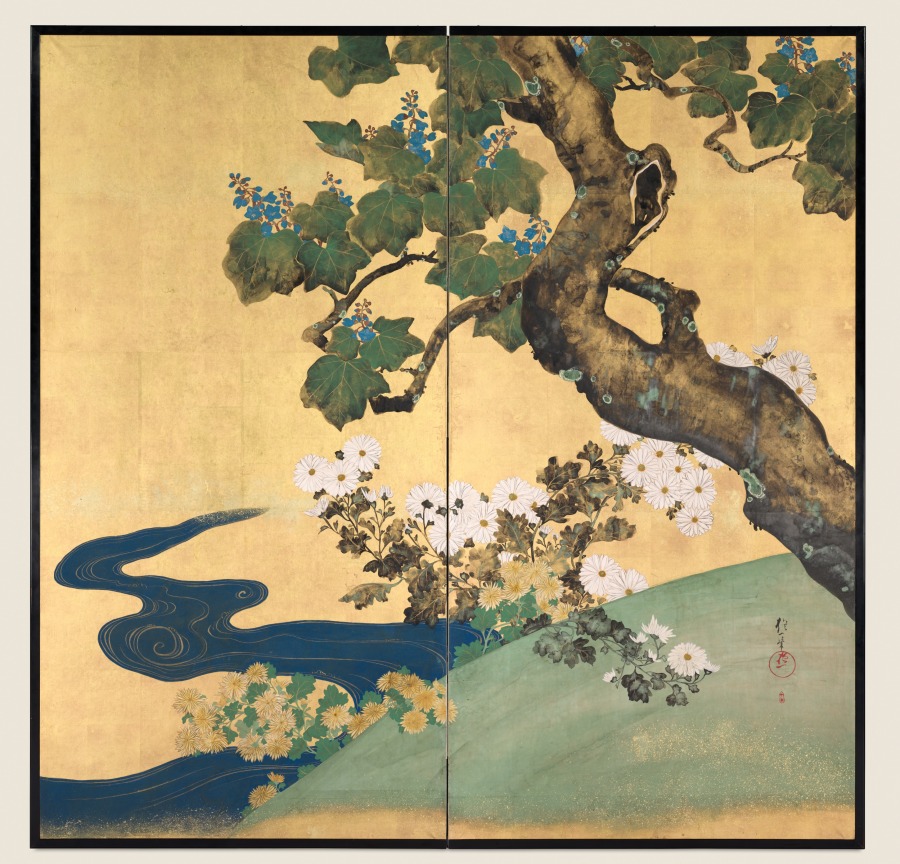
Sakai Hōitsu · The Cleveland Museum of Art · Gift of the American Foundation for the Maud E. and Warren H. Corning Botanical Collection · CC0
- Name
- Sakai Hōitsu 酒井 抱一
- Born
- 1 August 1761
- Birthplace
- Edo, Japan
- Died
- 4 January 1829
- Field
- * Painting
- Movement
- Rinpa school
- Nationality
- Japan
- Occupation
- painter · artist
- Fields
- Rimpa school
- Teachers
- Kanō Korenobu · Utagawa Toyoharu · Monnyo
- Known for
- Flowering Plants of Summer and Autumn
- Languages
- Japanese
VALÉORINE Encyclopedia
VALÉORINE documentary reading
Documentary summary
August 1, 1761 – January 4, 1829 was a Japanese painter of the Rinpa school. He is known for having revived the style and popularity of Ogata Kōrin, and for having created a number of reproductions of Kōrin's work.
Admitted source layer · organised and presented by VALÉORINE
Note VALÉORINE
Sakai Hōitsu (died 1828) was an artist and painter, of Japanese nationality. The artist was born in Ogawamachi and died in Negishi.
Sakai Hōitsu worked in Japan and Osaka. The artist was associated with Rimpa school.
Among the works is Flowering Plants of Summer and Autumn. The work spans Rimpa school. Languages used include Japanese.
Composed from admitted, traceable facts · 01 October 2026
VALÉORINE
Reference Check
Propose documentary evidence for Sakai Hōitsu. A contribution is never written directly as fact: identity, source, rights and evidence gates still decide.
Sign in to contribute
World of VALÉORINE
Documentary connections
Only confirmed graph relationships appear here. Images are shown only when their identity and reuse rights both pass the documentary gate.
Documentary evidence
Documentary basis
Authority files
getty · 500121066 · gnd · 132561018 · wikidata · Q3469342 · wikipedia · Sakai Hōitsu
In this article
Biography
Biography
Training under Kanō Korenobu, Utagawa Toyoharu and Monnyo is recorded. Suzuki Kiitsu, Ikeda Koson and Sakai Ōho are recorded as having studied under Sakai Hōitsu. The recorded working language is Japanese. Subjects and genres recorded for the work are Rimpa school. Places of work recorded in the authority are Osaka and Japan. Works named in the authority record are Flowering Plants of Summer and Autumn. Work by Sakai Hōitsu is recorded in the collections of National Gallery of Victoria, Minneapolis Institute of Art, The Nelson-Atkins Museum of Art, Ashmolean Museum and National Museum of World Cultures.
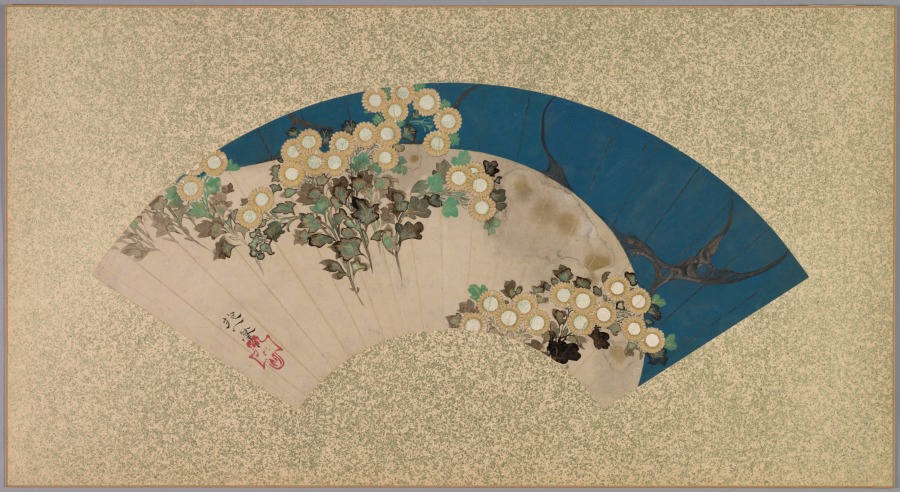
Chrysanthemums by the Water, 1761–1828, by Sakai Hōitsu
Sakai Hōitsu · The Cleveland Museum of Art · Purchase from the J. H. Wade Fund
Key facts
Key facts
• Name — Sakai Hōitsu 酒井 抱一 • Born — 1 August 1761 • Birthplace — Edo, Japan • Died — 4 January 1829 • Place of death — Edo, Japan • Field — * Painting • Design • Movement — Rinpa school • Works — * Flowering Plants of Summer and Autumn (Important Cultural Property) • Wind God and Thunder God
Biography
Biography
Sakai Hōitsu was born on 1 August 1761 in Edo. His father was the lord (daimyō) of Himeji Castle in Harima Province. The Sakai daimyō clan originated in Mikawa Province. They claim descent from Minamoto no Arichika. Arichika had two sons: one of them, Yasuchika, took the name of Matsudaira; and the other son, Chikauji, took the name of Sakai, and this is the ancestor of the Sakai clan. Sakai Hirochika, the son of Chikauji, had two sons as well; and the descendants of these two sons gave rise to the two principal branches of the clan. A cadet branch of the Sakai is composed of the descendants of Sakai Masachika, who was a vassal of the Tokugawa – Nobutada, Kiyoyasu et Hirotada. In 1561, Masachika was installed at Nishio Castle in Mikawa province, and the security of the castle was confided in him. In 1590, Sakai Shigetada, the son of Masachika, received the domain of Kawagoe in Musashi Province (15,000 koku); then in 1601, he was installed at Umayabashi in Kōzuke province (35,000 koku). In 1749, Sakai Tadakiyo (1626–1681) and his descendants were transferred to Himeji in Harima Province (150,000 koku); and they remained daimyō at Himeji until the Meiji period. Moving to Kyoto, Hōitsu began his studies in art in the Kanō school before moving on to study under Utagawa Toyoharu of the ukiyo-e style. He later studied under Watanabe Nangaku of the Maruyama school and Sō Shiseki of the nanga style before finally becoming a painter of the Rinpa school. • Illustration — Sakai Hoitsu's tomb Hōitsu, citing poor health as a reason, became a Buddhist priest in 1797, and spent the last 21 years of his life in seclusion. During this time, he studied the work of Ogata Kōrin extensively, as well as that of Kōrin's brother Ogata Kenzan, and produced a number of reproductions of the brothers' works. He also produced two books of woodblock prints of the brothers' work, as well as one book of his own; these were titled Kōrin Hyakuzu (1815), Kenzan Iboku Gafu (1823), and Oson Gafu respectively. He died at the age of 66, on 4 January 1829, in Edo.
Style
Style
• Illustration — Autumn Flowers and Moon Hōitsu's style shows elements of the realism of ukiyo-e, but resembles particularly the decorative style of Ogata Kōrin, which Hōitsu took major steps to revive. According to critic Robert Hughes, the core achievement in painting during the Edo period was the allusive and delicate work of the Rinpa artists; and in Hōitsu's large folding screen Flowers and Grasses of Summer and Autumn, he says, "you can almost feel the wind bending the rhythmical pattern of stems and leaves against their silver ground." In another screen, Flowering Plants of Summer, Hughes suggested that Hoitsu "possessed epigrammatic powers of observation," as demonstrated in another screen, Flowering Plants of Summer, in which "the fronds bend and bow under the summer rain, weaving a delicate lattice of green against the now tarnished silver ground." According to scholar Meccarelli the style used for painting vegetation was not faithful to chiaroscuro or naturalism, but rather retook the flora and fauna decorative paintings of Nanpin school.
Works
Works
Flowering Plants of Summer and Autumn is a pair of two-folded byōbu folding screens made using ink and color on silver and gold-foiled paper. The work depicts plants and flowers from the autumn and summer seasons, and it is considered one of his best paintings. It was painted on the back of Kōrin's Wind God and Thunder God screens (show below), that Hōitsu's family owned. The monumental two-sided byōbu screens became a symbol of the Rinpa tradition, but both sides of the screens have since been separated to protect them from damage. The screens measure 416.6 by 461.8 centimetres (164.5 in × 181.8 in) each. They are now part of the collection of the Tokyo National Museum, where they are exhibited occasionally. They are an Important Cultural Property. Wind God and Thunder God is a pair of two-folded screens made using ink and color on gold-foiled paper. They are an homage to both the original painting by Tawaraya Sōtatsu and Kōrin's later copy. The screens depicts Raijin, the god of lightning, thunder and storms in the Shinto religion and in Japanese mythology, and Fūjin, the god of wind. All three versions of the work were displayed together for the first time in seventy-five years in 2015, at the Kyoto National Museum exhibition "Rinpa: The Aesthetics of the Capital". The screens now belong to the Idemitsu Museum of Arts in Tokyo, where they were last displayed from September 16 to November 5, 2017, in The Art of Edo Rimpa exhibition.
Identity and origins
Identity and origins
The authorities additionally record the headings Sakai Hoitsu, Hōitsu, Keikyo-dōjin, Ukaan and Kishin Sakai. His recorded language was Japanese. His recorded confession was Honganji-ha.
Life and career
Dated record
Life and career
The full dated record · 2 entries
1761
Sakai Hōitsu born at Ogawamachi.
1828
Sakai Hōitsu died at Negishi.
Places
Named by the record
Places
Only places the record itself states, plotted where the house gazetteer settles their coordinates. Nothing is inferred from a name or a nationality.
Ogawamachi.
Birth place
Negishi.
Death place
Primary material
Documents and archives
authority file
- Gemeinsame Normdatei 132561018, Sakai, Hōitsu.
General reference · Deutsche Nationalbibliothek
- Getty Union List of Artist Names 500121066, Sakai Hōitsu.
General reference · The Getty Research Institute
reference work
- Wikidata, structured authority record Q3469342: Sakai Hōitsu
Reputable secondary · Wikimedia Foundation
- “Sakai Hōitsu”, English Wikipedia, consulted as further reading
Reputable secondary · Wikipedia
Notes from the source article
Cited by Wikipedia
Notes from the source article
These works are cited by the source article, in its own numbering. They are recorded as its citations, not as sources VALÉORINE has verified.
- 1.Sanseidō. 10 March 2025.
- 2.Bridge of Dreams: the Mary Griggs Burke collection of Japanese art. (2000) p. 309.
- 3.Encyclopedia Britannica. Sakai Hōitsu.
- 4.Papinot, Jacques. (2003). Nobiliare du Japon – Sakai, pp. 50–51; Papinot, Jacques Edmond Joseph. (1906). Dictionnaire d’histoire et de géographie du Japon. (in French/German).
- 5.Papinot, p. 51.
- 6.Encyclopedia Britannica. Sakai Hōitsu.
- 7.Encyclopedia Britannica. Sakai Hōitsu.
- 8.Hughes, Robert. "Style Was Key," Time. June 24, 2001.
- 9.Hughes, Robert. "Spare Clarity," Time. October 30, 1972.
- 10.Meccarelli, Marco "Chinese Painters in Nagasaki: Style and Artistic Contaminatio during the Tokugawa Period (1603-1868)" Ming Qing Studies 2015, pp. 175-236.
- 11.National Institutes for Cultural Heritage. Summer and autumn flower plants.
- 12.National Institutes for Cultural Heritage. Wind God and Thunder God.
- 13.Tokyo National Museum. Flowering plants of summer and autumn.
- 14.National Institutes for Cultural Heritage. Summer and autumn flower plants.
- 15.Kyoto National Museum. RINPA: The Aesthetics of the Capital.
- 16.Kyoto National Museum. RINPA: The Aesthetics of the Capital.
- 17.Idemitsu Museum of Arts. Exhibition Schedule.
References
Citations
References
Each reference names the institution holding it, so a reader may go to the document itself.
authority file
Gemeinsame Normdatei 132561018, Sakai, Hōitsu.Deutsche Nationalbibliothek
Secondary witnessauthority file
Getty Union List of Artist Names 500121066, Sakai Hōitsu.The Getty Research Institute
Secondary witnessreference work
Wikidata, structured authority record Q3469342: Sakai HōitsuWikimedia Foundation
Secondary witnessreference work
Secondary witness
Further particulars
Held on the record
Further particulars
Open the remaining particulars
He trained under Kanō Korenobu, Utagawa Toyoharu and Monnyo. Each of those relationships is stated by the authority record rather than inferred from style.
Sakai Hōitsu is recorded as painter and artist.
Recognition and collections
Work by Sakai Hōitsu is
National Gallery of Victoria, Minneapolis Institute of Art, The Nelson-Atkins Museum of Art and Ashmolean Museum
The Encyclopedia exists whether or not anything is for sale. Corrections are recorded rather than overwritten, and every version of this record is kept. Published 14 August 2026.
Elsewhere in Paintings
18,792 published records in this field, each with its sources named.
- Saint George HareArtist
- Saira WasimArtist
- Sait MadenArtist
- Sajitha R. ShankarArtist
- Sakari SuzukiArtist
- SalaìArtist
- Salam SalamzadaArtist
- SalarrueArtist
Best supported in this field
For owners
Own a work by Sakai Hōitsu?
A specialist will read what you send and tell you what the house can establish, what it cannot, and whether the object is suited to sale. There is no charge and no obligation. The object stays with you throughout; nothing is shipped to us unless it is arranged in writing beforehand.