
RT-23 Molodets
The RT-23 Molodets (lit. "brave man" or "fine fellow"; NATO reporting name: SS-24 Scalpel) was a cold-launched, three-stage, solid-fueled intercontinental ballistic missile developed and produced before 1991 by the Yuzhnoye Design Bureau in Dnipro, Ukraine (ex-Soviet Union). It came in silo- and rail-based variants, and was armed with 10 MIRV warheads (GRAU index: 15Ф444) of 550 kt yield.
Also recorded as Molodets · SS-24
RT-23 Molodets
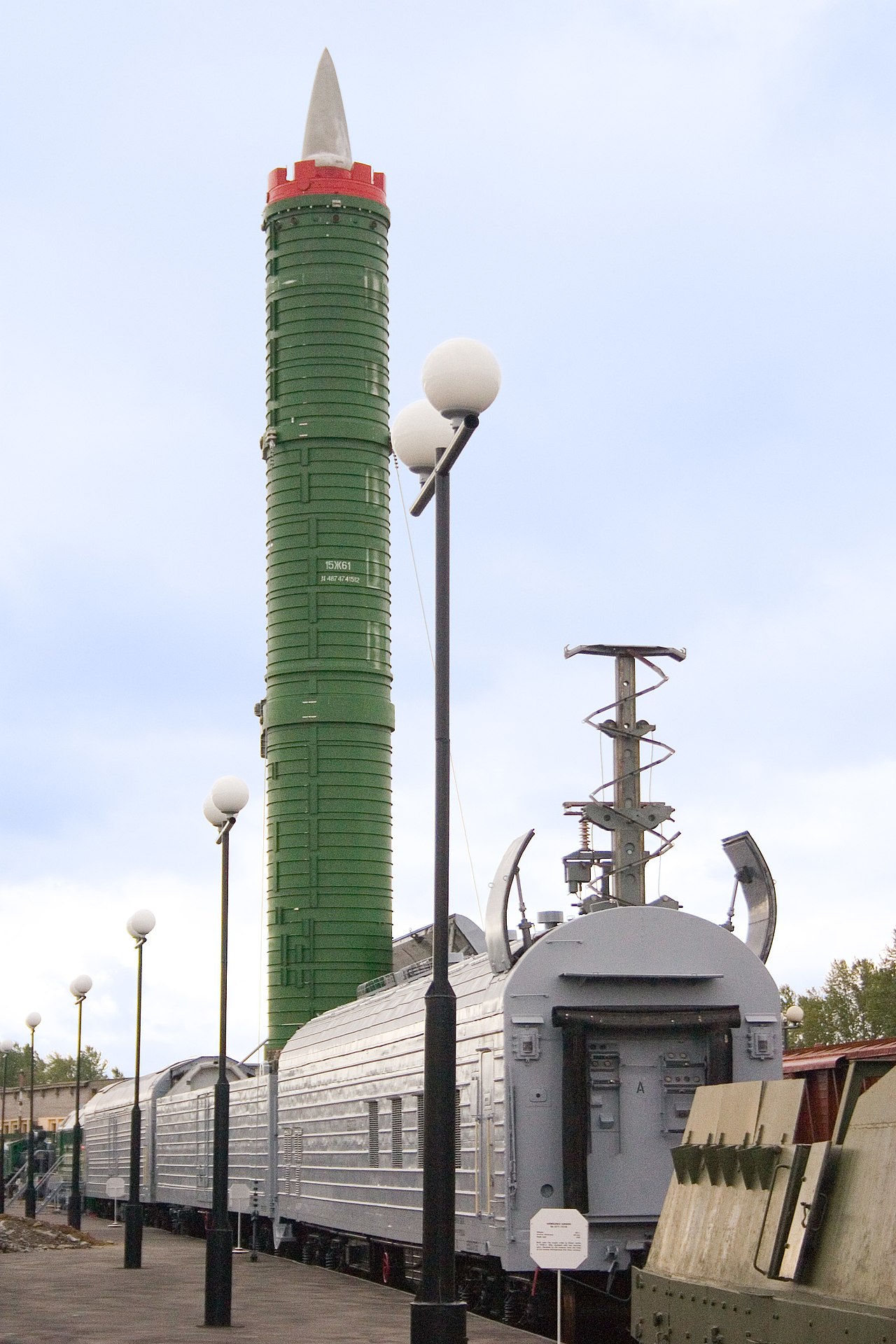
Panther · CC BY-SA 2.5
- Name
- RT-23 Molodets
- Field
- intercontinental ballistic missile
- Region
- Soviet Union
VALÉORINE Encyclopedia
VALÉORINE documentary reading
Documentary summary
The RT-23 Molodets (lit. "brave man" or "fine fellow"; NATO reporting name: SS-24 Scalpel) was a cold-launched, three-stage, solid-fueled intercontinental ballistic missile developed and produced before 1991 by the Yuzhnoye Design Bureau in Dnipro, Ukraine (ex-Soviet Union). It came in silo- and rail-based variants, and was armed with 10 MIRV warheads (GRAU index: 15Ф444) of 550 kt yield.
Admitted source layer · organised and presented by VALÉORINE
Note VALÉORINE
No house-authored Note is published until its assertions and sources pass the VALÉORINE evidence contract. The documentary article remains available in full while that enrichment is being consolidated.
Documentary enrichment in progress · no unsupported statement published
Reference Check
Propose documentary evidence for RT-23 Molodets. A contribution is never written directly as fact: identity, source, rights and evidence gates still decide.
Sign in to contribute
World of VALÉORINE
Documentary connections
Only confirmed graph relationships appear here. Images are shown only when their identity and reuse rights both pass the documentary gate.

Documentary evidence
Evidence Panel
not yet certified
- Identity
- resolved
- Independent source families
- 0
- Admitted assertions
- 0
- Open conflicts
- 0
Authority files
wikidata · Q201524 · wikipedia · RT-23 Molodets
In this article
Overview
Overview
All missiles were decommissioned by 2005 in accordance with the START II.
Key facts
Key facts
• Is Missile — yes • Name — RT-23 Molodets • Origin — USSR • Type — ICBM • Used By — Strategic Rocket Forces • Manufacturer — Yuzhnoye Design Bureau • Propellant — Solid fuel • Service — 1987–2005 • Engine — First stage: 15D305, Second stage: 15D339 • Engine Power — 15D305: 3,040 kN, 15D339: 1,470 kN • Weight — 104500 kg • Length — 23400 mm • Diameter — 2410 mm • Vehicle Range — 10000-11000 km • Filling — 10 × 550 kt MIRVs • Guidance — Inertial, autonomous • Launch Platform — Railcar TEL or silo • Accuracy — 150–500 m
History
History
• Illustration — The overhead line short-circuiting and diverting mechanism • Illustration — Railcar outriggers, deployed before launch The missile and rail-based missile complex – or BZhRK (lit. "Combat Rail-based Missile Complex") – were developed by the brothers Vladimir and Alexei Utkin as chief engineers in Yuzhnoye Design Bureau and Design Bureau for Special Machine-Building respectively. It was the culmination of a major Soviet effort to develop a solid-propellant ICBM with multiple basing modes which was initiated in 1969. As addition to the silo- and rail-based versions, a road-mobile version was considered but eventually rejected. The new missile was to replace the older liquid-fueled UR-100N which were entirely silo-based. Its United States counterpart was the Peacekeeper Rail Garrison, which was never deployed. The missile was tested through the 1980s and was deployed in 1987. A typical BZhRK consisted of three modified M62-class locomotives (designated DM62; were not different in appearance) and seventeen railcars: a camouflaged tank with diesel fuel and lubricants reserve, three 3-car autonomous launching modules (a launch support systems car, a car with an erectable RT-23 launcher and a launcher command post car), a regiment command post car, a communications systems car, a main diesel generator car, a provision storage car with refrigerators and water tanks, a dining car, and two separate living compartment cars for officers and enlisted personnel. All the railcars were camouflaged as either refrigerated vans or passenger cars. The lead locomotive was driven by three Railway Troops officers with good knowledge of a patrolling route, while the two others were operated by enlisted personnel. The train was able to cruise at speed of 80-120 km/h and launch the missiles at any point of the route on any Soviet rail line, which was made possible by implementation of the special mechanism for short-circuiting and diverting the overhead line. Shortly after ejection by the powder pressure accumulator, at a height of 20–30 m, the missile would incline itself, so that the first-stage exhaust would not damage or overturn the railcar launcher, and then ignite the first-stage engine. The rail-based missile incorporated an inflatable nose cone as a means of length reduction for accommodation in a refrigerator car, while the silo-based variant was equipped with a more robust folding nose cone, since it was expected to be operated in a much harsher preemptive nuclear strike environment. In order to prevent damage to the railroad tracks caused by high weight of the launching car with a missile (>200 tons), the special three-car coupling system was developed for the launching modules, allowing for even weight distribution between neighboring cars. The missile train was able to function autonomously for up to 28 days. In order to evaluate effects of a nearby nuclear explosion on the missile complex, on 27 February 1991, in Plesetsk, the "Sdvig" (lit. "Shift") experiment was conducted, upon which a pile of 100,000 TM-57 anti-tank mines was detonated with the yield of 1,000 tons of TNT at a distance of 850 and 450 meters from the two separate groups of railcar launching and command modules. The experiment showed that, despite moderate damage to the railcars, the complexes were still able to conduct simulated missile launches (the computer system of one of them required a reboot). The level of acoustic pressure in the command modules, however, "exceeded 150 dB" and "would have resulted in a 20-minutes hearing loss" for the personnel. Prior to that, in 1988, at Semipalatinsk Test Site, the rail-based complex took part in the "Siyanie" (lit. "Shining") and "Groza" (lit. "Thunderstorm") experiments, meant to evaluate its EMP and lightning protection effectiveness. According to US Defense Department, as of September 1991, production of the RT-23 had ended with approximately 90 missiles deployed. Its production facilities were located in Ukraine, and after the dissolution of the Soviet Union in 1991, the production of the missile was halted. The 46 silo-based missiles located in Ukraine were deactivated by mid-1996 and put into storage awaiting a decision on a feasible disposal method, while their warheads were sent to Russia for dismantlement. In 1998–2001, all Ukrainian RT-23 missiles were dismantled and 45 out of 46 RT-23 silos exploded, with one of them left intact for exhibition purposes. A total of 46 missiles remained in service by April 1997 with the Strategic Missile Forces (10 silo- and 36 rail-based). The remaining 10 silo-based missiles in Russia were deactivated and sent for dismantlement in 2001, and their silos were modified for Topol-M complexes. After 2000, the rail-based missiles were also gradually withdrawn from service, with the remaining 15 decommissioned in August 2005. In that same year, Nikolay Solovtsov, then commander of the Strategic Missile Forces, officially announced retirement of the RT-23 rail-based complex. The last RT-23 ICBM in Russia was eliminated in April 2008. Its successor, BZhRK Barguzin, was reportedly under development for the Strategic Missile Forces (RVSN), but in 2017 it was announced the project had been frozen due to insufficient funding.
Versions
Versions
RT-23 versions comparison • | Service — RT-23 — RT-23 UTTKh • | GRAU — 15Zh44 — 15Zh52 — 15Zh60 — 15Zh61 • | DIA — SS-24 PL-04 (R&D index) — SS-24 Mod 0 — SS-24 Mod 2 — SS-24 Mod 1 • | Bilateral — RS-22B — RS-22A — RS-22V • | Design bureau — SKB-586, NPO Yuzhynoy Acad. V. F. Utkin • | Approved — 23 July 1976 — 1 June 1979 — 9 August 1983 — 9 August 1983 • | Years of R&D — January 1969 – March 1977 — November 1982 – 1987 — 1983–1989 — 1983–1989 • | First flight test — 26 October 1982, failure; December 1982, success — April 1984 — 31 July 1986 — 27 February 1985 • | IOC — Canceled — 19 August 1988 — December 1988 — December 1987 • | Deployment date — Canceled — November 1987 — 28 November 1989 — 28 November 1989 • | Type of warhead — MIRV • | Warheads — 10 • | Payload (t) — 4.05 • | Total length (mm) — 23,300 — 23,400–23,800 — 18,800–23,400 — 23,300 • | Total length excl. excluding warhead (mm) — 18,800; 19,000 — 19,000 — 19,000 — 19,000 • | Missile diameter (mm) — 2,400 • | Launch mass (t) — 104.5 • | Operating range (km) — 10,000 — 10,000–11,000 — 10,100-11,000 — 10,100–10,450 • | CEP (m) — 500 — 150–250 • | Basing mode — Silo — Silo — Railroad
Former operators
Former operators
• and: The Strategic Missile Troops were the only operators of the RT-23 until the breakup of the Soviet Union. • Silo-based with 46th Rocket Division in Pervomaisk and 60th Rocket Division in Tatischevo. • Rail-based with 10th Rocket Division in Kostroma region, 52nd Rocket Division in Zvyozdny, Perm region, and 36th Rocket Division in Kedrovy, Krasnoyarsk region. •: The Armed Forces of Ukraine inherited 46 silo-based RT-23 missiles stationed in Pervomaisk upon independence from the Soviet Union.
Gallery
Gallery
• Illustration — RT-23 BZhRK at Varshavsky railway station. Now moved to Russian Railway Museum. • Illustration — The only remaining RT-23 silo in Pervomaisk.
Citations
References
Each reference names the institution holding it, so a reader may go to the document itself.
reference work
Partially resolvedreference work
Partially resolved
The Encyclopedia exists whether or not anything is for sale. Corrections are recorded rather than overwritten, and every version of this record is kept. Published 14 August 2026.
Elsewhere in Militaria
6,095 published records in this field, each with its sources named.
- RSS-40 BuranTerminology
- RT-15Terminology
- RT-20Terminology
- RT-21 Temp 2STerminology
- RT-2PM TopolTerminology
- RT-2PM2 Topol-MTerminology
- rubber bulletTerminology
- Ruby pistolTerminology
Best supported in this field
For owners
Own an object connected with RT-23 Molodets?
A specialist will read what you send and tell you what the house can establish, what it cannot, and whether the object is suited to sale. There is no charge and no obligation. The object stays with you throughout; nothing is shipped to us unless it is arranged in writing beforehand.