
Routledge
Routledge is an English multinational publisher. It was founded in 1836 by George Routledge, and specialises in providing academic books, journals and online resources in the fields of the humanities, behavioural science, education, law, and social science. The company publishes approximately 1,800 journals and 5,000 new books each year, and its backlist encompasses over 140,000 titles.
Routledge
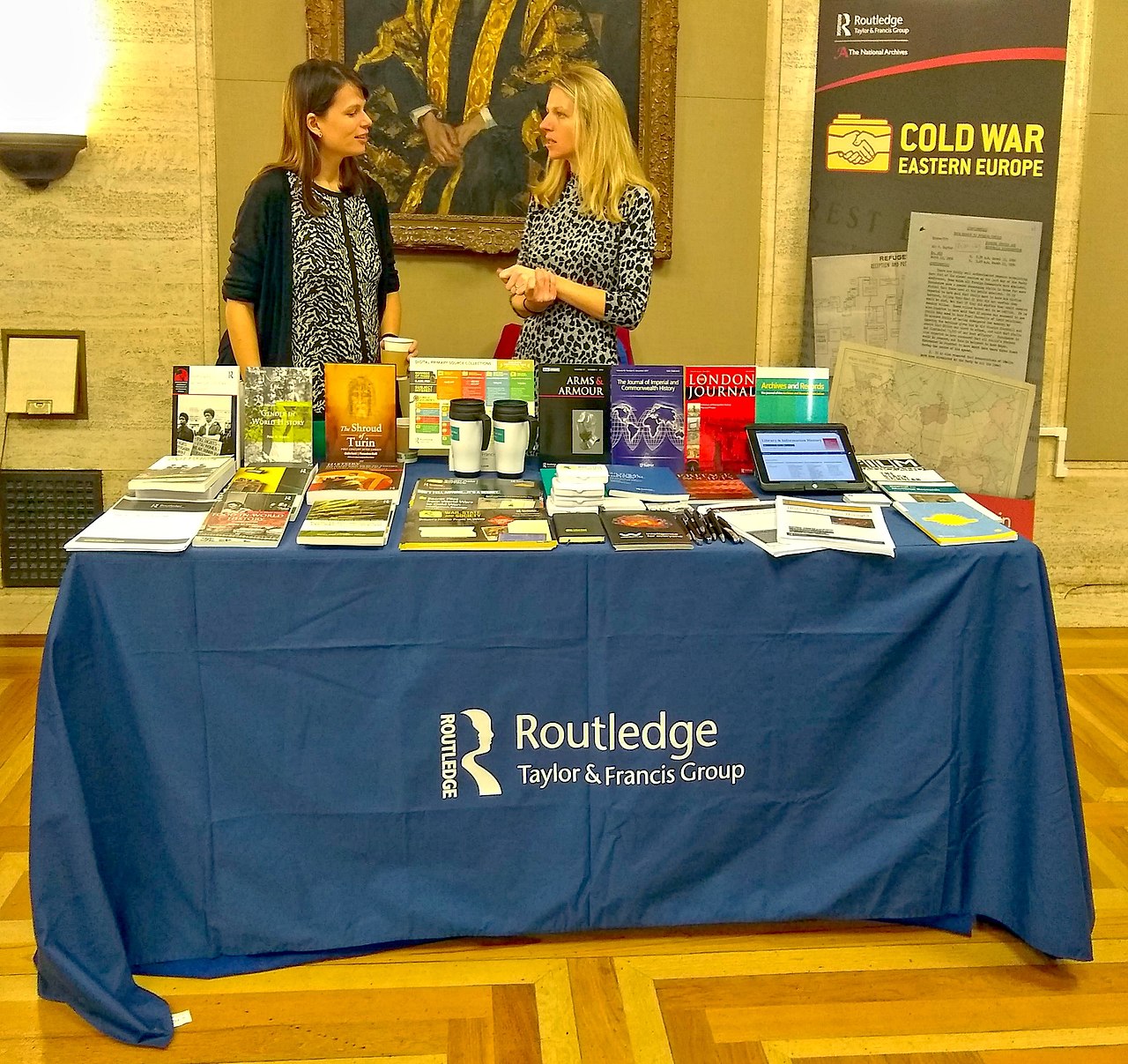
Philafrenzy · CC BY-SA 4.0
- Founded
- 1851.
- Headquarters
- London.
VALÉORINE Encyclopedia
VALÉORINE documentary reading
Documentary summary
Routledge is an English multinational publisher. It was founded in 1836 by George Routledge, and specialises in providing academic books, journals and online resources in the fields of the humanities, behavioural science, education, law, and social science. The company publishes approximately 1,800 journals and 5,000 new books each year, and its backlist encompasses over 140,000 titles.
Admitted source layer · organised and presented by VALÉORINE
Note VALÉORINE
No house-authored Note is published until its assertions and sources pass the VALÉORINE evidence contract. The documentary article remains available in full while that enrichment is being consolidated.
Documentary enrichment in progress · no unsupported statement published
Reference Check
Propose documentary evidence for Routledge. A contribution is never written directly as fact: identity, source, rights and evidence gates still decide.
Sign in to contribute
Documentary evidence
Evidence Panel
not yet certified
- Identity
- resolved
- Independent source families
- 0
- Admitted assertions
- 0
- Open conflicts
- 0
Authority files
gnd · 16273062-7 · wikidata · Q1508259 · wikipedia · Routledge
In this article
Overview
Overview
Claimed to be the largest global academic publisher within the humanities and social sciences. In 1998, Routledge became a subdivision and imprint of its former rival, Taylor & Francis Group (T&F), as a result of a £90 million acquisition deal from Cinven, a venture capital group that had purchased it two years previously for £25 million. Following the merger of Informa and T&F in 2004, Routledge became a publishing unit and major imprint within the Informa "academic publishing" division. Headquartered in the main T&F office at Milton Park in Abingdon, Oxfordshire; it also operates from T&F offices globally, including in Philadelphia, Melbourne, New Delhi, Singapore, Tokyo, Beijing and Taipei.
Key facts
Key facts
• Parent — Taylor & Francis • Status — Active • Founder — George Routledge • Country — England • Headquarters — Milton Park, Abingdon-on-Thames, Oxfordshire, England, UK • Distribution — Worldwide • Keypeople — Jeremy North (MD Books) • Publications — Books and academic journals • Topics — Humanities, social science, behavioral science, education, law • Url — routledge.com
History
History
The firm originated in 1836, when the London bookseller George Routledge published an unsuccessful guidebook, The Beauties of Gilsland, with his brother-in-law W. H. (William Henry) Warne as assistant. In 1848, the pair entered the booming market for selling inexpensive imprints of works of fiction to rail travellers, in the style of the German Tauchnitz family, which became known as the "Railway Library". The growing use of railways made a success of the venture, and this eventually led to Routledge, along with Warne's brother Frederick Warne, founding the company George Routledge & Co. in 1851. In the following year the company gained lucrative business through selling reprints of Uncle Tom's Cabin (which was in the public domain in the UK), which in turn enabled it to pay author Edward Bulwer-Lytton £20,000 for a 10-year lease allowing sole rights to print all 35 of his works including 19 of his novels to be sold cheaply as part of their "Railway Library" series. • Illustration — The Routledge stand at Senate House History Day 2018 The company was restyled in 1858 as Routledge, Warne & Routledge when George Routledge's son, Robert Warne Routledge, entered the partnership. Frederick Warne eventually left the company after the death of his brother W. H. Warne in May 1859. Gaining rights to some titles, he founded Frederick Warne & Co. in 1865, which became known for its Beatrix Potter books. In July 1865, George Routledge's son Edmund Routledge became a partner, and the firm became George Routledge & Sons. By 1899, the company was running close to bankruptcy. However, following a successful restructuring in 1902 by scientist Sir William Crookes, banker Arthur Ellis Franklin, managing director William Swan Sonnenschein and others, it was able to recover and began to acquire and merge with other publishing companies, including J. C. Nimmo Ltd. in 1903. In 1912, the company took over the management of Kegan Paul, Trench, Trübner & Co., the descendant of companies founded by Charles Kegan Paul, Alexander Chenevix Trench, Nicholas Trübner, and George Redway. These early 20th-century acquisitions brought with them lists of notable scholarly titles, and from 1912 onward, the company became increasingly concentrated in the academic and scholarly publishing business under the imprint "Kegan Paul Trench Trubner", as well as reference, fiction and mysticism. In 1947, George Routledge and Sons finally merged with Kegan Paul Trench Trubner (the umlaut had been quietly dropped in the First World War) under the name of Routledge & Kegan Paul. Using C. K. Ogden and later Karl Mannheim as advisers the company was soon particularly known for its titles in philosophy, psychology and the social sciences. In 1985, Routledge & Kegan Paul joined with Associated Book Publishers (ABP), which was later acquired by International Thomson in 1987. Under Thomson's ownership, Routledge's name and operations were retained, with the additions of backlists from Methuen, Tavistock Publications, Croom Helm and Unwin Hyman. In 1996, a management buyout financed by the European private equity firm Cinven saw Routledge operating as an independent company once again. In 1997, Cinven acquired journals publisher Carfax and book publisher Spon. In 1998, Cinven and Routledge's directors accepted a deal for Routledge's acquisition by Taylor & Francis Group (T&F), with the Routledge name being retained as an imprint and subdivision. In 2004, T&F became a division within Informa plc after a merger. Routledge continues as a primary publishing unit and imprint within Informa's 'academic publishing' division, publishing academic humanities and social science books, journals, reference works and digital products. Routledge has grown considerably as a result of organic growth and acquisitions of other publishing companies and other publishers' titles by its parent company. Humanities and social sciences titles acquired by T&F from other publishers are rebranded under the Routledge imprint. Routledge is a signatory of the SDG Publishers Compact, and has taken steps to support the achievement of the Sustainable Development Goals (SDGs). These include achieving CarbonNeutral publication certification for their print books and journals, under the Natural Capital Partners' CarbonNeutral Protocol.
People
People
The English publisher Fredric Warburg was a commissioning editor at Routledge during the early 20th century. Novelist Nina Stibbe, author of Love, Nina, worked at the company as a commissioning editor in the 1990s. Cultural studies editor William Germano served as vice-president and publishing director for two decades before becoming dean of the humanities at Cooper Union.
Authors
Reference works
Reference works
Taylor and Francis closed down the Routledge print encyclopaedia division in 2006. Some of its publications were: • Routledge Encyclopedia of Philosophy, by Edward Craig (1998), in 10 volumes, but now online. • Encyclopedia of Ethics, by Lawrence C. Becker and Charlotte B. Becker (2002), in three volumes. Reference works by Europa Publications, published by Routledge: • Europa World Year Book • International Who's Who • Europa World of Learning Many of Routledge's reference works are published in print and electronic formats as Routledge Handbooks and have their own dedicated website: Routledge Handbooks Online. The company also publishes several online encyclopedias and collections of digital content such as Routledge Encyclopedia of Philosophy, Routledge Encyclopedia of Modernism, Routledge Performance Archive, and South Asia Archive. Routledge Worlds series consisted of 66 books as of July 2023, which the publisher described as "magisterial surveys of key historical epochs". Included in the series are The Sikh World, The Pentecostal World, published in 2023, The Quaker World, The Ancient Israelite World, and The Sámi World published in 2022.
Book series
Book series
• The Broadway Travellers (1926–1937) edited by Eileen Power and Edward Denison Ross. • Colloquial Series of Multimedia Language Courses • Essential Grammars (since 1999) • The Histories of Material Culture and Collecting, 1700-1950, edited by Stacey Pierson • "provides a forum for the broad study of object acquisition and collecting practices in their global dimensions from 1700 to 1950. The series seeks to illuminate the intersections between material culture studies, art history, and the history of collecting. It takes as its starting point the idea that objects both contributed to the formation of knowledge in the past and likewise contribute to our understanding of the past today." • Morley's Universal Library (also known as: Routledge's Universal Library) (1883–1888) • The Muses' Library (1904–1940; 1950–1980) • established in 1891 by Lawrence & Bullen as a series of fine editions of poetry until L&B folded in 1900, Routledge revived the series in 1904 with reprints and new titles. Over the years parallel editions were published in the US by Charles Scribner's Sons, E. P. Dutton and Harvard University Press. • The Republic of Letters • Routledge's Railway Library (1848–99) • were sold through W. H. Smith's bookstalls on railway platforms; in 50 years 1,277 books were published, most as pictorial hardbacks, with some bestsellers re-released as cheaper paperbacks. Authors included Edward Bulwer Lytton, James Fenimore Cooper, Jane Austen, Benjamin Disraeli, Henry Fielding, Frances Trollope, William Harrison Ainsworth, Alexandre Dumas, and Victor Hugo.
Foundation
Foundation
Routledge is described in the collections that hold this material as British multinational academic publisher founded in 1836.
Institutional history
Dated record
Institutional history
Explore 1851
The full dated record · 3 entries
1851
Routledge established.
1851
Routledge is recorded from 1851.
1851
Routledge was established or created on 1 January 1851.
Publications
Publications
Routledge has been criticised for a pricing structure which "will limit readership to the privileged few", as opposed to options for open access offered by DOAJ, Unpaywall, and DOAB.
Books and published writings, 1969–2017
Catalogued output
Books and published writings, 1969–2017
These are catalogued publications carrying the name — editions and printings, distinct from the works they contain and from writing about the subject. The 2010s are the densest part of the run, with 36 titles, and that concentration is a fact about what the registers have catalogued rather than a judgement on the work itself. They belong to a run of 101 titles in all, from 1969 to 2026. A selection is set out below and the complete run may be opened beneath it.
83 editions carry dates between 1969 and 2017
The run opens with Routledge's decimal ready reckoner and closes with Commercial Lawcards 2012-2013
The entries follow Open Library
Books and published writings, 2020–2026
Catalogued output
Books and published writings, 2020–2026
17 editions carry dates between 2020 and 2026
The run opens with Partnership and Recognition in Action Research and closes with Ferrum College - CJU 350 001 - Fall 2026 - 180 Day - Tatum - Fullglass Courseware
Books and published writings without a settled date
Catalogued output
Books and published writings without a settled date
1 further edition are catalogued under Routledge's name without a date the collections agree on, which is why they are set apart from the dated run rather than placed in it.
The Europa World Year Book 2022
Context
Primary material
Context
The circumstances in which Routledge stands. Situated in United Kingdom. Routledge operates in publishing.
Documents and archives
Primary material
Documents and archives
institutional register
- Gemeinsame Normdatei 16273062-7, Routledge.
Unverified · GND (German National Library)
- Internet Archive holdings naming Routledge
Unverified · Internet Archive
- Wikidata, structured authority record Q1508259: Routledge
Unverified · Wikimedia Foundation
Institutional database
- arXiv, Cornell University, preprints naming “Routledge”
Scholarly · arXiv (Cornell University)
reference work
- “Routledge”, English Wikipedia, consulted as further reading
Reputable secondary · Wikipedia
Authority records
References
Citations
References
Each reference names the institution holding it, so a reader may go to the document itself.
Institutional database
arXiv, Cornell University, preprints naming “Routledge”arXiv (Cornell University)
Verifiedinstitutional register
Gemeinsame Normdatei 16273062-7, Routledge.GND (German National Library)
Partially resolvedinstitutional register
Internet Archive holdings naming RoutledgeInternet Archive
Partially resolvedinstitutional register
Wikidata, structured authority record Q1508259: RoutledgeWikimedia Foundation
Partially resolvedreference work
Partially resolved
The Encyclopedia exists whether or not anything is for sale. Corrections are recorded rather than overwritten, and every version of this record is kept. Published 14 August 2026.
Elsewhere in Publishers and printers
5,459 published records in this field, each with its sources named.
- Rosen PublishingOrganisation
- Rosicrucian FellowshipOrganisation
- Rote Hilfe e.V.Organisation
- RotpunktverlagOrganisation
- Rovira i Virgili UniversityOrganisation
- Rowohlt VerlagOrganisation
- Roxburghe ClubOrganisation
- RoxleyOrganisation
Best supported in this field
For owners
Own an object connected with Routledge?
A specialist will read what you send and tell you what the house can establish, what it cannot, and whether the object is suited to sale. There is no charge and no obligation. The object stays with you throughout; nothing is shipped to us unless it is arranged in writing beforehand.