
Rock Abrasion Tool
The Rock Abrasion Tool (RAT) is a grinding and brushing installation on NASA’s twin Mars Exploration Rovers, Spirit (MER-A) and Opportunity (MER-B), which landed on Mars in January 2004. It was designed, developed and continues to be operated by Honeybee Robotics LTD, a developer of specialized robots, automated technologies and related systems. The RAT was the first machine to gain access to the interior of rocks on another planet.
Also recorded as RAT
Rock Abrasion Tool
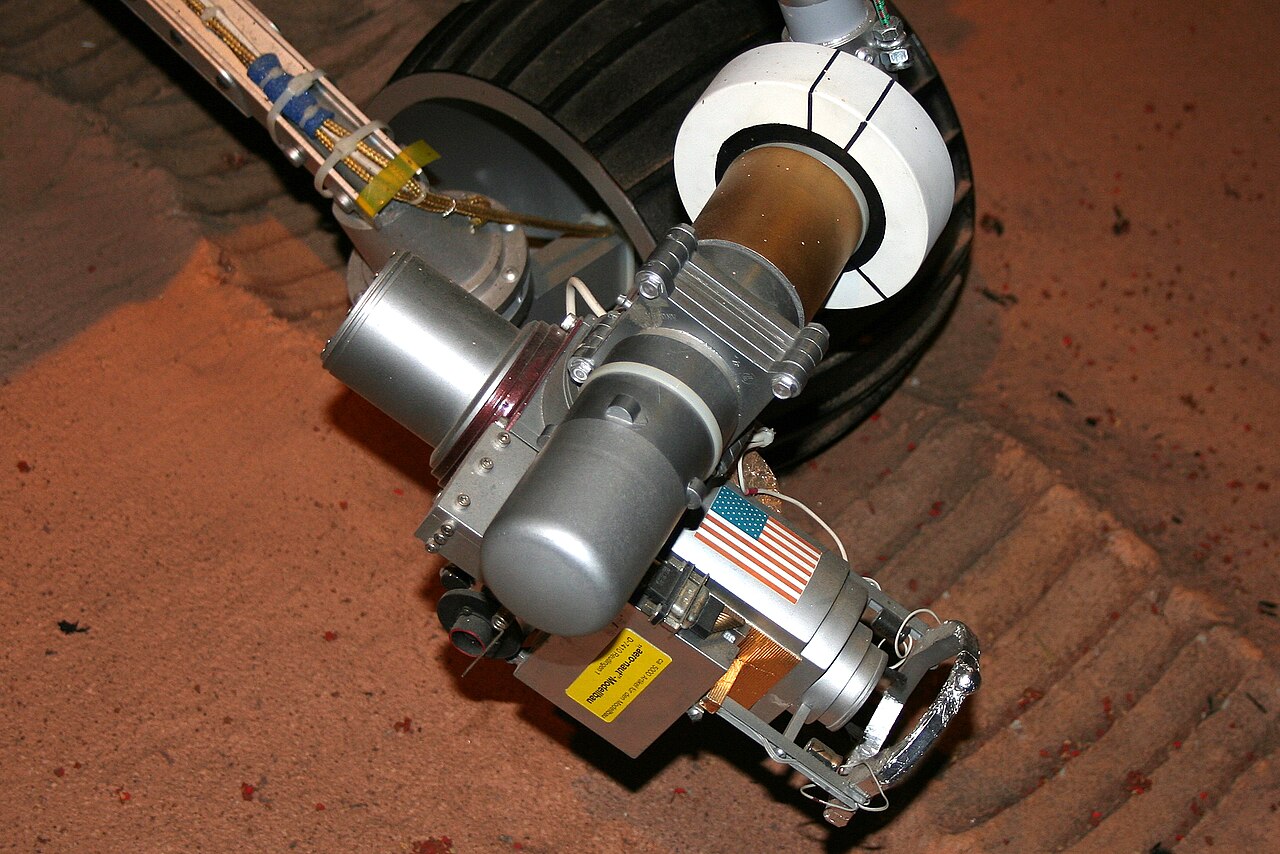
Rtphokie · CC BY-SA 3.0
- Name
- Rock Abrasion Tool
- Field
- physical tool
VALÉORINE Encyclopedia
VALÉORINE documentary reading
Documentary summary
The Rock Abrasion Tool (RAT) is a grinding and brushing installation on NASA’s twin Mars Exploration Rovers, Spirit (MER-A) and Opportunity (MER-B), which landed on Mars in January 2004. It was designed, developed and continues to be operated by Honeybee Robotics LTD, a developer of specialized robots, automated technologies and related systems. The RAT was the first machine to gain access to the interior of rocks on another planet.
Admitted source layer · organised and presented by VALÉORINE
Reference Check
Propose documentary evidence for Rock Abrasion Tool. A contribution is never written directly as fact: identity, source, rights and evidence gates still decide.
Sign in to contribute
Documentary evidence
Documentary basis
Authority files
wikidata · Q7354266 · wikipedia · Rock Abrasion Tool
In this article
Overview
Overview
The RAT has a mass of 0.685 kg, is 7 cm in diameter and 10 cm long, about the size of a soda can. It uses a diamond dust and resin wheel spinning at 3000 rpm to drill a 45 mm diameter by 5 mm deep bore hole in martian rocks. The RAT then uses two brushes to sweep dust from the bore holes for closer scientific inspection. Its average power consumption is 30 watts. There are five other instruments aboard both rovers, these are the Pancam (a camera), Mini-TES (an infrared spectrometer) for sensing targets at a distance, a microscopic imager, a Mössbauer spectrometer and an alpha particle X-ray spectrometer. The RAT provides these instruments with a smooth, clean surface from which they make more accurate observations. The RAT was first used by Spirit on its 34th sol (February 6, 2004). It was held up to the rock Adirondack, whereby it scraped to a depth of 2.85 mm over the course of three hours. Since then it has been used on numerous Martian rocks by both MER rovers. The RAT was originally controlled from NASA's Jet Propulsion Laboratory in Pasadena, California, but is now run by Honeybee Robotics LTD from their New York headquarters. The RAT is the first product of Honeybee Robotics LTD's to be sent into space by NASA. The cable shield of each RAT is made from aluminum recovered from the World Trade Center site after the September 11 attacks. • Illustration — The RAT has been used to grind a hole in the rock Adirondack. The hole is approximately 2.65 millimeters deep.
Key facts
Key facts
• Name — Rock Abrasion Tool • Operator — Honeybee Robotics • Manufacturer — Honeybee Robotics • Type — Installation • Function — Grinding and brushing • Began — February 6, 2004 • Webpage — Description from manufacturer's site • Mass — 0.685 kilograms • Dimensions — 7 cm in diameter and 10 cm long • Power Consumption — 30 watts • Spacecraft — Mars Exploration Rovers
Primary material
Digitised editions and texts
Meet the MOUSE (Micro-Optic Ultrasonic Exfoliator): Mars rover Rock Abrasion Tool (RAT) performance enhanced by ultrasonic technology.
Literature
Scholarly footprint
A count of publications is evidence of attention, not of standing, and is given here only as a measure.
Citations
References
Each reference names the institution holding it, so a reader may go to the document itself.
reference work
Secondary witnessreference work
Secondary witness
The Encyclopedia exists whether or not anything is for sale. Corrections are recorded rather than overwritten, and every version of this record is kept. Published 16 August 2026.
Elsewhere in Scientific instruments
736 published records in this field, each with its sources named.
- Reuven Ramaty High Energy Solar Spectroscopic ImagerTerminology
- riometerTerminology
- Ritchey–Chrétien telescopeTerminology
- robotic telescopeTerminology
- rolling rulerTerminology
- RONJATerminology
- ROSATTerminology
- rosette samplerTerminology
Best supported in this field
For owners
Own an object connected with Rock Abrasion Tool?
A specialist will read what you send and tell you what the house can establish, what it cannot, and whether the object is suited to sale. There is no charge and no obligation. The object stays with you throughout; nothing is shipped to us unless it is arranged in writing beforehand.