
RML 16 inch 80 ton gun
RML 16-inch 80-ton guns were large rifled muzzle-loading guns intended to give the largest British battleships parity with the large guns being mounted by Italian and French ships in the Mediterranean Sea in the 1870s.
RML 16 inch 80 ton gun

Niethe · Kriegschiffe unter Segel und Dampf ISBN 3-327-00490-0 · Public domain
- Name
- Ordnance RML 16-inch 80-ton gun
- Field
- naval artillery · rifled muzzle loader
- Region
- United Kingdom of Great Britain and Ireland
VALÉORINE Encyclopedia
VALÉORINE documentary reading
Documentary summary
RML 16-inch 80-ton guns were large rifled muzzle-loading guns intended to give the largest British battleships parity with the large guns being mounted by Italian and French ships in the Mediterranean Sea in the 1870s.
Admitted source layer · organised and presented by VALÉORINE
Reference Check
Propose documentary evidence for RML 16 inch 80 ton gun. A contribution is never written directly as fact: identity, source, rights and evidence gates still decide.
Sign in to contribute
World of VALÉORINE
Documentary connections
Only confirmed graph relationships appear here. Images are shown only when their identity and reuse rights both pass the documentary gate.

Documentary evidence
Documentary basis
Authority files
wikidata · Q7277044 · wikipedia · RML 16-inch 80-ton gun
In this article
Key facts
Key facts
• Name — Ordnance RML 16-inch 80-ton gun • Origin — United Kingdom • Type — Naval gun • Is Ranged — YES • Is Artillery — YES • Is Uk — YES • Service — 1880–1902 • Used By — Royal Navy • Wars — Bombardment of Alexandria (1882) • Designer — Royal Gun Factory • Design Date — 1874 • Manufacturer — Royal Arsenal • Number — 8 • Unit Cost — £10,000 • Variants — Mk I • Part Length — 288 in (bore) • Cartridge — 1684 lb Palliser, common, Shrapnel • Caliber — 16 in • Velocity — 1590 ft/s • Max Range — 8000 yd
Design and history
Design and history
• Illustration — Gun barrel construction In 1868 trials, the Krupp breechloader 24 cm K L/20 unexpectedly proved itself superior to the British 9-inch muzzle loader. This potentially posed a huge problem for the Royal Navy. The British manufacturers could not produce the huge ingots of quality steel that were required to manufacture comparable guns and relying on imported guns was unacceptable from a strategic perspective. However that might be, the German Navy was very small. Therefore, the British could counter the Krupp guns by simply increasing the size of their less effective muzzle loaders. In parallel to the contest between muzzleloaders and breechloaders, there was a race between armor and guns. On the Krupp side, this race processed gradually up till the 30.5 cm caliber. It then escalated with Krupp producing the 35.5 cm MRK L/22.5 of 56t and the United Kingdom making the 16-inch 80-ton gun. After a long design and experimentation period beginning in 1873, Inflexible with its four guns, became the only ship to mount the 16-inch 80-ton gun, in 1880. By that time such muzzle-loading guns were already obsolescent and were being superseded by a new generation of rifled breechloading guns. Two more guns were mounted for coastal defence in the Admiralty Pier Turret at Dover.
Characteristics
Characteristics
• Illustration — 112½-pound ¼ charge brown prism powder cartridge The gun was constructed of a toughened mild steel inner "A" tube surrounded by multiple wrought-iron coils, breech-piece and a jacket. Rifling was of the "polygroove plain section" type, with 33 grooves increasing from 0 to 1 turn in 50 calibres (i.e. 1 turn in 800 in) at the muzzle. The 16 inch 80 ton was a second-generation RML gun, equipped with polygroove rifling and firing only studless ammunition and using automatic gas-checks for rotation. The maximum range of the gun was 8000 yd. This was the maximum practical range at the low elevations used for firing armour-piercing projectiles on a flat trajectory intended to pierce the armoured sides of ships. Longer ranges would have been attained at higher elevations, but the armour-piercing properties would have been diminished at the lower terminal velocity and oblique angle of impact. The original charge was 450 pounds of prismatic black powder giving a muzzle velocity of 1604 feet/second. However, as this damaged the barrel, it was replaced by brown powder from April 1885. N.J.M. Campbell, "British Super-Heavy Guns". The final velocity was 1590 feet/second firing a 1684-pound projectile, with a charge of 450 pounds Prismatic brown powder (gunpowder).
Surviving examples
Surviving examples
• Illustration — The two guns in the Admiralty Pier Turret as they are today The only two remaining example are in the ruins of the Admiralty Pier Turret, Dover, Kent, UK.
Identity
Identity
RML 16 inch 80 ton gun is associated with United Kingdom of Great Britain and Ireland. Classified as a naval artillery or rifled muzzle loader.

Diagram showing cross-section of barrel of British RML 16 inch 80 ton naval gun.
artist not identified. Royal Gun Factory · Plate XIX in "Treatise on the Construction and Manufacture of Ordnance in the British Service" by Captain John F Owen R.A. Prepared in the Royal Gun Factory, London, 1879. Downloaded from https: arch
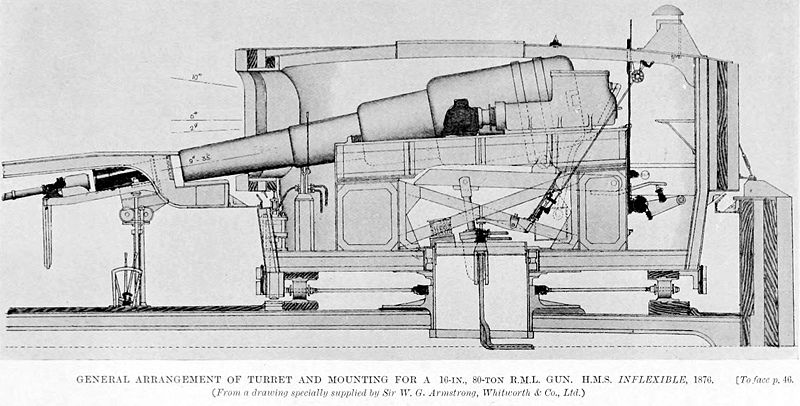
Diagram showing mounting of RML 16 inch gun in turret of British battleship HMS Inflexible. This shows the gun pointing downwards about to be reloaded.
W G Armstrong Co. · Sir William Laird Clowes, "The Royal Navy: a history from the earliest times to the present" Volume VII, page 47. Published by S. Low, Marston and Company, Limited, London, 1903. Downloaded from
Primary material
Documents and archives
authority record
- Wikidata, structured authority record Q7277044: RML 16 inch 80 ton gun
General reference · Wikidata
reference work
- “RML 16-inch 80-ton gun”, English Wikipedia, consulted as further reading
Reputable secondary · Wikipedia
Notes from the source article
Cited by Wikipedia
Notes from the source article
These works are cited by the source article, in its own numbering. They are recorded as its citations, not as sources VALÉORINE has verified.
Bibliography printed in the source article · 4
- Brassey, Thomas. The British Navy. Longmans, Green and Co., London. II. 1882.
- Campbell, N.J.M. British Super-Heavy Guns. 2002.
- Mackinlay, George. Text Book of Gunnery. 1887. His Majesty's Stationery Office, by Harrison and Sons, St. Martin's Lane. 1887.
- His Majesty's Stationery Office, by Harrison and Sons, St. Martin's Lane. Text Book of Gunnery. 1902. 1902.
References
Citations
References
Each reference names the institution holding it, so a reader may go to the document itself.
authority record
Secondary witnessreference work
Secondary witness
Connections
Knowledge graph
Connections
Each connection was recorded deliberately, with the basis for it kept on the internal record.
Broader subject
1- naval artilleryTerminology
Established from a fact already recorded on a verified source.
The Encyclopedia exists whether or not anything is for sale. Corrections are recorded rather than overwritten, and every version of this record is kept. Published 17 August 2026.
Elsewhere in Militaria
6,095 published records in this field, each with its sources named.
- RML 11 inch 25 ton gunTerminology
- RML 12 inch 25 ton gunTerminology
- RML 12 inch 35 ton gunTerminology
- RML 12.5 inch 38 ton gunTerminology
- RML 17.72 inch gunTerminology
- RML 2.5 inch Mountain GunTerminology
- RML 6.3-inch howitzerTerminology
- RML 6.6-inch howitzerTerminology
Best supported in this field
For owners
Own an object connected with RML 16 inch 80 ton gun?
A specialist will read what you send and tell you what the house can establish, what it cannot, and whether the object is suited to sale. There is no charge and no obligation. The object stays with you throughout; nothing is shipped to us unless it is arranged in writing beforehand.