
Rik Wouters
Hendrik Emil (Rik) Wouters (21 August 1882 – 11 July 1916) was a Belgian painter, sculptor and draughtsman. He died partway through the First World War on 11 July 1916 in Amsterdam. A sculptor, painter, draughtsman and etcher of typically fauvist style, Wouters' art resembled the works of artists including Henri Matisse, Paul Cézanne and André Derain – the "forefathers" of Fauvism.
Also recorded as Rik Wouter · Hendrick Wouters · Hendrik Emil
Rik Wouters
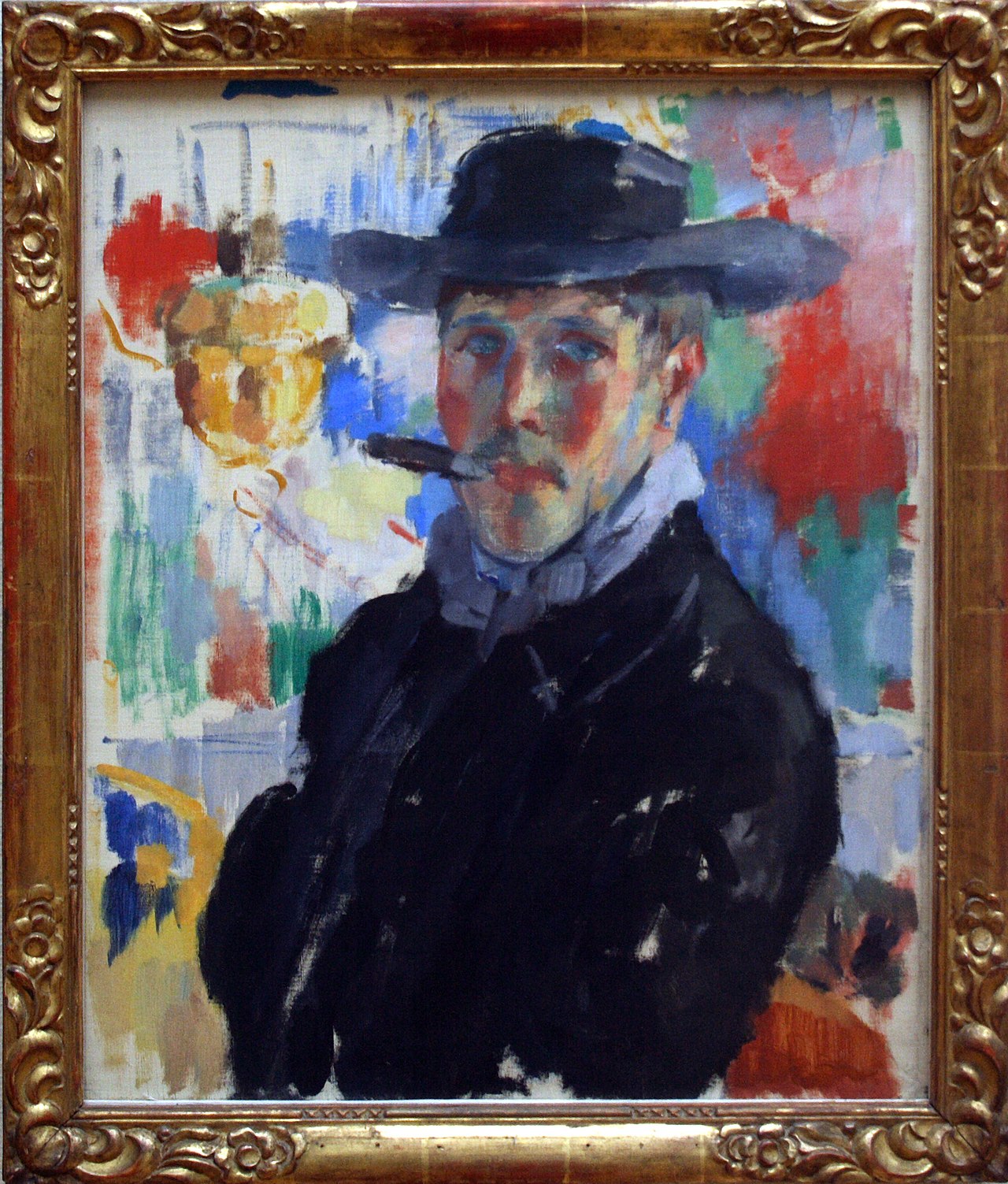
Rik Wouters · Own work Photo: Szilas · Public domain
- Name
- Rik Wouters
- Birth Name
- Hendrik Emil Wouters
- Born
- 21 August 1882
- Birthplace
- Mechelen, Belgium
- Died
- 11 July 1916
- Place of death
- Amsterdam, Netherlands
- Spouse
- Hélène Philomène Lionardine Duerinckx
- Full name
- Hendrik Emil Wouters.
- Nationality
- Belgium.
- Occupation
- painter, sculptor and graphic artist.
- Fields
- painting and art of sculpture.
- Movements
- Brabant fauvism.
VALÉORINE Encyclopedia
VALÉORINE documentary reading
Documentary summary
Hendrik Emil (Rik) Wouters (21 August 1882 – 11 July 1916) was a Belgian painter, sculptor and draughtsman. He died partway through the First World War on 11 July 1916 in Amsterdam. A sculptor, painter, draughtsman and etcher of typically fauvist style, Wouters' art resembled the works of artists including Henri Matisse, Paul Cézanne and André Derain – the "forefathers" of Fauvism.
Admitted source layer · organised and presented by VALÉORINE
Note VALÉORINE
No house-authored Note is published until its assertions and sources pass the VALÉORINE evidence contract. The documentary article remains available in full while that enrichment is being consolidated.
Documentary enrichment in progress · no unsupported statement published
Reference Check
Propose documentary evidence for Rik Wouters. A contribution is never written directly as fact: identity, source, rights and evidence gates still decide.
Sign in to contribute
World of VALÉORINE
Documentary connections
Only confirmed graph relationships appear here. Images are shown only when their identity and reuse rights both pass the documentary gate.
Documentary evidence
Evidence Panel
not yet certified
- Identity
- resolved
- Independent source families
- 0
- Admitted assertions
- 0
- Open conflicts
- 0
Authority files
wikidata · Q939197 · wikipedia · Rik Wouters
In this article
Biography
Biography
Rik Wouters' art, according to Adams (2018), reflects themes of "warmth and tenderness", his paintings characterised by an array of colours and brush strokes, frequently leaving unpainted canvas to increase this effect. Often depicting his muse-wife, Hélène, Wouters disregarded hidden symbolic inferences within his art in favour of a more "simplistic and genuine" style, distancing himself from mainstream artists. Wouters was educated in fine arts academies in Mechelen and Brussels, however his works usually slightly differ stylistically from other Fauvist artists. Wouters is known primarily for his sculptures and paintings including 'Lady in blue' (1914), 'Self-portrait with cigar (1914) and Chrysanthèmes (1915).
Rik Wouters studied at Royal Academy of Fine Arts of Brussels. Training under Charles van der Stappen is recorded. The recorded working language is Flemish Dutch. The field of work recorded is painting and art of sculpture. James Ensor and Paul Cézanne are recorded as an influence. Work by Rik Wouters is recorded in the collections of Museum Boijmans Van Beuningen, Royal Museum of Fine Arts Antwerp, Museum of Fine Arts Ghent (MSK), Groeningemuseum and Mu.ZEE - Kunstmuseum aan Zee.

De kar met bakstenen - Rik Wouters - Museum Hof van Busleyden
Rik Wouters

De Rupel - Rik Wouters - Museum Hof van Busleyden
Rik Wouters
Key facts
Key facts
• Name — Rik Wouters • Birth Name — Hendrik Emil Wouters • Born — 21 August 1882 • Birthplace — Mechelen, Belgium • Died — 11 July 1916 • Place of death — Amsterdam, Netherlands • Style — Fauvism • Spouse — Hélène Philomène Lionardine Duerinckx • Illustration — Sculpture "Huiselijke zorgen" at Middelheim Open Air Sculpture Museum, Antwerp • Illustration — Sculpture "Het zotte geweld" at Middelheim Open Air Sculpture Museum, Antwerp
Early life
Early life
Hendrik Emil Wouters was born on 21 August 1882 in Mechelen, Belgium. His father, Emil Wouters, was an ornamental sculptor and his mother, Melania Daems, was a housewife. Wouters' mother died in 1888. After dropping out of school at age 12, he began working on wooden sculptures and furniture decorations in his father's workshop and developed a passion for the craft. It was here that he met and began working with fellow Mechelen-born sculptor Ernest Wijnants, who would remain a lifelong friend. In 1912, Wouters painted a portrait of his friend, entitled Portrait of Ernest Wijnants. Wouters also developed an interest in drawing, and practiced in his free time. In 1897, aged fifteen, Wouters left his father's workshop in pursuit of a career as an artist and sculptor.
Education and apprenticeship
Education and apprenticeship
Having left the workshop, Rik Wouters enrolled at the Academy of Mechelen in 1897. He remained a pupil for 4 years; until 1901. Wouters applied to the Academy of Brussels in 1900, but was only admitted in 1901, resulting in a relocation to the Belgian capital to begin his tutelage under Charles Van der Stappen. Restricted by the mores of the institution, Wouters was unable to produce any works of originality and so painted within popular methodologies, including hidden iconographical meanings – a style he would later reject. Wouters achieved high results in the academy, ranking first in sculpture and second in historical composition. Regardless of his academic success, Wouters burned his works at the end of each year of his apprenticeship. His earliest completed surviving pieces of sculpture are from 1907 and his earliest paintings date from 1908. Edith Hoffman (1956) suggests that in these early works, although proficient in both crafts, Wouters remained "dependant on those masters he admired most", and that it wasn't until 1909 for his sculpting and 1910 for his painting that he became "completely individual". During his education in Brussels Wouters met Hélène Philomène Leonardine Duerinckx, born in Schaerbeek on 18 October 1886. Hélène, known as "Nel", would become Wouters' wife and greatest muse. The two were acquainted in 1902 and married three years later, in Amsterdam on April 15, 1905.
Career
Career
Rik Wouters' The Nymph (an unfinished sculpture created during 1904 and 1905) is considered to be his "breakthrough" piece as it represented his desire to escape the restrictions of the academy as well as the limits his own talent, although it was never finished nor sold. Following the completion of his studies, Wouters and his wife moved into a house in Watermael. However, Wouters was unable to support himself financially and so moved back in with his father in Mechelen. Again helping his father, Wouters failed to produce anything he deemed as satisfactory. He and his wife only intended to stay with his father for a short period, so he briefly worked for a porcelain manufacturer to make enough money to move to the countryside (in Boitsfort) in order to accommodate Hélène's recently contracted tuberculosis. They did this (in 1907) for clean air upon the advice of a doctor they had seen in the east side of Brussels however it also allowed Wouters an opportunity to paint freely. Initially Wouters primarily made sketches and developed his etching in the evenings. Sculpting began to occupy a larger portion of his focus over the next year and, in 1908, he modelled 12 bronze statues. Here Wouters experimented with light, unmixed colours, painting the cardboard evenly with a palette knife. He achieved three-dimensionality through colour contrasts – shadowing with darker reds, blues or greens – but rarely using drawn contours. Preferring to paint still lifes and interiors, Wouters created a "vibrant atmosphere" through the use of contrast and large strokes. This can be seen in works like 'Portrait of a woman in grey' (1905) and Portrait of a young boy (1905). Completely free of academic rigidity, Wouters was awarded second place in the Godecharle competition for his work Rêverie (1907) in 1907. This gave him access to a state allowance of 500 francs, allowing him to pay rent for the next two years. Despite this payment, Wouters and Hélène saved food in order to afford expensive paint. Over the next 4 years, Wouters further developed his style, using "highly sought-after plays of light and space", attracting the attention of Georges Giroux, who offered a contract with "Galerie Georges Giroux" in 1912. This contract granted Wouters the financial assistance required for him to work with his choice of materials, allowing him to produce works far more frequently. In 1912, he painted 60 canvasses, providing the money to travel to Paris and discover the Impressionists. Rik Wouters was the first Belgian artist to commit to a gallery contract of this kind. Whilst demonstrating the confidence the gallerist had in his art, it also meant that his profits were being split 50/50. Upon visiting Paris, Wouters saw the works of Cézanne, Monet, Renoir and Matisse, with whom he became increasingly appreciative of. According to Hoffman (1956), it was during this trip that he began to prioritise the "colour and light" of painting over his previous love of sculpting. He adopted a clearer and brighter palette and began to use light cloth in order to better preserve the colour tone. Additionally, Wouters started to dilute the oil paint with turpentine. He would then apply this thinly and sparsely across the canvas. Further experimentation with watercolours and the use of blank canvas began to create an effect which Julie Beckers (2017) describes as a "seemingly unfinished piece" which is used to "invite the observer to finish the strokes on his behalf". This can be seen in works such as By the window, Boitsfort (1913). Although many enjoyed this "unfinished" aesthetic, fellow artists in particular were appreciative of his style. Over the next few years (1912–13), he produced the best works of his short career. During this period he painted and drew almost constantly, making 50 canvasses in 1912. The crazy violence, Domestic worries and De strijkster are among the most famous of his art, all produced during this period. In 1913, he won the Picard prize. Although his wife occupied the focus of the majority of his works (around 75% of his oeuvre), Wouters occasionally painted other people and places of particular interest to him. His other muses included natural scapes from his local area (such as trees in the garden or a vase of flowers on the table) or close friends (such as his friend and fellow sculptor, Ernest Wijnants). All of which were painted with the same colourful and bright style. Additionally, Wouters produced a number of self portraits over his painting years. Initially, these were painted in his usual method, however, as his health worsened he began to adopt a bleaker palette, reflecting his situation.
Final years
Final years
Having returned to Belgium, Wouters borrowed 10,000 francs in order to buy a block of land upon which he built a house based on his own architectural designs. He and Nel moved into the new home in the spring of 1914. The First World War enveloped Belgium in 1914 and Wouters was mobilised to the front for over 6 weeks near the city of Liège. After the final fortress there fell, he fled from the Germans with his unit. He then arrived in Antwerp and was deployed in Fort Haasdonk. Wouters also got his first individual exhibition (in Giroux hall) during this year however the symptoms of his disease were beginning to manifest. He was captured and was taken to prisoner-of-war camps in Amersfoort and Zeist, but was provided with materials to paint and draw with. During this time, however, Wouters began to develop eye cancer and his health worsened. In 1915, he was released from the camp on health-related grounds and was reunited with his wife, Nel. In these years he lived with Hélène in an apartment in Amsterdam. The sombre tone of his paintings reflects his worsening health, seen in works such as Self-portrait with black eye patch (1916) and Rik with black eye dressing (1916). Wouters lost his eye to cancer 3 months before his death on 11 July 1916. Hélène remained in Amsterdam until 1919. She then moved backed to Belgium and remarried. She died in 1971, aged 85.
Life and career
Dated record
Life and career
The full dated record · 2 entries
1882
Rik Wouters born at Mechelen.
1916
Rik Wouters died at Amsterdam.
Places
Named by the record
Places
Only places the record itself states, plotted where the house gazetteer settles their coordinates. Nothing is inferred from a name or a nationality.
Mechelen.
Birth place
Amsterdam.
Death place
Paintings
Wouters has created the following paintings: • Illustration — The pink avenue, 1912, The Phoebus Foundation • Illustration — Chrysanthèmes, 1915, The Phoebus Foundation
Primary material
Documents and archives
reference work
- Wikidata, structured authority record Q939197: Rik Wouters
Reputable secondary · Wikidata
- “Rik Wouters”, English Wikipedia, consulted as further reading
Reputable secondary · Wikipedia
scholarly publication
- La afectación ocular tumoral del pintor y escultor Rik Wouters (1882-1916), Archivos de la Sociedad Española de Oftalmología, 2009
Scholarly · Crossref registry · 2009
Notes from the source article
Cited by Wikipedia
Notes from the source article
These works are cited by the source article, in its own numbering. They are recorded as its citations, not as sources VALÉORINE has verified.
- 1.De Vos, Oscar. Rik Wouters (1882–1916). Galerie Oscar de Vos. 2019.
- 2.Beckers, Julie. Rik Wouters: A Retrospective. Studio International.
- 3.Bertrand, Olivier. Rik Wouters (Mechelen, 1882 – Amsterdam, 1916). Belart.
- 4.Sold Lots: Rik Wouters. Christie's Gallery. September 2026.
- 5.Feekes, Jacobine. Rik Wouters. Kunstbus.
- 6.Museum of Belgian Fine Art. Biography of Rik Wouters. Virtual Museum of Belgian Fine Art.
- 7.Adams, Alexander. Review of Rik Wouters: A Retrospective. The Burlington Magazine. 1386. 803–804. 2018.
- 8.Hoffmann, Edith. Rik Wouters at the Biennale. The Burlington Magazine. 642. 334–332. 1956. 872015.
- 9.Millard, Charles. Fauvism. The Hudson Review. 29. 4. 576–580. 1976. 10.2307/3850497.
- 10.Wolf, Justin. Fauvism Movement Overview and Analysis. The Art Story. 2020.
References
Citations
References
Each reference names the institution holding it, so a reader may go to the document itself.
scholarly publication
La afectación ocular tumoral del pintor y escultor Rik Wouters (1882-1916), Archivos de la Sociedad Española de Oftalmología, 2009Crossref registry
Verifiedreference work
Partially resolvedreference work
Partially resolved
Further particulars
Held on the record
Further particulars
Open the remaining particulars
Rik Wouters was recorded at birth as Hendrik Emil Wouters. The authorities additionally record the headings Rik Wouter, Hendrick Wouters and Hendrik Emil. His recorded language was Flemish Dutch. He married Nel Duerinckx. Formation and teaching. Wouters studied at Royal Academy of Fine Arts of Brussels. He trained under Charles van der Stappen. His recorded influences include James Ensor and Paul Cézanne. Recorded as painter, sculptor and graphic artist.
Identity and origins
Recognition and collections
Work by Rik Wouters is
Museum Boijmans Van Beuningen, Royal Museum of Fine Arts Antwerp, Museum of Fine Arts Ghent (MSK) and Groeningemuseum
The Encyclopedia exists whether or not anything is for sale. Corrections are recorded rather than overwritten, and every version of this record is kept. Published 14 August 2026.
Elsewhere in Paintings
18,717 published records in this field, each with its sources named.
- Rigoberto SolerArtist
- Rihard JakopičArtist
- Rihards ZariņšArtist
- Riiko SakkinenArtist
- Rikki Wemega-KwawuArtist
- Rin YamashitaArtist
- Rina Ben-MenahemArtist
- Rina LazoArtist
Best supported in this field
For owners
Own a work by Rik Wouters?
A specialist will read what you send and tell you what the house can establish, what it cannot, and whether the object is suited to sale. There is no charge and no obligation. The object stays with you throughout; nothing is shipped to us unless it is arranged in writing beforehand.