
Richard Frankland
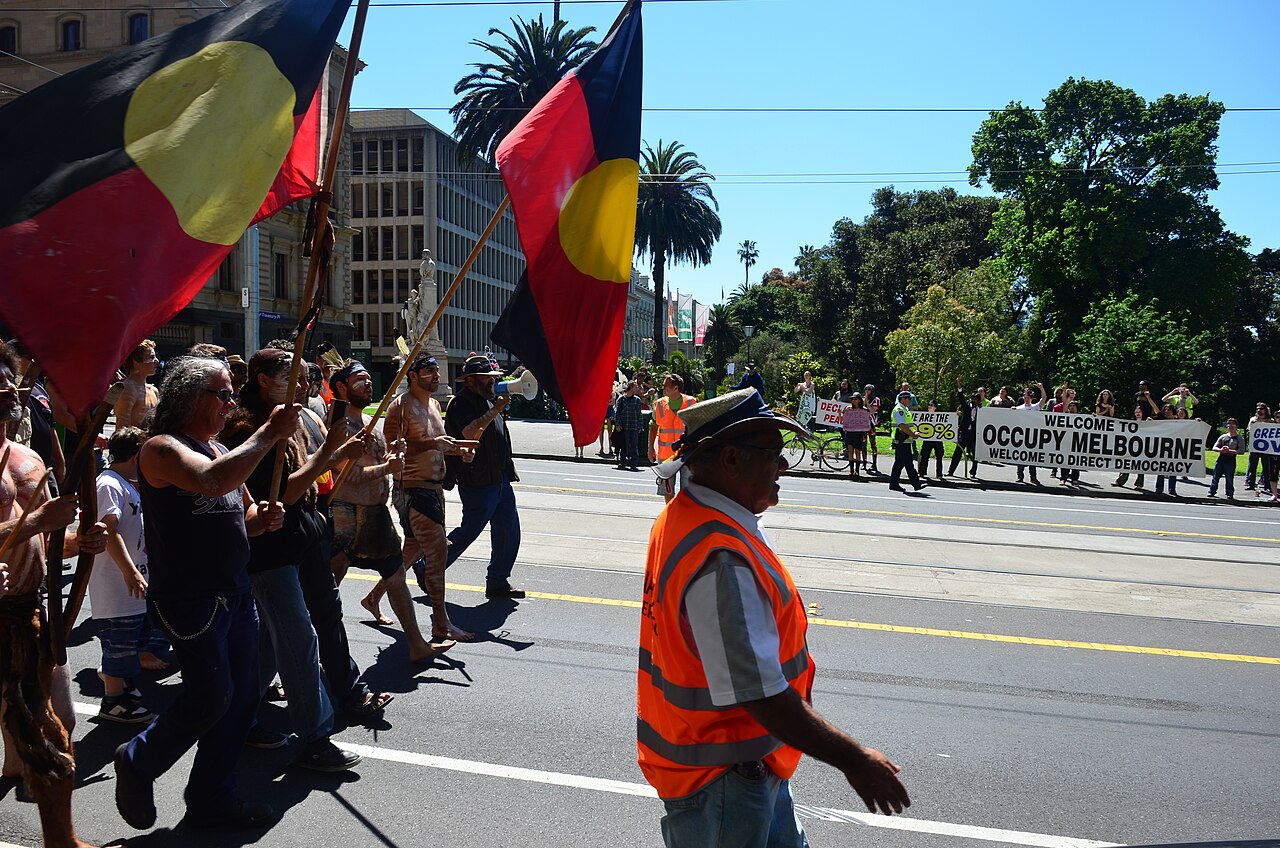
Illustration — Richard Frankland (with megaphone) at the Thousand Warrior march passing Occupy Melbourne in Treasury Gardens, 5 November 2011 Richard Joseph Frankland is an Australian playwright, scriptwriter and musician. He is an Aboriginal Australian of Gunditjmara origin from Victoria. He has worked significantly for Aboriginal Australian causes.
Also recorded as Richard Joseph Frankland
Richard Frankland
Peter Campbell · CC BY-SA 3.0
- Born
- 1963 · Victoria.
- Nationality
- Australia
- Occupation
- musician · director · producer · screenwriter · writer
Enciclopedia VALÉORINE
Il dossier documentario
Ogni enunciato è letto negli archivi di autorità delle istituzioni nominate. Scegliete «Prova» accanto a un enunciato per vedere la scheda da cui è tratto, il punto esatto e la data di lettura.
Richard Frankland figura come scrittore negli archivi di autorità della Deutsche Nationalbibliothek.
Istituzioni citate
Deutsche Nationalbibliothek
Non indicato dalle fonti citate: nazionalità
Catena di lettura completa (JSON)Reference Check
Propose documentary evidence for Richard Frankland. A contribution is never written directly as fact: identity, source, rights and evidence gates still decide.
Sign in to contribute
World of VALÉORINE
Documentary connections
Only confirmed graph relationships appear here. Images are shown only when their identity and reuse rights both pass the documentary gate.
Documentary evidence
Documentary basis
Authority files
wikidata · Q1414779 · wikipedia · Richard Frankland
In this article
Early life
Early life
Richard Joseph Frankland was born in Melbourne, but grew up mainly on the coast in south-west Victoria. He is a Gunditjmara man.
Career
Career
Frankland worked as a soldier, a fisherman, and as a field officer to the Royal Commission into Aboriginal Deaths in Custody (RCIADIC), which ran from 1987 until its final report was issued in 1991. His experience with RCIADIC inspired him to write several plays, including No Way to Forget, Who Killed Malcolm Smith, and Conversations with the Dead. Frankland won an AFI Award for Best Screenplay in a Short for his 1996 short film No Way to Forget. It was the first film by an Indigenous director to win an AFI Award. It screened at the 1996 Cannes Film Festival in the category of Un Certain Regard, and was broadcast nationally in Australia on SBS TV. He wrote and directed Harry's War (1999), a feature film based on his uncle's role in World War II on the Kokoda Trail. The film was screened at the British War Memorial in London and won Best Short Film at Spike Lee's alternative Oscars for black film-makers in Hollywood. His 2002 play, Conversations with the Dead, was staged in 2003 by Company B Belvoir, directed by Wesley Enoch and featuring Wayne Blair, Luke Carroll, Kirk Page, Elaine Crombie, her mother Lillian Crombie, and Vic Simms. In 2004, the play was performed at the United Nations.
Music
Music
Frankland is also a musician, whose music features on the soundtracks to many of his films. In 1992 his first band Djaambi supported Prince on his Australian tour. He formed The Charcoal Club in 1990, with a number of Indigenous and non-Indigenous members. They released three albums on CD: The Charcoal Club (2002), Cry Freedom (2005) and Hearts Full of Rust (2010).
Academia
Academia
Frankland served as Head of the Wilin Centre for Indigenous Arts and Cultural Development at the University of Melbourne, and in 2015 was appointed as an Associate Professor in Cross-Disciplinary Practice in the Division of Fine Arts and Music at the Victorian College of the Arts.
Plays
Plays
• Conversations with the Dead (2002) • Walkabout (2005)
Poem
Poem
• Two World One, this poem explores themes of Indigenous Australian identity, dual heritage and the difficulties in navigating two worlds and it is included in several anthologies including the Anthology of Australian Aboriginal literature (2008).
Books
*
Other activities
Other activities
In the early nineties he founded Mirimbiak Nations Aboriginal Corporation (MNAC) which was the first Indigenous statewide land organisation in some 25 years. MNAC was responsible for representing traditional owners and lodging all native title claims throughout the state of Victoria (excepting the already lodged Yorta Yorta, claim but including the recently successful Gunditjmara claim). Richard was also instrumental in forming Defenders of Native Title (DONT), which later became Australians for Native Title and Reconciliation (ANTAR). In 2004, he helped form the Your Voice political party, after the abolition of ATSIC, saying,
Films
Films
• Who Killed Malcolm Smith • No Way to Forget (1996) • After Mabo – The Amendments • Harry's War (1999) • Stone Bros. (2009)
Discography
• Down Three Waterholes Road – Larrikin (1997) • Dingo's Brekky Richard Frankland and the New Senate – Blackhorn Productions (2000) • The Charcoal Club: Meeting One The Charcoal Club – Taram Records(2002) • Cry Freedom: Meeting Two The Charcoal Club – Taram Records (2005)
Awards and nominations
• 2008 – Roz Bower Awards (Australia Council) – Awarded to Richard for his innovative leadership and significant artistic contributions, which have focused on reconciliation and social justice. • 2007 – 'Winner Outstanding Achievement' – Deadly Awards – The Circuit • 2006 – 'Band of The Year' (nominee) – Deadly Awards – Charcoal Club Band • 2004 – Uncle Jackie Charles Award – Awarded to Richard Frankland for services to Indigenous Theatre – Ilbijerri Theatre Company • 2000 – 'Best Short Film' – St Tropez Film Festival – Harry's War • 2000 – 'Best Short Film'/'3rd Most Popular Film Overall' – Black Filmmakers Hall of Fame (US) – Harry's War • 2000 – 'Best Short Film' – Atom Awards – Harry's War • 2000 – 'Best Screenplay', 'Open Craft Award' (David Ngoombujarra) – St Kilda Film Festival – Harry's War • 2000 – 'Best International Short Film' (Jury Award) – Hollywood Black Film Festival – Harry's War • 2000 – 'Best Australian Short Film' – Flickerfest – Harry's War • 1999 – 'Best Short Australian Film promoting Human Values' – Melbourne International Film Festival – Harry's War • 1998 – 'Best Visual Design (editing)' – Australian Film Institute Awards – After Mabo • 1997 – 'Best Film' – Bathurst Film Festival – No Way to Forget • 1997 – Invitation to participate in Australian Retrospective – Denver International Film Festival – No Way to forget Denver, USA • 1996 – 'Best Short Film', 'Best Sound in a Short Film' – Australian Film Institute Awards – No Way to Forget • 1996 – 'Best New Director' – Richard Frankland – St Kilda Film Festival – No Way to Forget • 1993 – 'Best Documentary' – Australian Film Institute Awards – Who Killed Malcolm Smith
Text attribution
Licensing
Text attribution
Part of the biographical narrative on this page reuses licensed material. Its origin, revision and licence are recorded here.
The biographical narrative on this page is based on the Wikipedia article Richard Frankland, revision 1365734315 (EN edition), by its contributors. VALÉORINE has edited that text and built its own documentary record around it. The reused material is available under CC BY-SA 4.0, and this page's reuse of it is offered under the same licence. Everything else on this page — the chronology, the holdings, the evidence, the plates and the connections — is VALÉORINE's own record. Sources and licences.
References
Citations
References
Each reference names the institution holding it, so a reader may go to the document itself.
reference work
Secondary witnessreference work
Secondary witness
The Encyclopedia exists whether or not anything is for sale. Corrections are recorded rather than overwritten, and every version of this record is kept. Published 21 August 2026.
Elsewhere in Music memorabilia
44,023 published records in this field, each with its sources named.
- Richard FinchPerson
- Richard FluryPerson
- Richard FortusPerson
- Richard FranckPerson
- Richard G. MitchellPerson
- Richard GallianoPerson
- Richard GavalisPerson
- Richard GendallPerson
Best supported in this field
For owners
Own a work by Richard Frankland?
A specialist will read what you send and tell you what the house can establish, what it cannot, and whether the object is suited to sale. There is no charge and no obligation. The object stays with you throughout; nothing is shipped to us unless it is arranged in writing beforehand.