
René Lacoste
Jean René Lacoste (2 July 1904 – 12 October 1996) was a French tennis player and businessman. He was nicknamed "the Crocodile" because of how he dealt with his opponents; he is also known worldwide as the creator of the Lacoste tennis shirt, which he introduced in 1929, and eventually founded the brand and its logo in 1933. Lacoste was one of the Four Musketeers with Jean Borotra, Jacques Brugnon, and Henri Cochet, French players who dominated tennis in the late 1920s and early 1930s.
Also recorded as Rene Lacoste
René Lacoste

Bundesarchiv, Bild 102-07746 / CC-BY-SA 3.0 · This image was provided to Wikimedia Commons by the German Federal Archive (Deutsches Bundesarchiv) as part of a cooperation project. The German Federal Archive guarantees an authentic representation · CC BY-SA 3.0 de
- Name
- René Lacoste
- Born
- 2 July 1904
- Birthplace
- Paris, France
- Died
- 12 October 1996
- Place of death
- Saint-Jean-de-Luz, France
- Nationality
- France
- Occupation
- tennis player · entrepreneur · tennis coach · fashion designer · coach · athlete
VALÉORINE Encyclopedia
VALÉORINE documentary reading
Documentary summary
Jean René Lacoste (2 July 1904 – 12 October 1996) was a French tennis player and businessman. He was nicknamed "the Crocodile" because of how he dealt with his opponents; he is also known worldwide as the creator of the Lacoste tennis shirt, which he introduced in 1929, and eventually founded the brand and its logo in 1933. Lacoste was one of the Four Musketeers with Jean Borotra, Jacques Brugnon, and Henri Cochet, French players who dominated tennis in the late 1920s and early 1930s.
Admitted source layer · organised and presented by VALÉORINE
Note VALÉORINE
No house-authored Note is published until its assertions and sources pass the VALÉORINE evidence contract. The documentary article remains available in full while that enrichment is being consolidated.
Documentary enrichment in progress · no unsupported statement published
Reference Check
Propose documentary evidence for René Lacoste. A contribution is never written directly as fact: identity, source, rights and evidence gates still decide.
Sign in to contribute
Documentary evidence
Evidence Panel
not yet certified
- Identity
- resolved
- Independent source families
- 0
- Admitted assertions
- 0
- Open conflicts
- 0
Authority files
wikidata · Q221454 · wikipedia · René Lacoste
In this article
Biography
Biography
He won seven Grand Slam singles titles at the French, American, and British championships and was an eminent baseline player and tactician of the pre-war period. Lacoste was ranked the World No. 1 player in some rankings for 1926, 1927 and 1929. He also won a bronze medal at the 1924 Summer Olympics.
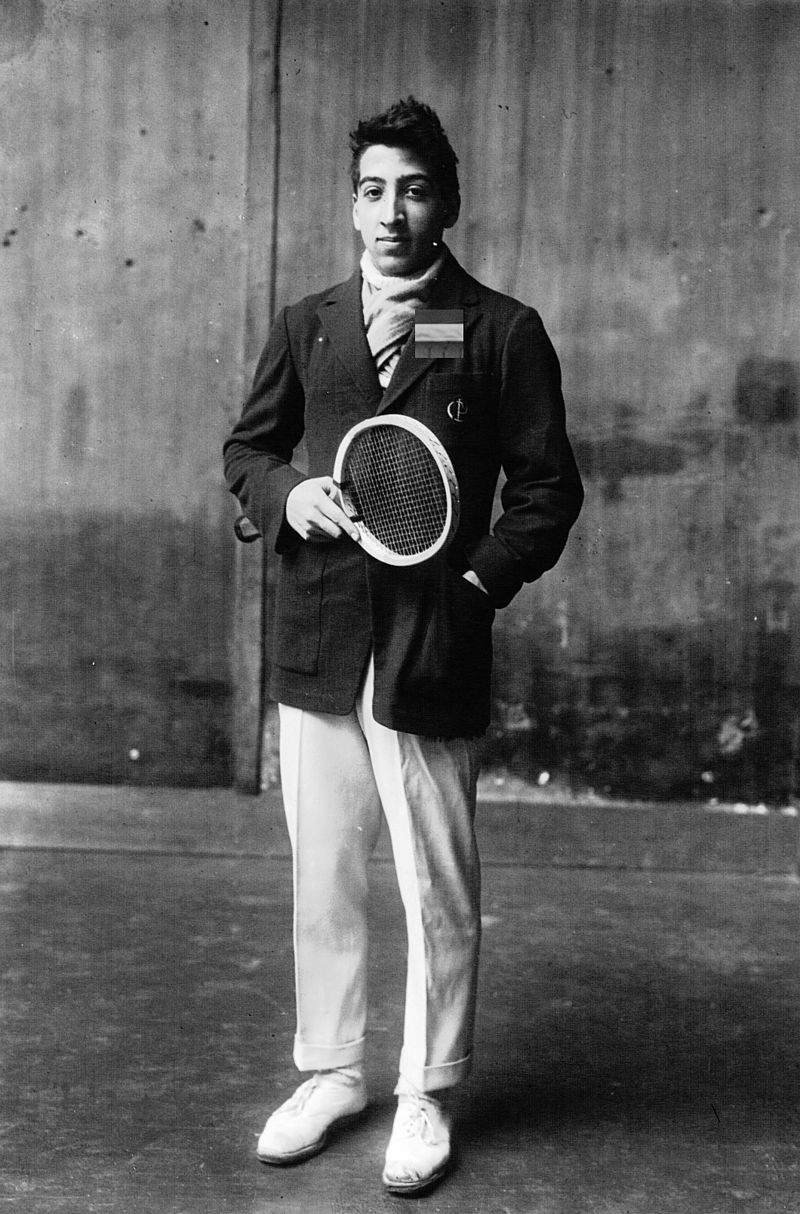
French tennis player Rene Lacoste
Agence de presse Meurisse · Bibliothèque nationale de France
![1923, [portrait du joueur de tennis René]](https://upload.wikimedia.org/wikipedia/commons/thumb/0/0e/Ren%C3%A9_Lacoste_1923_a.jpg/800px-Ren%C3%A9_Lacoste_1923_a.jpg)
1923, [portrait du joueur de tennis René]
Agence Rol · This file comes from Gallica Digital Library and is available under the digital ID btv1b53099528d
Key facts
Key facts
• Name — René Lacoste • Born — 2 July 1904 • Birthplace — Paris, France • Died — 12 October 1996 • Place of death — Saint-Jean-de-Luz, France • Retired — 1932 • Plays — Right-handed (one-handed backhand) • Tennishofyear — 1976 • Tennishofid — rene-lacoste • Singlesrecord — 262–43 (85.9%) • Singlestitles — 24 • Highestsinglesranking — No. 1 (1926, A. Wallis Myers) • Frenchopenresult — W (1925, 1927, 1929) • Wimbledonresult — W (1925, 1928) • Usopenresult — W (1926, 1927) • Othertournaments — yes • Olympicsresult — QF (1924) • Frenchopendoublesresult — W (1925, 1929) • Wimbledondoublesresult — W (1925) • Usopenmixedresult — F (1926, 1927) • Wimbledonmixedresult — 2R (1923) • Team — yes • Daviscupresult — W (1927, 1928) • Medaltemplates Expand — yes • Medaltemplates — Olympic Games
Tennis career
Tennis career
• Illustration — Lacoste in 1922 Lacoste started playing tennis at age 15 when he accompanied his father on a trip to England. His first participation in a Grand Slam tournament was the 1922 Wimbledon Championships in which he lost in the first round to Pat O'Hara Wood. The following year, 1923, he reached the fourth round at Wimbledon to be narrowly defeated by Cecil Campbell, and he competed for the first time in the U.S. Championships. His breakthrough came in 1925 when he won the singles title at the French Championships and at Wimbledon, in both cases after a victory in the final against compatriot Jean Borotra. The following year, 1926, Lacoste lost his French title after a straight-sets defeat in the final to Henri Cochet. He did not compete at Wimbledon that year, but in September he won the U.S. National Championships title against Borotra. He was ranked No. 1 for 1926 by A. Wallis Myers, tennis correspondent of The Daily Telegraph, Bill Tilden, Suzanne Lenglen and Stanley Doust (Daily Mail). In 1927, dubbed "The finest year in tennis history" by E. Digby Baltzell, Lacoste was part of the French team that captured the Davis Cup from the United States, ending the latter's 6-year title run. The final was played at the Germantown Cricket Club in Philadelphia and Lacoste won both his singles matches against Bill Johnston and Bill Tilden. He played Tilden in two Grand Slam tournament finals that year and won both of them. At the French Championships he was victorious in five sets; at the U.S. National Championships he defended his title and denied Tilden his seventh U.S. title by winning in straight sets, although he survived setpoints in the first and third set and was down a break in the second. At Wimbledon, Lacoste lost a five-set semifinal to Borotra. He was ranked No. 1 by A. Wallis Myers, Émile Deve, U.S. ranking committee president, Marcel Berger, (L'Opinion (French weekly newspaper)), Jean Samazeuilh (Le Miroir des sports) and Henri Cochet. In 1928 Lacoste lost his French title after a four-set loss in the final against Cochet. He took revenge by beating Cochet in the final of the Wimbledon Championships after having defeated Tilden in a five-set semifinal. The Challenge Round of the 1928 Davis Cup against the United States was played at the Stade Roland Garros in Paris on 27–29 July. The stadium was specifically constructed to host France's first defense of the Davis Cup. Lacoste lost the first rubber in a five-set match to Tilden but France won the remaining rubbers to defeat the challengers 4–1 and retain the cup. Lacoste did not participate in the 1928 U.S. Championships. Between 1923 and 1928 Lacoste played 51 Davis Cup matches for France in 26 ties and compiled a record of 32–8 in singles and 8–3 in doubles. The only major championship Lacoste played in 1929 was the French and he won his seventh, and last, Grand Slam singles title after a tight five-set final against Jean Borotra. Failing health, including respiratory disease, led to his withdrawal from competitive tennis in 1929. He would make a brief comeback at the 1932 French Championships, where he defeated reigning Wimbledon champion Sidney Wood in the third round, but lost in the fourth to Harry Lee. He was the non-playing captain of the French Davis Cup team in 1932 and 1933. The Four Musketeers were inducted simultaneously into the International Tennis Hall of Fame, in Newport, Rhode Island, in 1976. In his 1979 autobiography, Jack Kramer, the long-time tennis promoter and great player himself, included Lacoste in his list of the 21 greatest players of all time. In 1928 Lacoste wrote a book titled Lacoste on Tennis. There are numerous explanations of why Lacoste was originally nicknamed "The Crocodile." A 2006 New York Times obituary about Lacoste's son, Bernard, provides an apparently authoritative one. In the 1920s, supposedly, Lacoste made a bet with his team captain about whether he would win a certain match. The stakes were a suitcase he had seen in a Boston store; it was made of alligator skin. Following his victory, the American press dubbed him "The Alligator." Later, René Lacoste's friend Robert George embroidered a crocodile onto a blazer that Lacoste wore for his matches. • Illustration — Lacoste (right) with Otto Froitzheim
Playing style
Playing style
Lacoste was primarily a baseline player who relied on control, accuracy, and deeply-placed groundstrokes to put pressure on his opponents. In addition he possessed an excellent passing shot and backhand slice. Nicknamed the 'Tennis Machine' for his methodical game and ability to avoid errors, he was known as a devoted and hard-working player, rather than a player with a great amount of natural talent. His style was a complete contrast to that of his fellow Musketeer Henri Cochet. Lacoste was a studious tactician who meticulously analysed his opponents and kept detailed notes on their strengths and weaknesses.
Business career
Business career
In 1933, Lacoste founded La Société Chemise Lacoste with André Gillier. The company produced the tennis shirt, also known as a "polo shirt," which Lacoste often wore when he was playing; this had a crocodile (often thought to be an alligator) embroidered on the chest. In 1963, Lacoste's son Bernard took over the management of the company. In 1961, Lacoste created an innovation in racket technology by unveiling and patenting the first tubular steel tennis racket. At that time, wood rackets were the norm; the new version's strings were attached to the frame by a series of wires, which wrapped around the racket head. The steel-tube racket was stiffer, and imparted a greater force to the ball during a stroke. It was marketed in Europe under the Lacoste brand, but in the United States it was marketed by Wilson Sporting Goods. Pierre Darmon debuted the racket at Wimbledon in 1963, but it achieved critical acclaim and huge popularity as the Wilson T-2000, used by American tennis greats Billie Jean King and Jimmy Connors.
Personal life
Personal life
Rene Lacoste was born to Jeanne-Marie Magdeleine Larrieu-Let and Jean-Jules Lacoste. His maternal family is from Monein, in southwest France, the genealogy dating back to the 1700s. On 30 June 1930, he married golfing champion Simone de la Chaume. Their daughter, Catherine Lacoste, is a retired champion golfer, as well as former and now honorary president of the Golf Club Chantaco founded by her mother, located a few kilometres from Saint-Jean-de-Luz, France.
Singles: 10 (7 titles, 3 runner-ups)
Singles: 10 (7 titles, 3 runner-ups)
• Result — Year — Championship — Surface — Opponent — Score • Loss — 1924 — Wimbledon — Grass — Jean Borotra — 1–6, 6–3, 1–6, 6–3, 4–6 • Win — 1925 — French Championships — Clay — Jean Borotra — 7–5, 6–1, 6–4 • Win — 1925 — Wimbledon — Grass — Jean Borotra — 6–3, 6–3, 4–6, 8–6 • Loss — 1926 — French Championships — Clay — Henri Cochet — 2–6, 4–6, 3–6 • Win — 1926 — U.S. National Championships — Grass — Jean Borotra — 6–4, 6–0, 6–4 • Win — 1927 — French Championships — Clay — Bill Tilden — 6–4, 4–6, 5–7, 6–3, 11–9 • Win — 1927 — U.S. National Championships — Grass — Bill Tilden — 11–9, 6–3, 11–9 • Loss — 1928 — French Championships — Clay — Henri Cochet — 7–5, 3–6, 1–6, 3–6 • Win — 1928 — Wimbledon — Grass — Henri Cochet — 6–1, 4–6, 6–4, 6–2 • Win — 1929 — French Championships — Clay — Jean Borotra — 6–3, 2–6, 6–0, 2–6, 8–6
Doubles: 4 (3 titles, 1 runner-ups)
Doubles: 4 (3 titles, 1 runner-ups)
• Result — Year — Championship — Surface — Partner — Opponents — Score • Win — 1925 — French Championships — Clay — Jean Borotra — Jacques Brugnon Henri Cochet — 7–5, 4–6, 6–3, 2–6, 6–3 • Win — 1925 — Wimbledon — Grass — Jean Borotra — John Hennessey Raymond Casey — 6–4, 11–9, 4–6, 1–6, 6–3 • Loss — 1927 — French Championships — Clay — Jean Borotra — Jacques Brugnon Henri Cochet — 6–2, 2–6, 0–6, 6–1, 4–6 • Win — 1929 — French Championships — Clay — Jean Borotra — Jacques Brugnon Henri Cochet — 6–3, 3–6, 6–3, 3–6, 8–6
Mixed doubles: 2 (2 runner-ups)
Mixed doubles: 2 (2 runner-ups)
• Result — Year — Championship — Surface — Partner — Opponents — Score • Loss — 1926 — U.S. National Championships — Grass — Hazel Hotchkiss Wightman — Elizabeth Ryan Jean Borotra — 4–6, 5–7 • Loss — 1927 — U.S. National Championships — Grass — Hazel Hotchkiss Wightman — Eileen Bennett Henri Cochet — 2–6, 6–0, 3–6
Performance timeline
Performance timeline
(OF) only for French club members • Tournament — 1922 — 1923 — 1924 — 1925 — 1926 — 1927 — 1928 — 1929 — 1930 — 1931 — 1932 — Strike rate — Win–loss — Win % • Grand Slam tournaments • Australian Championships — A — A — A — A — A — A — A — A — A — A — A — 0 / 0 — 0–0 — – • French Championships — OF — W — F — W — F — W — A — A — 4R — 3 / 6 — 29–3 — 90.6 • Wimbledon — 1R — 4R — F — W — A — SF — W — A — A — A — A — 2 / 6 — 28–4 — 87.5 • U.S. Championships — A — 2R — QF — QF — W — W — A — A — A — A — A — 2 / 5 — 19–3 — 86.4 • Win–loss — 0–1 — 4–2 — 9–2 — 16–1 — 10–1 — 17–1 — 12–1 — 5–0 — 3–1 — 7 / 17 — 76–10 — 88.4 • National representation • Olympics — NH — QF — Not held — 0 / 1 — 3–1 — 75.0
All-time record
All-time record
• Tournament — Since — Record accomplished — Players matched • Grand Slam — 1877 — Youngest player to win 2 titles at 3 Grand Slams — Stands alone
Identity and origins
Identity and origins
The authorities additionally record the heading Rene Lacoste. His recorded language was French. He married Simone de la Chaume. 3 children are recorded: Catherine Lacoste, Michel Lacoste and Bernard Lacoste.
Life and career
Dated record
Life and career
The full dated record · 2 entries
1904
René Lacoste was born in 1904.
1996
René Lacoste died at Saint-Jean-de-Luz.
Citations
References
Each reference names the institution holding it, so a reader may go to the document itself.
reference work
Partially resolvedreference work
Partially resolved
The Encyclopedia exists whether or not anything is for sale. Corrections are recorded rather than overwritten, and every version of this record is kept. Published 14 August 2026.
Elsewhere in Fashion
2,260 published records in this field, each with its sources named.
- Rena KohDesigner
- Renato BalestraDesigner
- René BéguéDesigner
- Rene CaovillaDesigner
- Renée FirestoneDesigner
- Reni FolawiyoDesigner
- Renzo RossoDesigner
- Reza ShariffiDesigner
Best supported in this field
For owners
Own a work by René Lacoste?
A specialist will read what you send and tell you what the house can establish, what it cannot, and whether the object is suited to sale. There is no charge and no obligation. The object stays with you throughout; nothing is shipped to us unless it is arranged in writing beforehand.