
Raymond Duchamp-Villon
Raymond Duchamp-Villon (5 November 1876 – 9 October 1918) was a French sculptor.
Also recorded as Pierre-Maurice-Raymond Duchamp · Raymond Duchamp Villon · Pierre-Maurice Raymond Duchamp · Raymond Duchamp- Villon
Raymond Duchamp-Villon
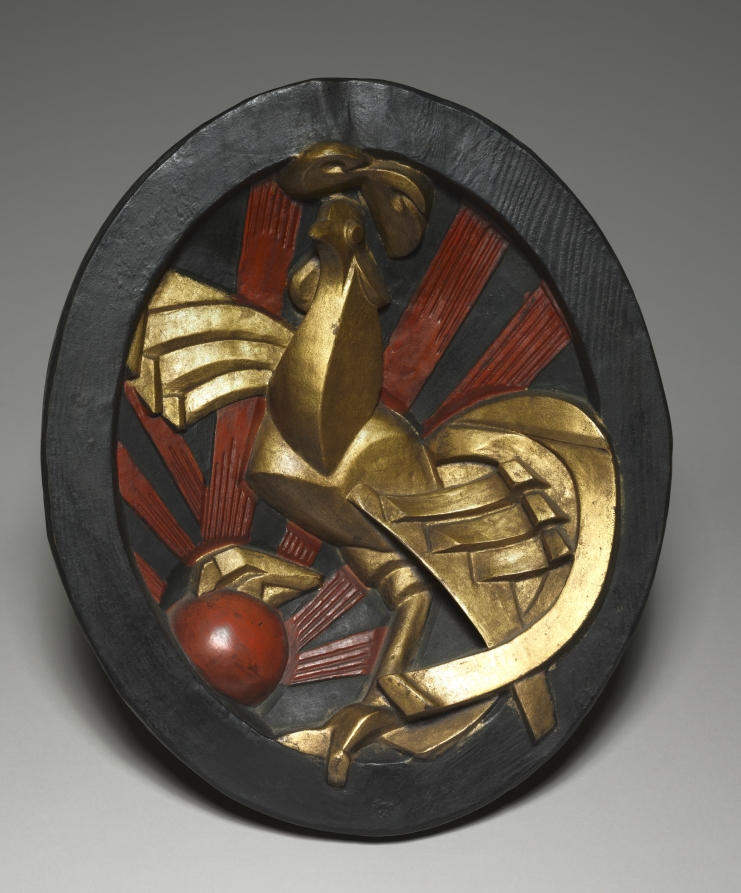
Raymond Duchamp-Villon · The Cleveland Museum of Art · Bequest of Lucia McCurdy McBride · CC0
- Born
- 1876.
- Died
- sources differ (1918 and 1918).
- Nationality
- France.
- Occupation
- sculptor and painter.
- Movements
- cubism.
- Known for
- Le Cheval by Raymond Duchamp-Villon.
VALÉORINE Encyclopedia
VALÉORINE documentary reading
Documentary summary
Raymond Duchamp-Villon (5 November 1876 – 9 October 1918) was a French sculptor.
Admitted source layer · organised and presented by VALÉORINE
Reference Check
Propose documentary evidence for Raymond Duchamp-Villon. A contribution is never written directly as fact: identity, source, rights and evidence gates still decide.
Sign in to contribute
Documentary evidence
Documentary basis
Authority files
wikidata · Q705282 · wikipedia · Raymond Duchamp-Villon
In this article
Life and art
Life and art
Duchamp-Villon was born Pierre-Maurice-Raymond Duchamp in Damville, Eure, in the Normandy region of France, the second son of Eugène and Lucie Duchamp (née Nicolle), the daughter of painter and engraver Émile Frédéric Nicolle. Of the six Duchamp children, four would become successful artists. He was the brother of Jacques Villon (1875–1963), painter, printmaker; Marcel Duchamp (1887–1968), painter, sculptor and author; Suzanne Duchamp-Crotti (1889–1963), painter. Duchamp-Villon inherited his love for art from his mother. From 1894 to 1898 Raymond Duchamp-Villon lived in the Montmartre Quarter of Paris with his brother Jacques and studied medicine at the Sorbonne. Rheumatic fever forced him to abandon his studies in 1898 and it left him partially incapacitated for a time. This unforeseen event altered the course of his life as he began to pursue an interest in sculpture. He started by creating small statuettes and essentially became self-taught, achieving a high level of mastery and acumen. In 1902 and 1903, he exhibited at the Salon de la Société Nationale des Beaux-Arts but to distinguish himself from his artist brother, he began to use the Duchamp-Villon designation on all his works. In 1905 Duchamp-Villon had his first exhibition at the Salon d'Automne and a show at the Galerie Legrip in Rouen with his brother Jacques. Two years later they moved to the village of Puteaux on the outskirts of Paris where the three Duchamp brothers were part of the regular meetings of what became known as the Section d'Or, involving artists, poets and critics. Raymond's reputation was such that he was made a member of the jury of the sculpture section of the Salon d'Automne in 1907 and was later instrumental in promoting the Cubist movement. In 1911 he exhibited at the Galerie de l’Art Contemporain in Paris and the following year his work was included in a show organized by the Duchamp brothers at the Salon de la Section d’Or at the Galerie de la Boétie. All three of the Duchamp brothers then showed their work at the 1913 Armory Show in New York City that helped introduce modern art to the United States. In 1913 he took part in exhibitions at the Galerie André Groult in Paris, the Galerie S. V. U. Mánes in Prague, and in 1914 at Der Sturm Gallery in Berlin. During World War I Raymond Duchamp-Villon served in the French army in a medical capacity, but still worked on his major cubist sculpture, The Large Horse. In late 1916, Raymond Duchamp-Villon contracted typhoid fever while stationed at the military quarters in Champagne. As a result, he was taken to the military hospital at Cannes where he died. In 1967, in Rouen, his last surviving artist brother Marcel helped organize an exhibition called Les Duchamp: Jacques Villon, Raymond Duchamp-Villon, Marcel Duchamp, Suzanne Duchamp. Some of this family exhibition was later shown at the Musée National d'Art Moderne in Paris.
Life and career
Dated record
Life and career
Explore 1876–1918
The full dated record · 3 entries
1876
Raymond Duchamp-Villon born at Damville.
1914
Le Cheval by Raymond Duchamp-Villon.
1918
Raymond Duchamp-Villon died at Cannes.
Primary material
Documents and archives
reference work
- Wikidata, structured authority record Q705282: Raymond Duchamp-Villon
Reputable secondary · Wikimedia Foundation
- “Raymond Duchamp-Villon”, English Wikipedia, consulted as further reading
Reputable secondary · Wikipedia
scholarly publication
- L'architectonique cubiste du corps : les schémas anatomiques chez Picasso et Raymond Duchamp-Villon, 1907-1918
Scholarly · Crossref registry
Notes from the source article
Cited by Wikipedia
Notes from the source article
These works are cited by the source article, in its own numbering. They are recorded as its citations, not as sources VALÉORINE has verified.
References
Citations
References
Each reference names the institution holding it, so a reader may go to the document itself.
scholarly publication
L'architectonique cubiste du corps : les schémas anatomiques chez Picasso et Raymond Duchamp-Villon, 1907-1918Crossref registry
Institutional witnessreference work
Wikidata, structured authority record Q705282: Raymond Duchamp-VillonWikimedia Foundation
Secondary witnessreference work
Secondary witness
The Encyclopedia exists whether or not anything is for sale. Corrections are recorded rather than overwritten, and every version of this record is kept. Published 14 August 2026.
Elsewhere in Sculpture
6,174 published records in this field, each with its sources named.
- Ratip Aşir AcudoğuArtist
- Ray KingArtist
- Raymond CouvègnesArtist
- Raymond DelamarreArtist
- Raymond HainsArtist
- Raymond Léon RivoireArtist
- Raymond MasonArtist
- Raymond PetitArtist
Best supported in this field
For owners
Own a work by Raymond Duchamp-Villon?
A specialist will read what you send and tell you what the house can establish, what it cannot, and whether the object is suited to sale. There is no charge and no obligation. The object stays with you throughout; nothing is shipped to us unless it is arranged in writing beforehand.