
pyrophone
Illustration — One of the pyrophones constructed by Kastner, as seen in 2013 in the Musée historique de Strasbourg • Illustration — Durant's diagram of the sound-creating gas burners, the, "mechanisms that allowed two flames to unite or diverge to produce a musical note" • Illustration — Kastner A pyrophone, also known as a "fire/explosion organ" or "fire/explosion calliope", is a musical instrument in which notes are sounded by explosions, or similar forms of rapid combustion, rapid heating, or the like, such as burners in cylindrical glass tubes, creating light and sound. It was invented by physicist and musician Georges Frédéric Eugène Kastner (born 1852 in Strasbourg, France – died 1882 in Bonn, Germany), son of composer Jean-Georges Kastner, around 1870.
Also recorded as fire organ · explosion organ · fire calliope
pyrophone
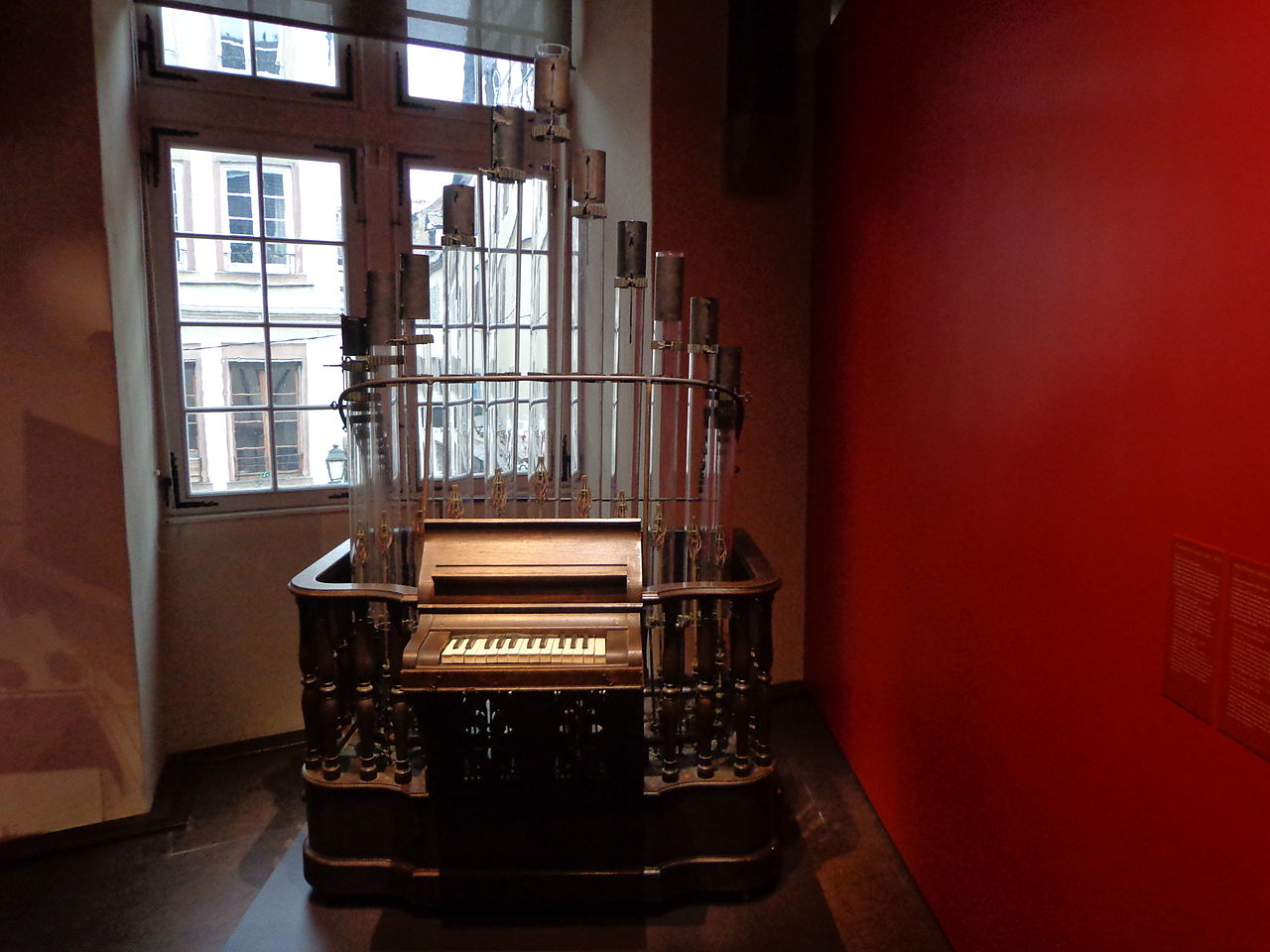
Edelseider · CC BY-SA 3.0
- Field
- musical instrument
VALÉORINE Encyclopedia
VALÉORINE documentary reading
Documentary summary
Illustration — One of the pyrophones constructed by Kastner, as seen in 2013 in the Musée historique de Strasbourg • Illustration — Durant's diagram of the sound-creating gas burners, the, "mechanisms that allowed two flames to unite or diverge to produce a musical note" • Illustration — Kastner A pyrophone, also known as a "fire/explosion organ" or "fire/explosion calliope", is a musical instrument in which notes are sounded by explosions, or similar forms of rapid combustion, rapid heating, or the like, such as burners in cylindrical glass tubes, creating light and sound. It was invented by physicist and musician Georges Frédéric Eugène Kastner (born 1852 in Strasbourg, France – died 1882 in Bonn, Germany), son of composer Jean-Georges Kastner, around 1870.
Admitted source layer · organised and presented by VALÉORINE
Reference Check
Propose documentary evidence for pyrophone. A contribution is never written directly as fact: identity, source, rights and evidence gates still decide.
Sign in to contribute
Documentary evidence
Documentary basis
Authority files
wikidata · Q365289
In this article
Design
Design
Kastner's patent
History
History
• Illustration — The German composer Wendelin Weißheimer playing a pyrophone Pyrophones originated in the 19th century. Byron Higgins, using hydrogen burning within the bottom of an open glass tube, first pointed out that if flame is placed in a glass tube sound may be produced in 1777 and in 1818 Michael Faraday attributed the tones to very rapid explosions. Physicist John Tyndall demonstrated that flame(s) in a tube may be made to sound if they are placed close to one third the length of the tube, the explosion occurs at a rate which matches the fundamental or one of the harmonics of the tube, and the volume of the flame is not too great. Brewer, Moigno, and de Parville describe Kastner as having invented the instrument about twenty years before 1890, and he filed a patent on Christmas Eve of 1874. Charles Gounod attempted to include the organ in his opera Jeanne d'Arc (1873) and the instrument was shown in the Paris Exhibition (1878). Henry Dunant was a proponent, and Wendelin Weißheimer composed Five Sacred Sonnets for Voice, Flute, Oboe, Clarinet, Pyrophone and Piano (1880).
Audio
Audio
*
Video
Video
*
Cinema
Cinema
*
Related musical instruments
Fuel sources
Fuel sources
Pyrophones are usually powered by propane, but gasoline powered mobile units have been built, to connect to automobile fuel intake manifolds and use the spark plugs and wiring, etc., to detonate one or more of the chambers. Hydrogen pyrophones are often made using upside-down glass test tubes as the combustion chambers. Different colors were probably not achieved in Kastner's time, but would be possible with the addition of salts to the flames.
References
Citations
References
Each reference names the institution holding it, so a reader may go to the document itself.
reference work
Secondary witness
The Encyclopedia exists whether or not anything is for sale. Corrections are recorded rather than overwritten, and every version of this record is kept. Published 16 August 2026.
Elsewhere in Collectables
20,755 published records in this field, each with its sources named.
- Pyongyang RacerWork
- PyracurseWork
- Pyramid of DoomWork
- PyroblazerWork
- PyrotechnicaWork
- Q.U.B.E.Work
- Q*bertWork
- QairaqTerminology
Best supported in this field
For owners
Own an object connected with pyrophone?
A specialist will read what you send and tell you what the house can establish, what it cannot, and whether the object is suited to sale. There is no charge and no obligation. The object stays with you throughout; nothing is shipped to us unless it is arranged in writing beforehand.