
Prussian Academy of Arts
Illustration — Arnim Palace, the Prussian Academy of Arts building on Pariser Platz in Berlin, c. 1903 The Prussian Academy of Arts (Preußische Akademie der Künste) was a state arts academy first established in 1694 by prince-elector Frederick III of Brandenburg in Berlin, in personal union Duke Frederick I of Prussia, and later king in Prussia. After the Accademia dei Lincei in Rome and the Académies Royales in Paris, the Prussian Academy of Art was the oldest institution of its kind in Europe, with a similar mission to other royal academies of that time, such as the Real Academia Española in Madrid, the Royal Society in London, or the Royal Swedish Academy of Fine Arts in Stockholm.
VALÉORINE Encyclopedia
VALÉORINE documentary reading
Documentary summary
Illustration — Arnim Palace, the Prussian Academy of Arts building on Pariser Platz in Berlin, c. 1903 The Prussian Academy of Arts (Preußische Akademie der Künste) was a state arts academy first established in 1694 by prince-elector Frederick III of Brandenburg in Berlin, in personal union Duke Frederick I of Prussia, and later king in Prussia. After the Accademia dei Lincei in Rome and the Académies Royales in Paris, the Prussian Academy of Art was the oldest institution of its kind in Europe, with a similar mission to other royal academies of that time, such as the Real Academia Española in Madrid, the Royal Society in London, or the Royal Swedish Academy of Fine Arts in Stockholm.
Admitted source layer · organised and presented by VALÉORINE
Note VALÉORINE
No house-authored Note is published until its assertions and sources pass the VALÉORINE evidence contract. The documentary article remains available in full while that enrichment is being consolidated.
Documentary enrichment in progress · no unsupported statement published
Reference Check
Propose documentary evidence for Prussian Academy of Arts. A contribution is never written directly as fact: identity, source, rights and evidence gates still decide.
Sign in to contribute
World of VALÉORINE
Documentary connections
Only confirmed graph relationships appear here. Images are shown only when their identity and reuse rights both pass the documentary gate.

Educated At · incoming
Adalbert Begas
Artist
http://sammlerhaus-koethen.de/NEU/fotos/adalb01.htm
Educated At · incoming
Adolf Eybel
Artist

Educated At · incoming
Albert Hinrich Hussmann
Artist
Bronzeskulptur

Educated At · incoming
Alexander Calandrelli
Artist
Wikimedia Commons
Educated At · incoming
Alfred Mann
Person

Educated At · incoming
Anna Gerresheim
Artist
kunstmuseum-schwaan.de

Educated At · incoming
Anton von Werner
Artist
Unknown source Unknown source

Educated At · incoming
August Kiss
Artist
Own work

Educated At · incoming
August Volz
Artist
Wikimedia Commons

Educated At · incoming
August von Brandis
Artist
Book: August von Brandis, 1999

Educated At · incoming
Carl Georg Enslen
Artist
http://webcollection.landesmuseen.ch/

Educated At · incoming
Edvard Isto
Artist
http://kokoelmat.fng.fi/app?si=A-1993-369
Educated At · incoming
Elise Blumann
Artist

Educated At · incoming
Emil Bohnke
Person
Own work
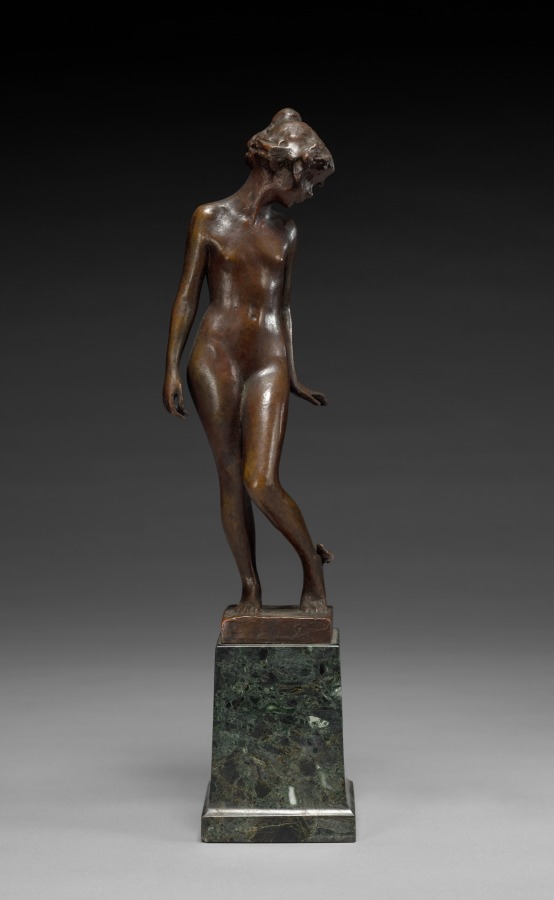
Educated At · incoming
Emil Fuchs
Artist
Gift of Mr. and Mrs. Dudley S. Blossom
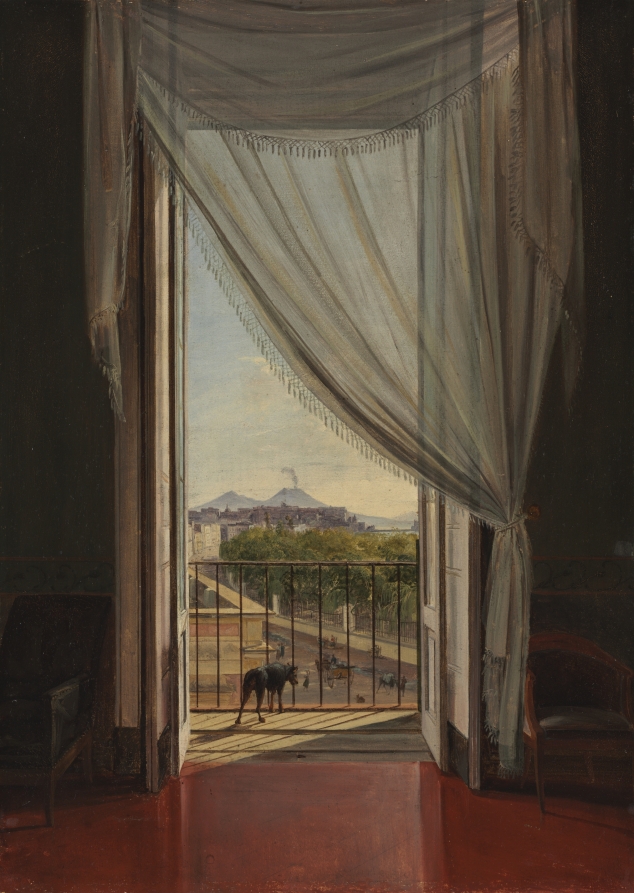
Educated At · incoming
Franz Ludwig Catel
Artist
Mr. and Mrs. William H. Marlatt Fund
Documentary evidence
Evidence Panel
not yet certified
- Identity
- unresolved
- Independent source families
- 0
- Admitted assertions
- 0
- Open conflicts
- 0
In this article
People
People
The academy had a decisive influence on art and its development in the German-speaking world throughout its existence. For an extended period of time it was also the German artists' society and training organisation, whilst the Academy's Senate became Prussia's arts council as early as 1699. It dropped 'Prussian' from its name in 1945 and was finally disbanded in 1955 after the 1954 foundation of two separate academies of art for East Berlin and West Berlin in 1954. Those two separate academies merged in 1993 to form Berlin's present-day Academy of Arts.
Most artists were associated with the academy as members. Membership was an honorary distinction extended to prominent domestic Prussian artists (after unification, German artists) and selected foreign figures as well. A 'deliberative' body of senators was chosen from the membership – some elected, and some automatically included due to other rank. The academy was not a school, although it had associations with educational institutions, notably the state school that evolved into the present-day Berlin University of the Arts.
Directors
Directors
• Joseph Werner (1695–1699) • Samuel Theodor Gericke (1705–1712) • Friedrich Wilhelm Weidemann (1718–1732 [1750?]) • Antoine Pesne (1732–1757) • Blaise Nicholas Le Sueur (1757–1785) • Bernhard Rode (1785–1797) • Daniel Chodowiecki (1797–1801) • Johann Gottfried Schadow (1815–1850) • Anton von Werner (1875–1915) • Franz Heinrich Schwechten (1915–1918) • Max Liebermann (1920–1932) • Max von Schillings (1932–1933)
1694 to 1799
1694 to 1799
The academy was founded to include painters, sculptors, and architects as members, which reflected the classical unity of the arts ideal. The scope was expanded in 1704 to include "Mechanical Sciences". The academy's first director (president) was Swiss painter Joseph Werner. In 1796, the Academy announced a competition for a monument in honour of Frederick the Great. Friedrich Gilly designed a monumental temple in the style of revolutionary architecture (Revolutionsarchitektur) to be erected on Leipziger Platz in Berlin. Today, the design is part of the collection of the Kupferstichkabinett Berlin. Name changes: • 1696–1704 Kurfürstliche Academie der Mahler-, Bildhauer- und Architectur-Kunst (Electoral Academy of the Arts of Painter, Sculptor and Architecture) • 1704–1790 Königlich-Preussische Akademie der Künste und mechanischen Wissenschaften (Royal Prussian Academy of the Arts and Mechanical Sciences) • 1790–1809 Königliche Akademie der bildenden Künste und mechanischen Wissenschaften zu Berlin (Royal Academy of Fine Arts and Mechanical Sciences of Berlin)
19th century
19th century
Longtime director and sculptor Johann Gottfried Schadow served from 1815 to 1850. In 1833 the academy added a fine arts division, and a music division in 1835. Emil Fuchs studied at the Academy under Fritz Schaper and Anton von Werner, shortly before 1891. Otto Geyer studied there from 1859 to 1864. Sculptor Wilhelm Neumann-Torborg studied at the academy from 1878 until 1885, under Otto Knille and Fritz Schaper. In 1885, he won the Academy's Rome Scholarship for his thesis, "The Judgment of Paris". Anna Gerresheim studied there from 1876 for four years in the "ladies class" under Karl Gussow. Oskar Frenzel studied there between 1884 and 1889 under Paul Friedrich Meyerheim and Eugen Bracht. He was from 1904 until his death a member of the Academy. Painter Friedrich Wachenhusen studied there in 1889 under Eugen Bracht. Name changes: • 1790–1809 Königliche Akademie der bildenden Künste und mechanischen Wissenschaften zu Berlin (Royal Academy of Fine Arts and Mechanical Sciences of Berlin) • 1809–1875 Königlich Preussische Akademie der Künste (Royal Prussian Academy of the Arts) • 1875–1882 Königlich Preussische Akademie der Künste zu Berlin (Royal Prussian Academy of the Arts of Berlin) • 1882–1918 Königliche Akademie der Künste zu Berlin (Royal Academy of the Arts of Berlin)
20th century
20th century
• Illustration — Director Max Liebermann (center) opening a 1922 "Black & White" Exhibition at the Academy In 1926 the academy added a Dichtkunst (Fine Poetry) division, a Dichtung (Poetry) division in 1932, and the German Academy of Poetry from the beginning of June 1933. From 1930 until his parting into exile in 1933, novelist Heinrich Mann was its president. Painter and sculptor Paul Wallat studied there from 1902 to 1909 under Otto Brausewetter (de) (1835–1904) and Carl Saltzmann. On 29 December 1906 he received the award of the Ginsberg Foundation of the Berlin Academy. In 1920, Käthe Kollwitz became the first woman elected to the Prussian Academy, but with the coming to power of Adolf Hitler in 1933 she was expelled because of her beliefs and her art. Name changes: • 1882–1918 Königliche Akademie der Künste zu Berlin (Royal Academy of the Arts of Berlin) • 1918–1926 Akademie der Künste zu Berlin (Academy of the Arts of Berlin) • 1926–1931 Preußische Akademie der Künste zu Berlin (Prussian Academy of the Arts of Berlin) • 1931–1954 Preussische Akademie der Künste (Prussian Academy of the Arts; disbanded)
Knowledge graph
People and holdings
Those recorded as working within this institution, and the records it holds or is connected with.
Studied at
3- Emil BohnkePerson
Established from a fact already recorded on a verified source.
- Emil FuchsArtist
Established from a fact already recorded on a verified source.
- Johan NordhagenArtist
Established from a fact already recorded on a verified source.
The Encyclopedia exists whether or not anything is for sale. Corrections are recorded rather than overwritten, and every version of this record is kept. Published —.
Elsewhere in General
16,157 published records in this field, each with its sources named.
- Proviso East High SchoolOrganisation
- Proviso West High SchoolOrganisation
- Provița de JosPlace
- Provo High SchoolOrganisation
- Prussian Military AcademyOrganisation
- PruszkówPlace
- PrzeciszówPlace
- PrzedbórzPlace
Best supported in this field
For owners
Own an object connected with Prussian Academy of Arts?
A specialist will read what you send and tell you what the house can establish, what it cannot, and whether the object is suited to sale. There is no charge and no obligation. The object stays with you throughout; nothing is shipped to us unless it is arranged in writing beforehand.