
Pottery for oil
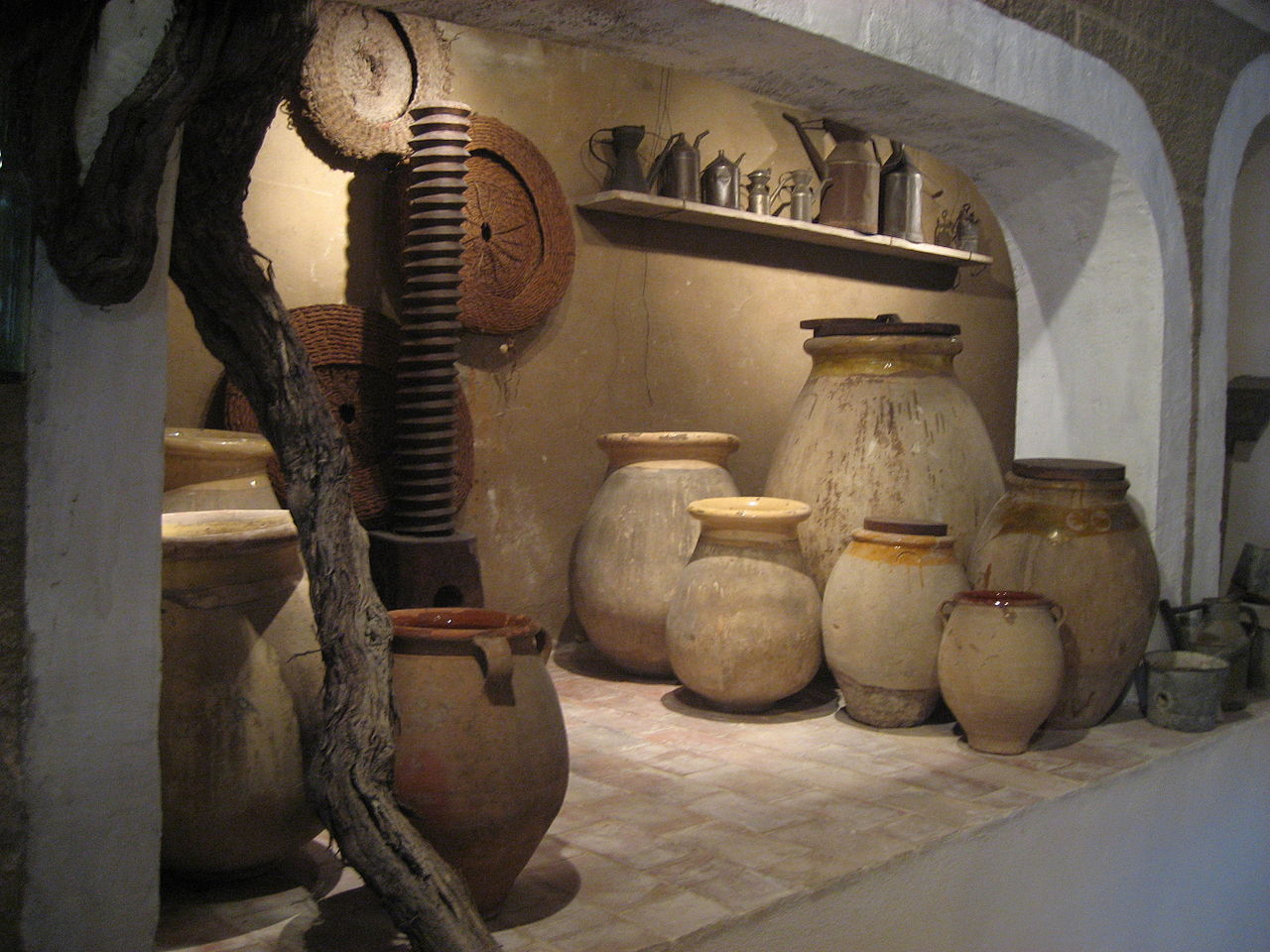
Illustration — Metal alcuza (top) and oil containers at the Musée du Terroir Marseillais Pottery for oil is the generic term for ceramic objects, whether coarse or glazed, used for the transportation, storage, and consumption of oily products, particularly olive oil and its culture. Among the most popular items in this category of earthenware are oil cruets and alcuzas, cantarillas, orzas, amphoras, and jars for food. Unguentaries and redomas in ancient pharmacopeia; and lamps and lucernas for lighting.
Pottery for oil
Jeamazet · CC BY-SA 3.0
- Field
- pottery
VALÉORINE Encyclopedia
VALÉORINE documentary reading
Documentary summary
Illustration — Metal alcuza (top) and oil containers at the Musée du Terroir Marseillais Pottery for oil is the generic term for ceramic objects, whether coarse or glazed, used for the transportation, storage, and consumption of oily products, particularly olive oil and its culture. Among the most popular items in this category of earthenware are oil cruets and alcuzas, cantarillas, orzas, amphoras, and jars for food. Unguentaries and redomas in ancient pharmacopeia; and lamps and lucernas for lighting.
Admitted source layer · organised and presented by VALÉORINE
Reference Check
Propose documentary evidence for Pottery for oil. A contribution is never written directly as fact: identity, source, rights and evidence gates still decide.
Sign in to contribute
World of VALÉORINE
Documentary connections
Only confirmed graph relationships appear here. Images are shown only when their identity and reuse rights both pass the documentary gate.

Documentary evidence
Documentary basis
Authority files
wikidata · Q130601865 · wikipedia · Pottery for oil
In this article
History
History
• Illustration — Betic amphora for transporting olive oil, 2nd century CE. Underwater site of Escombreras. National Museum of Underwater Archaeology, Cartagena (Spain). The binomial pottery-oil is documented to have originated in the ancient Assyrian empire towards the end of the 3rd millennium BCE, in the archaeological digs of the Ebla palace, where thousands of containers capable of storing 120,000 kg of oil were found. There are also written records in cuneiform from the palace's tablet archive, repeatedly mentioning taxes on oil and quality distinctions. Continuing perhaps from the Hippocratic medicine and information from ancient world historians like Pliny the Elder, a manuscript preserved in the Bibliothèque Nationale de France, the «Tacuinum sanitatis» by the Arab physician Ibn Butlan, compiled in the 15th century, listed remedies and formulations highlighting the essential role of pottery in olive oil culture, both in food and in ointments and balms. The prominence of the so-called Panathenaic amphorae, filled with oil and awarded to victors in games and festivals as containers for balms, is also noted. Greeks, Romans, and Phoenicians shared the pottery-oil association as a basis for their trade. Archaeological references are numerous, with the model of the Iberian-Roman city of Lucentum as an example.
Types of containers and vessels
Types of containers and vessels
In a basic arrangement or catalog of containers related to the use and consumption of oils, the following can be differentiated:
Oil cruets
Oil cruets
Domestic use containers with varied morphologies that can be summarized in three characteristic elements: prototypes of jugs or cantarillas (with an ovoid body), with one or two handles and a narrow neck. To facilitate pouring, models with occasionally tubular and fine spouts have been developed. Due to their function and use, oil cruets can be related to the setrill (perhaps of the same root that Nebrija noted for azeytera) from Eastern Spain and the càntir d'oli from Catalonia (or oil pitcher).
Alcuzas
Alcuzas
Researchers seem to agree that the nominal relation to the typology of alcuzas depends more on the traditional designation of the vessel in its place of manufacture and use than on its appearance and form. That is, a container called alcuza in La Mancha is almost identical to another called oil cruet in Aragon, and in turn, they are the same as a Levantine setrill. Similarly, in a documented catalog of both archaeological objects and a museum ceramic collection, two vessels of very different appearance and typology can be seen called setrill, oil cruet, or alcuza. Thus, in this category of domestic containers for storing and serving olive oil, there are oil cruets with spouts like botijos, or Toledo alcuza identical to the Cordoban perulas painted by Julio Romero de Torres.
Amphorae
Amphorae
Represented in the iconography of Ancient Egypt in the context of pottery and the oil industry, they have been dated on the coasts of Lebanon and Syria, during the 15th century BCE and in the 14th century BCE in the Mycenaean area. Their massive use in wine and oil trade has left countless archaeological references, and from these and later written documents, it is known that these pointed and rounded base containers (designed to be 'fixed' in the sand of beaches during transport and handling) filled the long benches of transport ships. To withstand the hardships and harsh conditions of travel, each container was sealed with a ceramic disk and then with a lime paste. The larger ones, during the period of Roman commercial expansion, could hold about 50 liters of oil. The oil amphorae from Bética were notable, such as those classified as Dressel 20 amphorae, with specific shapes adapted to different uses, including for storage and transportation, to make them practical for trade.
Orzas
Orzas
Typically used in Hispania, orzas have a significant size, with rounded shapes and typically come with two handles. They are almost always made with coarse ceramic, with a thin and smooth exterior surface and a rough, unglazed interior. The oil or other contents were protected by a thin paste applied during firing. In the Iberian Peninsula, orzas are commonly used for storing and transporting oil, and they often have a capacity of 10 to 25 liters.
Other containers
Other containers
Domestic use also included containers such as bottles, jugs, and pots for serving and storing oil, which varied in shape and size according to regional customs and periods. These also included unguentaria (for ointments) and lamp vessels like lucernae and candelabra.
Citations
References
Each reference names the institution holding it, so a reader may go to the document itself.
reference work
Secondary witnessreference work
Secondary witness
The Encyclopedia exists whether or not anything is for sale. Corrections are recorded rather than overwritten, and every version of this record is kept. Published 16 August 2026.
Elsewhere in Ceramics
1,104 published records in this field, each with its sources named.
- Pirro CunibertiArtist
- Pit fired potteryTerminology
- Polia PillinArtist
- Polikarps VilcānsArtist
- Pravoslav RadaArtist
- Princess Bona Margherita of Savoy-GenoaArtist
- Pueblo potteryTerminology
- pyxisTerminology
Best supported in this field
For owners
Own an object connected with Pottery for oil?
A specialist will read what you send and tell you what the house can establish, what it cannot, and whether the object is suited to sale. There is no charge and no obligation. The object stays with you throughout; nothing is shipped to us unless it is arranged in writing beforehand.