
Pisanello
1380/1395 – c. 1450/1455), born Antonio di Puccio Pisano or Antonio di Puccio da Cereto, also erroneously called Vittore Pisano by Giorgio Vasari, was one of the most distinguished painters of the early Italian Renaissance and Quattrocento. He was acclaimed by poets such as Guarino da Verona and praised by humanists of his time, who compared him to such illustrious names as Cimabue, Phidias and Praxiteles.
Also recorded as Antonio di Puccio Pisano · Antonio di Puccio da Cereto · Antonio Pisano Pisanello · Antonio di Puccio Pisano Pisanello
Pisanello
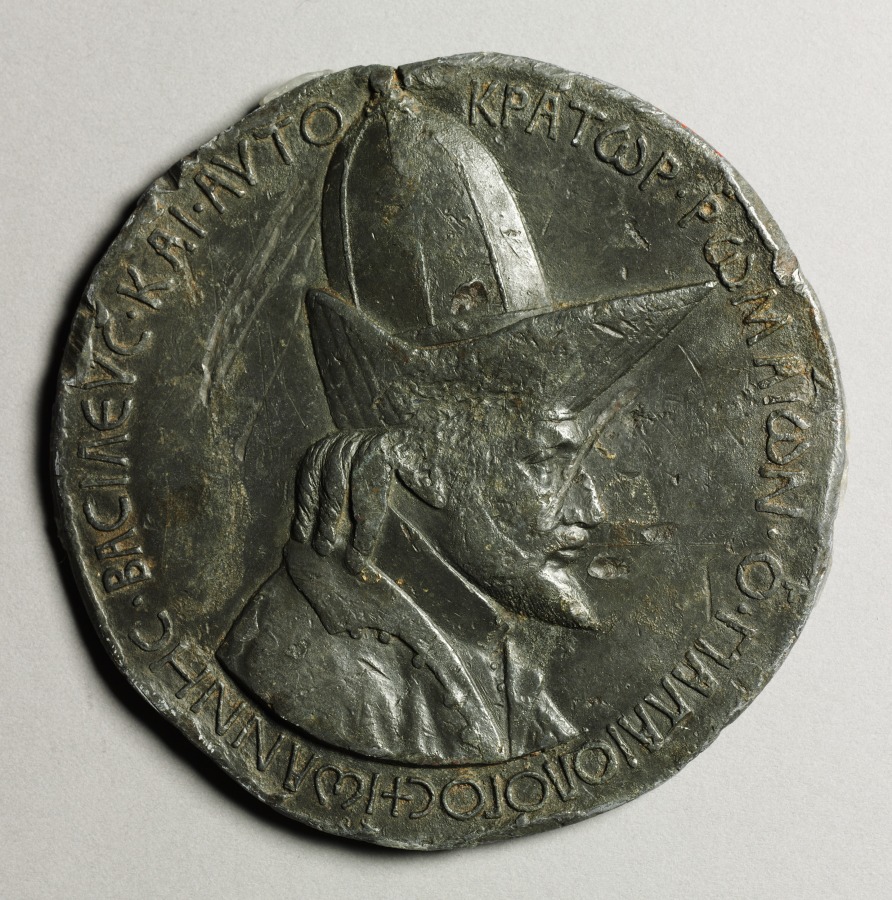
Pisanello · The Cleveland Museum of Art · John L. Severance Fund · CC0
- Born
- sources differ (1395 and 1380).
- Died
- sources differ (1455 and 1450).
- Nationality
- Republic of Pisa.
- Occupation
- painter, illuminator, medalist and draftsperson.
- Fields
- portrait.
- Movements
- Veronese school and Renaissance.
- Known for
- Medal of John VIII Palaiologos, The Vision of Saint Eustace, Saint George and the Princess, Codex Vallardi, Drawings in the Codex Vallardi, First Lionello d'Este medal and Museo Correr.
VALÉORINE Encyclopedia
VALÉORINE documentary reading
Documentary summary
1380/1395 – c. 1450/1455), born Antonio di Puccio Pisano or Antonio di Puccio da Cereto, also erroneously called Vittore Pisano by Giorgio Vasari, was one of the most distinguished painters of the early Italian Renaissance and Quattrocento. He was acclaimed by poets such as Guarino da Verona and praised by humanists of his time, who compared him to such illustrious names as Cimabue, Phidias and Praxiteles.
Admitted source layer · organised and presented by VALÉORINE
Note VALÉORINE
Pisanello (1395–1455) was a draftsperson, illuminator and medalist, among other activities and a national of the Republic of Pisa. Born in Pisa, the draftsperson died in Rome.
Pisanello was active in painting. The draftsperson was associated with Renaissance and Veronese school.
Works include Codex Vallardi, drawings for Saint George and the princess, Drawings in the Codex Vallardi and First Lionello d'Este medal, Museo Correr, among others. Genres include portrait. Languages used include Italian.
Composed from admitted, traceable facts · 27 September 2026
VALÉORINE
Reference Check
Propose documentary evidence for Pisanello. A contribution is never written directly as fact: identity, source, rights and evidence gates still decide.
Sign in to contribute
Documentary evidence
Documentary basis
Authority files
getty · 500061342 · gnd · 118594613 · wikidata · Q311082 · wikipedia · Pisanello
In this article
Early life
Early life
Known for his resplendent frescoes in murals, portraits, easel pictures, and a number of drawings such as those in the Codex Vallardi (Louvre). He is the most important commemorative portrait medallist in the first half of the 15th century, and he can claim to have originated this important genre. He was employed by the Doge of Venice, the Pope in the Vatican and the courts of Verona, Ferrara, Mantua, Milan, Rimini, and by the King of Naples. He stood in high esteem in the Gonzaga and Este families. Pisanello had a number of his works wrongly ascribed to other artists such as Piero della Francesca, Albrecht Dürer and Leonardo da Vinci, to name a few. While most of his paintings have perished, a number of his drawings and medals have survived.
Pisanello's life is somewhat shrouded in mystery. He was born between 1380 and 1395 and died between 1450 and 1455 (probably between 14 July and 8 October 1455). He was a native of Pisa but spent his early years in San Vigilio sul Lago in the territory of Verona. He was probably given his early training by a Veronese painter (perhaps Altichiero or Stefano da Verona) as his early style is in the tradition of Veronese painting.
Training
Training
Between 1415 and 1420, Pisanello was the assistant of the renowned painter and illuminator Gentile da Fabriano from whom he acquired his refined, delicate, detailed style. Pisanello also acquired from him a taste for precious materials and beautiful fabrics that can be found in his later paintings. The frescoes in the Doge's Palace at Venice, on which they worked together, have perished as well as the frescoes in the Basilica of St. John Lateran and the palaces of Mantua and Pavia. In 1422, Pisanello was reported to be in Mantua in the service of young Ludovico Gonzaga, son of the Marchese of Mantua Gianfrancesco Gonzaga. He continued to work for the Gonzaga family till the 1440s. Giorgio Vasari, an artist and biographer of the Italian Renaissance, states that Pisanello also worked in the workshop of Andrea del Castagno, author of the painted equestrian monument of Niccolò da Tolentino (1456) in the Cathedral in Florence. He must also have known Paolo Uccello, the painter of the Battle of San Romano with its multiple horses. Pisanello's love of drawing horses probably finds its origin in this relationship; but as there is so much unknown of his life, this attribution by Vasari is not reliable and may only be a legend. Pisanello's Madonna of the Quail, now in the Museo di Castelvecchio in Verona, is signed by "Antonius Pisanus". It is tentatively dated at c. 1420. The style is a blend of the styles of Gentile da Fabriano and Stefano da Verona. This might show that Pisanello was also a pupil of the latter in Verona. Pisanello stayed again in Verona in 1424. However, according to some scholars, he painted frescoes about hunting and fishing and jousts in Pavia the same year. These were commissioned by the Duke of Milan Filippo Maria Visconti. There is no trace of these frescoes left. Back in Mantua with the Gonzagas between 1424 and 1426, Pisanello painted one of his important surviving works: the fresco Annunciation in San Fermo, Verona. It was used to embellish the funeral monument of Nicolò di Brenzoni by the Florentine sculptor Nanni di Bartolo. When Gentile da Fabriano died in Rome between August and October 1427, his work at the Basilica of St. John Lateran was unfinished. Pisanello completed the frescoes of his former master between 1431 and 1432. All these frescoes were destroyed when the basilica was rebuilt in the 17th century by Francesco Borromini. The Kupferstichkabinet in Berlin has a pale sketch of this fresco, drawn by Borromini. While in Rome, he became more and more influenced by the classical style of Renaissance art.
Style
Style
Pisanello's drawings are generally prized as jewels of the quattrocento, and provide evidence of the elegant garb of the time, including spectacular hats. In contrast with his contemporaries, his drawings are not drafts for future paintings but are autonomous works of art. He compiled several books of drawings, detailed and accurate studies of fauna and flora drawn with poetic naturalism, and elegant costumes.
Nobility
Nobility
Pisanello travelled to several Italian cities and was introduced to a number of courts. He stayed for a while in Florence. In this period he painted two important portraits: Emperor Sigismund, now in the Kunsthistorisches Museum, Vienna (but the attribution is still contested) and Portrait of a Man (now in the Palazzo Rosso, Genoa). Pisanello returned to Verona between 1433 and 1438. His fresco masterpiece from this period is Saint George and the Princess of Trebizond (c. 1433–1438) at the Pellegrini Chapel, church of Sant'Anastasia, Verona. It had to be restored after water seepage damaged the fresco at the end of the 19th century. He prepared for this painting with a number of drawings, some of which are on display in the Louvre Museum, Paris.
Political unrest
Political unrest
In 1438, a war broke out between the ruler of Milan Filippo Maria Visconti and the republic of Venice. Pisanello was in Mantua with Gianfrancesco Gonzaga. They decided to play a part in the capture of Verona. Consequently, the Venetian government called him a rebel and threatened him with a stiff sentence. Only an intercession by a powerful friend could preserve him. After a stay in Milan between 1440 and 1441, Pisanello went back to Ferrara in 1441. There he painted his acclaimed portrait of Lionello d'Este, now on display at the Accademia Carrara, Bergamo. His Madonna and Child with Two Saints (National Gallery, London) probably dated from the same period. The impressive fresco cycle Scenes of War and Chivalry in the Palazzo Ducale di Mantova, Mantua probably dates from 1447.
Later life
Later life
From December 1448 until the end of his life he lived in Naples, where he enjoyed great repute at the Aragon court. The poet Porcellio even wrote an ode in his honour. He may have lived five or six years longer, but there is no more mention of him in the records.
Life and career
Dated record
Life and career
The full dated record · 2 entries
1395
Pisanello was born in 1395.
1455
Pisanello died at Rome.
Portraits and medal making
From 1435, Pisanello became more and more interested in portraiture and medal making. He was introduced to Leonello d'Este, Marquess of Ferrara. His famous Portrait of an Este Princess dates from this period. Pisanello was a prolific medalist, as evidenced by art historians such as Federico Zeri. He was the first to reinvent the genre as we still understand it today: a portrait on the front and a symbolic feat on the reverse. The medals of the lords of the Italian courts (Gonzaga, Este, Malatesta, Crown of Aragon, etc.) were a success. The powerful people of his time were depicted in profile on the front, while on the reverse there were allegorical scenes or symbolic figures. All this was often correlated by mottos, symbols and various attributes linking to higher culture. Pisanello's The Vision of Saint Eustace, now at the National Gallery in London, long ascribed to Albrecht Dürer because of its perfection of this fine panel, shows most animals in profile or defined poses with miniature-like delicacy. The story in this small painting (egg tempera on wood) is probably only a pretext for showing "noble" animals (horses, hunting dogs, stag, bear...) and the noblest creature of all: the hunting courtier. In 1439, the Council of Florence negotiated with the Byzantine Emperor John VIII Palaiologos. On this occasion, Pisanello struck a commemorative medal of the emperor, the earliest portrait medal of post-classical times. He also made some drawings with portraits of the emperor and his retinue (Louvre and Chicago), suggesting he had a commission for a painting or fresco for the Este residence. Pisanello thus became the inventor of the fields of portrait medals and related medallic art. During his lifetime Pisanello was best known for his medals. He has been copied multiple times in later generations. The medalist art declined when it deviated from the art of Pisanello. Before him, the few medals made were struck like minted coins. Pisanello, on the other hand, melted his medals the same as a bronze low-relief, clearly showing the work of a painter and a modeller. He even signed his medals with Opus Pisani pictoris (made by the painter Pisano). In his view, the portraits in his medals equal the portraits in his paintings. He even adds allegories at the reverse of his medals, such as the unicorn in the Cecilia Gonzaga medal, underlying the noble character of the princess.
Legacy
Specimens of Pisanello's work as a painter still exist in Rome, Venice, Verona, Pistoia and two in the National Gallery, London (The Vision of Saint Eustace and The Virgin and Child with Saint George and Saint Anthony Abbot). A number of his drawings can now be found at the Biblioteca Ambrosiana in Milan, Italy and the Louvre, Paris. According to art historian Millard Meiss, Pisanello is regarded as the last and greatest master of the International Gothic style. Pisanello influenced a number of his contemporaries, but he did not create his own school. His genius shone briefly and after his death, he was quickly forgotten in the rise of the humanistic and classical culture of the Renaissance. He is now considered the last and most magnificent artist of the courtly style of the Gothic art in the 15th century, called the International Gothic style. On the other hand, he may also be considered as one of the first leaders of the Renaissance movement.
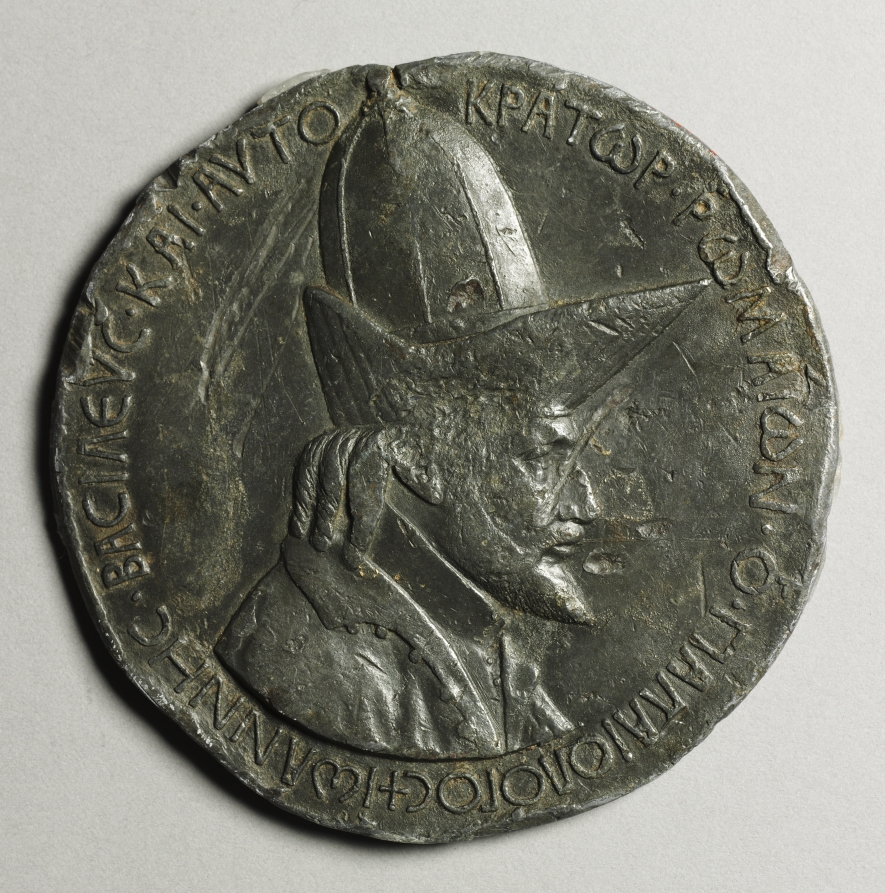
Portrait of John VIII Palaeologus, Emperor of Constantinople, 1424-1428 (obverse), c. 1438–1439, by Pisanello
Pisanello · The Cleveland Museum of Art · John L. Severance Fund
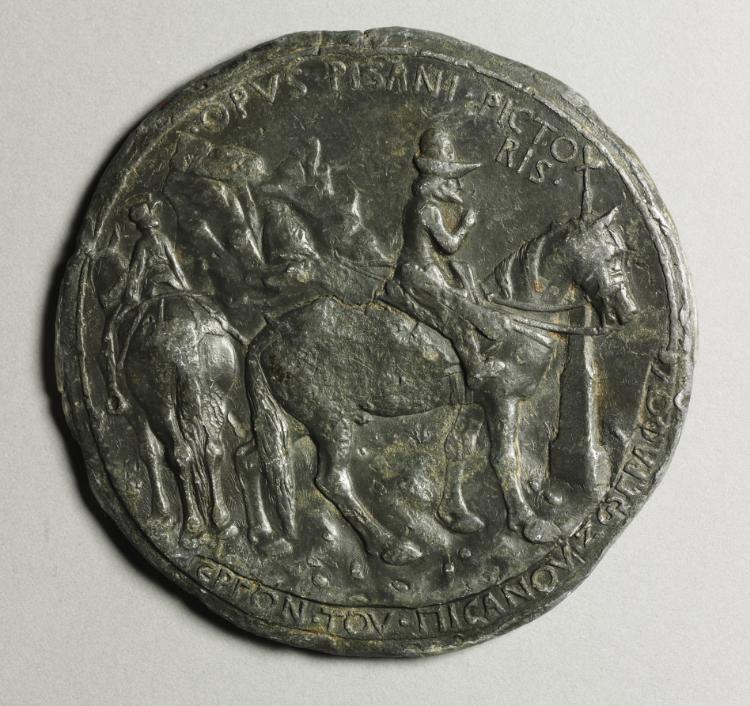
Portrait of John VIII Palaoelogus, Emperor of Constantinople, 1424-1428 (reverse), c. 1438–1439, by Pisanello
Pisanello · The Cleveland Museum of Art · John L. Severance Fund
Primary material
Documents and archives
authority file
- Gemeinsame Normdatei 118594613, Pisanello.
General reference · Deutsche Nationalbibliothek
- Getty Union List of Artist Names 500061342, Pisanello, Amico di.
General reference · The Getty Research Institute
reference work
- Wikidata, structured authority record Q311082: Pisanello
Reputable secondary · Wikimedia Foundation
- “Pisanello”, English Wikipedia, consulted as further reading
Reputable secondary · Wikipedia
Notes from the source article
Cited by Wikipedia
Notes from the source article
These works are cited by the source article, in its own numbering. They are recorded as its citations, not as sources VALÉORINE has verified.
- 1.Victoria and Albert Museum
- 2.21. 649.
- 3.Zeri, Dolcetta, 1999, p=33}}.
- 4.Italian painter Antonio Pisano. 2020-11-16.
References
Citations
References
Each reference names the institution holding it, so a reader may go to the document itself.
authority file
Gemeinsame Normdatei 118594613, Pisanello.Deutsche Nationalbibliothek
Secondary witnessauthority file
Getty Union List of Artist Names 500061342, Pisanello, Amico di.The Getty Research Institute
Secondary witnessreference work
Wikidata, structured authority record Q311082: PisanelloWikimedia Foundation
Secondary witnessreference work
Secondary witness
The Encyclopedia exists whether or not anything is for sale. Corrections are recorded rather than overwritten, and every version of this record is kept. Published 14 August 2026.
Elsewhere in Paintings
18,623 published records in this field, each with its sources named.
- Piotr NazarovArtist
- Piotr Petrovitch VeretschaginArtist
- Piotr UklańskiArtist
- Pirkko LepistöArtist
- Placido CampoloArtist
- Placido CostanziArtist
- Plácido Francés y PascualArtist
- Plautilla NelliArtist
Best supported in this field
For owners
Own a work by Pisanello?
A specialist will read what you send and tell you what the house can establish, what it cannot, and whether the object is suited to sale. There is no charge and no obligation. The object stays with you throughout; nothing is shipped to us unless it is arranged in writing beforehand.