
Pier Francesco Mola
Pier Francesco Mola, called Il Ticinese (9 February 1612 – 13 May 1666) was a Swiss-Born Italian painter of the High Baroque, mainly active around Rome. His masterpiece as a fresco painter is widely considered to be the fresco in the gallery of Alexander VII in the Quirinal Palace Gallery, entitled Joseph making himself known to his Brethren (1657). However, Mola is considered to have been better as a painter of small pictures, especially landscapes.
Also recorded as Francis Mola · Francesco Mola di Lugano · Pietro Meola · Francisco Molu
Pier Francesco Mola
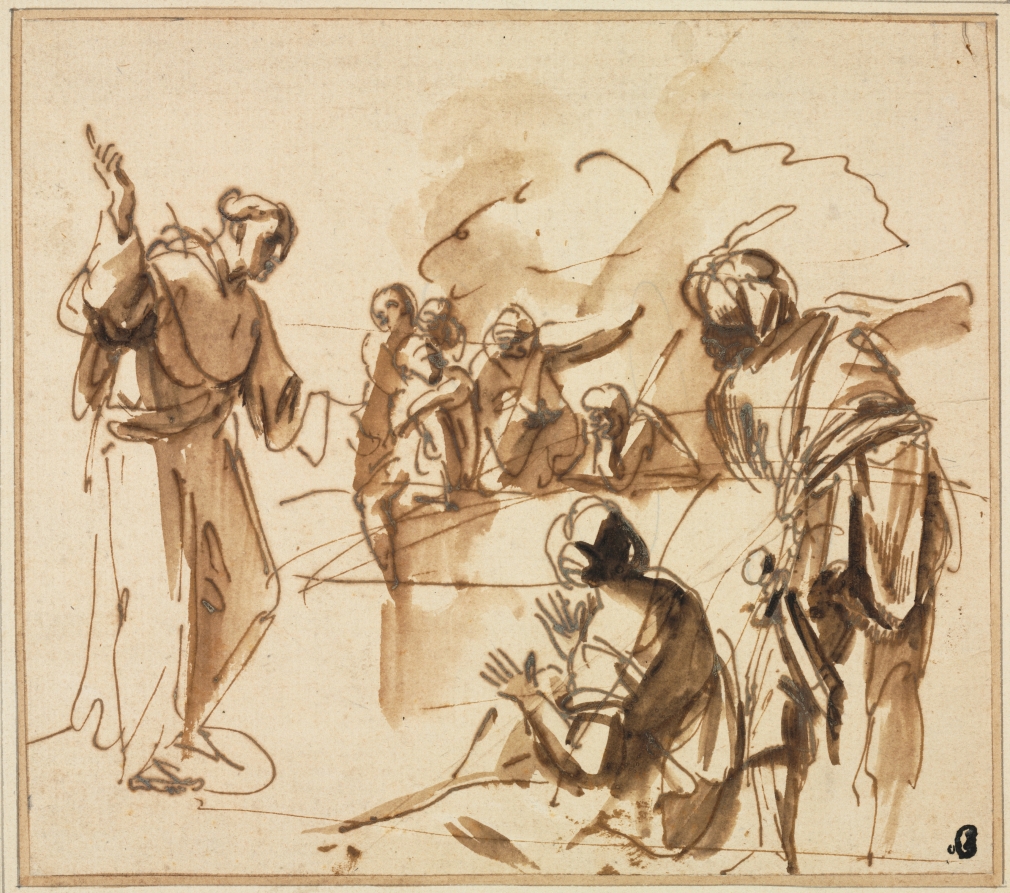
Pier Francesco Mola · The Cleveland Museum of Art · Norman O. Stone and Ella A. Stone Memorial Fund · CC0
- Name
- Pier Francesco Mola
- Birth Name
- Pietro Francesco Mola
- Born
- 9 February 1612
- Birthplace
- Ticino, now Switzerland
- Died
- 13 May 1666
- Place of death
- Rome, Papal States
- Known for
- Painting
- Movement
- Baroque
- Nationality
- Switzerland.
- Occupation
- painter and printmaker.
- Movements
- Baroque.
VALÉORINE Encyclopedia
VALÉORINE documentary reading
Documentary summary
Pier Francesco Mola, called Il Ticinese (9 February 1612 – 13 May 1666) was a Swiss-Born Italian painter of the High Baroque, mainly active around Rome. His masterpiece as a fresco painter is widely considered to be the fresco in the gallery of Alexander VII in the Quirinal Palace Gallery, entitled Joseph making himself known to his Brethren (1657). However, Mola is considered to have been better as a painter of small pictures, especially landscapes.
Admitted source layer · organised and presented by VALÉORINE
Note VALÉORINE
Pier Francesco Mola (1612–1666) was a Swiss painter and printmaker. The painter was associated with Baroque. Works include Oriental Warrior and Rest on the Flight into Egypt.
Composed from admitted, traceable facts · 27 September 2026
VALÉORINE
Reference Check
Propose documentary evidence for Pier Francesco Mola. A contribution is never written directly as fact: identity, source, rights and evidence gates still decide.
Sign in to contribute
Documentary evidence
Evidence Panel
not yet certified
- Identity
- resolved
- Independent source families
- 0
- Admitted assertions
- 0
- Open conflicts
- 0
Authority files
wikidata · Q1192715 · wikipedia · Pier Francesco Mola
In this article
Key facts
Key facts
• Name — Pier Francesco Mola • Birth Name — Pietro Francesco Mola • Born — 9 February 1612 • Birthplace — Ticino, now Switzerland • Died — 13 May 1666 • Place of death — Rome, Papal States • Known for — Painting • Movement — Baroque
Early works and travels in northern Italy before 1647
Early works and travels in northern Italy before 1647
Mola was born in Coldrerio (now in Ticino, Switzerland). At the age of four, he moved to Rome with his father Giovanni Battista Mola, a painter. With the exception of the years 1633–1640 and 1641–1647, during which he resided in Venice and Bologna, respectively, he lived for the rest of his life in Rome. His earliest recorded works are pen and chalk figure sketches that he added to several architectural drawings in a sketchbook by his father (New York, Metropolitan Museum of Art). Several sheets are dated 1631, including a sheet of ink and chalk studies entitled Standing Man, Flying Angels, and a Design for a Decorative Panel (fol. 45), which are entirely by him. These drawings show that, before any known contact with Venetian and Bolognese painting, apart from what he could see in Rome, he already displayed greater interest in chiaroscuro than in form. The pen and chalk strokes, in his typically fluid line, are buttressed with characteristic passages of parallel hatching in a mix of pen and chalk softened with wash. From 1633 to 1640 and again from 1641 to 1647, Mola was in northern Italy, finishing his training and launching his career, but his movements are too poorly documented to allow any detailed account of his stylistic development. A signed and dated portrait drawing of his friend Pietro Testa (Montpellier, Musée Fabre) records his presence in Lucca in 1637. He was in Rome for Easter 1641 and by the summer of the same year had moved back to Coldrerio, where he frescoed the Cappella Nuova of the Oratory of the Madonna del Carmelo. He may have been in Venice in 1644. Francesco Albani, in a letter of 1658, says that Mola studied with him in Bologna for two years, and Giovanni Battista Passeri, Mola’s biographer and personal acquaintance, wrote that Mola studied with Albani during his second visit to northern Italy. Perhaps the difficulties he had experienced with the Coldrerio frescoes encouraged him to seek out a master experienced in fresco, which would account for him joining Albani’s studio after 1642, rather than in 1633 when he first travelled north.
Public commissions and mature works in Rome, 1647–1657
Public commissions and mature works in Rome, 1647–1657
In 1647 Mola established himself in Rome, his style by this time reflecting his deep knowledge of the work of Titian, the Bassano family, Guercino and Albani, artists he had particularly admired in northern Italy. The commissions he received in Rome for frescoes and altarpieces demanded the creation of a grander style, and his first documented work there, the Image of St. Dominic Carried to Soriano by the Virgin, St. Catherine and St. Mary Magdalene (Rome, Santi Domenico e Sisto), was a deliberate attempt to fuse key elements of Roman 17th-century painting and northern Italian art of the 16th and 17th centuries, a programme that he pursued for the remainder of his career. A pen, ink, and wash compositional study (Haarlem, Teylers Museum) shows the direct impact of Albani’s style, but the monumentality of the figures and the rich, dark colours reveal a different artistic temperament and are deeply indebted to Guercino. The wine red, dark green, deep blue, and chocolate brown accented with white are a palette reminiscent of Titian and the Bassano family, yet with the addition of the complex violet greys of Guercino. The realism of some passages, such as the monk’s veined hands and hollow cheeks, reveals a straightforward naturalism more typical of northern Italy than of Rome. As a fresco painter, Mola was still tentative and uncertain, as is demonstrated by the ceiling fresco Bacchus and Ariadne (c. 1650; Rome, Palazzo Costaguti). Later in the 1650s, his Roman fresco commissions reveal his growing admiration for the most monumental works of the Roman High Renaissance by Raphael and Michelangelo. This development is apparent in St. Peter Baptizing in Prison and the Conversion of St. Paul (Rome, Church of the Gesù, Ravenna Chapel), yet these works were less assured in their treatment of space than the large Joseph Greeting his Brethren (1656–57; Rome, Quirinal Palace) and should be dated earlier than it, perhaps to 1649 when Francesco Ravenna, the patron who commissioned them, became a consul of the city. The Quirinal fresco, Mola’s most important Roman commission, fills one end of Alexander VII’s gallery, and 10 drawings (examples, London, British Museum; Düsseldorf, Kunstmuseum) attest to the care with which he prepared it. The staging of the drama, with Joseph standing on the left, arms outstretched to greet his 12 brothers (several of whom have dropped to their knees to express their chagrin and astonishment), recalls that of Raphael’s tapestry cartoon Christ’s Charge to St. Peter (London, Victoria and Albert Museum). The grouping is less planar than Raphael’s, however, and the eye is led back in stages through majestic architecture to a typically lush landscape. The main figures have the heroic proportions of Michelangelo’s Sistine Chapel ignudi, while the cleverly arranged cloak of Joseph, framing his arms and giving bulk to his slight proportions, shows that Mola understood Bernini’s use of similar devices to impart drama to his figure sculpture. • Illustration — Landscape with Hagar and the Angel, Paris, Louvre Mola’s private commissions of this period gradually attained a new Roman grandeur. The splendid Barbary Pirate, his only signed and dated picture (1650; Paris, Louvre), is a romantic, three-quarter-length figure in exotic eastern dress. The works, whose presence in Roman private collections formed during his lifetime suggests a date in the Roman period (e.g., the Expulsion of Hagar and Ishmael and Rebecca and Eliezer, both Rome, Galleria Colonna; Bacchus, Rome, Galleria Spada; and the Dream of Endymion, Rome, Palazzo dei Conservatori, Braccio Nuovo), are large canvases in which the figures dominate. A group of cabinet pictures, with figures between the small scale of the early works (1632–1646) and the heroic scale of his later paintings, may belong to a transitional phase, as Mola adjusted the scale of his private commissions to the grandeur of his public style. These evocative and poetic works include the Mercury and Argus (Oberlin, Ohio, Allen Memorial Art Museum), Erminia Guarding Her Flocks and its pendant, the lyrical Erminia and Vafrino Tending the Wounded Tancred (early 1650s; Paris, Louvre).
Gallery
Gallery
• Illustration — Diane and Endymion, Capitoline Museums, Rome • Illustration — Head of an elderly bearded man, priv. col. • Illustration — Self portrait, Gabinetto dei Disegni e delle Stampe, Uffizi • Illustration — Portrait of a Bearded Man, priv. col. • Illustration — Sleeping Cupid, Landesmuseum Mainz • Illustration — St. Andrew, priv. col. • Illustration — St. Jerome, Pinacoteca Vaticana, Rome • Illustration — Erminia and Valfrino Tending the Wounded Tancred After the Battle with Argante, Louvre, Paris • Illustration — Hagar and Ishmael in the Wilderness, Blanton Museum of Art, Austin, Texas • Illustration — Adoration of the Shepherds, Musée des Beaux-Arts de Nîmes • Illustration — Mercurius and Argos, Oberlin, Ohio, Allen Memorial Art Museum • Illustration — The Geographer, Hermitage Museum, Saint Petersburg
Life and career
Dated record
Life and career
The full dated record · 2 entries
1612
Pier Francesco Mola born at Coldrerio.
1666
Pier Francesco Mola died at Rome.
Late works, 1658 and after
In 1658 Mola prepared and began a fresco of mythological scenes for the ceiling of the Stanza dell’Aria in Prince Camillo Pamphili’s summer palace at Valentino. A number of surviving drawings (e.g. Kupferstichkabinett Berlin; Chatsworth, Derbys; Florence, Uffizi; Madrid, Real Academia de Bellas Artes de San Fernando) record his ambitious and attractive scheme. Unfortunately, he became involved in a dispute with the Pamphili that resulted in a lengthy lawsuit (1659–64), and his partially finished work was destroyed and replaced with one by Mattia Preti in 1661. • Illustration — The vision of St. Bruno, Malibu, J. Paul Getty Museum Despite this setback, he continued to attract important patrons, among them Pope Alexander VII and the Colonna family. Pascoli records his contacts with Christina, Queen of Sweden, and two pictures, the Death of Archimedes (Rome, priv. col.), one of a group of pictures of philosophers, and the Head of Medusa, were in her collection. Mola’s late works, such as the impressive Vision of St. Bruno (1662–63; Malibu, J. Paul Getty Museum) painted for Prince Agostino Chigi, nephew of Alexander VII, became increasingly dramatic and powerful. Mola explored this subject first in a series of exceptionally beautiful drawings (Hessisches Landesmuseum Darmstadt; Saint Petersburg, Hermitage; Frankfurt, Städel) and in the painting produced his finest resolution of Venetian colouring and Roman grandeur. The saint, reclining in the lower left corner in a flowing white robe, looks up and gestures towards two cherubim who hover in the upper right against a brilliant sky. The saint is shaded by two trees, their crossed trunks and their branches reaching up beyond the top of the canvas. A panoramic landscape fills the right side of the picture. The composition is indebted to Andrea Sacchi’s Vision of St. Romuald (1631; Rome, Pincoteca Vaticana); the strong tonal contrasts of the landscape are reminiscent of Guercino, while the mountain ranges and azure blue tones suggest the influence of Titian. In his drawings, for example, Erminia and Vafrino Tending the Wounded Tancred (Düsseldorf Kunstmuseum), his use of curved pen lines enlivened with patches of brown ink wash suggests Guercino’s style, but Mola usually mixed pen and chalk, especially red chalk, to achieve a variety of tonal effects. Mola became principal of the Accademia di San Luca, Rome, in 1662 but resigned a year later owing to ill health. Passeri confirms that his health was affected by the lawsuit with the Pamphili and says that studio assistants worked on some of his later commissions. Several of Mola’s caricatures suggest a melancholy discontent; in a drawing inscribed ‘Adio speranze’ (London, BM), an artist sits brooding beside his palette and brushes, which lie scattered on the ground. An upturned cornucopia, a symbol of abundance, pours forth onions. Mola died on 13 May 1666 in Rome, aged 54. Among his pupils were Jean-Baptiste Forest, Antonio Gherardi, and Giuseppe Bonati.
Notes from the source article
Cited by Wikipedia
Notes from the source article
These works are cited by the source article, in its own numbering. They are recorded as its citations, not as sources VALÉORINE has verified.
- 1.Qurinale Gallery. www.quirinale.it.
- 2.Wittkower, Rudolph. Art and Architecture in Italy, 1600–1750. Yale University Press. II. 136. 1999.
Bibliography printed in the source article · 4
- cite book
- cite book
- cite journal
- Freedberg, Sydney J. Painting in Italy, 1500-1600. 323–325 Penguin Books Ltd. 1993.
References
Citations
References
Each reference names the institution holding it, so a reader may go to the document itself.
reference work
Wikidata, structured authority record Q1192715: Pier Francesco MolaWikimedia Foundation
Partially resolvedreference work
Partially resolved
Further particulars
Held on the record
Further particulars
Open the remaining particulars
The authorities additionally record the headings Francis Mola, Francesco Mola di Lugano, Pietro Meola, Francisco Molu and F. His recorded confession was Catholicism. He was the child of Giovanni Battista Mola. Work and production. Works recorded as notable number 3: Erminia and Valfrino Tending the Wounded Tancred After the Battle with Argante, Oriental Warrior and Rest on the Flight into Egypt.
Identity and origins
Recognition and collections
Work by Pier Francesco Mola is
Museum Boijmans Van Beuningen, Städel Museum, Minneapolis Institute of Art and Museo del Prado
The Encyclopedia exists whether or not anything is for sale. Corrections are recorded rather than overwritten, and every version of this record is kept. Published 14 August 2026.
Elsewhere in Prints
4,138 published records in this field, each with its sources named.
- Philips BrueghelEngraver
- Philips van MalleryEngraver
- Philips WouwermanEngraver
- Philopoemen ConstantinidiEngraver
- Pierre AlechinskyEngraver
- Pierre Amédée Marcel-BéronneauEngraver
- Pierre AudouinEngraver
- Pierre AyotEngraver
Best supported in this field
For owners
Own a work by Pier Francesco Mola?
A specialist will read what you send and tell you what the house can establish, what it cannot, and whether the object is suited to sale. There is no charge and no obligation. The object stays with you throughout; nothing is shipped to us unless it is arranged in writing beforehand.