
Petronius
Gaius Petronius Arbiter (c. 66 AD; sometimes Titus Petronius Niger) was a Roman courtier during the reign of Nero. He is generally believed to be the author of the Satyricon, a satirical novel believed to have been written during the Neronian era.
Also recorded as Gaius Petronius Arbiter · Publius Petronius Niger · Titus Petronius Niger · Petronius Arbiter
Petronius

P. Bodart · GoogleBooks · Public domain
- Name
- Petronius
- Born
- c. 27 AD
- Birthplace
- Massalia (ancient Marseille)
- Died
- c. 66 AD (aged c. 38–39)
- Place of death
- Cumae
- Occupation
- Novelist
- Nationality
- Ancient Rome.
- Known for
- Satyricon.
VALÉORINE Encyclopedia
VALÉORINE documentary reading
Documentary summary
Gaius Petronius Arbiter (c. 66 AD; sometimes Titus Petronius Niger) was a Roman courtier during the reign of Nero. He is generally believed to be the author of the Satyricon, a satirical novel believed to have been written during the Neronian era.
Admitted source layer · organised and presented by VALÉORINE
Note VALÉORINE
No house-authored Note is published until its assertions and sources pass the VALÉORINE evidence contract. The documentary article remains available in full while that enrichment is being consolidated.
Documentary enrichment in progress · no unsupported statement published
Reference Check
Propose documentary evidence for Petronius. A contribution is never written directly as fact: identity, source, rights and evidence gates still decide.
Sign in to contribute
Documentary evidence
Evidence Panel
not yet certified
- Identity
- resolved
- Independent source families
- 0
- Admitted assertions
- 0
- Open conflicts
- 0
Authority files
gnd · 120880725 · gnd · 300262337 · wikidata · Q47180 · wikipedia · Petronius
In this article
Biography
Biography
He is one of the most important characters in Henryk Sienkiewicz's historical novel Quo Vadis (1895). Leo Genn portrays him in the 1951 film of the same name.
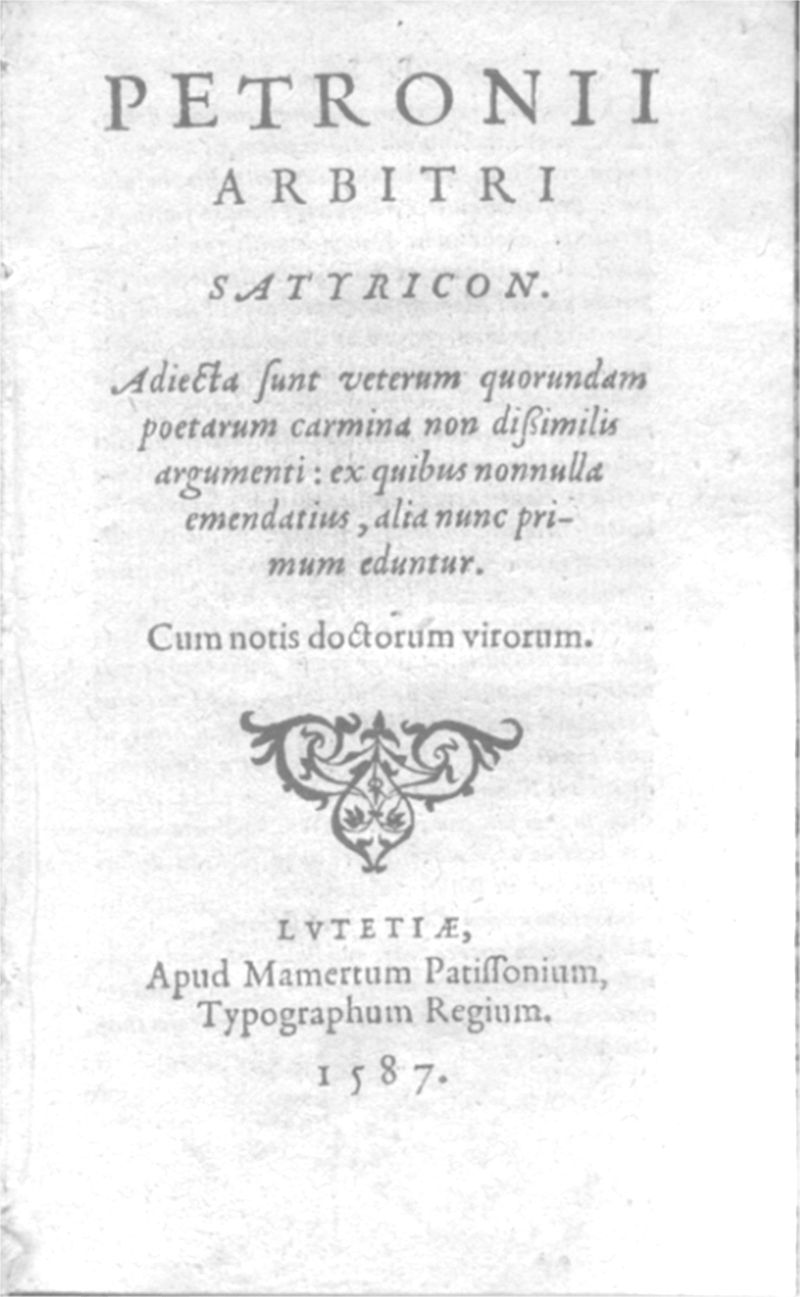
Satyricon-Ausgabe von Pierre Pithou, Paris, 1587 (= Schmeling/Stuckey Nr. 19), Titelblatt
Photo: Thomas Völker, Berlin. · (Original text: Exemplar im Eigentum des Einstellers). Original uploader was Thomas Völker at de.wikipedia
Key facts
Key facts
• Name — Petronius • Born — c. 27 AD • Birthplace — Massalia (ancient Marseille) • Died — c. 66 AD (aged c. 38–39) • Place of death — Cumae • Occupation — Novelist • Notable Works — The Satyricon
Life
Life
• Illustration — Leo Genn as Petronius in the 1951 film Quo Vadis A reference to Petronius by Sidonius Apollinaris places him, or his Satyricon, in Massalia (ancient Marseille). He might have been born and educated there. Tacitus, Plutarch and Pliny the Elder describe Petronius as the elegantiae arbiter (also phrased arbiter elegantiarum), "judge of elegance", in the court of the emperor Nero. He served as suffect consul in 62. Later, he became a member of the senatorial class who devoted himself to a life of pleasure. His relationship to Nero was apparently akin to that of a fashion advisor. Tacitus gives this account of Petronius in his historical work the Annals (XVI.18): None of the ancient sources give any further detail about his life, or mention that he was a writer. However, a medieval manuscript written around 1450 of the Satyricon credited a "Titus Petronius" as the author of the original work. Traditionally, this reference is linked with Petronius Arbiter, since the novel appears to have been written or at least set during his lifetime. The link, however, remains speculative and disputed.
Death
Death
• Illustration — The Death of Petronius (Piotr Stachiewicz, c. 1900) Petronius' high position soon made him the object of envy for those around him. Having attracted the jealousy of Tigellinus, the commander of the emperor's guard, he was accused of treason. He was arrested at Cumae in 65 AD but did not wait for a sentence. Instead, he chose to take his own life. Tacitus again records his elegant suicide in the sixteenth book of the Annals: According to Pliny the Elder: "T. Petronius, a consular, when he was going to die through Nero's jealousy and envy, broke his fluorspar wine-dipper so that the emperor's table would not inherit it. It had cost 300,000 sesterces". T. Petronius and G. Petronius have been said to have been the same man.
Identity and origins
Identity and origins
He also worked under the name arbiter elegantiae. His recorded language was Latin.
As a writer
Petronius's development of his characters in the Satyricon, namely Trimalchio, transcends the traditional style of writing of ancient literature. In the literature written during Petronius's lifetime, the emphasis was always on the typical considerations of the plot, which had been laid down by classical rules. The character, which was hardly known in ancient literature, was secondary. Petronius goes beyond these literary limitations in his exact portrayals of detailed speech, behaviour, surroundings, and appearance of the characters. Another literary device Petronius employs in his novel is a collection of specific allusions. The allusions to certain people and events are evidence that the Satyricon was written during Nero's time: "The references to contemporary figures, the economic and social conditions offered by the novel, the legal arguments, and above all the literary connections with the younger Seneca and with Lucan, have combined to make this Neronian date highly probable." These also suggest that it was aimed at a contemporary audience which consisted in part of Nero's courtiers and even Nero himself. The message Petronius tries to convey in his work is far from moral and does not intend to produce reform, but is written above all to entertain and should be considered artistically. Nevertheless, his writings can be a valuable tool to better comprehend the customs and ways of life of Roman society at that particular time, since the author strives to preserve the plausibility of his representation, as can be noted by the frequent use of allusions and detailed descriptions of characters and behaviours. As the title implies, the Satyricon is a satire, specifically a Menippean satire, in which Petronius satirizes nearly everything, using his taste as the only standard. It is speculated that Petronius's depiction of Trimalchio mirrors that of Nero. Although the author's own opinion is never alluded to, the opinions of the characters involved in the story are evident, as is how Encolpius criticizes Trimalchio.
Primary material
Documents and archives
reference work
- “Petronius”, English Wikipedia, consulted as further reading
Reputable secondary · Wikipedia
- Wikidata, structured authority record Q47180: Petronius
Reputable secondary · Wikimedia Foundation
authority file
- Gemeinsame Normdatei 120880725, Petronius, Salernitanus.
Unverified · Deutsche Nationalbibliothek
Citations
References
Each reference names the institution holding it, so a reader may go to the document itself.
reference work
Partially resolvedauthority file
Gemeinsame Normdatei 120880725, Petronius, Salernitanus.Deutsche Nationalbibliothek
Partially resolvedreference work
Wikidata, structured authority record Q47180: PetroniusWikimedia Foundation
Partially resolved
The Encyclopedia exists whether or not anything is for sale. Corrections are recorded rather than overwritten, and every version of this record is kept. Published 14 August 2026.
Elsewhere in Books
38,988 published records in this field, each with its sources named.
- Petro PanchAuthor
- Petro TrochanowskiAuthor
- Petronella Johanna de TimmermanAuthor
- Petronella MoensAuthor
- Petros AdamianAuthor
- Petros Brailas-ArmenēsAuthor
- Petros DuryanAuthor
- Petros MarkarisAuthor
Best supported in this field
For owners
Own a work by Petronius?
A specialist will read what you send and tell you what the house can establish, what it cannot, and whether the object is suited to sale. There is no charge and no obligation. The object stays with you throughout; nothing is shipped to us unless it is arranged in writing beforehand.