
Peter Schat
Illustration — Peter Schat in 1968 Peter Ane Schat (5 June 1935 – 3 February 2003) was a Dutch composer.
Also recorded as Peter Ane Schat
Peter Schat

Ron Kroon for Anefo · Nationaal Archief · CC BY-SA 3.0 nl
- Born
- 1935. · Utrecht.
- Died
- 2003. · Amsterdam.
- Nationality
- Kingdom of the Netherlands.
- Occupation
- composer.
- Fields
- opera, chamber music, vocal music and music.
- Honours
- Matthijs Vermeulen Award and Joost van den Vondel Prize.
- Languages
- Dutch.
Enciclopedia VALÉORINE
Il dossier documentario
Ogni enunciato è letto negli archivi di autorità delle istituzioni nominate. Scegliete «Prova» accanto a un enunciato per vedere la scheda da cui è tratto, il punto esatto e la data di lettura.
Peter Schat compare negli archivi di autorità della Bibliothèque nationale de France e della Deutsche Nationalbibliothek come compositore, insegnante di musica e musicografo (5 giugno 1935 – 3 febbraio 2003).
Vita
La nascita di Peter Schat è registrata il 5 giugno 1935, e la morte il 3 febbraio 2003 a Amsterdam. Il luogo di nascita di Peter Schat è Utrecht, Paesi Bassi, secondo la Deutsche Nationalbibliothek e la Bibliothèque nationale de France.
Istituzioni citate
Bibliothèque nationale de France · Deutsche Nationalbibliothek
Catena di lettura completa (JSON)Reference Check
Propose documentary evidence for Peter Schat. A contribution is never written directly as fact: identity, source, rights and evidence gates still decide.
Sign in to contribute
World of VALÉORINE
Documentary connections
Only confirmed graph relationships appear here. Images are shown only when their identity and reuse rights both pass the documentary gate.
Documentary evidence
Documentary basis
Authority files
museum · 743de1ce-6bb5-435c-9ff1-51a6fa82e9f9 · wikidata · Q2034318 · wikipedia · Peter Schat
In this article
Biography
Biography
The recorded working language is Dutch. The field of work recorded is opera, chamber music and vocal music. Work by Peter Schat is recorded in the collections of Royal Collections of the Netherlands. Distinctions recorded are Matthijs Vermeulen Award and Joost van den Vondel Prize.
Schat was born on 5 June 1935 in Utrecht. He studied composition with Kees van Baaren (1952–1958) at the Utrecht Conservatoire and Royal Conservatory of The Hague. Then he studied with Mátyás Seiber (1959 London) and with Pierre Boulez (1960–1961 Basel). His 1954 Passacaglia and Fugue for organ was a notable early student work. Under van Baaren and Seiber, he combined traditional forms with dodecaphony in his 1954 Introductie en adagio in oude stijl and 1957 Septet. He won the 1957 Gaudeamus International Composers Award. Boulez led him to a more radical, strict form of serialism. Schat was regarded as one of the outstanding representatives of the avant garde in the Netherlands. In the late sixties Schat became associated with the Provo movement; their publications were printed in his cellar. He was involved in the notorious 1969 "notenkrakersactie" (Nutcracker Action) in which a group of activists interrupted a concert by the Concertgebouw Orchestra, demanding an open discussion of music policy. That same year, Schat contributed, together with the composers Reinbert de Leeuw, Louis Andriessen, Jan van Vlijmen, and Misha Mengelberg, and the writers Harry Mulisch and Hugo Claus, to Reconstructie, a sort of opera, or "morality" theatre work, about the conflict between American imperialism and liberation. In February 1969 he co-founded the Studio for Electro-Instrumental Music (STEIM) in Amsterdam. Among his most widely noted works are Thema (from 1970) and To You (from 1972). To You was performed at the Holland Festival. The 1970s also brought Schat's most distinctive contribution to 20th-century music theory, the "tone clock". It lends its name to a translation of his collected essays, The Tone Clock (Contemporary Music Studies) (1993, Taylor and Francis Verlag). Schat died in Amsterdam on 3 February 2003, from cancer.
= Footnotes ===== External links
= Footnotes ===== External links
• Official website • http: www.peterschat.nl/composition.html (in English)

Studio Peter Schat in attic on Oudezijdsachterburgwal
Taks
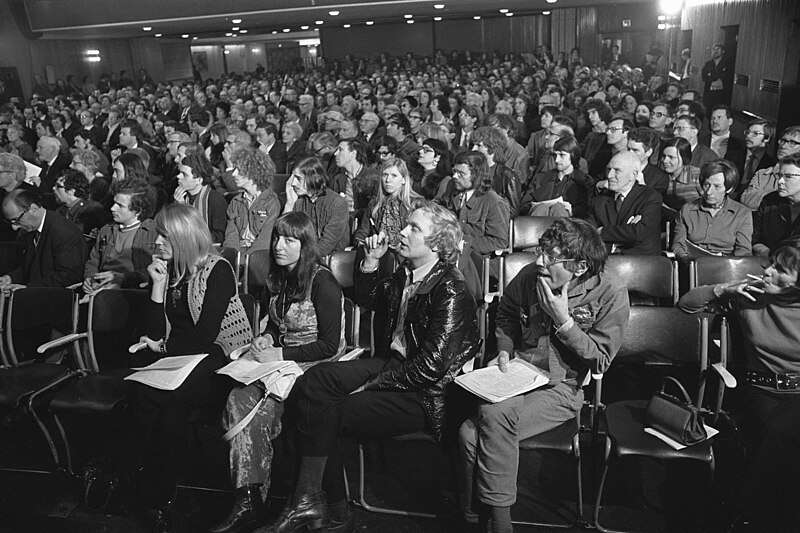
Discussion in Krasnapolsky between "De Notenkrakers" and the Concertgebouw Orchestra (Amsterdam). Front row Reinbert de Leeuw (right, with glasses), left next to him Peter Schat, April 22, 1970
Bert Verhoeff (ANEFO) · GaHetNa (Nationaal Archief NL) 923-4615
Life and career
Dated record
Life and career
The full dated record · 2 entries
1980
peter schat monkey subdues the white bone demon (1980) is digitised and catalogued by Internet Archive.
2003
Peter Schat died at Amsterdam.
Places
Named by the record
Places
Only places the record itself states, plotted where the house gazetteer settles their coordinates. Nothing is inferred from a name or a nationality.
Utrecht.
Birth place
Amsterdam.
Death place
Composition
• Illustration — Peter Schat's studio under the roof on Oudezijds Voorburgwal 119 • Symphonies • Symphony No. 1 (1978, rev 1979) • Symphony No. 2 (1983, rev. 1984) • Symphony No. 3 (1998-2003) • Chamber music • Octet (1958) • Improvisations and symphonies (1960) • Signalement (1961) • First Essay on Electrocution (1966) • Hypothema (1969) • Choir music • The Fall (1960) • The Fifth Season (1973) • Breath (1984) • An Indian Requiem (1995) • Opera and music theater • Labyrint (1966) • Reconstructie (1969) • Houdini (1977) • Aap verslaat de knekelgeest (1980) • Symposion (1989) • Piano music • Variations (1956) • Inscriptions (1959) • Anathema (1969) • Polonaise (1981) • Other • Passacaglia and Fugue for organ (1954) • Clockwise and Anti-Clockwise for 16 wind instruments (1967) • Thema (1970) • To you (1972) • Canto General • Kind en Kraai • De Hemel (1990)
Primary material
Documents and archives
reference work
- Wikidata, structured authority record Q2034318: Peter Schat
Reputable secondary · Wikidata
- “Peter Schat”, English Wikipedia, consulted as further reading
Reputable secondary · Wikipedia
Institutional database
- MusicBrainz artist record for Peter Schat
Scholarly · MetaBrainz Foundation
Text attribution
Licensing
Text attribution
Part of the biographical narrative on this page reuses licensed material. Its origin, revision and licence are recorded here.
The biographical narrative on this page is based on the Wikipedia article Peter Schat, revision 1330435125 (EN edition), by its contributors. VALÉORINE has edited that text and built its own documentary record around it. The reused material is available under CC BY-SA 4.0, and this page's reuse of it is offered under the same licence. Everything else on this page — the chronology, the holdings, the evidence, the plates and the connections — is VALÉORINE's own record. Sources and licences.
Notes from the source article
Cited by Wikipedia
Notes from the source article
These works are cited by the source article, in its own numbering. They are recorded as its citations, not as sources VALÉORINE has verified.
References
Citations
References
Each reference names the institution holding it, so a reader may go to the document itself.
Institutional database
MusicBrainz artist record for Peter SchatMetaBrainz Foundation
Institutional witnessreference work
Secondary witnessreference work
Secondary witness
The Encyclopedia exists whether or not anything is for sale. Corrections are recorded rather than overwritten, and every version of this record is kept. Published 14 August 2026.
Elsewhere in Music memorabilia
44,060 published records in this field, each with its sources named.
- Peter SandloffPerson
- Peter SarstedtPerson
- Peter SattmannPerson
- Peter SchärliPerson
- Peter SchickelePerson
- Peter SchidlofPerson
- Peter SchillingPerson
- Peter SchindlerPerson
Best supported in this field
For owners
Own a work by Peter Schat?
A specialist will read what you send and tell you what the house can establish, what it cannot, and whether the object is suited to sale. There is no charge and no obligation. The object stays with you throughout; nothing is shipped to us unless it is arranged in writing beforehand.