
Penny Red
The Penny Red was a British postage stamp, issued in 1841. It succeeded the Penny Black and continued as the main type of postage stamp in the United Kingdom of Great Britain and Ireland until 1879, with only minor changes to the design during that time. The colour was changed from black to red because of difficulty in seeing a cancellation mark on the Penny Black; a black cancellation mark was readily visible on a Penny Red. • Illustration — A perforated Penny Red with letters in four corners and plate 148, therefore printed 1871 or later • Illustration — The plate number, 148 in this case, may be found in the margin of the stamp.
Penny Red

Royal Mail · http: ppid=1122 image=290267200 images=290267200,290267263,290267324 formats=0,0,0 format=0 · Public domain
- Field
- postage stamp
- Region
- United Kingdom of Great Britain and Ireland
VALÉORINE Encyclopedia
VALÉORINE documentary reading
Documentary summary
The Penny Red was a British postage stamp, issued in 1841. It succeeded the Penny Black and continued as the main type of postage stamp in the United Kingdom of Great Britain and Ireland until 1879, with only minor changes to the design during that time. The colour was changed from black to red because of difficulty in seeing a cancellation mark on the Penny Black; a black cancellation mark was readily visible on a Penny Red. • Illustration — A perforated Penny Red with letters in four corners and plate 148, therefore printed 1871 or later • Illustration — The plate number, 148 in this case, may be found in the margin of the stamp.
Admitted source layer · organised and presented by VALÉORINE
Reference Check
Propose documentary evidence for Penny Red. A contribution is never written directly as fact: identity, source, rights and evidence gates still decide.
Sign in to contribute
World of VALÉORINE
Documentary connections
Only confirmed graph relationships appear here. Images are shown only when their identity and reuse rights both pass the documentary gate.
Documentary evidence
Documentary basis
Authority files
wikidata · Q2636946 · wikipedia · Penny Red
In this article
Key facts
Key facts
• Date Of Production — 1841–1879 • Face Value — 1d • Depicts — Queen Victoria (1837–1901) • Printer — Perkins, Bacon & Co • Perforation — * 1841: none • 1850: 16 gauge (experimental) • 1854: 16 gauge • 1855: 14 gauge
History
History
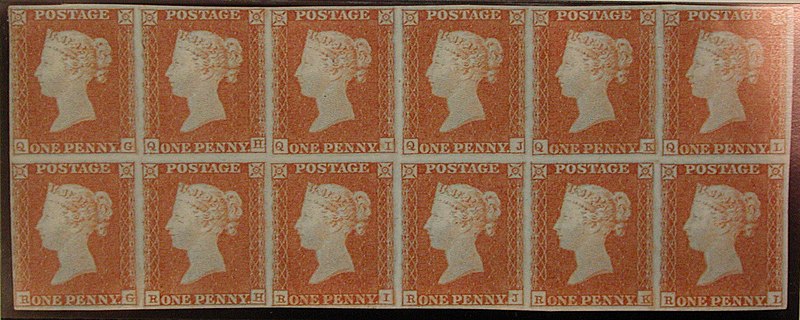
Initially, some of the same plates used to print the Penny Black were used to print the Penny Red. About 21 billion Penny Reds were printed by Messrs. Perkins, Bacon & Co. The stamps were printed in sheets of 240 (20 rows of 12 stamps), so one row cost 1 shilling and a complete sheet one pound. This configuration of 240 stamps per sheet continued with all low-value British postage stamps issued until decimalisation in 1971, when the sheet size was changed to 200 (20 rows of 10 stamps), making the lowest value denomination (half new penny) one pound per sheet. The sheets had no perforations and stamps had to be cut from the sheet using scissors, as with the Penny Black and the early printings of the Two Pence Blue. Each stamp had unique letters AA, AB etc. in its lower corners, so that its position on the plate could be identified: Plate configuration • AA — AB — AC — AD — AE — AF — AG — AH — AI — AJ — AK — AL • BA — BB — BC — BD — BE — BF — BG — BH — BI — BJ — BK — BL • • — • — • — • — • — • — • — • — • — • — • — • • • — • — • — • — • — • — • — • — • — • — • — • • • — • — • — • — • — • — • — • — • — • — • — • • SA — SB — SC — SD — SE — SF — SG — SH — SI — SJ — SK — SL • TA — TB — TC — TD — TE — TF — TG — TH — TI — TJ — TK — TL The upper corners were occupied by stars. Perforations, in an experimental gauge 16, first came into use in 1850 and were officially adopted in 1854, also in gauge 16. The experimental perforated issue can be distinguished from the general issue as the latter was applied to a stamp that used a different alphabet type for the identifying letters. In January 1855, the perforation size was changed from 16 to 14 as it was found that the sheets were coming apart too easily; the reduced size allowed the sheets to remain intact until pressure was applied to force the separation. The upper corners of each stamp were now occupied by the same identifying letters in reverse.
Withdrawal
Withdrawal
The era of the Penny Red came to its close at the end of 1879, along with Perkins Bacon's contract. It was superseded by the Penny Venetian Red printed by De La Rue, which was in use for a little over a year before being succeeded in turn by the long-lived Penny Lilac. Since then, the stamp has become in demand amongst stamp collectors.
Chronology
Chronology
• 10 February 1841 – first issue: colour of 1d stamp changed from black to red-brown. • 1848 – Plates 70 and 71 were rouletted by Henry Archer • 1850 – Some Alphabet 1 plates were perforated 16 by Henry Archer • 24 February 1854 – perforations 16 introduced on all Alphabet II plates. • January 1855 – perforation size changed from 16 to 14. • 15 May 1855 – watermark changed from small crown to large crown. • August 1855 – Alphabet III introduced • 1 April 1864 – Letters in all four corners and plate number engraved on each stamp from plate 71 onwards. • 27 October 1879 – last plate (225) put to press. • 3 December 1879 – contract to print the Penny Red formally ended.
Chronology
Dated record
Chronology
The full dated record · 2 entries
1841
Penny Red first recorded.
1879
Penny Red recorded as ended.
Plate numbers
On 1 April 1864, the stamp was issued with the plate number engraved in the design, in the left and right side lace work. At this time, the stars in the top corners were also replaced with the same check letters as used in the lower corners, but in reverse order. Because of wear, over 400 different plates were used to print the Penny Red. Two different basic watermarks were used for the paper, small crown (on the early issues) and large crown, introduced on 15 May 1855. The first stamps printed on the large crown watermarked paper showed two small vertical lines in the central portion of the crown (Type 1). Later printings showed a revised watermark on which these central lines are not present (Type 2). Stamps from some of the individual plate numbers, such as plate 77, are very rare and in 2016, an example from this plate was auctioned for £495,000.
General and cited references
General and cited references
• Stanley Gibbons Ltd, Specialised Stamp Catalogue Volume 1: Queen Victoria • J.B. Seymour & C. Gardiner-Hill The Postage Stamps of Great Britain Part 1 (Royal Philatelic Society London, 3rd. edition, 1967) • W.R.D. Wiggins (Ed.) The Postage Stamps of Great Britain Part 2 (Royal Philatelic Society London, 2nd edition, 1962)

British; Postage stamps; Postage Stamps
William Wyon · This file was donated to Wikimedia Commons as part of a project by the Metropolitan Museum of Art. See the Image and Data Resources Open Access Policy
British; Postage stamps; Postage Stamps
William Wyon · This file was donated to Wikimedia Commons as part of a project by the Metropolitan Museum of Art. See the Image and Data Resources Open Access Policy
Notes from the source article
Cited by Wikipedia
Notes from the source article
These works are cited by the source article, in its own numbering. They are recorded as its citations, not as sources VALÉORINE has verified.
- 1.Steven Allen British and Colonial Stamps. 1840 2d and 1841 2d a plating aid.
- 2.The Penny Red. The Penny Red Collector.
- 3.Stanley Gibbons Ltd, Specialised Stamp Catalogue Volume 1: Queen Victoria (8th ed. 1985) p. 207.
- 4.Collectors Club of Great Britain. Classic British Stamps - the Penny Red Plate 77 Stamp. 2012-11-06.
- 5.Collector gets ‘buzz’ after spending half a million pounds on stamp. Irish Times. 11 March 2016.
- 6.SG7, Stanley Gibbons Stamp Catalogue, Commonwealth & British Empire Stamps 1840–1970, issued in 2009
- 7.SG17.
- 8.SG22.
- 9.SG26.
- 10.http://www.pennystars.comPenny Red at pennystars. Retrieved 10 November 11.
References
Citations
References
Each reference names the institution holding it, so a reader may go to the document itself.
reference work
Secondary witnessreference work
Secondary witness
The Encyclopedia exists whether or not anything is for sale. Corrections are recorded rather than overwritten, and every version of this record is kept. Published 14 August 2026.
Elsewhere in Stamps
54 published records in this field, each with its sources named.
- Mint stampTerminology
- newspaper stampTerminology
- non-denominated postageTerminology
- Penny BlueTerminology
- personalised stampTerminology
- phosphor banded stampTerminology
- postage due stampTerminology
- postage stamp blockTerminology
Best supported in this field
For owners
Own an object connected with Penny Red?
A specialist will read what you send and tell you what the house can establish, what it cannot, and whether the object is suited to sale. There is no charge and no obligation. The object stays with you throughout; nothing is shipped to us unless it is arranged in writing beforehand.