
pedestal desk
Illustration — A pedestal desk • Illustration — Kneehole desk (1760s-1770s) A pedestal desk (also, when made of steel, known as a tanker desk) is usually a large, flat, free-standing desk made of a simple rectangular working surface resting on two pedestals or small cabinets of stacked drawers of one or two sizes, with plinths around the bases. Often, there is also a central large drawer above the legs and knees of the user. Sometimes, especially in the 19th century and modern examples, a "modesty panel" is placed in front, between the pedestals, to hide the legs and knees of the user from anyone else sitting or standing in front.
pedestal desk

Biscan · Bundesarchiv, Bild 183-32676-0001 / Biscan / CC-BY-SA 3.0 · This image was provided to Wikimedia Commons by the German Federal Archive (Deutsches Bundesarchiv) as part of a cooperation project. The German Federal Archive guarantees an authentic representation · CC BY-SA 3.0 de
- Field
- desk
VALÉORINE Encyclopedia
VALÉORINE documentary reading
Documentary summary
Illustration — A pedestal desk • Illustration — Kneehole desk (1760s-1770s) A pedestal desk (also, when made of steel, known as a tanker desk) is usually a large, flat, free-standing desk made of a simple rectangular working surface resting on two pedestals or small cabinets of stacked drawers of one or two sizes, with plinths around the bases. Often, there is also a central large drawer above the legs and knees of the user. Sometimes, especially in the 19th century and modern examples, a "modesty panel" is placed in front, between the pedestals, to hide the legs and knees of the user from anyone else sitting or standing in front.
Admitted source layer · organised and presented by VALÉORINE
Reference Check
Propose documentary evidence for pedestal desk. A contribution is never written directly as fact: identity, source, rights and evidence gates still decide.
Sign in to contribute
Documentary evidence
Documentary basis
Authority files
wikidata · Q14946468 · wikipedia · Pedestal desk
In this article
Overview
This variation is sometimes called a "panel desk". The smaller and older pedestal desks with such a panel are sometimes called kneehole desks, they were intended for small spaces like boudoirs and were usually placed against a wall. The kneehole desks are also known as bureau tables (this is somewhat confusing, as these desks lack the actual bureau). From the mid-18th century onwards, the pedestal desk has often had a top that is inlaid with a large panel of leather (sometimes with a gold- or blind-stamped border) or baize for a writing surface, within a cross-banded border. If the desk has a wooden top surface, it may have a pull-out lined writing drawer, or the pull-out may be fitted with a folding horse to serve as a bookrest. Very few non-specialists call this form a pedestal desk. Most people usually refer to it as an executive desk, in contrast with the cubicle desk which is assigned to those who work under the executive. However, the term executive desk has been applied to so many desk forms as to be misleading, so the less-used but more precise "pedestal desk" has been retained here. The pedestal desk appeared, especially in England, in the 18th century but became popular in the 19th and the 20th, overtaking the variants of the secretary desk and the writing table in sheer numbers. The French stayed faithful to the writing table or bureau plat ("flat desk"), which might have a matching paper-case (cartonnier) that stood upon it. • Illustration — Pedestal desk in the French Empire style by Irving & Casson–A. There were at least two precursors to the pedestal desk: The French bureau Mazarin (a desk named for Cardinal Mazarin) of the late 17th century and the Chinese jumu desk or scholar's desk, which Europeans knew almost entirely at second-hand, largely from illustrations on porcelain. However, unlike the pedestal desk, these precursors had an incomplete stack of drawers and compartments holding up the two ends. The cases of drawers were raised about 15 – from the floor on legs. When a pedestal desk is doubled in size to form a nearly square working surface, and drawers are put on both sides to accommodate two users at the same time, it becomes a partners desk. Thomas Chippendale gives designs for such tables, which were generally used in libraries, as writing tables in The Gentleman and Cabinet-Maker's Director (1753–4 and 1762). Pedestal desks made of steel sheet metal were introduced in 1946 and were popular in America until the 1970s. Called tanker desks, these products of the post-war economy with excess of steel and processing facilities for it, were used in institutions such as schools and business and government offices. When the pedestal desk form is cut to about two thirds of its normal width, and one of the pedestals is replaced by legs, this is then called a right pedestal desk or a left pedestal desk, depending on the position of the pedestal. This kind of form is common for a student desk. The pedestal desk is also one of the two principal forms of the big campaign desk, used by the military in the past. It can then be considered a portable desk in a limited way since the writing surface could be easily separated from the pedestals, to facilitate transport. The three separate elements were often fitted with large handles on the sides.
Pedestal desk is a desk.
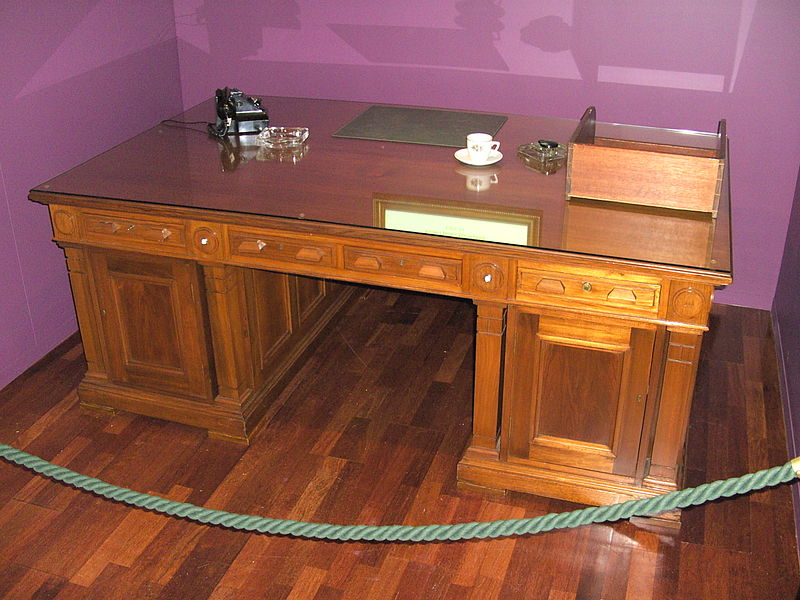
Desk of former Prime Ministers of Australia, on show in the Museum of Australian Democracy, Old Parliament House, Canberra. Used by Prime Ministers from Stanley Bruce (from 1927) to Bob Hawke (1988), then in the new Parliament House by John Howard (1996-2007). The desk was designed for OPH by the building's designer, John Smith Murdoch.
- Peter Ellis - Talk · Peter Ellis at English Wikipedia · Own work (Original text: I created this work entirely by myself.)

Sir Rowland Hill's Desk.
Mike Peel · Originally uploaded through the Britain Loves Wikipedia website.
Primary material
Documents and archives
reference work
- “Pedestal desk”, English Wikipedia, consulted as further reading
Reputable secondary · Wikipedia
authority record
- Wikidata, structured authority record Q14946468: pedestal desk
General reference · Wikidata
Notes from the source article
Cited by Wikipedia
Notes from the source article
These works are cited by the source article, in its own numbering. They are recorded as its citations, not as sources VALÉORINE has verified.
Bibliography printed in the source article · 6
- Aronson, Joseph. The Encyclopedia of Furniture. 3rd ed. New York: Crown Publishers, 1966.
- Charron, Andy. Desks: Outstanding Projects from America's Best Craftsmen. Taunton Press, 2000. pp. 124–144.
- Gloag, John. A Short Dictionary Of Furniture. Read Books Ltd. 2013. 978-1-4474-9772-1.
- Gloag, John. A Complete Dictionary of Furniture. Woodstock, N.Y.: Overlook Press, 1991.
- Moser, Thomas. Measured Shop Drawings for American Furniture. New York: Sterling Publishing Inc., 1985.
- Nixon, Rick. Life Through Aliens. University of Waterloo. 2006. 978-0-494-17219-3.
References
Citations
References
Each reference names the institution holding it, so a reader may go to the document itself.
reference work
Secondary witnessauthority record
General reference
The Encyclopedia exists whether or not anything is for sale. Corrections are recorded rather than overwritten, and every version of this record is kept. Published 16 August 2026.
Elsewhere in Furniture
924 published records in this field, each with its sources named.
- Paschal trikirionTerminology
- Paumgartner altarpieceTerminology
- Peacock chairTerminology
- Peacock ThroneTerminology
- People's altarTerminology
- Pergamon AltarTerminology
- Peruvian tombolaTerminology
- Pesaro AltarpieceTerminology
Best supported in this field
For owners
Own an object connected with pedestal desk?
A specialist will read what you send and tell you what the house can establish, what it cannot, and whether the object is suited to sale. There is no charge and no obligation. The object stays with you throughout; nothing is shipped to us unless it is arranged in writing beforehand.