
Paul Signac
Paul Victor Jules Signac (lang; 11 November 1863 – 15 August 1935) was a French Neo-Impressionist painter who, with Georges Seurat, helped develop the artistic technique Pointillism. A keen sailor, he is best known for his seascapes and views of ports and rivers.
Also recorded as Hsi-nieh-kʻo · Polʹ Sinʹi︠a︡k · Paul Victor Jules Signac · Signac
Paul Signac
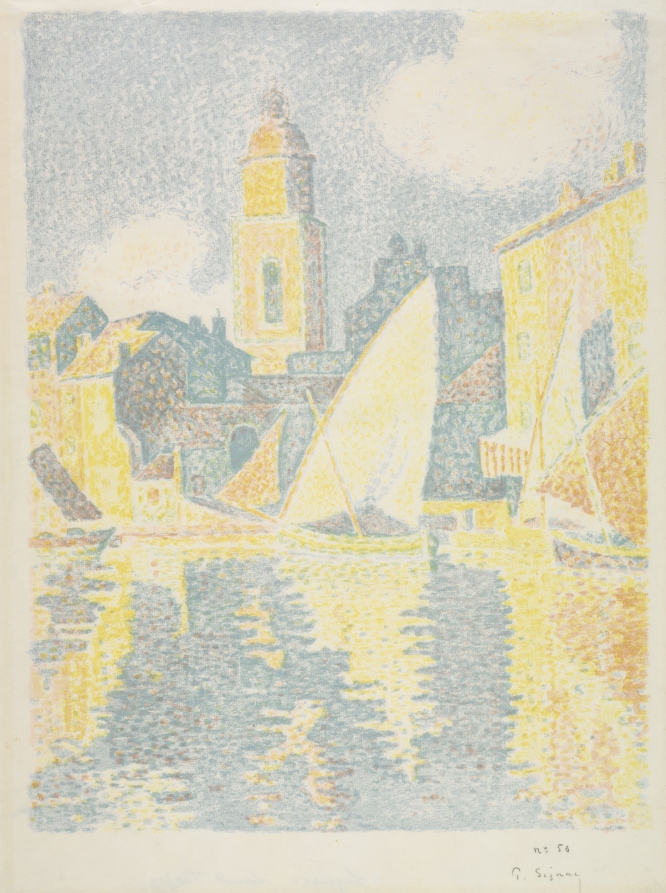
Paul Signac · The Cleveland Museum of Art · Gift of The Print Club of Cleveland in memory of William J. Eastman · CC0
- Name
- Paul Signac
- Birth Name
- Paul Victor Jules Signac
- Born
- 11 November 1863
- Birthplace
- Paris, France
- Died
- 15 August 1935
- Known for
- Painting
- Movement
- Post-Impressionism, Pointillism, Divisionism, Neo-impressionism
- Nationality
- France.
- Occupation
- painter, draftsperson, printmaker, graphic artist and architectural drafter.
- Fields
- portrait, figure, landscape painting, cityscape and still life.
- Movements
- pointillism.
VALÉORINE Encyclopedia
VALÉORINE documentary reading
Documentary summary
Paul Victor Jules Signac (lang; 11 November 1863 – 15 August 1935) was a French Neo-Impressionist painter who, with Georges Seurat, helped develop the artistic technique Pointillism. A keen sailor, he is best known for his seascapes and views of ports and rivers.
Admitted source layer · organised and presented by VALÉORINE
Note VALÉORINE
No house-authored Note is published until its assertions and sources pass the VALÉORINE evidence contract. The documentary article remains available in full while that enrichment is being consolidated.
Documentary enrichment in progress · no unsupported statement published
Reference Check
Propose documentary evidence for Paul Signac. A contribution is never written directly as fact: identity, source, rights and evidence gates still decide.
Sign in to contribute
World of VALÉORINE
Documentary connections
Only confirmed graph relationships appear here. Images are shown only when their identity and reuse rights both pass the documentary gate.


Documentary evidence
Evidence Panel
not yet certified
- Identity
- resolved
- Independent source families
- 0
- Admitted assertions
- 0
- Open conflicts
- 0
Authority files
wikidata · Q151573 · wikipedia · Paul Signac
In this article
Key facts
Key facts
• Name — Paul Signac • Birth Name — Paul Victor Jules Signac • Born — 11 November 1863 • Birthplace — Paris, France • Died — 15 August 1935 • Place of death — Paris, France • Works — List of paintings • Known for — Painting • Movement — Post-Impressionism, Pointillism, Divisionism, Neo-impressionism
Biography
Biography
Paul-Victor-Jules Signac was born in Paris on 11 November 1863. His parents wanted him to study architecture but, as he said, his preference was to draw the Seine. He was particularly affected by an 1880 exhibition of Claude Monet's work. Signac began boating. • Illustration — Portrait of Félix Fénéon, by Paul Signac in 1890, oil on canvas, 73.5 × 92.5 cm (28.9 × 36.4 in), Museum of Modern Art, New York • Illustration — Portrait of Paul Signac by Georges Seurat in 1890, conté crayon, private collection • Illustration — Portrait of his wife, Berthe, painted at Saint-Tropez by Paul Signac, 1893, Femme à l'ombrelle (Woman with Umbrella), oil on canvas, 81 x 65 cm, Musée d'Orsay, Paris In 1884 he met Claude Monet and Georges Seurat. He was struck by the systematic working methods of Seurat and by his theory of colors and he became Seurat's faithful supporter, friend, and heir with his description of Neo-Impressionism and Divisionism method. Under Seurat's influence he abandoned the short brushstrokes of Impressionism to experiment with scientifically-juxtaposed small dots of pure color, intended to combine and blend not on the canvas, but in the viewer's eye, the defining feature of Pointillism. The Mediterranean coast is a major theme across Signac's paintings. He left the capital each summer, to stay in the south of France in the village of Collioure or at St. Tropez, where he bought a house and invited his friends. He envisioned the south of France as the perfect location for a future anarchist utopia. Signac, Albert Dubois-Pillet, Odilon Redon, and Seurat were among the founders of the Société des Artistes Indépendants. The association began in Paris 29 July 1884 with the organization of massive exhibitions, embracing as their motto, "Neither jury nor awards" (Sans jury ni récompense). "The purpose of Société des Artistes Indépendants—based on the principle of abolishing admission jury—is to allow the artists to present their works to public judgement with complete freedom". For the following three decades their annual exhibitions flourished and set the trends in art of the early twentieth century. Signac was a guiding force in the Société and was its President from 1908 until his death. • Illustration — Capo di Noli, 1898, oil on canvas, 93.5 × 75 cm (36.8 × 29.5 in), Wallraf-Richartz Museum, Cologne • Illustration — In the Time of Harmony: the Golden Age is not in the Past, it is in the Future, 1893–95, oil on canvas, 310 x 410 cm (122 × 161.4 in), Mairie de Montreuil, Paris In 1886 Signac met Vincent van Gogh in Paris. During 1887 the two artists regularly went to Asnières-sur-Seine together, where they painted such subjects as river landscapes and cafés. Initially, Van Gogh chiefly admired Signac's loose painting technique. Signac also met Toulouse Lautrec, who was a friend of Van Gogh. In March 1889, Signac visited Van Gogh at Arles. In 1890, during the banquet of the XX exhibition in Brussels, Lautrec challenged to a duel the artist Henri de Groux who criticized Van Gogh's works. Signac declared he would continue to fight for Van Gogh’s honor if Lautrec was killed. De Groux apologized for the slight and left the group and the duel never took place. The next year he made a short trip to Italy, seeing Genoa, Florence, and Naples. In 1888, Signac discovered anarchist ideas by reading Élisée Reclus, Kropotkin, and Jean Grave, who all developed the ideas of anarchist communism. With his friends Charles Angrand, Henri-Edmond Cross, Maximilien Luce, and Camille Pissarro he contributed to Jean Grave's paper, Les Temps Nouveaux (New Times). In 1892, he sailed the Garonne River southeast in France to the Mediterranean Sea, spending time in Saint-Tropez. Signac experimented with various media. As well as oil paintings and watercolors he made etchings, lithographs, and many pen-and-ink sketches composed of small, laborious dots. The Neo-Impressionists influenced the next generation: Signac inspired Henri Matisse, André Derain and his friend Robert Deborne in particular, thus playing a decisive role in the evolution of Fauvism. Signac himself did not admire the style when it first appeared. Having prospered well, his financial support of the arts was considerable. As donations, he sent regular cheques and made a gift of his works for five lotteries between 1895 and 1912. Signac's 1893 painting, In the Time of Harmony originally was entitled, In the Time of Anarchy, but political repression targeting the anarchists in France at this time forced him to change the title before the work could be accepted by a gallery. At the 1905 Salon des Indépendants, Henri Matisse exhibited the proto-Fauve painting Luxe, Calme et Volupté. The brightly colored composition was painted in 1904 after a summer spent working in St. Tropez on the French Riviera alongside the neo-Impressionist painters Henri-Edmond Cross and Paul Signac. The painting is Matisse's most important work in which he used the Divisionist technique advocated by Signac, which Matisse had adopted in 1898 after reading Signac's essay, d'Eugène Delacroix au Néo-Impressionnisme. Signac purchased the work after the 1905 Salon des Indépendants. In 1908 Signac was elected president of the Twenty-fourth Salon des Indépendants. As president of the Société des Artistes Indépendants, from 1908 until his death, Signac encouraged younger artists by exhibiting the controversial works of the Fauves and the Cubists. He was the first patron to buy a painting by Matisse. Signac served as a juror with Florence Meyer Blumenthal in awarding the Prix Blumenthal, a grant given between 1919 and 1954 to painters, sculptors, decorators, engravers, writers, and musicians.
Personal life
Personal life
On 7 November 1892, Signac married Berthe Roblès at the town hall of the 18th arrondissement of Paris. The witnesses at the wedding were Alexandre Lemonier, Maximilien Luce, Camille Pissarro, and Georges Lecomte. In November 1897, the Signacs moved to a new apartment in the Castel Béranger, which was built by Hector Guimard. A little later, in December of the same year, they acquired a house in Saint-Tropez named La Hune where the painter had a vast studio constructed that he inaugurated on 16 August 1898. In September 1913, Signac rented a house at Antibes, where he took up residence with Jeanne Selmersheim-Desgrange. She gave birth to their daughter, Ginette, on 2 October 1913. Meanwhile, Signac left La Hune and the Castel Beranger apartment to Berthe and they remained friends for the rest of his life. On 6 April 1927, Signac formally adopted Ginette. His granddaughter, Françoise Cachin, was an art historian. Paul Signac died from sepsis in Paris on 15 August 1935 at the age of 71. His body was cremated and was interred three days later, on 18 August, at the Père Lachaise Cemetery.
Author
Gallery
Gallery
• Illustration — alt=painting Road to Gennevilliers, 1883, Musée d'Orsay, Paris • Illustration — alt=painting Comblat le Chateau. Le Pré., 1886, Dallas Museum of Art • Illustration — Les Andelys, Côte d'Aval, 1886, oil on canvas, 60 × 92 cm, Art Institute of Chicago • Illustration — Gasometers at Clichy, 1886, National Gallery of Victoria, Melbourne • Illustration — Sunday (Dimanche), 1889, Private Collection • Illustration — alt=painting Cassis, Cap Lombard, Opus 196, 1889, Kunstmuseum Den Haag, The Hague • Illustration — The Port at Sunset, 1892, Museum Barberini, Potsdam • Illustration — Place des Lices, 1893, oil on canvas, Carnegie Museum of Art, Pittsburgh • Illustration — The Bonaventure Pine, 1893, Museum of Fine Arts, Houston • Illustration — Saint-Tropez. Fontaine des Lices, 1895, Guggenheim Museum Bilbao • Illustration — alt=painting Golfe-Juan, ca. 1896, Worcester Art Museum • Illustration — Le Démolisseur, c. 1897-1899, Musée d'Orsay, Paris • Illustration — The Port of Saint-Tropez, 1901, oil on canvas, 131 x 161.5 cm (51.6 x 63.6 in), National Museum of Western Art, Tokyo • Illustration — alt=painting Grand Canal (Venice), 1905, Toledo Museum of Art, Toledo, Ohio • Illustration — The Lagoon of Saint Mark, Venice, 1905 oil on canvas, 129.5 x 162.6 cm, Chrysler Museum of Art • Illustration — alt=painting Notre-Dame-de-la-Garde (La Bonne-Mère) Marseilles, 1905–06, Metropolitan Museum of Art • Illustration — alt=painting The Port of Rotterdam, 1907, Museum Boijmans Van Beuningen • Illustration — The Port of Marseille, 1907, Hermitage Museum • Illustration — alt=painting The Pine Tree at Saint Tropez, 1909, Pushkin Museum, Moscow • Illustration — alt=painting Antibes, 1911, Albertina, Vienna • Illustration — Antibes le soir, 1914, Strasbourg Museum of Modern and Contemporary Art • Illustration — Antibes, The Pink Cloud, 1916, oil on canvas, 92 x 36 cm (36 x 28 in), Museum Of Fine Arts, Boston • Illustration — alt=painting Entrée du port de la Rochelle, 1921, oil on canvas, 130.5 x 162 cm (51.4 × 63.8 in), Musée d'Orsay • Illustration — Port of Concarneau, 1925, Artizon Museum, Tokyo • Illustration — Application of Mr. Charles Henry's Chromatic Circle, 1888, by Paul Signac.
Illustrations in periodicals
• L'almanach de Cocagne pour l'an 1920–1922, Dédié aux vrais Gourmands Et aux Francs Buveurs (1921), published by Jean Cocteau and Bertrand Guégan (1892–1943) • La Gerbe (Nantes), periodical.
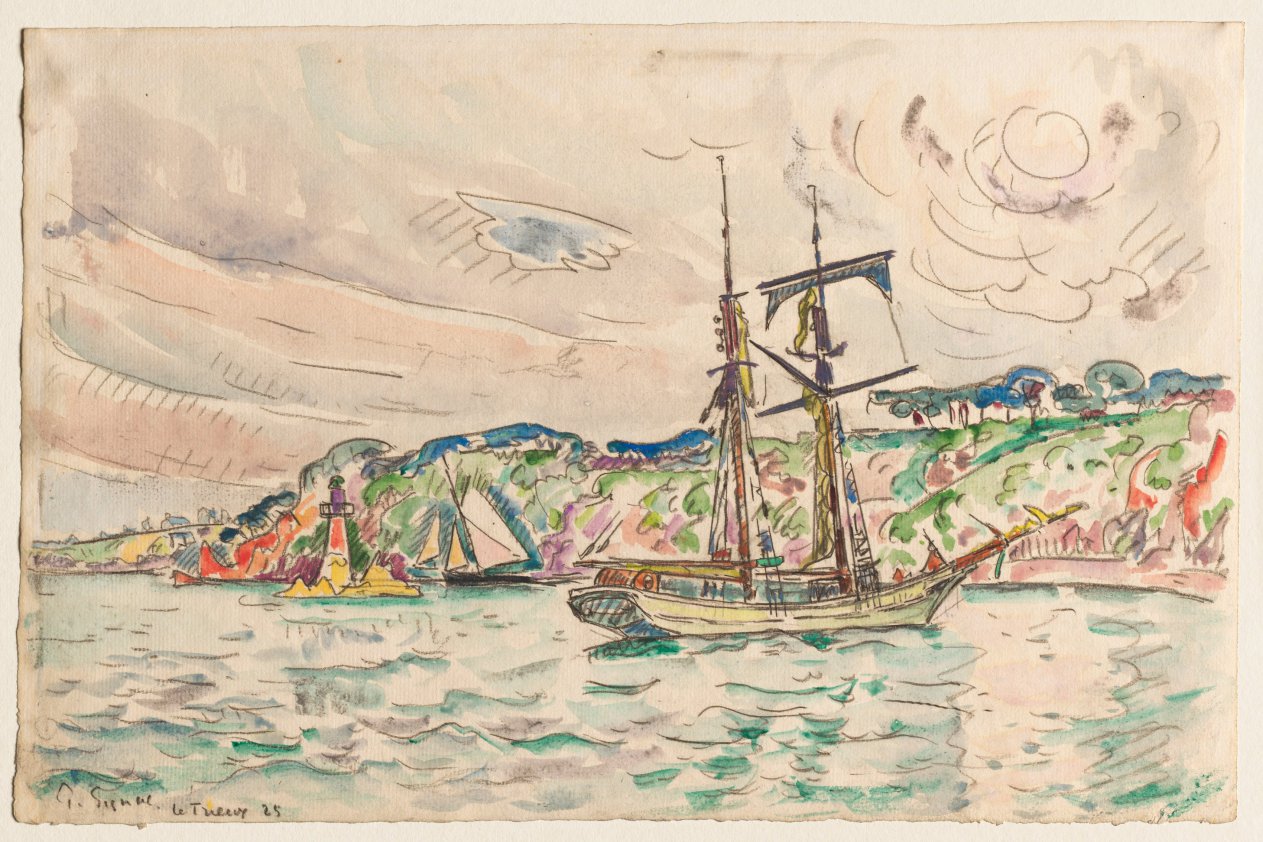
Ships near the Trieux River, 1925, by Paul Signac
Paul Signac · The Cleveland Museum of Art · Mr. and Mrs. Lewis B. Williams Collection
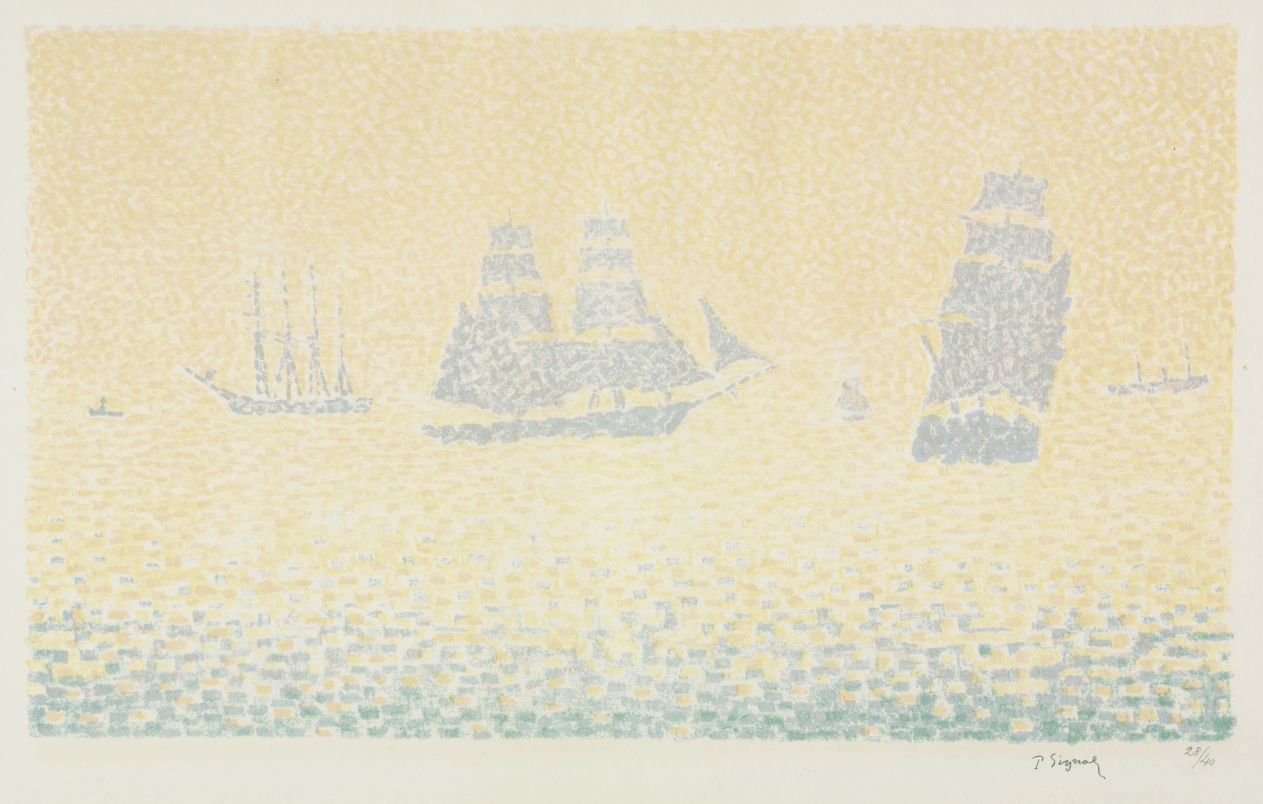
Boats, c. 1890s, by Paul Signac
Paul Signac · The Cleveland Museum of Art · Mr. and Mrs. Lewis B. Williams Collection
Primary material
Documents and archives
authority record
- Wikidata, structured authority record Q151573: Paul Signac
Unverified · Wikidata
reference work
- “Paul Signac”, English Wikipedia, consulted as further reading
Reputable secondary · Wikipedia
Notes from the source article
Cited by Wikipedia
Notes from the source article
These works are cited by the source article, in its own numbering. They are recorded as its citations, not as sources VALÉORINE has verified.
- 1.Cite American Heritage Dictionary Signac access-date=30 August 2019
- 2.Ruhberg Kark, Art of the 20th Century Benedikt Taschen Verlag GMBH 1998
- 3.Brodskaya, Nathalia. Post-Impressionism. Parkstone International. 76. 2014. 978-1-78310-389-8.
- 4.Anne Dymond (2003) A Politicized Pastoral: Signac and the Cultural Geography of Mediterranean France, The Art Bulletin, 85:2, 353-370, DOI: 10.1080/00043079.2003.10787076 .
- 5.Société des Artistes Indépendants. www.artistes-independants.fr.
- 6.Portrait of Vincent van Gogh Henri de Toulouse-Lautrec, 1887. Van Gogh Museum.
- 7.Bailey, Martin. New discoveries: Paul Signac painted watercolours of Van Gogh's asylum. The Art Newspaper. 2019-09-12.
- 8.Wright, Alastair. Matisse and the Subject of Modernism. Princeton: Princeton University Press, 2004. 94.
- 9.Paul Signac: 1863–1935.
- 10.Christie, Stuart. The World That Never Was: A True Story of Dreamers, Schemers, Anarchists and Secret Agents. Pantheon. 27 March 2010.
- 11.UCLA Art Council et al. 1966, p. 11
- 12.Oxford Art Online, "Henri Matisse"
- 13.Paul Signac, d'Eugène Delacroix au Néo-Impressionnisme, 1898 (Third edition 1921)
- 14.Russell T. Clement, Les Fauves: A Sourcebook, Greenwood Publishing Group, 1994
- 15.Jewish Women's Archive, Michele Siegel. Florence Meyer Blumenthal.
- 16.Notice WorldCat ; sudoc ; BnF . Engraved on wood and unpublished drawings of: Matisse, J. Marchand, R. Dufy, Sonia Lewitska, de Segonzac, Jean Émile Laboureur, Friesz, Marquet, Pierre Laprade, Signac, Louis Latapie, Suzanne Valadon, Henriette Tirman and others.´
- 17.Encyclopedia of Arkansas.
References
Citations
References
Each reference names the institution holding it, so a reader may go to the document itself.
authority record
Partially resolvedreference work
Partially resolved
People, houses and institutions
Knowledge graph
People, houses and institutions
Teachers, collaborators, publishers and institutions recorded against this person, each on a stated basis.
The Encyclopedia exists whether or not anything is for sale. Corrections are recorded rather than overwritten, and every version of this record is kept. Published 14 August 2026.
Elsewhere in Prints
4,138 published records in this field, each with its sources named.
- Paul Raphael MeltsnerEngraver
- Paul RennerEngraver
- Paul SandbyEngraver
- Paul SérusierEngraver
- Paul VerreesEngraver
- Paul WinstanleyEngraver
- Paul-Albert BesnardEngraver
- Paul-Marcel DammannEngraver
Best supported in this field
For owners
Own a work by Paul Signac?
A specialist will read what you send and tell you what the house can establish, what it cannot, and whether the object is suited to sale. There is no charge and no obligation. The object stays with you throughout; nothing is shipped to us unless it is arranged in writing beforehand.