
Paul McCartney
He gained global fame with the Beatles, for whom he was the bassist and keyboardist, and shared primary songwriting and lead vocal duties with John Lennon. McCartney is known for his melodic approach to bass-playing, versatile tenor vocal range and musical eclecticism, exploring genres ranging from pre–rock and roll pop to classical, ballads and electronica. His songwriting partnership with Lennon was the most successful in music history.
Also recorded as Macca · Ian Iachimoe · Paul Ramon
Paul McCartney

Raph_PH · ACL18051018-122 · CC BY 2.0
- Name
- Paul McCartney
- Birth Name
- James Paul McCartney
- Born
- 18 June 1942
- Birthplace
- Liverpool, England
- Occupation
- * Singer
- Awards
- Full list
- Nationality
- United Kingdom
- Fields
- rock music · art rock · psychedelic rock · pop rock · classical music · beat music
- Known for
- Ram · Band on the Run · Maybe I'm Amazed · Band on the Run · Live and Let Die
VALÉORINE Encyclopedia
VALÉORINE documentary reading
Documentary summary
He gained global fame with the Beatles, for whom he was the bassist and keyboardist, and shared primary songwriting and lead vocal duties with John Lennon. McCartney is known for his melodic approach to bass-playing, versatile tenor vocal range and musical eclecticism, exploring genres ranging from pre–rock and roll pop to classical, ballads and electronica. His songwriting partnership with Lennon was the most successful in music history.
Admitted source layer · organised and presented by VALÉORINE
Reference Check
Propose documentary evidence for Paul McCartney. A contribution is never written directly as fact: identity, source, rights and evidence gates still decide.
Sign in to contribute
World of VALÉORINE
Documentary connections
Only confirmed graph relationships appear here. Images are shown only when their identity and reuse rights both pass the documentary gate.
Documentary evidence
Documentary basis
Authority files
gnd · 1211008428 · museum · ba550d0e-adac-4864-b88b-407cab5e76af · wikidata · Q2599 · wikipedia · Paul McCartney
In this article
Biography
Biography
Paul McCartney was born in Liverpool, McCartney taught himself piano, guitar, and songwriting as a teenager, having been influenced by his father, a jazz player, and rock and roll performers such as Little Richard and Buddy Holly. He began his career when he joined Lennon's skiffle group, the Quarrymen, in 1957, which evolved into the Beatles in 1960. Sometimes called "the cute Beatle", McCartney later immersed himself in the London avant-garde scene and played a key role in incorporating experimental aesthetics into the Beatles' studio productions. Starting with the 1967 album Sgt. Pepper's Lonely Hearts Club Band, he gradually became the band's de facto leader, providing creative impetus for most of their music and film projects. Many of his Beatles songs, including "And I Love Her", "Yesterday", "Eleanor Rigby" and "Blackbird", rank among the most covered songs in history. Although primarily a bassist with the Beatles, he has played a number of other instruments, including keyboards, guitars and drums, on various songs with all of his associated bands and projects. After the Beatles disbanded, he debuted as a solo artist with the 1970 album McCartney and went on to form the band Wings with his first wife, Linda, and Denny Laine. Under McCartney's leadership, Wings became one of the most successful bands of the 1970s. He wrote or co-wrote their US or UK number-one hits, such as "My Love", "Band on the Run", "Listen to What the Man Said", "Silly Love Songs" and "Mull of Kintyre". He resumed his solo career in 1980 and has been touring as a solo artist since 1989. Apart from Wings, his UK or US number-one hits include "Uncle Albert/Admiral Halsey" (with Linda), "Coming Up", "Pipes of Peace", "Ebony and Ivory" (with Stevie Wonder), and "Say Say Say" (with Michael Jackson). McCartney has been involved in projects to promote international charities related to animal rights, seal hunting, land mines, vegetarianism, poverty, and music education. McCartney is one of the best-selling music artists of all time, with estimated sales of 100million records. He is one of only three recording artists, along with Phil Collins and Jackson, who have sold over 100 million records both as solo artists and separately as principal members of a band. He has written or co-written a record 32 songs that have topped the Billboard Hot 100 and, As of 2009, he had sales of 25.5 million RIAA certified units in the US. McCartney's honours include two inductions into the Rock and Roll Hall of Fame (as a member of the Beatles in 1988 and as a solo artist in 1999), an Academy Award, a Primetime Emmy Award, 19 Grammy Awards, an appointment as a Member of the Order of the British Empire in 1965 and an appointment as Knight Bachelor in 1997 for services to music.
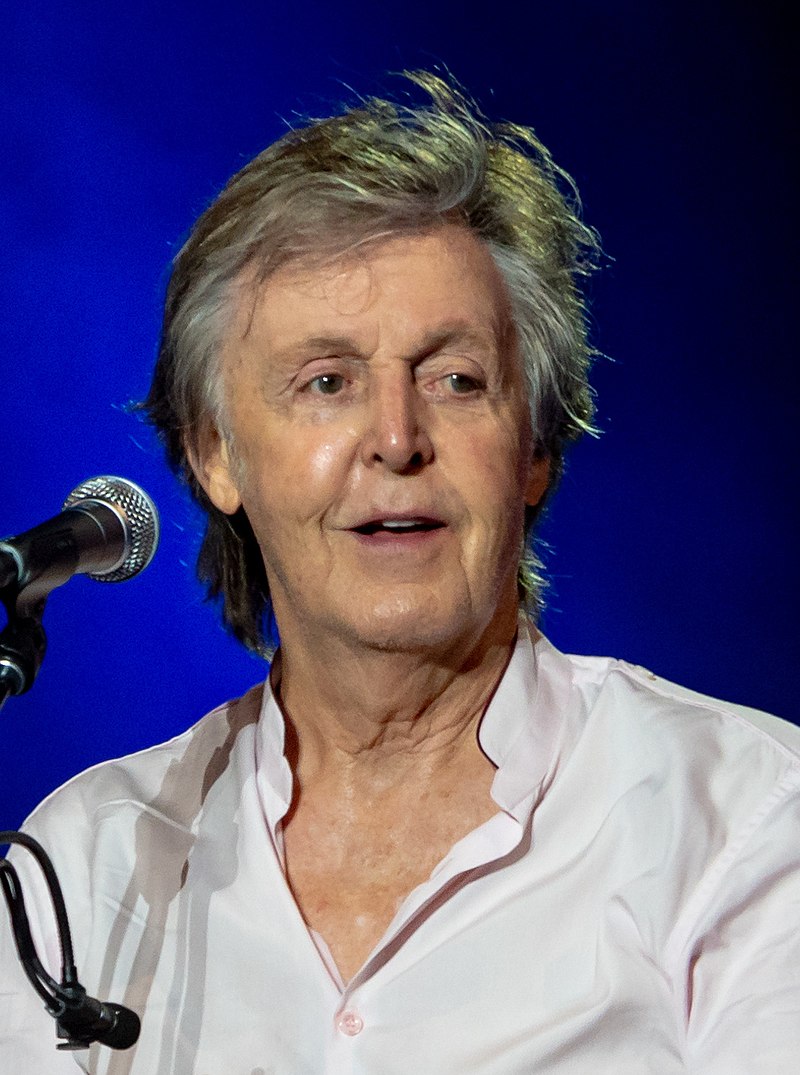
ACL18051018-169
Raph_PH · ACL18051018-169
Key facts
Key facts
• Honorific Prefix — Sir • Name — Paul McCartney • Other Names — * Macca • Bernard Webb • The Fireman • Apollo C. Vermouth • Percy "Thrills" Thrillington • Birth Name — James Paul McCartney • Born — 18 June 1942 • Birthplace — Liverpool, England • Occupation — * Singer • songwriter • musician • record and film producer • businessman • Years Active — 1957–present • Children — 5; including Heather, Mary, Stella and James • Relatives — Mike McCartney (brother) • Awards — Full list • Website — PaulMcCartney.com
Early life
Early life
• Illustration — 20 Forthlin Road, Allerton, where the McCartney family moved in 1955 James Paul McCartney was born on 18 June 1942 at Walton Hospital in the Walton area of Liverpool, where his mother, Mary Patricia (née Mohin), had qualified to practise as a nurse. His father, James, was known as Jim. Both of his parents were of Irish descent. McCartney has a younger brother, Peter Michael, and a younger stepsister, Ruth, born to Jim's second wife, Angie, during her first marriage. Paul and Michael were baptised in their mother's Catholic faith, even though their father was a former Protestant who had turned agnostic. Religion was not emphasised in the household. Before the war, Jim had worked as a salesman for the cotton merchants A. Hannay and Co., having been promoted from his job as a sample boy in their warehouse; when the war broke out, Hannay's was shuttered, and Jim was employed as a lathe turner at Napier's defence engineering works, volunteering for the fire brigade at night. The growing family was rehoused at a flat in Knowsley in 1944 and then in a council housing development in Speke in 1946. After the war, Jim returned to his job at the cotton merchants with a reduced income. Mary's work as a visiting midwife was much more remunerative. McCartney attended Stockton Wood Road Primary School in Speke from 1947 until 1949, when he transferred to Joseph Williams Junior School in Belle Vale because of overcrowding at Stockton. In 1953, he was one of only three students out of 90 to pass the 11-Plus exam, meaning he could attend the Liverpool Institute, a grammar school rather than a secondary modern school. In 1954, he met schoolmate George Harrison on the bus from his suburban home in Speke. The two quickly became friends; McCartney later admitted: "I tended to talk down to him because he was a year younger." Mary McCartney's midwifery paid well, and her earnings enabled them to move into 20 Forthlin Road in Allerton, where they lived until 1964. She rode a bicycle to her patients; McCartney described an early memory of her leaving at "about three in the morning [the] streets... thick with snow". On 31 October 1956, when McCartney was 14, his mother died of an embolism as a complication of surgery for breast cancer. McCartney's loss later became a connection with John Lennon, whose mother, Julia, died in 1958 when Lennon was 17. McCartney's father was a trumpet player and pianist who led Jim Mac's Jazz Band in the 1920s. He kept an upright piano in the front room, encouraged his sons to be musical and advised McCartney to take piano lessons. However, McCartney preferred to learn by ear. When McCartney was 11, his father encouraged him to audition for the Liverpool Cathedral choir, but he was not accepted. McCartney then joined the choir at St Barnabas' Church, Mossley Hill. McCartney received a nickel-plated trumpet from his father for his fourteenth birthday, but when rock and roll became popular on Radio Luxembourg, McCartney traded it for a £15 Framus Zenith (model 17) acoustic guitar, since he wanted to be able to sing while playing. He found it difficult to play guitar right-handed, but after noticing a poster advertising a Slim Whitman concert and realising that Whitman played left-handed, he reversed the order of the strings. McCartney wrote his first song, "I Lost My Little Girl", on the Zenith, and composed another early tune that would become "When I'm Sixty-Four" on the piano. American rhythm and blues influenced him, and Little Richard was his schoolboy idol; "Long Tall Sally" was the first song McCartney performed in public, at a Butlin's Filey holiday camp talent competition.
1957–1960: The Quarrymen
1957–1960: The Quarrymen
At the age of fifteen on 6 July 1957, McCartney met John Lennon and his band, the Quarrymen, at the St Peter's Church Hall fête in Woolton. The Quarrymen played a mix of rock and roll and skiffle, a type of popular music with jazz, blues and folk influences. Soon afterwards, the members of the band invited McCartney to join as a rhythm guitarist, and he formed a close working relationship with Lennon. Harrison joined in 1958 as lead guitarist, followed by Lennon's art school friend Stuart Sutcliffe on bass, in 1960. By May 1960, the band had tried several names, including Johnny and the Moondogs, Beatals and the Silver Beetles. They adopted the name the Beatles in August 1960 and recruited drummer Pete Best shortly before a five-engagement residency in Hamburg.
1960–1970: The Beatles
1960–1970: The Beatles
In 1961, Sutcliffe left the Beatles, and McCartney became their bass player. It is disputed whether he did so reluctantly or actively sought out the role. While in Hamburg, they recorded professionally for the first time and were credited as the Beat Brothers, who were the backing band for English singer Tony Sheridan on the single "My Bonnie". This resulted in attention from Brian Epstein, who was a key figure in their subsequent development and success. He became their manager in January 1962. Ringo Starr replaced Best in August, and the band had their first hit, "Love Me Do", in October, becoming popular in the UK in 1963, and in the US a year later. The fan hysteria became known as "Beatlemania", and the press sometimes referred to McCartney as the "cute Beatle". McCartney co-wrote (with Lennon) several of their early hits, including "I Saw Her Standing There", "She Loves You", "I Want to Hold Your Hand" (1963) and "Can't Buy Me Love" (1964). In August 1965, the Beatles released the McCartney composition "Yesterday", featuring a string quartet. Included on the Help! LP, the song was the group's first recorded use of classical music elements and their first recording that involved only a single band member. "Yesterday" became one of the most covered songs in popular music history. Later that year, during recording sessions for the album Rubber Soul, McCartney began to supplant Lennon as the dominant musical force in the band. Musicologist Ian MacDonald wrote, "from [1965][...] [McCartney] would be in the ascendant not only as a songwriter, but also as instrumentalist, arranger, producer, and de facto musical director of the Beatles." Critics described Rubber Soul as a significant advance in the refinement and profundity of the band's music and lyrics. Considered a high point in the Beatles catalogue, both Lennon and McCartney said they had written the music for the song "In My Life". McCartney said of the album, "we'd had our cute period, and now it was time to expand." Recording engineer Norman Smith stated that the Rubber Soul sessions exposed indications of increasing contention within the band: "the clash between John and Paul was becoming obvious[...] [and] as far as Paul was concerned, George [Harrison] could do no right—Paul was absolutely finicky." In 1966, the Beatles released the album Revolver. Featuring sophisticated lyrics, studio experimentation, and an expanded repertoire of musical genres ranging from innovative string arrangements to psychedelic rock, the album marked an artistic leap for the Beatles. The first of three consecutive McCartney A-sides, the single "Paperback Writer" preceded the LP's release. The Beatles produced a short promotional film for the song, and another for its B-side, "Rain". The films, described by Harrison as "the forerunner of videos", aired on The Ed Sullivan Show and Top of the Pops in June 1966. Revolver also included McCartney's "Eleanor Rigby", which featured a string octet. According to Jonathan Gould, the song is "a neoclassical tour de force[...] a true hybrid, conforming to no recognizable style or genre of song". Except for some backing vocals, the song included only McCartney's lead vocal and the strings arranged by producer George Martin. The band gave their final commercial concert at the end of their 1966 US tour. Later that year, McCartney completed his first musical project independent of the group—a film score for the UK production The Family Way. The score was a collaboration with Martin, who used two McCartney themes to write thirteen variations. The soundtrack failed to chart, but it won McCartney an Ivor Novello Award for Best Instrumental Theme. Upon the end of the Beatles' performing career, McCartney sensed unease in the band and wanted them to maintain creative productivity. He pressed them to start a new project, which became Sgt. Pepper's Lonely Hearts Club Band, widely regarded as rock's first concept album. McCartney was inspired to create a new persona for the group, to serve as a vehicle for experimentation and to demonstrate to their fans that they had musically matured. He invented the fictional band of the album's title track. As McCartney explained, "We were fed up with being the Beatles. We really hated that fucking four little mop-top approach. We were not boys we were men[...] and [we] thought of ourselves as artists rather than just performers." Starting in November 1966, the band adopted an experimental attitude during recording sessions for the album. Their recording of "A Day in the Life" required a forty-piece orchestra, which Martin and McCartney took turns conducting. The sessions produced the double A-side single "Strawberry Fields Forever"/"Penny Lane" in February 1967, and the LP followed in June. Based on an ink drawing by McCartney, the LP's cover included a collage designed by pop artists Peter Blake and Jann Haworth, featuring the Beatles in costume as the Sgt. Pepper's Lonely Hearts Club Band, standing with a host of celebrities. The cover piqued a frenzy of analysis. Epstein's death in August 1967 created a void, which left the Beatles perplexed and concerned about their future. McCartney stepped in to fill that void and gradually became the de facto leader and business manager of the group that Lennon had once led. In his first creative suggestion after this change of leadership, McCartney proposed that the band move forward on their plans to produce a film for television, which was to become Magical Mystery Tour. According to Beatles historian Mark Lewisohn, the project was "an administrative nightmare throughout". McCartney largely directed the film, which brought the group their first unfavourable critical response. By late 1968, relations within the band were deteriorating. The tension grew during the recording of their eponymous double album, also known as the "White Album". Matters worsened the following year during the Let It Be sessions, when a camera crew filmed McCartney lecturing the group: "We've been very negative since Mr. Epstein passed away... we were always fighting [his] discipline a bit, but it's silly to fight that discipline if it's our own." • Illustration — McCartney in 1968 In March 1969, McCartney married his first wife, Linda Eastman, and in August, the couple had their first child, Mary, named after his late mother. Abbey Road was the band's last recorded album, and Martin suggested "a continuously moving piece of music", urging the group to think symphonically. McCartney agreed, but Lennon did not. They eventually compromised, agreeing to McCartney's suggestion: an LP featuring individual songs on side one and a long medley on side two. In October 1969, a rumour surfaced that McCartney had died in a car crash in 1966 and was replaced by a lookalike. This was quickly refuted when a November Life cover featured him and his family, accompanied by the caption "Paul is still with us". John Lennon privately left the Beatles in September 1969, though agreed not to go public with the information to not jeopardise ongoing business negotiations. McCartney was in the midst of business disagreements with his bandmates, largely concerning Allen Klein's management of the group, when he announced his own departure from the group on 10 April 1970. He filed a suit for the band's formal dissolution on 31 December 1970, and in March 1971 the court appointed a receiver to oversee the finances of the Beatles' company Apple Corps. An English court legally dissolved the Beatles' partnership on 9 January 1975, though sporadic lawsuits against their record company EMI, Klein, and each other persisted until 1989.
1970–1981: Wings
1970–1981: Wings
• Illustration — McCartney in 1969, around the time he recorded his first solo album McCartney. In 1970, McCartney continued his musical career with his first solo release, McCartney, a US number-one album. Apart from some vocal contributions from Linda, McCartney is a one-man album, with McCartney providing compositions, instrumentation and vocals. In 1971, he collaborated with Linda and drummer Denny Seiwell on a second album, Ram. A UK number one and a US top five, Ram included the co-written US number-one hit single "Uncle Albert/Admiral Halsey". Later that year, ex-Moody Blues guitarist Denny Laine joined the McCartneys and Seiwell to form the band Wings. McCartney had this to say on the group's formation: "Wings were always a difficult idea[...] any group having to follow [the Beatles'] success would have a hard job[...] I found myself in that very position. However, it was a choice between going on or finishing, and I loved music too much to think of stopping." In September 1971, the McCartneys' daughter Stella was born, named in honour of Linda's grandmothers, both of whom were named Stella. Following the addition of guitarist Henry McCullough, Wings' first concert tour began in 1972 with a debut performance in front of an audience of seven hundred at the University of Nottingham. Ten more gigs followed as they travelled across the UK in a van during an unannounced tour of universities, during which the band stayed in modest accommodation and received pay in coinage collected from students, while avoiding Beatles songs during their performances. McCartney later said, "The main thing I didn't want was to come on stage, faced with the whole torment of five rows of press people with little pads, all looking at me and saying, 'Oh well, he is not as good as he was.' So we decided to go out on that university tour which made me less nervous[...] by the end of that tour I felt ready for something else, so we went into Europe." During the seven-week, 25-show Wings Over Europe Tour, the band played almost solely Wings and McCartney solo material: the Little Richard cover "Long Tall Sally" was the only song that the Beatles had previously recorded. McCartney wanted the tour to avoid large venues; most of the small halls they played had capacities of fewer than 3,000 people. In March 1973, Wings achieved their first US number-one single, "My Love", included on their second LP, Red Rose Speedway, a US number one and UK top five. McCartney's collaboration with Linda and former Beatles producer Martin resulted in the song "Live and Let Die", which was the theme song for the James Bond film of the same name. Nominated for an Academy Award, the song reached number two in the US and number nine in the UK. It also earned Martin a Grammy for his orchestral arrangement. Music professor and author Vincent Benitez described the track as "symphonic rock at its best". • Illustration — Performing with then wife Linda in 1976 After the departure of McCullough and Seiwell in 1973, the McCartneys and Laine recorded Band on the Run. The album was the first of seven platinum Wings LPs. It was a US and UK number one, the band's first to top the charts in both countries and the first ever to reach the Billboard charts on three occasions. One of the best-selling releases of the decade, it remained on the UK charts for 124 weeks. Rolling Stone named it one of the Best Albums of the Year for 1973, and in 1975, Paul McCartney and Wings won the Grammy Award for Best Pop Vocal Performance for the song "Band on the Run", and Geoff Emerick won the Grammy for Best Engineered Recording for the album. In 1974, Wings achieved a second US number-one single with the title track. The album also included the top-ten hits "Jet" and "Helen Wheels", and earned the 418th spot on Rolling Stone's list of the 500 Greatest Albums of All Time. In 1974, McCartney hired guitarist Jimmy McCulloch and drummer Geoff Britton to replace McCullough and Seiwell. Britton subsequently quit during recording sessions in 1975 and was replaced by Joe English. Wings followed Band on the Run with the chart-topping albums Venus and Mars (1975) and Wings at the Speed of Sound (1976). In 1975, they began the fourteen-month Wings Over the World Tour, which included stops in the UK, Australia, Europe and the US. The tour marked the first time McCartney performed Beatles songs live with Wings, with five in the two-hour set list: "I've Just Seen a Face", "Yesterday", "Blackbird", "Lady Madonna" and "The Long and Winding Road". Following the second European leg of the tour and extensive rehearsals in London, the group undertook an ambitious US arena tour that yielded the US number-one live triple LP Wings over America. In September 1977, the McCartneys' third child was born, a son they named James. In November, the Wings song "Mull of Kintyre", co-written with Laine, was quickly becoming one of the best-selling singles in UK chart history. The most successful single of McCartney's solo career, it achieved double the sales of the previous record holder, "She Loves You", and went on to sell 2.5 million copies and hold the UK sales record until the 1984 charity single, "Do They Know It's Christmas?" • Illustration — At Amsterdam's Schiphol Airport, January 1980 London Town (1978) spawned a US number-one single ("With a Little Luck"), and continued Wings' string of commercial successes, making the top five in both the US and the UK. Critical reception was unfavourable, and McCartney expressed disappointment with the album. Back to the Egg (1979) featured McCartney's assemblage of a rock supergroup dubbed "Rockestra" on two tracks. The band included Wings along with Pete Townshend, David Gilmour, Gary Brooker, John Paul Jones, John Bonham and others. Though certified platinum, critics panned the album. Wings completed their final concert tour in 1979, with twenty shows in the UK that included the live debut of the Beatles songs "Got to Get You into My Life", "The Fool on the Hill" and "Let It Be". In 1980, McCartney released his second solo LP, the self-produced McCartney II, which peaked at number one in the UK and number three in the US. As with his first album, he composed and performed it alone. The album contained the song "Coming Up", the live version of which, recorded in Glasgow, Scotland, in 1979 by Wings, became the group's last number-one hit. By 1981, McCartney felt he had accomplished all he could creatively with Wings and decided he needed a change. The group discontinued in April 1981 after Laine quit following disagreements over royalties and salaries.
1982–1990
1982–1990
In 1982, McCartney collaborated with Stevie Wonder on the Martin-produced number-one hit "Ebony and Ivory", included on McCartney's Tug of War LP, and with Michael Jackson on "The Girl Is Mine" from Thriller. "Ebony and Ivory" was McCartney's record 28th single to hit number one on the Billboard 100. The following year, he and Jackson worked on "Say Say Say", McCartney's most recent US number one As of 2014. McCartney earned his latest UK number one As of 2014 with the title track of his LP release that year, "Pipes of Peace". In 1984, McCartney starred in Give My Regards to Broad Street, a feature film he also wrote and produced and which included Starr in an acting role. It was disparaged by critics: Variety described the film as "characterless, bloodless, and pointless"; while Roger Ebert awarded it a single star, writing, "you can safely skip the movie and proceed directly to the soundtrack". The album fared much better, reaching number one in the UK and producing the US top-ten hit single "No More Lonely Nights", featuring David Gilmour on lead guitar. In 1985, Warner Brothers commissioned McCartney to write a song for the comedic feature film Spies Like Us. He composed and recorded the track in four days, with Phil Ramone co-producing. McCartney participated in Live Aid, performing "Let it Be", but technical difficulties rendered his vocals and piano barely audible for the first two verses, punctuated by squeals of feedback. Equipment technicians resolved the problems and David Bowie, Alison Moyet, Pete Townshend and Bob Geldof joined McCartney on stage, receiving an enthusiastic crowd reaction. McCartney collaborated with Eric Stewart on Press to Play (1986), with Stewart co-writing more than half the songs on the LP. In 1988, McCartney released Снова в СССР, initially available only in the Soviet Union, which contained eighteen covers; recorded over the course of two days. In 1989, he joined forces with fellow Merseysiders Gerry Marsden and Holly Johnson to record an updated version of "Ferry Cross the Mersey", for the Hillsborough disaster appeal fund. That same year, he released Flowers in the Dirt; a collaborative effort with Elvis Costello that included musical contributions from Gilmour and Nicky Hopkins. McCartney then formed a band consisting of himself and Linda, with Hamish Stuart and Robbie McIntosh on guitars, Paul "Wix" Wickens on keyboards and Chris Whitten on drums. In September 1989, they launched the Paul McCartney World Tour, his first in over a decade. During the tour, McCartney performed for the largest paying stadium audience in history on 21 April 1990, when 184,000 people attended his concert at Maracanã Stadium in Rio de Janeiro, Brazil. That year, he released the triple album Tripping the Live Fantastic, which contained selected performances from the tour.
1991–1999
1991–1999
• Illustration — McCartney in 1992 McCartney ventured into orchestral music in 1991 when the Royal Liverpool Philharmonic Society commissioned a musical piece by him to celebrate its sesquicentennial. He collaborated with composer Carl Davis, producing Liverpool Oratorio. The performance featured opera singers Kiri Te Kanawa, Sally Burgess, Jerry Hadley and Willard White with the Royal Liverpool Philharmonic Orchestra and the choir of Liverpool Cathedral. Reviews were negative. The Guardian was especially critical, describing the music as "afraid of anything approaching a fast tempo", and adding that the piece has "little awareness of the need for recurrent ideas that will bind the work into a whole". The paper published a letter McCartney submitted in response in which he noted several of the work's faster tempos and added, "happily, history shows that many good pieces of music were not liked by the critics of the time so I am content to[...] let people judge for themselves the merits of the work." The New York Times was slightly more generous, stating, "There are moments of beauty and pleasure in this dramatic miscellany[...] the music's innocent sincerity makes it difficult to be put off by its ambitions". Performed around the world after its London premiere, the Liverpool Oratorio reached number one on the UK classical chart, Music Week. In 1991, McCartney performed a selection of acoustic-only songs on MTV Unplugged and released a live album of the performance titled Unplugged (The Official Bootleg). During the 1990s, McCartney collaborated twice with Youth of Killing Joke as the musical duo "the Fireman". The two released their first electronica album together, Strawberries Oceans Ships Forest, in 1993. McCartney released the rock album Off the Ground in 1993. The subsequent New World Tour followed, which led to the release of the Paul Is Live album later that year. Starting in 1994, McCartney took a four-year break from his solo career to work on Apple's Beatles Anthology project with Harrison, Starr and Martin. He recorded a radio series called Oobu Joobu in 1995 for the American network Westwood One, which he described as "widescreen radio". Also in 1995, Prince Charles presented him with an Honorary Fellowship of the Royal College of Music—"kind of amazing for somebody who doesn't read a note of music", commented McCartney. In 1997, McCartney released the rock album Flaming Pie. Starr appeared on drums and backing vocals in "Beautiful Night". Later that year, he released the classical work Standing Stone, which topped the UK and US classical charts. In 1998, he released Rushes, the second electronica album by the Fireman. In 1999, McCartney released Run Devil Run. Recorded in one week, and featuring Ian Paice and David Gilmour, it was primarily an album of covers with three McCartney originals. He had been planning such an album for years, having been previously encouraged to do so by Linda, who had died of cancer in April 1998. McCartney did an unannounced performance at the benefit tribute, "Concert for Linda", his wife of 29 years who died a year earlier. It was held at the Royal Albert Hall in London on 10 April 1999, and was organised by two of her close friends, Chrissie Hynde and Carla Lane. Also during 1999, he continued his experimentation with orchestral music on Working Classical.
2000–2009
2000–2009
In 2000, he released the electronica album Liverpool Sound Collage with Super Furry Animals and Youth, using the sound collage and musique concrète techniques that had fascinated him in the mid-1960s. He contributed the song "Nova" to a tribute album of classical, choral music called A Garland for Linda (2000), dedicated to his late wife. In 2001, McCartney recorded a version of "That's All Right" with Elvis Presley's original guitarist Scotty Moore and original drummer D. J. Fontana. Having witnessed the September 11 attacks from the JFK airport tarmac, McCartney was inspired to take a leading role in organising the Concert for New York City. His studio album release in November that year, Driving Rain, included the song "Freedom", written in response to the attacks. The following year, McCartney went out on tour with a new band that included guitarists Rusty Anderson and Brian Ray, accompanied by Paul "Wix" Wickens on keyboards and Abe Laboriel Jr. on drums. They began the Driving World Tour in April 2002, which included stops in the US, Mexico and Japan. The tour resulted in the double live album Back in the US, released internationally in 2003 as Back in the World. The tour earned a reported $126.2 million, an average of over $2 million per night, and Billboard named it the top tour of the year. The group continues to play together; McCartney has played live with Ray, Anderson, Laboriel, and Wickens longer than he played live with the Beatles or Wings. In July 2002, McCartney married Heather Mills. In November, on the first anniversary of George Harrison's death, McCartney performed at the Concert for George. He participated in the National Football League's Super Bowl, performing "Freedom" during the pre-game show for Super Bowl XXXVI in 2002 and headlining the halftime show at Super Bowl XXXIX in 2005. The English College of Arms honoured McCartney in 2002 by granting him a coat of arms. His crest, featuring a Liver bird holding an acoustic guitar in its claw, reflects his background in Liverpool and his musical career. The shield includes four curved emblems which resemble beetles' backs. The arms' motto is Ecce Cor Meum, Latin for "Behold My Heart". In 2003, the McCartneys had a child, Beatrice Milly. In July 2005, McCartney performed at the Live 8 event in Hyde Park, London, opening the show with "Sgt. Pepper's Lonely Hearts Club Band" (with U2) and closing it with "Drive My Car" (with George Michael), "Helter Skelter", and "The Long and Winding Road". In September, he released the rock album Chaos and Creation in the Backyard, for which he provided most of the instrumentation. In 2006, McCartney released the classical work Ecce Cor Meum. The rock album Memory Almost Full followed in 2007. In 2008, he released his third Fireman album, Electric Arguments. In September 2008, McCartney performed at Yarkon Park in Tel Aviv, his first ever concert in Israel, during the country's 60th anniversary year. His setlist featured 31 songs from both his Beatles and Wings catalogues. During the trip, he also visited Bethlehem, where he addressed the region's political situation, telling reporters, "All we need is peace in the region and a two-state solution." Also in 2008, he performed at a concert in Liverpool to celebrate the city's year as European Capital of Culture. In 2009, after a four-year break, he returned to touring and has since performed over 80 shows. More than forty-five years after the Beatles first appeared on American television during The Ed Sullivan Show, he returned to the same New York theatre to perform on Late Show with David Letterman. On 9 September 2009, EMI reissued the Beatles catalogue following a four-year digital remastering effort, releasing a music video game called The Beatles: Rock Band the same day. McCartney's enduring fame has made him a popular choice to open new venues. In 2009, he performed three sold-out concerts at the newly built Citi Field, a venue constructed to replace Shea Stadium in Queens, New York. These performances yielded the double live album Good Evening New York City later that year.
2010s
2010s
• Illustration — Live in Dublin, 2010 In 2010, McCartney opened the Consol Energy Center in Pittsburgh, Pennsylvania; it was his first concert in Pittsburgh since 1990 due to the old Civic Arena being deemed unsuitable for McCartney's logistical needs. In July 2011, McCartney performed at two sold-out concerts at the new Yankee Stadium. A New York Times review of the first concert reported that McCartney was "not saying goodbye but touring stadiums and playing marathon concerts". In August 2011, McCartney left EMI and signed with Decca Records, the same record company that famously rejected the Beatles back in January 1962. McCartney was commissioned by the New York City Ballet, and in September 2011, he released his first score for dance, a collaboration with Peter Martins called Ocean's Kingdom on Decca Records. Also in 2011, McCartney married Nancy Shevell. He released Kisses on the Bottom, a collection of standards, in February 2012, the same month that the National Academy of Recording Arts and Sciences honoured him as the MusiCares Person of the Year, two days prior to his performance at the 54th Annual Grammy Awards. McCartney remains one of the world's top draws. He played to over 100,000 people during two performances in Mexico City in May, with the shows grossing nearly $6 million. In June 2012, McCartney closed Queen Elizabeth's Diamond Jubilee Concert held outside Buckingham Palace, performing a set that included "Let It Be" and "Live and Let Die". He closed the opening ceremony of the 2012 Summer Olympics in London on 27 July, singing "The End" and "Hey Jude" and inviting the audience to join in on the coda. Having donated his time, he received £1 from the Olympic organisers. On 12 December 2012, McCartney performed with three former members of Nirvana (Krist Novoselic, Dave Grohl, and guest member Pat Smear) during the closing act of 12-12-12: The Concert for Sandy Relief, seen by approximately two billion people worldwide. On 28 August 2013, McCartney released the title track of his upcoming studio album New, which came out in October 2013. A primetime entertainment special was taped on 27 January 2014 at the Ed Sullivan Theater with a 9 February 2014 CBS airing. The show featured McCartney and Ringo Starr, and celebrated the legacy of the Beatles and their groundbreaking 1964 performance on The Ed Sullivan Show. The show, titled The Night That Changed America: A Grammy Salute to The Beatles, featured 22 classic Beatles songs as performed by various artists, including McCartney and Starr. In May 2014, McCartney cancelled a sold-out tour of Japan and postponed a US tour to October due to begin that month after he contracted a virus. He resumed the tour with a high-energy three-hour appearance in Albany, New York, on 5 July 2014. On 14 August 2014, McCartney performed in the final concert at Candlestick Park in San Francisco, California before its demolition; this was the same venue at which the Beatles played their final concert for a paying audience in 1966. In 2014, McCartney wrote and performed "Hope for the Future", the ending song for the video game Destiny. In November 2014, a 42-song tribute album titled The Art of McCartney was released, which features a wide range of artists covering McCartney's solo and Beatles work. Also that year, McCartney collaborated with American rapper Kanye West on the single "Only One", released on 31 December. In January 2015, McCartney collaborated with West and Barbadian singer Rihanna on the single "FourFiveSeconds". They released a music video for the song in January and performed it live at the 57th Annual Grammy Awards on 8 February 2015. McCartney featured on West's 2015 single "All Day", which also features Theophilus London and Allan Kingdom. • Illustration — McCartney performing with his band at Desert Trip in October 2016 In February 2015, McCartney performed with Paul Simon for the Saturday Night Live 40th Anniversary Special. McCartney and Simon performed the first verse of "I've Just Seen a Face" on acoustic guitars, and McCartney later performed "Maybe I'm Amazed". McCartney shared lead vocals on the Alice Cooper-led Hollywood Vampires supergroup's cover of his song "Come and Get It", which appears on their debut album, released on 11 September 2015. On 10 June 2016, McCartney released the career-spanning collection Pure McCartney. The set includes songs from throughout McCartney's solo career and his work with Wings and the Fireman, and is available in three different formats (2-CD, 4-CD, 4-LP and Digital). The 4-CD version includes 67 tracks, most of which were top-40 hits. McCartney appeared in the 2017 adventure film Pirates of the Caribbean: Dead Men Tell No Tales, in a cameo role as Uncle Jack. In January 2017, McCartney filed a suit in United States district court against Sony/ATV Music Publishing seeking to reclaim ownership of his share of the Lennon–McCartney song catalogue beginning in 2018. Under US copyright law, for works published before 1978 the author can reclaim copyrights assigned to a publisher after 56 years. McCartney and Sony agreed to a confidential settlement in June 2017. On 20 June 2018, McCartney released "I Don't Know" and "Come On to Me" from his album Egypt Station, which was released on 7 September through Capitol Records. Egypt Station became McCartney's first album in 36 years to top the Billboard 200, and his first to debut at number one. On 26 July 2018, McCartney played at The Cavern Club, with his regular band of Anderson, Ray, Wickens and Abe Laboriel Jr. The gig was filmed and later broadcast by BBC, on Christmas Day 2020, as Paul McCartney at the Cavern Club.
2020s
2020s
McCartney's 19th solo album, McCartney III, was released on 18 December 2020, via Capitol Records; it became his first number-one solo album in the UK since Flowers in the Dirt in 1989. The album was recorded in England during the COVID-19 lockdowns and continues McCartney's trend of self-titled solo albums with him playing all of the instruments. An album of "reinterpretations, remixes, and covers" titled McCartney III Imagined was released on 16 April 2021. McCartney's book The Lyrics: 1956 to the Present was released in November 2021. Described as a "self-portrait in 154 songs", the book is based on conversations McCartney had with the Irish poet Paul Muldoon. The Lyrics was named Book of the Year by both Barnes & Noble and Waterstones. McCartney's "Got Back" tour ran from 28 April 2022 to 16 June 2022 in the United States, his first in the country since 2019. The tour concluded on 25 June 2022 when McCartney headlined Glastonbury Festival, a week after his 80th birthday. Performing on the Pyramid Stage, he became the oldest solo headliner at the festival. Special guests were Dave Grohl and Bruce Springsteen. In 2022, he received the Primetime Emmy Award for Outstanding Documentary or Nonfiction Series at the 74th Primetime Creative Arts Emmy Awards, as a producer for the documentary The Beatles: Get Back. • Illustration — McCartney and Ringo Starr performing together in London, 2024 In 2023, McCartney published the book 1964: Eyes of the Storm, a collection of recently discovered photos he had taken at the height of Beatlemania. The book was published in conjunction with an exhibition of his photographs titled, "Paul McCartney Photographs 1963–64: Eyes of the Storm." The exhibit was organised by the National Portrait Gallery, London, in collaboration with McCartney and appeared in numerous venues in the United States and Japan with additional appearances in France and Canada. In February 2025, McCartney performed for the Saturday Night Live 50th Anniversary Special. Backed by his touring band, McCartney performed "Golden Slumbers", "Carry That Weight", and "The End" in medley form to close out the anniversary special. In May 2025, he released a new version of "My Valentine", recorded as a duet with Barbra Streisand for her album The Secret of Life: Partners, Volume Two. In November 2025, McCartney released his first new recording in five years, a nearly silent track as part of a protest against AI companies using musicians' work without permission to train their models. The piece appears on the B-side of a protest LP called Is This What We Want?, made up of similarly quiet recordings. Across about two minutes and forty-five seconds, it is mostly a quiet hiss with brief clatters and fades, symbolising a future in which original music is "silenced" if artists' rights are not protected. The tracks message is "the British government must not legalise music theft to benefit AI companies." The project is organised by composer Ed Newton-Rex and is backed by major artists including Sam Fender, Kate Bush, Hans Zimmer and the Pet Shop Boys. McCartney has warned that unchecked AI risks destroying career paths for young composers and songwriters and the future of original music. On 26 March 2026, McCartney released the single "Days We Left Behind" from his twentieth solo studio album, The Boys of Dungeon Lane, which was released on 29 May. McCartney performed on 16 May 2026 season finale of Saturday Night Live. McCartney, who was joined on drums by Chad Smith of the Red Hot Chili Peppers and backing singer Ingrid Michaelson, performed "Days We Left Behind" (its live debut), "Band on the Run" and "Coming Up", a song he had previously performed forty-six years earlier on his first appearance on Saturday Night Live. "Help!" and "Drive My Car" (featuring Will Ferrell on cowbell) were also performed but not shown on television. He also made an appearance in the opening monologue with host Ferrell and Smith along with appearing in another sketch later in the episode. On 21 May 2026, McCartney was the final guest on The Late Show with Stephen Colbert, filmed at the Ed Sullivan Theater. In July 2026, McCartney performed privately during the wedding reception of Taylor Swift and Travis Kelce. His set included the Beatles' song "I Want to Hold Your Hand", marking his first time playing it live since September 1964, during the Beatles' first North American tour. McCartney appears on Foreign Tongues, the studio album by the Rolling Stones, released on 10 July 2026.
Musicianship
Musicianship
McCartney is a largely self-taught musician, and his approach was described by musicologist Ian MacDonald as "by nature drawn to music's formal aspects yet wholly untutored[...] [he] produced technically 'finished' work almost entirely by instinct, his harmonic judgement based mainly on perfect pitch and an acute pair of ears[...] [A] natural melodist—a creator of tunes capable of existing apart from their harmony." McCartney likened his approach to "the primitive cave artists, who drew without training".
Early influences
Early influences
McCartney's earliest musical influences include Elvis Presley, Little Richard, Buddy Holly, Carl Perkins, and Chuck Berry. When asked why the Beatles did not include Presley on the Sgt. Pepper cover, McCartney replied, "Elvis was too important and too far above the rest even to mention[...] so we didn't put him on the list because he was more than merely a[...] pop singer, he was Elvis the King." McCartney stated that in his bassline for "I Saw Her Standing There", he quoted Berry's "I'm Talking About You". McCartney called Little Richard an idol, whose falsetto vocalisations inspired McCartney's own vocal technique. McCartney said he wrote "I'm Down" as a vehicle for his Little Richard impersonation. In 1971, McCartney bought the publishing rights to Holly's catalogue, and in 1976, on the fortieth anniversary of Holly's birth, McCartney inaugurated the annual "Buddy Holly Week" in England. The festival has included guest performances by famous musicians, songwriting competitions, drawing contests and special events featuring performances by the Crickets.
Bass guitar
Bass guitar
• Illustration — McCartney using a Höfner 500/1 bass in 2016 While best known for primarily using a plectrum or pick, McCartney occasionally plays fingerstyle. He was strongly influenced by Motown artists, in particular James Jamerson, whom McCartney called a hero for his melodic style. He was also influenced by Brian Wilson, as he commented: "because he went to very unusual places". Another favourite bassist of his is Stanley Clarke. McCartney's skill as a bass player has been acknowledged by bassists including Sting, Dr. Dre bassist Mike Elizondo, and Colin Moulding of XTC. McCartney has consistently been ranked at or near the top of lists of the best bass players ever. He was voted the best rock bassist in Creems 1973 and 1974 Reader Poll Results and the third best rock bassist in its 1975 and 1977 Reader Poll Results. He was voted the third best bassist of all time in a 2011 Rolling Stone readers' poll and, in 2020, Rolling Stone ranked him the ninth greatest bassist of all time. In 2020, Bass Player ranked him the third best bass player of all time. He was voted the fifth greatest bassist of all time in a 2021 MusicRadar readers' poll. Music critic J. D. Considine ranked McCartney the second best bass player. During McCartney's early years with the Beatles, he primarily used a Höfner 500/1 bass, although from 1965, he favoured his Rickenbacker 4001S for recording. While typically using Vox amplifiers, by 1967, he had also begun using a Fender Bassman for amplification. During the late 1980s and early 1990s, he used a Wal 5-String, which he said made him play more thick-sounding basslines, in contrast to the much lighter Höfner, which inspired him to play more sensitively, something he considers fundamental to his playing style. He changed back to the Höfner around 1990 for that reason. He uses Mesa Boogie bass amplifiers while performing live. MacDonald identified "She's a Woman" as the turning point when McCartney's bass playing began to evolve dramatically, and Beatles biographer Chris Ingham singled out Rubber Soul as the moment when McCartney's playing exhibited significant progress, particularly on "The Word". Bacon and Morgan agreed, calling McCartney's groove on the track "a high point in pop bass playing and[...] the first proof on a recording of his serious technical ability on the instrument." MacDonald inferred the influence of James Brown's "Papa's Got a Brand New Bag" and Wilson Pickett's "In the Midnight Hour", American soul tracks from which McCartney absorbed elements and drew inspiration as he "delivered his most spontaneous bass-part to date". Bacon and Morgan described his bassline for the Beatles song "Rain" as "an astonishing piece of playing[...] [McCartney] thinking in terms of both rhythm and 'lead bass'[...] [choosing] the area of the neck[...] he correctly perceives will give him clarity for melody without rendering his sound too thin for groove." MacDonald identified the influence of Indian classical music in "exotic melismas in the bass part" on "Rain" and described the playing as "so inventive that it threatens to overwhelm the track". By contrast, he recognised McCartney's bass part on the Harrison-composed "Something" as creative but overly busy and "too fussily extemporised". McCartney identified Sgt. Pepper's Lonely Hearts Club Band as containing his strongest and most inventive bass playing, particularly on "Lucy in the Sky with Diamonds".
Acoustic guitar
Acoustic guitar
• Illustration — McCartney playing an Epiphone Texan in 2014 McCartney primarily flatpicks while playing acoustic guitar, though he also uses elements of fingerpicking. Examples of his acoustic guitar playing on Beatles tracks include "Yesterday", "Michelle", "Blackbird", "I Will", "Mother Nature's Son" and "Rocky Raccoon". McCartney singled out "Blackbird" as a personal favourite and described his technique for the guitar part in the following way: "I got my own little sort of cheating way of [fingerpicking][...] I'm actually sort of pulling two strings at a time[...] I was trying to emulate those folk players." He employed a similar technique for "Jenny Wren". He played an Epiphone Texan on many of his acoustic recordings, but also used a Martin D-28.
Electric guitar
Electric guitar
• Illustration — McCartney playing a Gibson Les Paul in concert, 2018 McCartney played lead guitar on several Beatles recordings, including what MacDonald described as a "fiercely angular slide guitar solo" on "Drive My Car", which McCartney played on an Epiphone Casino. McCartney said of the instrument: "if I had to pick one electric guitar it would be this." McCartney bought the Casino in 1964, on the knowledge that the guitar's hollow body would produce more feedback. He has retained that original guitar to the present day. He contributed what MacDonald described as "a startling guitar solo" on the Harrison composition "Taxman" and the "shrieking" guitar on "Sgt. Pepper's Lonely Hearts Club Band" and "Helter Skelter". MacDonald also praised McCartney's "coruscating pseudo-Indian" guitar solo on "Good Morning Good Morning". McCartney also played lead guitar on "Another Girl". During his years with Wings, McCartney tended to leave electric guitar work to other group members, though he played most of the lead guitar on Band on the Run. In 1990, when asked who his favourite guitar players were he included Eddie Van Halen, Eric Clapton and David Gilmour, stating, "but I still like Hendrix the best". He has primarily used a Gibson Les Paul for electric work, particularly during live performances. In addition to these guitars, McCartney is known to use and own a range of other electric guitars, usually favouring the Fender Esquire and its subsequent incarnation, the Fender Telecaster, using the latter with a sunburst finish on Wings' tours in the 1970s. He also owns a rare Ampeg Dan Armstrong Plexi guitar, the only left handed one known to be in existence, which appeared in the Wings video for "Helen Wheels".
Vocals
Vocals
McCartney is known for his belting power, versatility and wide tenor vocal range, spanning over four octaves. He was ranked the 11th greatest singer of all time by Rolling Stone, voted the 8th greatest singer ever by NME readers and number 10 by Music Radar readers in the list of "the 30 greatest lead singers of all time". Over the years, McCartney has been named a significant vocal influence by Chris Cornell, Billy Joel, Steven Tyler, Brad Delp, and Axl Rose. McCartney's vocals have crossed several music genres throughout his career. On "Call Me Back Again", according to Benitez, "McCartney shines as a bluesy solo vocalist", while MacDonald called "I'm Down" "a rock-and-roll classic" that "illustrates McCartney's vocal and stylistic versatility". MacDonald described "Helter Skelter" as an early attempt at heavy metal, and "Hey Jude" as a "pop/rock hybrid", pointing out McCartney's "use of gospel-style melismas" in the song and his "pseudo-soul shrieking in the fade-out". Benitez identified "Hope of Deliverance" and "Put It There" as examples of McCartney's folk music efforts while musicologist Walter Everett considered "When I'm Sixty-Four" and "Honey Pie" attempts at vaudeville. MacDonald praised the "swinging beat" of the Beatles' twenty-four bar blues song, "She's a Woman" as "the most extreme sound they had manufactured to date", with McCartney's voice "at the edge, squeezed to the upper limit of his chest register and threatening to crack at any moment." MacDonald described "I've Got a Feeling" as a "raunchy, mid-tempo rocker" with a "robust and soulful" vocal performance and "Back in the U.S.S.R." as "the last of [the Beatles'] up-tempo rockers", McCartney's "belting" vocals among his best since "Drive My Car", recorded three years earlier. McCartney also teasingly tried out classical singing, namely singing various renditions of "Besame Mucho" with the Beatles. He continued experimenting with various musical and vocal styles throughout his post-Beatles career. "Monkberry Moon Delight" was described by Pitchforks Jayson Greene as "an absolutely unhinged vocal take, Paul gulping and sobbing right next to your inner ear", adding that "it could be a latter-day Tom Waits performance".
Keyboards
Keyboards
• Illustration — Paul McCartney performing in the East Room of the White House, 2010 McCartney played piano on several Beatles songs, including "She's a Woman", "For No One", "A Day in the Life", "Hello, Goodbye", "Lady Madonna", "Hey Jude", "Martha My Dear", "Let It Be" and "The Long and Winding Road". MacDonald considered the piano part in "Lady Madonna" as reminiscent of Fats Domino, and "Let It Be" as having a gospel rhythm. MacDonald called McCartney's Mellotron intro on "Strawberry Fields Forever" an integral feature of the song's character. McCartney played a Moog synthesiser on the Beatles song "Maxwell's Silver Hammer" and the Wings track "Loup (1st Indian on the Moon)". Ingham described the Wings songs "With a Little Luck" and "London Town" as being "full of the most sensitive pop synthesizer touches".
Drums
Drums
McCartney played drums on the Beatles' songs "Back in the U.S.S.R.", "Dear Prudence", "Martha My Dear", "Wild Honey Pie" and "The Ballad of John and Yoko". He also played all the drum parts on his albums McCartney, McCartney II and McCartney III, as well as on Wings' Band on the Run, and most of the drums on his solo LP Chaos and Creation in the Backyard. His other drumming contributions include Paul Jones' rendition of "And the Sun Will Shine" (1968), Steve Miller Band's 1969 tracks "Celebration Song" and "My Dark Hour", and "Sunday Rain" from the Foo Fighters' 2017 album Concrete and Gold.
Tape loops
Tape loops
In the mid-1960s, when visiting artist friend John Dunbar's flat in London, McCartney brought tapes he had compiled at then-girlfriend Jane Asher's home. They included mixes of various songs, musical pieces and comments made by McCartney that Dick James made into a demo for him. Heavily influenced by American avant-garde musician John Cage, McCartney made tape loops by recording voices, guitars and bongos on a Brenell tape recorder and splicing the various loops. He referred to the finished product as "electronic symphonies". He reversed the tapes, sped them up, and slowed them down to create the desired effects, some of which the Beatles later used on the songs "Tomorrow Never Knows" and "The Fool on the Hill".
Trumpet
Trumpet
McCartney's first instrument was the trumpet, given to him by his trumpet-playing father. McCartney took to the instrument, but realized he couldn't sing with the mouthpiece in. He asked his father if he could trade it for a guitar, which he did. McCartney only occasionally played the trumpet on recordings, such as on "Only a Northern Song". At a 2009 Preservation Hall Jazz Band benefit, he joined their jazz band on trumpet for "When the Saints Go Marching In." During the 2026 The Late Show with Stephen Colbert finale, McCartney joined Louis Cato and the Great Big Joy Machine playing trumpet on the same song.
Creative outlets
Creative outlets
While at school during the 1950s, McCartney thrived at art assignments, often earning top accolades for his visual work. However, his lack of discipline negatively affected his academic grades, preventing him from earning admission to art college. During the 1960s, he delved into the visual arts, explored experimental cinema, and regularly attended film, theatrical and classical music performances. His first contact with the London avant-garde scene was through artist John Dunbar, who introduced McCartney to art dealer Robert Fraser. At Fraser's flat he first learned about art appreciation and met Andy Warhol, Claes Oldenburg, Peter Blake, and Richard Hamilton. McCartney later purchased works by Magritte, whose painting of an apple had inspired the Apple Records logo. McCartney became involved in the renovation and publicising of the Indica Gallery in Mason's Yard, London, which Barry Miles had co-founded and where Lennon first met Yoko Ono. Miles also co-founded International Times, an underground paper that McCartney helped to start with direct financial support and by providing interviews to attract advertiser income. Miles later wrote McCartney's official biography, Many Years from Now (1997). McCartney became interested in painting after watching artist Willem de Kooning work in de Kooning's Long Island studio. McCartney took up painting in 1983, and he first exhibited his work in Siegen, Germany, in 1999. The 70-painting show featured portraits of Lennon, Andy Warhol, and David Bowie. Though initially reluctant to display his paintings publicly, McCartney chose the gallery because events organiser Wolfgang Suttner showed genuine interest in McCartney's art. In September 2000, the first UK exhibition of McCartney's paintings opened, featuring 500 canvases at the Arnolfini Gallery in Bristol, England. In October 2000, McCartney's art debuted in his hometown of Liverpool. McCartney said, "I've been offered an exhibition of my paintings at the Walker Art Gallery[...] where John and I used to spend many a pleasant afternoon. So I'm really excited about it. I didn't tell anybody I painted for 15 years but now I'm out of the closet". McCartney is lead patron of the Liverpool Institute for Performing Arts, a school in the building formerly occupied by the Liverpool Institute for Boys. When McCartney was a child, his mother read him poems and encouraged him to read books. His father invited Paul and his brother Michael to solve crosswords with him, to increase their "word power", as McCartney said. In 2001, McCartney published Blackbird Singing, a volume of poems and lyrics to his songs for which he gave readings in Liverpool and New York City. In the foreword of the book, he explains: "When I was a teenager[...] I had an overwhelming desire to have a poem published in the school magazine. I wrote something deep and meaningful—which was promptly rejected—and I suppose I have been trying to get my own back ever since". His first children's book was published by Faber & Faber in 2005, High in the Clouds: An Urban Furry Tail, a collaboration with writer Philip Ardagh and animator Geoff Dunbar. Featuring a squirrel whose woodland home is razed by developers, it had been scripted and sketched by McCartney and Dunbar over several years, as an animated film. The Observer labelled it an "anti-capitalist children's book". In 2018, he wrote the children's book Hey Grandude! together with illustrator Kathryn Durst, which was published by Random House Books in September 2019. The book is about a grandpa and his three grandchildren with a magic compass on an adventure. A follow-up, titled Grandude's Green Submarine, was released in September 2021. In 1981, McCartney asked Geoff Dunbar to direct a short animated film called Rupert and the Frog Song; McCartney was the writer and producer, and he also added some of the character voices. His song "We All Stand Together" from the film's soundtrack reached No. 3 in the UK Singles Chart. In 1992, he worked with Dunbar on an animated film about the work of French artist Honoré Daumier, which won them a BAFTA award. In 2004, they worked together on the animated short film Tropic Island Hum. The accompanying single, "Tropic Island Hum"/"We All Stand Together", reached number 21 in the UK. McCartney also produced and hosted The Real Buddy Holly Story, a 1985 documentary featuring interviews with Keith Richards, Phil and Don Everly, the Holly family, and others. In 1995, he made a guest appearance on the Simpsons episode "Lisa the Vegetarian" with Linda and directed a short documentary about the Grateful Dead.
Business
Business
Since the Rich List began in 1989, McCartney has been the UK's wealthiest musician, with an estimated fortune of £1 billion in 2024. In addition to an interest in Apple Corps and MPL Communications, an umbrella company for his business interests, he owns a significant music publishing catalogue, with access to over 25,000 copyrights, including the publishing rights to the musicals Guys and Dolls, A Chorus Line, Annie and Grease. He earned £40 million in 2003, the highest income that year within media professions in the UK. This rose to £48.5 million by 2005. McCartney's 18-date On the Run Tour grossed £37 million in 2012. McCartney signed his first recording contract, as a member of the Beatles, with Parlophone Records, an EMI subsidiary, in June 1962. In the United States, the Beatles recordings were distributed by EMI subsidiary Capitol Records. The Beatles re-signed with EMI for another nine years in 1967. After forming their own record label, Apple Records, in 1968, the Beatles' recordings would be released through Apple although the masters were still owned by EMI. Following the break-up of the Beatles, McCartney's music continued to be released by Apple Records under the Beatles' 1967 recording contract with EMI which ran until 1976. Following the formal dissolution of the Beatles' partnership in 1975, McCartney re-signed with EMI worldwide and Capitol in the US, Canada and Japan, acquiring ownership of his solo catalogue from EMI as part of the deal. In 1979, McCartney signed with Columbia Records in the US and Canada—reportedly receiving the industry's most lucrative recording contract to date, while remaining with EMI for distribution throughout the rest of the world. As part of the deal, CBS offered McCartney ownership of Frank Music, publisher of the catalogue of American songwriter Frank Loesser. McCartney's album sales were below CBS' expectations and reportedly the company lost at least $9 million on the contract. McCartney returned to Capitol in the US in 1985, remaining with EMI until 2006. In 2007, McCartney signed with Hear Music, becoming the label's first artist. He returned to Capitol for 2018's Egypt Station. In 1963, Dick James established Northern Songs to publish the songs of Lennon–McCartney. McCartney initially owned 20% of Northern Songs, which became 15% after a public stock offering in 1965. In 1969, James sold a controlling interest in Northern Songs to Lew Grade's Associated Television (ATV) after which McCartney and John Lennon sold their remaining shares although they remained under contract to ATV until 1973. In 1972, McCartney re-signed with ATV for seven years in a joint publishing agreement between ATV and McCartney Music. Since 1979, MPL Communications has published McCartney's songs. McCartney and Yoko Ono attempted to purchase the Northern Songs catalogue in 1981, but Grade declined their offer. Soon afterward, ATV Music's parent company, Associated Communications Corp., was acquired in a takeover by businessman Robert Holmes à Court, who later sold ATV Music to Michael Jackson in 1985. McCartney has criticised Jackson's purchase and handling of Northern Songs over the years. In 1995, Jackson merged his catalogue with Sony for a reported £59,052,000 ($95 million), establishing Sony/ATV Music Publishing, in which he retained half-ownership. Northern Songs was formally dissolved in 1995, and absorbed into the Sony/ATV catalogue. McCartney receives writers' royalties which together are per cent of total commercial proceeds in the US, and which vary elsewhere between 50 and 55 per cent. Two of the Beatles' earliest songs—"Love Me Do" and "P.S. I Love You"—were published by an EMI subsidiary, Ardmore & Beechwood, before signing with James. McCartney acquired their publishing rights from Ardmore in 1978, and they are the only two Beatles songs owned by MPL Communications.
Drugs
Drugs
McCartney first used drugs in the Beatles' Hamburg days when they often used Preludin to maintain their energy while performing for long periods. Bob Dylan introduced them to cannabis in a New York hotel room in 1964; McCartney recalls getting "very high" and "giggling uncontrollably". His use of the drug soon became habitual, and according to Miles, McCartney wrote the lyrics "another kind of mind" in "Got to Get You into My Life" specifically as a reference to cannabis. During the filming of Help!, McCartney occasionally smoked a joint in the car on the way to the studio, and often forgot his lines. Director Richard Lester overheard two physically attractive women trying to persuade McCartney to use heroin, but he refused. Introduced to cocaine by Robert Fraser, McCartney used the drug regularly during the recording of Sgt. Pepper's Lonely Hearts Club Band, and for about a year in total but stopped because of his dislike of the unpleasant melancholy he felt afterwards. Initially reluctant to try LSD, McCartney eventually did so in late 1966, and took his second "acid trip" in March 1967 with Lennon after a Sgt. Pepper studio session. He later became the first Beatle to discuss the drug publicly, declaring: "It opened my eyes... [and] made me a better, more honest, more tolerant member of society." McCartney made his attitude about cannabis public in 1967, when he, along with the other Beatles and Epstein, added his name to a July advertisement in The Times, which called for its legalisation, the release of those imprisoned for possession, and research into marijuana's medical uses. In 1972, a Swedish court fined McCartney £1,000 for cannabis possession. Soon after, Scottish police found marijuana plants growing on his farm, leading to his 1973 conviction for illegal cultivation and a £100 fine at Campbeltown Sheriff Court. As a result of his drug convictions, the US government repeatedly denied him a visa until December 1973. Arrested again for marijuana possession in 1975 in Los Angeles, Linda took the blame, and the court soon dismissed the charges. In January 1980, when Wings flew to Tokyo for a tour of Japan, customs officials found approximately 8 oz of cannabis in his luggage. Years later, McCartney said, "I don't know what possessed me to just stick this bloody great bag of grass in my suitcase. Thinking back on it, it almost makes me shudder." They arrested McCartney and brought him to a local jail while the Japanese government decided what to do. After ten days, they released and deported him without charge. In 1984, while McCartney was on holiday in Barbados, authorities arrested him for possession of marijuana and fined him $200. Upon his return to England, he stated that cannabis was less harmful than the legal substances alcohol, tobacco and glue, and that he had done no harm to anyone. In 1997, he spoke out in support of decriminalisation of cannabis: "People are smoking pot anyway and to make them criminals is wrong." McCartney quit cannabis in 2015, citing a desire to set a good example for his grandchildren.
Vegetarianism and activism
Vegetarianism and activism
• Illustration — Russian president Vladimir Putin with McCartney and his then-wife Heather Mills in Moscow in 2003 Since 1975, McCartney has been a vegetarian. He and his wife Linda were vegetarians for most of their 29-year marriage. They decided to stop consuming meat after Paul saw lambs in a field as they were eating a meal of lamb. Soon after, the couple became outspoken animal rights activists. In his first interview after Linda's death, he promised to continue working for animal rights, and in 1999, he spent £3,000,000 to ensure Linda McCartney Foods remained free of genetically engineered ingredients. In 1995, he narrated the documentary Devour the Earth, written by Tony Wardle. McCartney is a supporter of the animal rights organisation People for the Ethical Treatment of Animals. He has appeared in the group's campaigns, and in 2009, McCartney narrated a video for them titled "Glass Walls", which was harshly critical of slaughterhouses, the meat industry, and their effect on animal welfare. McCartney has also supported campaigns headed by the Humane Society of the United States, Humane Society International, World Animal Protection, and the David Shepherd Wildlife Foundation. Following McCartney's marriage to Mills, he joined her in a campaign against land mines, becoming a patron of Adopt-A-Minefield. In a 2003 meeting at the Kremlin with Vladimir Putin, ahead of a concert in Red Square, McCartney and Mills urged Russia to join the anti-landmine campaign. In 2006, the McCartneys travelled to Prince Edward Island to raise international awareness of seal hunting. The couple debated with Danny Williams, Newfoundland's then Premier, on Larry King Live, stating that fishermen should stop hunting seals and start seal-watching businesses instead. McCartney also supports the Make Poverty History campaign. McCartney has participated in several charity recordings and performances, including the Concerts for the People of Kampuchea, Ferry Aid, Band Aid, Live Aid, Live 8, and the 1989 recording of "Ferry Cross the Mersey". In 2004, he donated a song to an album to aid the "US Campaign for Burma", in support of Burmese Nobel Prize winner Aung San Suu Kyi. In 2008, he donated a song to Aid Still Required's CD, organised as an effort to raise funds to assist with the recovery from the devastation caused in Southeast Asia by the 2004 tsunami. In 2009, McCartney wrote to Tenzin Gyatso, the 14th Dalai Lama, asking him why he was not a vegetarian. As McCartney explained, "He wrote back very kindly, saying, 'my doctors tell me that I must eat meat'. And I wrote back again, saying, you know, I don't think that's right... I think he's now being told... that he can get his protein somewhere else... It just doesn't seem right—the Dalai Lama, on the one hand, saying, 'Hey guys, don't harm sentient beings... Oh, and by the way, I'm having a steak. In 2012, McCartney joined the anti-fracking campaign Artists Against Fracking. Save the Arctic is a campaign to protect the Arctic and an international outcry and a renewed focus concern on oil development in the Arctic, attracting the support of more than five million people. This includes McCartney, Archbishop Desmond Tutu and 11 Nobel Peace Prize winners. In 2015, following British prime minister David Cameron's decision to give members of parliament a free vote on amending the law against fox hunting, McCartney was quoted: "The people of Britain are behind this Tory government on many things but the vast majority of us will be against them if hunting is reintroduced. It is cruel and unnecessary and will lose them support from ordinary people and animal lovers like myself." After the 2016 Orlando shooting, McCartney expressed his solidarity for the victims during a concert in Berlin. During the COVID-19 pandemic, McCartney called for Chinese wet markets (which sell live animals, including wild ones) to be banned. He expressed concern over both the health impacts of the practice as well as its cruelty to animals. In 2020 McCartney commented on ecocide, stating that he "recently heard about this campaign to make ecocide a crime at the International Criminal Court. The idea is clearly catching on... and not before time if we are to prevent further devastation of the planet." McCartney is one of the 100 contributors to the book Dear NHS: 100 Stories to Say Thank You, of which all proceeds go to NHS Charities Together and The Lullaby Trust. In 2024, McCartney continued his connection to The Tree Register by sponsoring the first ever Tree Register Yearbook.
Football
Football
McCartney has publicly professed support for Everton F.C. and has also shown favour for Liverpool F.C. In 2008, he ended speculation about his allegiance when he said: "Here's the deal: my father was born in Everton, my family are officially Evertonians, so if it comes down to a derby match or an FA Cup final between the two, I would have to support Everton. But after a concert at Wembley Arena I got a bit of a friendship with Kenny Dalglish, who had been to the gig and I thought 'You know what? I am just going to support them both because it's all Liverpool.
Political views
Political views
McCartney campaigned against the United Kingdom's continued membership of the European Economic Community in the 1975 referendum. In September 2019, McCartney stated that the 2016 Brexit referendum was "probably a mistake," saying that the situation at the time was "a mess." He also said that the 2016 campaign had consisted of "all crazy promises". He did not vote due to his ongoing tour at the time of the referendum and stated that he would likely not have voted due to his confusion on the matter. McCartney refused to perform his song "Freedom" in The 'US' Tour as he felt the song had become "hijacked" and acquired a militaristic meaning due to the George W. Bush administration's war on terror. In June 2016, following the Pulse nightclub shooting in Orlando, Florida, McCartney signed an open letter published in Billboard urging the United States Congress to impose stricter gun control. In 2018, McCartney attended a March for Our Lives rally in New York City. McCartney cited the murder of John Lennon as motivation for joining the protests when he told a CNN journalist, "One of my best friends was killed in gun violence, so it's important to me."
Girlfriends and wives
Girlfriends and wives
McCartney's first serious girlfriend in Liverpool was Dorothy "Dot" Rhone, whom he met at the Casbah club in 1959. The couple had a two-and-a-half-year relationship, and were due to marry until Rhone's miscarriage, after which McCartney ended the engagement. McCartney began dating British actress Jane Asher in 1963. The two resided at Asher's parents' home in Marylebone, central London, for more than two years before moving to McCartney's own home in St John's Wood in March 1966. He wrote several songs while living with the Ashers, including "Yesterday", "And I Love Her", "You Won't See Me" and "I'm Looking Through You", the latter three having been inspired by their romance. They had a five-year relationship and planned to marry, but Asher broke off the engagement after she discovered that McCartney had become involved with an American screenwriter named Francie Schwartz. • Illustration — With Linda Eastman in 1976 McCartney's first wife was Linda Eastman, whom he married in March 1969. She had first met the Beatles in 1966 as a photographer. She commented, "It was John who interested me at the start. He was my Beatle hero. But when I met him the fascination faded fast, and I found it was Paul I liked." The pair first became properly acquainted in May 1967 at a Georgie Fame concert at The Bag O'Nails club, during her UK assignment to photograph rock musicians in London. About their relationship, Paul said, "We had a lot of fun together... just the nature of how we aren't, our favourite thing really is to just hang, to have fun. And Linda's very big on just following the moment." After the break-up of the Beatles, the McCartneys collaborated musically and formed Wings in 1971. They faced derision from some fans and critics, who questioned her inclusion. He went on to say, "We thought we were in it for the fun... it was just something we wanted to do, so if we got it wrong—big deal. We didn't have to justify ourselves." Paul and Linda had four children—Linda's daughter Heather (legally adopted by Paul), Mary, Stella, and James—and remained married until Linda's death from breast cancer at age 56 in 1998. After Linda died, Paul said, "I got a counsellor because I knew that I would need some help. He was great, particularly in helping me get rid of my guilt [about wishing I'd been] perfect all the time... a real bugger. But then I thought, hang on a minute. We're just human. That was the beautiful thing about our marriage. We were just a boyfriend and girlfriend having babies." In 2002, McCartney married Heather Mills, a former model and anti-landmine campaigner. In 2003, the couple had a child, Beatrice Milly, named in honour of Mills's late mother and one of McCartney's aunts. They separated in April 2006 and divorced acrimoniously in May 2008. In 2004, he commented on media animosity toward his partners: "[the British public] didn't like me giving up on Jane Asher... I married [Linda], a New York divorcee with a child, and at the time they didn't like that". McCartney married New Yorker Nancy Shevell in a civil ceremony at Marylebone Town Hall, London, on 9 October 2011. The wedding was a modest event attended by a group of about 30 relatives and friends. The couple had been together since November 2007. Shevell is vice-president of a family-owned transportation conglomerate which owns New England Motor Freight. She is a former member of the board of the New York area's Metropolitan Transportation Authority. Shevell is about 18 years younger than McCartney. They had known each other for about 20 years prior to marrying, having met because both had homes in the Hamptons.
John Lennon
John Lennon
Following the Beatles' break-up, McCartney initially had a strained relationship with Lennon, although they briefly became close again in early 1974, and played music together on one occasion. In later years, the two grew apart. McCartney often phoned Lennon, but was apprehensive about the reception he would receive. McCartney's last telephone call to Lennon, days before Lennon and Ono released Double Fantasy, was friendly: "[It is] a consoling factor for me, because I do feel it was sad that we never actually sat down and straightened our differences out. But fortunately for me, the last phone conversation I ever had with him was really great, and we didn't have any kind of blow-up", he said. On 9 December 1980, McCartney followed the news that Lennon had been murdered the previous night; Lennon's death created a media frenzy around the surviving members of the band. McCartney was leaving an Oxford Street recording studio that evening when he was surrounded by reporters who asked him for his reaction; he responded: "It's a drag". The press quickly criticised him for what appeared to be a superficial response. In 2025 Sean Ono Lennon said: “I always notice the look in his eyes and the tone of his voice. Really felt like someone who was unable to process what was going on. He just seemed almost robotic, which I think some people took possibly as coldness, but I never took it as that, ’cause I understood even then what it was like when something that terrible happens". In 1983, McCartney said: "I would not have been as typically human and standoffish as I was if I knew John was going to die. I would have made more of an effort to try and get behind his 'mask' and have a better relationship with him." He told Mojo in 2002 that Lennon was his greatest hero. McCartney sang backing vocals on Harrison's 1981 tribute to Lennon, "All Those Years Ago", which featured Starr on drums. He also released his own tribute to Lennon, "Here Today", in 1982. In 2010 Yoko Ono referred to John and Paul as brothers. "Sure, they were two macho, very talented guys who had strong opinions, arguments, like most brothers. But when it came to the crux of the matter, when Paul thought John was in dire straights, he helped".
George Harrison
George Harrison
Discussing his relationship with McCartney, Harrison said: "Paul would always help along when you'd done his ten songs—then when he got 'round to doing one of my songs, he would help. It was silly. It was very selfish, actually... There were a lot of tracks, though, where I played bass... because what Paul would do—if he'd written a song, he'd learn all the parts for Paul and then come in the studio and say (sometimes he was very difficult): 'Do this'. He'd never give you the opportunity to come out with something." In 1988 Harrison said: "Actually, I love Paul, he's my mate, and it doesn't matter what they say in the papers, they're not gonna get much mileage out of that one." After Harrison's death in November 2001, McCartney said he was "a lovely guy and a very brave man who had a wonderful sense of humour". He went on to say: "We grew up together and we just had so many beautiful times together—that's what I am going to remember. I'll always love him, he's my baby brother."
Ringo Starr
Ringo Starr
McCartney and Starr collaborated on several post-Beatles projects, starting in 1973 when McCartney contributed instrumentation and backing vocals for "Six O'Clock", a song McCartney wrote for Starr's album Ringo. McCartney played a kazoo solo on "You're Sixteen" from the same album. Starr appeared as a fictional version of himself in McCartney's 1984 film Give My Regards to Broad Street, and played drums on most tracks of the soundtrack album, which includes re-recordings of several McCartney-penned Beatles songs. Starr played drums and sang backing vocals on "Beautiful Night" from McCartney's 1997 album Flaming Pie. The pair collaborated again in 1998, on Starr's Vertical Man, which featured McCartney's backing vocals on three songs, and instrumentation on one. Since Harrison's death in 2001, McCartney has contributed to several of Starr's albums and the two have performed together on stage on several occasions.
Achievements
Achievements
McCartney was inducted into the Rock and Roll Hall of Fame in 1988 as a member of the Beatles and again as a solo artist in 1999. In 1979, the Guinness Book of World Records recognised McCartney as the "most honored composer and performer in music", with 60 gold discs (43 with the Beatles, 17 with Wings) and, as a member of the Beatles, sales of over 100 million singles and 100 million albums, and as the "most successful song writer", he wrote jointly or solo 43 songs which sold one million or more records between 1962 and 1978. In 2009, Guinness World Records again recognised McCartney as the "most successful songwriter" having written or co-written 188 charted records in the United Kingdom, of which 91 reached the top 10 and 33 made it to number one. • Illustration — Paul McCartney and Stevie Wonder perform "Ebony and Ivory" at a concert at the White House in 2010 McCartney has written, or co-written, 32 number-one singles on the Billboard Hot 100: twenty with the Beatles; seven solo or with Wings; one as a co-writer of "A World Without Love", a number-one single for Peter and Gordon; one as a co-writer on Elton John's cover of "Lucy in the Sky with Diamonds"; one as a co-writer on Stars on 45's "Medley"; one as a co-writer with Michael Jackson on "Say Say Say"; and one as writer on "Ebony and Ivory" performed with Stevie Wonder. As of 2009, he has 15.5 million RIAA-certified units in the United States as a solo artist, plus another 10 million with Wings. Credited with more number ones in the UK than any other artist, McCartney has participated in twenty-four chart topping singles: seventeen with the Beatles, one solo, and one each with Wings, Stevie Wonder, Ferry Aid, Band Aid, Band Aid 20 and "The Christians et al." He is the only artist to reach the UK number one as a soloist ("Pipes of Peace"), duo ("Ebony and Ivory" with Wonder), trio ("Mull of Kintyre", Wings), quartet ("She Loves You", the Beatles), quintet ("Get Back", the Beatles with Billy Preston) and as part of a musical ensemble for charity (Ferry Aid). "Yesterday" is one of the most covered songs in history, with more than 2,200 recorded versions. According to the BBC, it is "the only one by a UK writer to have been aired more than seven million times on American TV and radio and is third in the all-time list... [and] is the most played song by a British writer [last] century in the US". His 1968 Beatles composition "Hey Jude" achieved the highest sales in the UK that year and topped the US charts for nine weeks, which is longer than any other Beatles single. It was also the longest single released by the band and, at seven minutes eleven seconds, was at that time the longest number one. "Hey Jude" is the best-selling Beatles single, achieving sales of over five million copies soon after its release. In July 2005, McCartney's performance of "Sgt. Pepper's Lonely Hearts Club Band" with U2 at Live 8 became the fastest-released single in history. Available within forty-five minutes of its recording, hours later it had achieved number one on the UK Official Download Chart. In December 2020, with the release of McCartney III and its subsequent charting at number 2 on the US Billboard 200, McCartney became the first artist to have a new album in the top two chart positions in each of the last six decades.
Key facts
Key facts
• Notes — Granted by the College of Arms, 18 June 2001 • Escutcheon — Or between two Flaunches fracted fesswise two roundels Sable over all six guitar strings palewise throughout counterchanged. • Crest — On a wreath of the colours a Liver Bird calling Sable supporting with the dexter claws a guitar Or stringed Sable. • Orders — Suspended below the Shield, the insignia of the Order of the Companions of Honour (CH), Knight Bachelor, and a member of the Order of the British Empire (MBE). • Motto — ECCE COR MEUM (Behold My Heart) • Symbolism — The guitar is McCartney's best-known instrument, the liver bird is the symbol of his hometown of Liverpool, the flaunches invoke beetle backs to reference The Beatles, and Ecce Cor Meum is a classical music album he wrote.
Solo
Solo
• McCartney (1970) • Ram (1971) (with Linda McCartney) • McCartney II (1980) • Tug of War (1982) • Pipes of Peace (1983) • Give My Regards to Broad Street (1984) • Press to Play (1986) • CHOBA B CCCP (1988) • Flowers in the Dirt (1989) • Off the Ground (1993) • Flaming Pie (1997) • Run Devil Run (1999) • Driving Rain (2001) • Chaos and Creation in the Backyard (2005) • Memory Almost Full (2007) • Kisses on the Bottom (2012) • New (2013) • Egypt Station (2018) • McCartney III (2020) • The Boys of Dungeon Lane (2026)
With Wings
With Wings
• Wild Life (1971) • Red Rose Speedway (1973) • Band on the Run (1973) • Venus and Mars (1975) • Wings at the Speed of Sound (1976) • London Town (1978) • Back to the Egg (1979) • One Hand Clapping (2024) (live-in-studio album)
Classical
Classical
• Paul McCartney's Liverpool Oratorio (1991) (with Carl Davis) • Standing Stone (1997) • Working Classical (1999) • Ecce Cor Meum (2006) • Ocean's Kingdom (2011) (dance score with Peter Martins)
As the Fireman (McCartney and Youth)
As the Fireman (McCartney and Youth)
• Strawberries Oceans Ships Forest (1993) • Rushes (1998) • Electric Arguments (2008)
Other
Other
• The Family Way (1967) (soundtrack) • Thrillington (1977) (Ram instrumental) • Liverpool Sound Collage (2000) (with Super Furry Animals & The Beatles archival sound) • Twin Freaks (2005) (remix album with DJ Freelance Hellraiser) • McCartney III Imagined (2021) (remix album)
Television
Television
• Year — Title — Role — Notes • 1963–64 — Ready Steady Go! — Himself — Music programme, 3 episodes • 1964 — Around the Beatles — Himself — Concert special • What's Happening! The Beatles in the U.S. — Himself — Documentary • 1964–65 — The Ed Sullivan Show — Himself — Variety show, 4 episodes • 1965 — The Music of Lennon & McCartney — Himself — Variety tribute special • 1966 — The Beatles at Shea Stadium — Himself — Concert special • The Beatles in Japan — Himself — Concert special • 1973 — James Paul McCartney — Himself — TV special • 1975 — A Salute to the Beatles: Once upon a Time — Himself — Documentary • 1977 — All You Need Is Love: The Story of Popular Music — Himself — Documentary mini-series • 1985 — Live Aid — Himself — Benefit concert special • 1987 — It Was Twenty Years Ago Today — Himself — Documentary • 1988 — The Power of Music — Himself, narrator — Documentary • 1995 — ' — Himself (voice) — Episode: "Lisa the Vegetarian" • The Beatles Anthology — Himself — Documentary mini-series • 1997 — Music for Montserrat — Himself — Benefit concert special • 2001 — Wingspan — Himself — Documentary • The Concert for New York City — Himself — Benefit concert special • 2005 — Live 8 — Himself — Benefit concert special • Saturday Night Live — Paul Simon — Episode: "Alec Baldwin/Christina Aguilera" • 2012 — 30 Rock — Himself — Episode: "Live from Studio 6H" (East Coast airing only) • 2015 — SNL40: The Anniversary Special — Himself — Musical guest—"Maybe I'm Amazed" • 2015 — BoJack Horseman — Himself (voice) — Episode: "After the Party" • 2019–26 — The Late Show with Stephen Colbert — Himself — 3 episodes, including the series finale • 2021 — McCartney 3,2,1 — Himself — Documentary mini-series • The Beatles: Get Back — Himself — Documentary mini-series • 2025 — SNL50: The Anniversary Special — Himself — Musical guest—"Golden Slumbers"/"Carry That Weight"/"The End" • 2026 — Saturday Night Live season 51 — Himself — Musical guest—"Days We Left Behind"/"Band on the Run"/"Coming Up"
Tours
Tours
Wings tours • Wings University Tour (1972) • Wings Over Europe Tour (1972) • Wings 1973 UK Tour (1973) • Wings Over the World tour (1975–1976) • Wings UK Tour 1979 (1979) Solo tours • The Paul McCartney World Tour (1989–1990) • Unplugged Tour 1991 (1991) • The New World Tour (1993) • Driving World Tour (2002) • Back in the World Tour (2003) • '04 Summer Tour (2004) • The 'US' Tour (2005) • Secret Tour 2007 (2007) • Summer Live '09 (2009) • Good Evening Europe Tour (2009) • Up and Coming Tour (2010–2011) • On the Run (2011–2012) • Out There (2013–2015) • One on One (2016–2017) • 2018 Secret Gigs (2018) • Freshen Up (2018–2019) • Got Back (2022–2025)
Identity and origins
Identity and origins
He also worked under the names Percy "Thrills" Thrillington, Paul Ramon and Apollo C. The authorities additionally record the headings Macca, Ian Iachimoe and Paul Ramon. His recorded language was English. His recorded confession was deism.
Identity
Identity
Paul McCartney is recorded with the occupation film score composer. Recorded with the occupation singer-songwriter. Recorded with the occupation bass guitarist. Classed in the genre psychedelic rock. Recorded as guitarist, singer-songwriter, painter and pianist.
Life and career
Dated record
Life and career
The full dated record · 2 entries
1942
Paul McCartney born.
1967
All You Need Is Love is dated 1967.
Film
• Year — Title — Role — Notes • 1964 — ' — Himself — McCartney plays a fictionalised version of himself • 1965 — Help! — Himself — McCartney plays a fictionalised version of himself • 1967 — Magical Mystery Tour — Himself / Major McCartney / Red-Nosed Magician (uncredited) — Director (writer and producer uncredited) • 1968 — Yellow Submarine — Himself (uncredited) — Animated, based upon a song by Lennon–McCartney • 1970 — Let It Be — Himself — Documentary • 1977 — The Day the Music Died — Himself — Documentary • 1980 — Concert for Kampuchea — Himself — Documentary • Rockshow — Himself — Documentary • 1982 — ' — Cowboy — Short, executive producer • The Compleat Beatles — Himself — Documentary • 1984 — Give My Regards to Broad Street — Himself — Screenplay, producer, actor • 1985 — Rupert and the Frog Song — Rupert / Edward / Bill / Boy Frog (voice) — Animated short, writer, executive producer • 1987 — Eat the Rich — Banquet Rich — Cameo • The Real Buddy Holly Story — Himself — Documentary, producer • 1990 — The Beatles: The First U.S. Visit — Himself — Documentary • 1991 — Get Back — Himself — Documentary • 1992 — Daumier's Law — Animated short, music, writer, executive producer • 1997 — Tropic Island Hum — Wirral / Froggo / Bison / Various (voice) — Animated short, writer, executive producer • 2000 — Shadow Cycle — Animated short, writer • 2001 — Tuesday — Himself (voice) — Animated short, executive producer • 2003 — Mayor of the Sunset Strip — Himself — Documentary • Concert for George — Himself — Documentary • 2008 — Tribute This! — Himself — Documentary • All Together Now — Himself — Documentary • 2009 — Brüno — Himself — Cameo • Al's Brain in 3-D — Man on the Street — Short • 2010 — David Wants to Fly — Himself — Documentary • The Last Play at Shea — Himself — Documentary • 2011 — The Love We Make — Himself — Documentary • George Harrison: Living in the Material World — Himself — Documentary • 2013 — Sound City — Himself — Documentary • 12-12-12 — Himself — Documentary, producer • 2014 — Finding Fela — Himself — Documentary • Glen Campbell: I'll Be Me — Himself — Documentary • 2016 — The Beatles: Eight Days a Week — Himself — Documentary • 2017 — Pirates of the Caribbean: Dead Men Tell No Tales — Uncle Jack — Cameo • 2018 — Quincy — Himself — Documentary • The Bruce McMouse Show — Himself — Unreleased Wings concert film • 2022 — If These Walls Could Sing — Himself — Documentary directed by Mary McCartney • 2024 — Stevie Van Zandt: Disciple — Himself — Documentary • 2025 — Spinal Tap II: The End Continues — Himself — Cameo • Man on the Run — Himself — Documentary, executive producer
Primary material
Documents and archives
Institutional database
- MusicBrainz artist record for Paul McCartney
Scholarly · MetaBrainz Foundation
reference work
- “Paul McCartney”, English Wikipedia, consulted as further reading
Reputable secondary · Wikipedia
authority file
- Gemeinsame Normdatei 1211008428, New (Zusammenstellung, Paul McCartney).
General reference · Deutsche Nationalbibliothek
Awards and honours
• Illustration — McCartney receiving the 2010 Gershwin Prize from US President Barack Obama • Illustration — Légion d'honneur Over his career McCartney has received 19 Grammy Awards, an Academy Award, a Primetime Emmy Award, and a Critics' Choice Movie Award as well as nominations for two BAFTA Awards and three Golden Globe Awards. He has also been inducted into the Rock and Roll Hall of Fame twice: in 1988 as a member of the Beatles, and in 1999 as a solo artist. • Organisation — Year — Honour — Ref. • Queen Elizabeth II — 1965 — Member of the Order of the British Empire • University of Sussex — 1988 — Honorary Doctor of the University degree • Queen Elizabeth II — 1997 — Knighted by for services to music • The Ivors Academy — 2000 — Fellowship • BRIT Award — 2008 — Outstanding Contribution to Music • Yale University — 2008 — Honorary Doctor of Music degree • Gershwin Prize — 2010 — Contributions to popular music • John F. Kennedy Center for the Performing Arts — 2010 — Kennedy Center Honors • Hollywood Walk of Fame — 2012 — Walk of Fame Star • Légion d'Honneur — 2012 — For his services to music • MusiCares — 2012 — Person of the Year • International Astronomical Union — 2015 — 4148 McCartney, asteroid named after him at the Minor Planet Center • Queen Elizabeth II — 2017 — Appointed Member of the Order of the Companions of Honour (CH) • People for the Ethical Treatment of Animals — 2020 — Lifetime Achievement Award
Notes from the source article
Cited by Wikipedia
Notes from the source article
These works are cited by the source article, in its own numbering. They are recorded as its citations, not as sources VALÉORINE has verified.
- 1.Doyle, Patrick. Musicians on Musicians: Taylor Swift & Paul McCartney. Rolling Stone. 13 November 2020.
- 2.Paul McCartney. 26 December 2012.
- 3.Newman, Jason. It Takes Two: 10 Songwriting Duos That Rocked Music History. Billboard. 23 August 2011.
- 4.Elmes, John. The 10 Most Covered Songs. The Independent. 5 December 2008.
- 5.Conradt, Stacy. 10 of the Most Covered Songs in Music History. Mental Floss. 30 November 2017.
- 6.CBS News. Book excerpt: Phil Collins' "Not Dead Yet". 22 October 2016.
- 7.Wright, Jade. Macca, me and my mum's marzipan butties – Beatles star Paul McCartney's stepmum on life just outside the spotlight. Liverpool Echo. 14 January 2013.
- 8.Miles, 1997, p=4 : (primary source); : (secondary source).
- 9.Carlin, 2009, pp=8–9 .
- 10.Carlin, 2009, p=11 .
- 11.Benitez, 2010, p=1 : Transferred to Joseph Williams Junior School due to overcrowding at Stockton; : Transferred to Joseph Williams in 1949.
- 12.Beatle's schoolboy photo auction. BBC News. 16 August 2009.
- 13.Benitez, 2010, p=2 : The two soon became friends, "I tended to talk down to him because he was a year younger"; : On grammar school versus secondary modern, 125: On meeting Harrison.
- 14.Playboy Interview, December 1984
- 15.20 Forthlin Road. infobritain.co.uk.
- 16.Benitez, 2010, p=2 : "Mary was the family's primary wage earner"; : "where they lived through 1964".
- 17.Benitez, 2010, p=2 : On Mary's death (secondary source); : On Mary's death (primary source); : Mary died from an embolism.
- 18.Welch, Chris. Paul McCartney: The Definitive Biography. Proteus Books. 18. 1984. 978-0-86276-125-7.
- 19.Miles, 1997, p=21 : Jim gave McCartney a nickel-plated trumpet which was later traded for a Zenith acoustic guitar; : when rock and roll became popular on Radio Luxembourg.
- 20.Harry, 2002, pp=509 : McCartney: "The first song I ever sang in public was "Long Tall Sally"., 533–534: Harry: "Long Tall Sally", was "The first number Paul ever sang on stage".
- 21.Spitz, 2005, p=95 : "The Quarrymen played a spirited set of songs—half skiffle, half rock 'n roll".
- 22.Norman, 1981, pp=145,146
- 23.Miles, 1997, p=74 : McCartney: "Nobody wants to play bass, or nobody did in those days"; : On McCartney playing bass when Sutcliffe was indisposed, : "Sutcliffe gradually began to withdraw from active participation in the Beatles, ceding his role as the group's bassist to Paul McCartney".
- 24.Lewisohn, 1992, p=59 : "Love Me Do", : Replacing Best with Starr., : "Beatlemania" in the UK., : "Beatlemania" in the US; : the cute Beatle; : Starr joining the Beatles in August 1962.
- 25.For song authorship see: : "Can't Buy Me Love", : "I Saw Her Standing There"; : "I Want to Hold Your Hand"; and : "I Saw Her Standing There", : "She Loves You", : "I Want to Hold Your Hand", : "Can't Buy Me Love", ; For release dates, US and UK peak chart positions of the preceding songs see: .
- 26.Buk, 1996, p=51 : Their first recording that involved only a single band member; : The group's first recorded use of classical music elements in their music.
- 27.MacDonald, 2005, pp=157–158 : "Yesterday" as the most covered song in history.
- 28.Levy, 2005, p=18 : Rubber Soul is described by critics as an advancement of the band's music; : As they explored facets of romance and philosophy in their lyrics.
- 29.MacDonald, 2005, pp=169–170 : "In My Life" as a highlight of the Beatles catalogue.; : Both Lennon and McCartney have claimed lead authorship for "In My Life".
- 30.MacDonald, 2005, p=195 : The first of three consecutive McCartney A-sides; : Revolver s release was preceded by "Paperback Writer".
- 31.The Beatles, 2000, p=214 : "the forerunner of videos"; : The films aired on The Ed Sullivan Show and Top of the Pops.
- 32.Gould, 2007, p=350 : "neoclassical tour de force", : "a true hybrid".
- 33.Harry, 2000a, p=970 : Rock's first concept album; : McCartney sensed unease among the bandmates and wanted them to maintain creative productivity.
- 34.Miles, 1997, p=303 : McCartney creating a new identity for the group.
- 35.Emerick, Massey, 2006, p=158 : Martin and McCartney took turns conducting; : Recording "A Day in the Life" required a forty-piece orchestra.
- 36.Gould, 2007, pp=391–395 : The Sgt. Pepper cover featured the Beatles as the imaginary band alluded to in the album's title track, standing with a host of celebrities (secondary source); : Standing with a host of celebrities (primary source); : On McCartney's design for the Sgt. Pepper cover (primary source); : On McCartney's design for the Sgt. Pepper cover (secondary source).
- 37.Gould, 2007, pp=391–395 : The Sgt. Pepper cover attracted curiosity and analysis; : On McCartney's design for the Sgt. Pepper cover (primary source); : On McCartney's design for the Sgt. Pepper cover (secondary source).
- 38.Gould, 2007, p=470 : Apple Corps formed as part of Epstein's business plan; : The Beatles' first Apple Records LP release.
- 39.Brown, Gaines, 2002, p=299 : "We've been very negative since Mr. Epstein passed away"; : The White Album, : Let It Be.
- 40.Sounes, 2010, pp=171–172 : Paul and Linda's first meeting; : On their wedding; : On the birth of their first child Mary.
- 41.Lewisohn, 1992, p=349 : McCartney's departure from the Beatles (secondary source); : McCartney's departure from the Beatles (primary source); : Lennon's personal appointment of Klein, : McCartney's disagreement with Lennon, Harrison, and Starr over Klein's management of the Beatles.
- 42.Lewisohn, 1992, pp=350–351 : US and UK singles and album release dates with peak chart positions; : "one of the greatest phenomena in the history of mass entertainment", "widely regarded as the greatest concentration of singing, songwriting, and all-around musical talent that the rock'n'roll era has produced"; : "not anything like anything else [...] [a] vastness of talent [...] of genius, incomprehensible".
- 43.For song authorship see: : "Get Back", : "Hello, Goodbye", : "Hey Jude", : "Let it Be", : "The Long and Winding Road"; For release dates, US and UK peak chart positions of the preceding songs see: .
- 44.Harry, 2002, pp=556–563 : McCartney; : McCartney, a US number one.
- 45.Roberts, 2005, p=312 : Peak UK chart position and weeks on charts for McCartney.
- 46.Ingham, 2009, pp=105 : Ram, 114–115: "Uncle Albert/Admiral Halsey"; : Peak US chart positions for Ram.
- 47.McGee, 2003, p=245 : Peak UK and US chart positions for Wild Life; : Peak UK chart position and weeks on chart for Wild Life.
- 48.Sounes, 2010, pp=287–288 : Birth of Stella; : Stella McCartney.
- 49.Harry, 2002, p=845 : "traveled across the UK"; : "Scrupulously avoiding Beatles songs".
- 50.Harry, 2002, pp=641–642 : "My Love", : Red Rose Speedway; : Peak US chart positions for Red Rose Speedway; : Peak UK chart position for Red Rose Speedway.
- 51.Harry, 2002, pp=515–516 : "Live and Let Die"; : "My Love".
- 52.Benitez, 2010, p=50 : "symphonic rock at its best"; : "Live and Let Die" US chart peak; : "Live and Let Die" UK chart peak.
- 53.Sounes, 2010, p=304 : Pyrotechnics; : Laser lighting display; : Performing "Live and Let Die" with pyrotechnics, 1993; : Performing "Live and Let Die" with pyrotechnics, 2002.
- 54.Benitez, 2010, pp=51–60 : Band on the Run; : Band on the Run a number-one album in the UK with 124 weeks on the charts.
- 55.Harry, 2002, pp=53–54 : "Band on the Run" (single).
- 56.Band on the Run ranked 418th greatest album. Rolling Stone.
- 57.Harry, 2002, pp=882–883 : Venus and Mars, : Wings at the Speed of Sound; : Peak UK chart position for Venus and Mars.
- 58.McGee, 2003, p=245 : NME ranking Wings at the Speed of Sound number 1, and the LP was number 1 on three charts in the US; : Peak UK chart position and weeks on charts for Wings at the Speed of Sound.
- 59.Blaney, 2007, p=116 : "And for the first time, McCartney included songs associated with the Beatles, something he'd been unwilling to do previously"; : Wings Over the World Tour; : "featuring a modest handful of McCartney's Beatle tunes"; : "Paul decided it would be a mistake not to ... [perform] a few Beatles songs."
- 60.Harry, 2002, pp=912–913 : Wings over America; : "After extensive rehearsals in London".
- 61.Carlin, 2009, pp=247–248 : Birth of James; : one of the best-selling singles in UK chart history.
- 62.Ingham, 2009, pp=107–108 : "Mull of Kintyre"; : "the biggest hit of McCartney's career".
- 63.Harry, 2002, pp=840–841 : Thrillington Hipgnosis cover art; : Thrillington.
- 64.Harry, 2002, pp=42–43 : Back to the Egg, : London Town, : the Rockestra; : London Town and Back to the Egg; : Back to the Egg certified platinum.
- 65.Harry, 2002, pp=845–851 : Wings tours details, : Wings UK Tour 1979; : Wings UK Tour 1979.
- 66.Harry, 2002, p=578 : He composed all the music and performed the instrumentation himself; : McCartney II a UK number-one, and a US top-five.
- 67.Benitez, 2010, pp=100–103 : McCartney II; : "Coming Up".
- 68.Benitez, 2010, pp=96–97 : On Wings' April dissolution, McCartney fearing for his personal safety and the commercial disappointment of Back to the Egg; : "Back to the Egg spent only eight weeks in the British charts, the shortest chart run of any Wings album".; : "Paul is doing other things, that's all".; : McCartney's reluctance to tour for fear of his personal safety; : On McCartney's reluctance to tour out of fear for his personal safety, and Laine's statement that this was a significant contributing factor to Wings' dissolution.
- 69.Ingham, 2009, pp=109–110 : Wings disbanded in 1981; : US and UK chart positions of Wings' LPs; : Wings, 912–913: Wings over America; : one of few live albums ever to achieve the top spot in America.
- 70.McGee, 2003, pp=244–245 : Wings' US and UK singles and albums chart positions; : "Listen to What the Man Said", 788: "Silly Love Songs"
- 71.Harry, 2002, p=311 : "Ebony and Ivory"; : "The Girl Is Mine"; : Eric Stewart.
- 72.American Top 40 replay. 22 May 1982.
- 73.Harry, 2002, pp=720–722 : Pipes of Peace album and song., : "Say Say Say"; : Last UK number one single; For the peak US chart position of Pipes of Peace see: .
- 74.the Recording Industry Association of America. RIAA: Searchable Database.
- 75.Harry, 2002, pp=365–374 : Give My Regards to Broad Street (film); : Starr in Give My Regards to Broad Street.
- 76.Ebert, Roger. Give My Regards to Broad Street review. Chicago Sun-Times. 1 January 1984.
- 77.Blaney, 2007, p=167 : Peak US chart position for "No More Lonely Nights", (number 6); : Gilmour on guitar; : "No More Lonely Nights".
- 78.Blaney, 2007, p=171 : Peak US and UK chart positions for "Spies Like Us"; : "Became a top-ten hit for McCartney"; : Peak UK chart position for "Spies Like Us".
- 79.Blaney, 2007, p=177 : Peak UK and US chart positions for Press to Play; : Peak UK chart position for Press to Play.
- 80.Harry, 2002, p=100 : Снова в СССР; : Press to Play; : Eric Stewart.
- 81.Harry, 2002, pp=272–273 : Elvis Costello; : Flowers in the Dirt.
- 82.Blaney, 2007, p=191 : Peak US chart position for "Flowers in the Dirt" (#21); : Peak UK chart position for "Flowers in the Dirt" (#1).
- 83.Harry, 2002, p=851 : the Paul McCartney World Tour band; : the Paul McCartney World Tour band.
- 84.Harry, 2002, pp=526–528 : Liverpool Oratorio.
- 85.Rothstein, Edward. Review/Music; McCartney's 'Liverpool Oratorio'. The New York Times. 20 November 1991.
- 86.Benitez, 2010, p=134 : Performed around the world; : on the UK classical chart, Music Week.
- 87.Harry, 2002, pp=873–874 : Unplugged: the Official Bootleg.
- 88.Harry, 2002, pp=685–686, 687 : The New World Tour.
- 89.Sounes, 2010, p=458 : Honorary Fellowship, : McCartney; "Yeah, it's kind of amazing for somebody who doesn't read a note of music".
- 90.Blaney, 2007, p=223 : The peak UK chart position for "Young Boy", : Starr on "Beautiful Night", : Peak US chart position for Flaming Pie; : Peak UK chart position for "Young Boy", : Peak UK chart position for Flaming Pie.
- 91.Harry, 2002, pp=335–336 : Flaming Pie; : Standing Stone; : Rushes
- 92.Graff, 2000, p=40 ; : Linda's battle with cancer., : Run Devil Run.
- 93.Harry, 2002, pp=350–351 : "Choral"; : "Classical".
- 94.D.J. Fontana, 87, Elvis Presley's Longtime Drummer, Is Dead. The New York Times. 14 June 2018.
- 95.Harry, 2002, pp=268–270 : The Concert for New York City; : "Freedom".
- 96.Benitez, 2010, p=15 : New band details; : New band details.
- 97.Blaney, 2007, p=261 : Peak US chart position for Back in the U.S.; : Peak UK chart position for Back in the World.
- 98.Waddell, Ray. The Top Tours of 2002: Veterans rule the roost, with Sir Paul leading the pack. Billboard. 28 December 2002.
- 99.Deruso, Nick. Interview of Brian Ray on Paul McCartney. Something Else!. 9 May 2013.
- 100.Harry, 2002, pp=577 : McCartney's marriage to Mills; : Concert for George.
- 101.Harry, 2002, pp=825–826 : McCartney performing at Super Bowl XXXVI in 2002; : McCartney performing at Super Bowl XXXIX in 2005.
- 102.Ex-Beatle granted coat of arms. BBC News. 22 December 2002.
- 103.Blaney, 2007, p=269 : Peak UK and US chart positions for "Fine Line"; : Peak UK and US chart positions for Chaos and Creation in the Backyard; : Peak UK chart position for "Jenny Wren".
- 104.Waddell, Ray. Top Tours Take Center Stage. PaulMcCartney.com. 5 August 2006.
- 105.Memory Almost Full – Paul McCartney. Billboard. 23 June 2007.
- 106.Electric Arguments – the Fireman. Billboard. 13 December 2008.
- 107.Michaels, Sean. Paul McCartney promises Israel gig will go ahead despite death threats. The Guardian. 16 September 2008.
- 108.McCartney Performs In Israel 43 Years After Beatles Ban. Billboard. 26 September 2008.
- 109.McCartney makes Bethlehem visit. BBC. 25 September 2008.
- 110.Paul McCartney Treats Liverpool to 'A Day in the Life' Live Debut. Rolling Stone. 2 June 2008.
- 111.Paul McCartney Stuns Manhattan With Set on Letterman's Marquee. Rolling Stone. 16 July 2009.
- 112.Gross, Doug. Still Relevant After Decades, The Beatles Set to Rock 9 September 2009. CNN. 4 September 2009.
- 113.Mervis, Scott. Paul McCartney sells out two shows at Consol. Pittsburgh Post-Gazette. 14 June 2010.
- 114.Aswad, Jem. Beatles End Digital Boycott, Catalog Now on iTunes. Rolling Stone. CNNMoney.com. 16 November 2010.
- 115.Pareles, Jon. A Gentle Reminder of Paul McCartney's Survival and Vitality. The New York Times. 16 July 2011.
- 116.Perpetua, Matthew. Paul McCartney Signs to Label That Rejected the Beatles. Rolling Stone. Penske Media Corporation. 23 August 2011.
- 117.Ocean's Kingdom. PaulMcCartney.com. 2 October 2011.
- 118.Sir Paul McCartney marrying for the third time. BBC News. 9 October 2011.
- 119.National Academy of Recording Arts and Sciences. Paul McCartney Is 2012 MusiCares Person of the Year. PaulMcCartney.com. 13 September 2011.
- 120.Charts:Current Box Score. Billboard.
- 121.On the Run. PaulMcCartney.com.
- 122.Sutherland, Mark. Paul McCartney, Elton John Honor Queen at Diamond Jubilee Concert. Rolling Stone. 5 June 2012.
- 123.Sir Paul to end London 2012 opening ceremony. BBC News. 5 June 2012.
- 124.Paul McCartney Olympics Payment: Singer Paid One Pound ($1.57) For Big Gig. HuffPost. 30 July 2012.
- 125.Shriver, Jerry. Springsteen, Kanye, Stones, McCartney rock Sandy relief. USA Today. 13 December 2012.
- 126.Greenwald, David. Paul McCartney's 'New' Single Lands, Album Due in October: Listen. Billboard. 28 August 2013.
- 127.Gans, Andrew. "Anna Kendrick, David Letterman, John Mayer, Keith Urban, Katy Perry, Sean Penn, Stevie Wonder and More Set for CBS' Beatles Tribute; Song List Announced" Playbill, 7 February 2014
- 128.Demetriou, Danielle. Paul McCartney cancels a string of Japan concerts due to unspecified 'virus'. The Daily Telegraph. 19 May 2014.
- 129.Vozick-Levinson, Simon. Paul McCartney Bounces Back in Albany. Rolling Stone. 6 July 2014.
- 130.Paul McCartney Closes Candlestick Park 'in Style' – Rolling Stone. Rolling Stone. 15 August 2014.
- 131.Sinclair, Brendan. Paul McCartney working with Bungie. GameSpot. CBS Interactive. 7 July 2012.
- 132.Gamespot. Destiny End Credits Easter Egg reveals Paul McCartney's Song Hope for the Future. 11 September 2014.
- 133.Bob Dylan, Kiss and More Cover Paul McCartney for Tribute Comp – Rolling Stone. Rolling Stone. 9 September 2014.
- 134.Markman, Rob. Kanye West Drops New Song For The New Year: Listen To 'Only One'. MTV.
- 135.White, Caitlin. Rihanna Dropped Her New Song With Kanye And Paul McCartney—Hear 'FourFiveSeconds'. MTV News. 25 January 2015.
- 136.Kreps, Daniel. Watch Rihanna, Kanye and McCartney on 'FourFiveSeconds' Video Shoot. Rolling Stone. 31 January 2015.
- 137.Payne, Chris. The 2015 Grammys: Best and Worst Moments. Billboard. 11 February 2015.
- 138.Kanye West – "All Day" (Feat. Allan Kingdom, Theophilus London, & Paul McCartney). Stereogum. 2 March 2015.
- 139.Blistein, Joel. Paul McCartney, Miley Cyrus, Paul Simon Captivate at 'SNL 40'. Rolling Stone. 16 February 2015.
- 140.Britton, Luke Morgan. Alice Cooper details 'Hollywood Vampires' album featuring Paul McCartney, Dave Grohl and Johnny Depp. NME. 5 August 2015.
- 141.Foreman, Polly. Paul McCartney announces career-spanning compilation. Uncut. 31 March 2016.
- 142.67 Tracks of Pure McCartney . PaulMcCartney.com. 31 March 2016.
- 143.Paul McCartney Joins Johnny Depp & Crew For 'Pirates Of The Caribbean: Dead Men Tell No Tales'. Deadline Hollywood. 24 March 2016.
- 144.We can't work it out: Paul McCartney to sue Sony for rights to Beatles classics. The Guardian. 18 January 2017. 0261-3077.
- 145.Sir Paul McCartney sues Sony over Beatles songs. BBC News. 19 January 2017.
- 146.Beatles song rights dispute: Paul McCartney and Sony ATV work it out. The Guardian. Agence France-Presse. 3 July 2017.
- 147.Paul McCartney Settles with Sony/ATV to Reclaim Beatles Copyright. Fortune.
- 148.Blistein, Jon. Paul McCartney Details New Double A-Side Single. Rolling Stone. 19 June 2018.
- 149.Sky News. Paul McCartney scores first number one album in United States in 36 years.
- 150.Paul McCartney at the Cavern Club. BBC.
- 151.Martoccio, Angie. Paul McCartney Announces New Album, 'McCartney III'. Rolling Stone. 21 October 2020.
- 152.LadBaby land third Christmas No.1 with fastest-selling single of 2020. Music Week.
- 153.'It's just me': an exclusive interview with Paul McCartney about McCartney III. Loud and Quiet. 21 October 2020.
- 154.Kreps, Daniel. Paul McCartney Taps St. Vincent, Beck, Phoebe Bridgers for 'III Imagined' Album. Rolling Stone. 11 March 2021.
- 155.Kreps, Daniel. Paul McCartney Announces 'The Lyrics: 1956 to the Present' Memoir. Rolling Stone. 24 February 2021.
- 156.The Lyrics: 1956 to the Present is the 2021 Barnes & Noble Book of the Year!. B&N Reads. 18 November 2021.
- 157.Waterstones Book of the Year 2021. Waterstones.com.
- 158.Blistein, Jon. Paul McCartney Will Get Back to the Road on 'Got Back' Tour. Rolling Stone. Rolling Stone, LLC. (Penske Media Corporation). 18 February 2022.
- 159.Sir Paul McCartney makes history as oldest solo headliner at Glastonbury. ITV News. 25 June 2022.
- 160.Sir Paul McCartney set to make history as oldest solo headliner at Glastonbury. The Independent. 25 June 2022.
- 161.BBC. BBC Music – Glastonbury, 2022, Paul McCartney.
- 162.Watch Dave Grohl and Bruce Springsteen join Paul McCartney on stage at Glastonbury 2022. NME. 26 June 2022.
- 163.Carey, Matthew. Paul McCartney, Ringo Starr, Director Peter Jackson Win Emmys For 'The Beatles: Get Back'. Deadline. 4 September 2022.
- 164.CBS News. Rediscovering Paul McCartney's photos of The Beatles' 1964 invasion – CBS News. 18 June 2023.
- 165.See Paul McCartney's personal photos of The Beatles from his book '1964: Eyes of the Storm'. USA Today.
- 166.Paul McCartney. paulmccartney.com.
- 167.The best moments from the 'Saturday Night Live' 50th anniversary special. AP News. 16 February 2025.
- 168.SNL 50 Closes Out with Paul McCartney-Led 'Abbey Road' Medley. AXS TV. 18 February 2025.
- 169.Zemler, Emily. Barbra Streisand, Paul McCartney Join Forces for 'My Valentine' Duet. Rolling Stone. 16 May 2025.
- 170.Booth, Robert. Paul McCartney joins music industry protest against AI with silent track. The Guardian. 17 November 2025. 0261-3077.
- 171.Savage, Mark. Paul McCartney announces nostalgic new album, The Boys of Dungeon Lane. BBC News. British Broadcasting Corporation. 26 March 2026.
- 172.Lasimone, Ashley. Paul McCartney Jumps Into 'SNL' Monologue's Will Ferrell/Chad Smith Joke. Billboard. 17 May 2026.
- 173.Vaillancourt, William. 'SNL': Gibberish-Talking Mechanics Will Ferrell, Paul McCartney Exploit Car Owners. Rolling Stone. 17 May 2026.
- 174.Goldsmith, Jill. Stephen Colbert's Final 'Late Show' Guests Start To Emerge Including Paul McCartney As Studio Audience "Moved" By Farewell. Deadline.com. 22 May 2026.
- 175.Kreps, Daniel. Paul McCartney Played Beatles Classic for First Time Since 1964 at Taylor Swift's Wedding. Rolling Stone. 5 July 2026.
- 176.The Rolling Stones announce new album, 'Foreign Tongues.' Here's what we know so far. AP News. 5 May 2026.
- 177.MacDonald, 2005, p=12 : Natural melodist, : Perfect pitch and an acute pair of ears.
- 178.The Beatles, 2000, p=21 : "the Messiah has arrived!", (primary source); : "The Messiah had arrived", (secondary source).
- 179.Harry, 2000a, pp=140–141 : Chuck Berry; : Buddy Holly, : Elvis Presley; : Carl Perkins and Little Richard; : Presley, : Holly, : Berry.
- 180.MacDonald, 2005, pp=66–67 : "According to McCartney, the bassline was taken from "...I'm Talking About You""; : McCartney: "I'm not gonna tell you I wrote the thing when Chuck Berry's bass player did; : McCartney: "I played exactly the same notes as he did and it fitted our number perfectly".
- 181.MacDonald, 2005, p=156 : (secondary source); : (primary source).
- 182.Harry, 2002, pp=420–425 : "Buddy Holly Week" 1976–2001.
- 183.Mulhern, 1990, p=18 : The influence of Motown and James Jamerson, : Stanley Clarke.
- 184.Creem magazine selected readers poll results.
- 185.Rolling Stone Readers Pick the Top Ten Bassists of All Time. Rolling Stone. 31 March 2011.
- 186.The 50 Greatest Bassists of All Time. Rolling Stone. 1 July 2020.
- 187.The 100 best bass players of all time. Bass Player. 10 August 2020.
- 188.The 30 greatest bassists of all time – ranked. MusicRadar. 9 June 2021.
- 189.Steve Parker Micro Site – New Book of Rock Lists.
- 190.Babiuk, 2002, pp=16–17 : Höfner 500/1, : Rickenbacker 4001, : Vox amplifiers; : Fender Bassman.
- 191.MacDonald, 2005, pp=133–134 : "She's a Woman"; : "began to come into its own".
- 192.Bacon, Morgan, 2006, pp=10, 44 : Rubber Soul as the starting point for McCartney's bass improvement, : "a high point in pop bass playing".
- 193.MacDonald, 2005, pp=157–158 : "Yesterday", : "I'm Looking Through You", : "Michelle", : "Blackbird", : "Mother Nature's Son", : "Rocky Raccoon", : "I Will".
- 194.Babiuk, 2002, pp=146–147, 152, 161, 164 : Epiphone Texan; : Martin D-28.
- 195.Babiuk, 2002, p=149 : "If I had to pick one electric guitar"; : "Drive My Car", "fiercely angular slide guitar solo".
- 196.PAUL MCCARTNEY EXPLAINS HOW JIMI HENDRIX MADE HIM BUY HIS FAVOURITE GUITAR. Guitar.com | All Things Guitar. 13 August 2020.
- 197.MacDonald, 2005, pp=200–201 : "Taxman", : "Sgt. Pepper's Lonely Hearts Club Band", : "Good Morning Good Morning", : "Helter Skelter".
- 198.James E. Perone. The Album: A Guide to Pop Music's Most Provocative, Influential, and Important Creations. ABC-CLIO. 585. 17 October 2012. 978-0-313-37907-9.
- 199.Gear Rundown: Paul McCartney. 7 July 2017.
- 200.Coplan, Chris. Axl Rose is NOT the singer with the widest range. Consequence of Sound. 25 May 2014.
- 201.Concert Hotels. The Vocal Ranges of the World's Greatest Singers.
- 202.The Rolling Stone. 100 Greatest Singers – Paul McCartney. 3 December 2010.
- 203.The greatest singers ever – as voted by you. NME. 21 June 2011.
- 204.The Music Radar. The 30 Greatest Lead Singers of All Time. 7 December 2010.
- 205.Soundgarden singer Chris Cornell goes quiet. Stuff. 6 June 2015.
- 206.33 Years Ago: Billy Joel Channels the Beatles on 'The Nylon Curtain'. Stuff. 23 September 2015.
- 207.Lopez, Vincent. 'Steven Tyler's 'Abbey Road' Tribute To Paul McCartney!'. Society Of Rock. 13 May 2015.
- 208.Remembering Brad Delp. Stuff.
- 209.Axl Rose responds to list calling him 'world's greatest singer'. Rolling Stone. 28 May 2014.
- 210.Benitez, 2010, p=68 : "Call Me Back Again"; : "I'm Down".
- 211.MacDonald, 2005, pp=297–298 : "Helter Skelter", : "Hey Jude".
- 212.Benitez, 2010, p=128 : "Put It There", : "Hope of Deliverance"; : "When I'm Sixty-Four", : "Honey Pie".
- 213.MacDonald, 2005, pp=309–310 : "Back in the U.S.S.R"., : "I've Got a Feeling", a "raunchy, mid-tempo rocker" with a "robust and soulful" performance.
- 214.Paul McCartney on The Fireman. Clash.
- 215.The Essential. Paul McCartney – McCartney II.
- 216.MaccaFan.net. Press to Play.
- 217.Paul McCartney/Linda McCartney – Ram. Pitchfork.
- 218.MacDonald, 2005, pp=178–180 : "She's a Woman", : "For No One", : "A Day in the Life", : "Hello, Goodbye", : "Lady Madonna", : "Hey Jude", : "Martha My Dear", : "Let It Be", : "The Long and Winding Road".
- 219.MacDonald, 2005, pp=275–276 : "Lady Madonna", : "Let It Be".
- 220.MacDonald, 2005, p=357 : "Maxwell's Silver Hammer"; : "Loup (1st Indian on the Moon)".
- 221.Ingham, 2009, p=117 : "the most sensitive pop synthesizer touches"; : McCartney playing keyboards on "London Town".
- 222.MacDonald, 2005, p=309 : "Wild Honey Pie", : "Back in the USSR", : "Dear Prudence", : "Martha My Dear", : "The Ballad of John and Yoko".
- 223.Benitez, 2010, p=19 : McCartney, : Band on the Run, : McCartney II; : he played most of the instrumentation himself.
- 224.beatleshelp.net. Paul Jones – And The Sun Will Shine – The Dog Presides.
- 225.Lewisohn, Mark. The Beatles: All These Years: Volume I: Tune In. Crown Archetype. 309. 2013. 978-1-4000-8305-3.
- 226.Castleman, Harry. All Together Now – The First Complete Beatles Discography 1961–1975. Ballantine Books. 78. 1977. 978-0-345-25680-5.
- 227.Kim, Michelle. Paul McCartney Plays Drums On Foo Fighters' New Album. Pitchfork. Pitchfork Media. 2 August 2017.
- 228.MacDonald, 2005, pp=185–193 : Tape loops used on "Tomorrow Never Knows"; : Tape loops used on "The Fool on the Hill".
- 229.Gleadow, Ewan. Paul McCartney says he traded in gift for a guitar because he 'wouldn't be able to sing' with a trumpet. Cult Following. 16 September 2025.
- 230.Banas, Erica. Paul McCartney Plays Trumpet During Preservation Hall Livestream. WMMR. 23 June 2023.
- 231.Friedman, Roger. Watch Colbert Finale Extra with Jon Batiste and Paul McCartney — on Trumpet! — Play "When the Saints Go Marching In". Showbiz411. 22 May 2026.
- 232.Harry, 2000a, pp=549–550 : Indica Gallery renovation and Lennon meeting Ono; : Miles as McCartney's official biographer; : Barry Miles and IT.
- 233.McCartney art makes UK debut. BBC News. 29 September 2000.
- 234.liverpoolmuseums.org.uk. Walker Gallery Exhibition: 24 May – 4 August 2002. BBC News. 20 October 2000.
- 235.Miles, 1997, p=12 : "word power" (primary source); : "word power" (secondary source).
- 236.Horovitz, Michael. Roll over, Andrew Motion. The Guardian. 14 October 2006.
- 237.Merritt, Stephanie. It took him years to write . The Observer. 17 December 2005.
- 238.Hey Grandude!. Random House Books.
- 239.McCartney, Paul. Grandude's Green Submarine. Penguin Books. 2021. 9780241472965.
- 240.McCartney releases frog follow-up. BBC News. 29 February 2004.
- 241.White Star (copyright MPL Communications and BBC TV). The Real Buddy Holly Story. 2004.
- 242.Race, Michael. Sir Paul McCartney first UK billionaire musician. BBC News. 17 May 2024.
- 243.Sir Paul is 'pop billionaire'. BBC News. 6 January 2002.
- 244.McCartney tops media rich list. BBC News. 30 October 2003.
- 245.48 million in 2005. The Telegraph. 18 May 2006.
- 246.Casciato, Paul. McCartney tops UK music rich list, Adele richest youngster. Reuters. 11 April 2013.
- 247.Dannen, Fredric, Hit Men: Power Brokers and Fast Money Inside the Music Business, Vintage Books, London, 1991, ( ), pp. 126–127
- 248.Blaney, 2007, pp=287–297 : McCartney's discography, with release label detail; : McCartney discography with release label detail.
- 249.Hermis, Will. McCartney joins Starbucks label. BBC News. 22 March 2007.
- 250.Leeds, Jeff. Michael Jackson Bailout Said to Be Close. The New York Times. 13 April 2006.
- 251.Harry, 2002, pp=456–459 : McCartney was unhappy about Jackson's purchase and handling of Northern Songs; : Northern Songs dissolved and absorbed into Sony/ATV.
- 252.Harry, 2002, p=536 : The only Beatles songs owned by MPL Communications; : McCartney acquired the publishing rights for "Love Me Do" and "P.S. I Love You".
- 253.Brown, Gaines, 2002, p=182 : Habitual marijuana use by McCartney and the Beatles; : Marijuana references in Beatles songs.
- 254.Miles, 1997, p=247 : Cocaine use during Sgt. Pepper recording sessions; : McCartney used the drug for about a year then stopped.
- 255.Miles, 1997, pp=379–380 : First LSD "trip", : Second LSD "trip".
- 256.Harry, 2002, pp=300–307 : Drugs.
- 257.Performing Songwriter, Paul McCartney: 9 Days in a Tokyo Jail , Lydia Hutchinson, 16 January 2011.
- 258.Paul McCartney reveals what made him finally stop smoking cannabis. The Independent. 30 May 2015.
- 259.Food Programme. Food in the life of Sir Paul McCartney. BBC Radio 4. 27 January 2013.
- 260.GM-free ingredients. BBC News. 10 June 1999.
- 261.World Preservation Foundation. Devour the Earth.
- 262.Video: Paul McCartney narrates Peta video on slaughterhouses. The Telegraph. 7 December 2009.
- 263.Xmas Update: Paul Supports New Pro-Vegetarian PETA UK Campaign: 'Celebrate Life'. PaulMcCartney.com. 19 December 2012.
- 264.Michael, Destries. Paul McCartney Narrates "If Slaughterhouses Had Glass Walls.". Ecorazzi. 7 December 2009.
- 265.David Shepherd Wildlife Foundation. Tiger Time.
- 266.Humane Society of the United States. Sir Paul McCartney Supports HSI and The HSUS' Be Cruelty-Free Campaign.
- 267.McCartney calls for landmine ban. BBC News. 20 April 2001.
- 268.en.kremlin.ru. President Vladimir Putin received a legendary singer and former Beatle, Paul McCartney, and his wife, Heather Mills. 24 May 2003.
- 269.CNN. Interview transcript, McCartney and Heather, Larry King Live, Seal cull. 3 March 2006.
- 270.Look to the Stars. Make Poverty History: Celebrity Supporters & Events.
- 271.Harry, 2002, pp=270 : Concerts for the People of Kampuchea, 327–328: "Ferry Cross the Mersey", 514–515: Live Aid; : Band Aid & Band Aid 20, 187: Ferry Aid.
- 272.Aid Still Required. BBC News. 20 June 2005.
- 273.Ellen, Barbara. Interview: Paul McCartney. The Guardian. 17 July 2010.
- 274.Navarro, Mireya. Yoko Ono and Sean Lennon Organize Artists Against Fracking. The New York Times. 29 August 2012.
- 275.Greenpeace Blocks Two Major Oil Rigs to 'Save the Arctic'. TRANSCEND Media Service.
- 276.Hundreds of Protests in 36 Countries Demand Release of Arctic 30. EcoWatch. 18 October 2013.
- 277.Dathan, Matt. 'A bunch of lying b*****ds' – Brian May and Paul McCartney hit out at David Cameron's 'cruel and unnecessary' bid to bring back fox hunting. The Independent. 10 July 2015.
- 278.Ruby, Jennifer. Sir Paul McCartney drapes rainbow flag around him during emotional tribute to Orlando shooting victims. Evening Standard. 15 June 2016.
- 279.Beaumont-Thomas, Ben. Paul McCartney calls for 'medieval' Chinese markets to be banned over coronavirus. The Guardian. 15 April 2020.
- 280.Supporters of Ecocide Law. Stop Ecocide International.
- 281.Green Energy and Sacrifice Zones: Ecocide?. WFM/IGP.
- 282.The Case For Criminalizing Ecocide. globalissues.org. 28 February 2023.
- 283.Moore, Sam. Paul McCartney and Ricky Gervais among 100 contributors to 'Dear NHS' charity book. NME. 17 April 2020.
- 284.The Tree Register. Tree Register Yearbook 2023–24. 3, 8. 2024.
- 285.Haymarket Media Group. Did The Beatles Hide Their Footballing Love Away?. Everton Football Club. 15 July 2008.
- 286.Murray, Robin. The Beatles: Which Football Teams Did They Support?. clashmusic.com. 18 June 2024.
- 287.Beckett, Andy. Daily Mail backs campaign to remain in Europe . in 1975. The Guardian. 5 June 2016.
- 288.BBC News. Sir Paul McCartney: Brexit vote probably a mistake. 20 September 2019.
- 289.Edgers, Geoff. Paul McCartney was 'so confused' on Brexit that he couldn't vote. The Washington Post. 28 June 2016.
- 290.Dahlen, Chris. Interview: Sir Paul McCartney. Pitchfork. 21 May 2007.
- 291.Maine, Samantha. Thom Yorke, Paul McCartney and more lobby congress on gun control NME.COM. NME. 23 June 2016.
- 292.McCartney, Gaga sign letter to Congress about gun violence. The Seattle Times. Associated Press. June 23, 2016.
- 293.Horton, Alex. Why Paul McCartney marched: 'One of my best friends was killed in gun violence'. The Washington Post. March 24, 2018.
- 294.Miles, 1997, pp=104–107 : Living at the Asher home, 254: McCartney's move to his home in St. John's Wood.
- 295.Harry, 2002, pp=27–32 : Jane Asher, : Francie Schwartz.
- 296.Francie Schwartz. McCartney Times. 10 December 2016.
- 297.Sir Paul McCartney and Heather Mills finalise divorce. The Telegraph. 12 May 2008.
- 298.McCartney's lament: I can't buy your love. The Sydney Morning Herald. 12 June 2004.
- 299.Sir Paul McCartney marries US heiress Nancy Shevell. BBC News. 9 October 2011.
- 300.Chan, Sewell. Former Beatle Linked to Member of M.T.A. Unit. The New York Times. 7 November 2007.
- 301.New England Motor Freight. Nancy Shevell – Vice President – Administration.
- 302.Donohue, Pete. Mrs. Paul McCartney quits MTA board. Daily News. 25 January 2012.
- 303.Meet Paul McCartney's Third Wife. ABC News.
- 304.Graff, 2000, p=40 : "John is kinda like a constant ... always there in my being, : "in my soul, so I always think of him".
- 305.Badman, 1999, pp=122–123 ; ; harvnb, Sandford, 2006, pp=227–229
- 306.Goodman, Joan. Playboy Interview: Paul and Linda McCartney. Playboy. 31, no. 12. December 1984. 82.
- 307.Paul McCartney: Man on the Run. Directed by Morgan Neville, Tremolo Productions, 2025.
- 308.Can't buy me love: Yoko tells how Paul saved her marriage to John. The Times. 9 October 2010.
- 309.Glazer, Mitchell. Growing Up at 33⅓: The George Harrison Interview. Crawdaddy. February 1977. 35–36.
- 310.Aspel, Michael. Aspel – George Harrison and Ringo Starr. 1988.
- 311.Poole, Oliver. I'll always love him, he's my baby brother, says tearful McCartney. The Telegraph. 1 December 2001.
- 312.Song of the Day: "Six O'clock", Ringo Starr. The Star-Ledger. 16 December 2010.
- 313.Stewart, Barbara. The Complete How to Kazoo. Workman. 2006. 978-0-7611-4221-8.
- 314.Gardner, Elysa. McCartney, Starr reunite for Lynch Foundation benefit. USA Today. 6 April 2009.
- 315.Kreps, Daniel. Ringo Starr Recruits Paul McCartney for New Album "Y Not". Rolling Stone. 19 November 2009.
- 316.Greene, Andy. Paul McCartney Surprises Fans at Ringo Birthday Gig. Rolling Stone. 7 July 2012.
- 317.Paul McCartney and Ringo Starr reunited to perform Beatles classics at Dodger Stadium , CNN.com 14 July 2019. Retrieved 26 July 2019
- 318.Weller, Phil. "Here to make its first stage appearance in 50 years is my original bass." Paul McCartney's iconic Höfner bass returns to the stage after being lost for over 50 years as he brings the Got Back tour to a star-studded close. Guitar Player. 27 December 2024.
- 319.McWhirter, Norris. Guinness Book of World Records. Sterling Publishing. 235, 250, 251. 1980. 978-0-8069-0168-8.
- 320.Glenday, Craig. Guinness World Records 2009. Bantam Books. 290. 2009. 978-0-553-59256-6.
- 321.Most No. 1s By Artist (All-Time). Billboard. 6 August 2008.
- 322.Recording Industry Association of America. Top Selling Artists.
- 323.Roberts, 2005, p=49 : Band Aid & Band Aid; : the Beatles; : Ferry Aid; : Solo, Wings, Stevie Wonder and "The Christians et al."
- 324.McCartney's Yesterday earns US accolade. BBC News. 17 December 1999.
- 325.Caulfield, Keith. Taylor Swift's 'Evermore' Spends Second Week at No. 1 on Billboard 200. Billboard.
- 326.National Academy of Recording Arts and Sciences. Paul McCartney.
- 327.Anon. University of Sussex Honorary Degrees Committee List of Honorary Graduates. University of Sussex.
- 328.Martin, Nicole. Outstanding Brit award lifts Sir Paul McCartney. The Daily Telegraph. 21 February 2008.
- 329.Yale gives Paul McCartney honorary music degree. USA Today. 26 May 2008.
- 330.Pareles, Jon. McCartney Is Honored at White House. The New York Times. 2 June 2010.
- 331.Becker, Bernie. Glittering Tributes for Winners of Kennedy Center Honors. The New York Times. 5 December 2010.
- 332.Sinha, Piya. Paul McCartney finally gets Walk of Fame star. Reuters. 9 February 2012.
- 333.SBS News. Paul McCartney awarded French Legion of Honor. 8 September 2012.
- 334.National Academy of Recording Arts and Sciences. Paul McCartney Is 2012 MusiCares Person Of The Year. 13 September 2011.
- 335.IAU Minor Planet Center. Minor planet number 4148 has been named in honor of former Beatle Paul McCartney.
- 336.61962. B25. 17 June 2017.
- 337.Queens Birthday Honours: McCartney a Companion of Honour. BBC News. 16 June 2017.
- 338.Paul & Linda get a Lifetime Achievement Awards from PETA. The Paul McCartney project.
- 339.College of Arms. The arms of Sir Paul McCartney, Kt., M.B.E.
- 340.BBC. Ex-Beatle granted coat of arms. 22 December 2002.
- 341.Andreybz. Ringo Starr – The Cooler. 17 November 2006.
- 342.British Film Institute. Tuesday (2001). bfi.org.uk.
- 343.Alexander, Bryan. Paul McCartney went too pirate for 'Pirates of the Caribbean'. USA Today. 31 May 2017.
- 344.Paul McCartney and Wings in The Bruce McMouse Show. PaulMcCartney.com. 10 January 2019.
- 345.If These Walls Could Sing Premieres At Abbey Road. AbbeyRoad.com.
- 346.Harry, 2002, pp=845–851 : Wings tours details; : Wings tours dates.
- 347.Tour archives. PaulMcCartney.com.
Bibliography printed in the source article · 56
- Babiuk, Andy. Beatles Gear: All the Fab Four's Instruments, from Stage to Studio. Backbeat Books. 2002. 978-0-87930-731-8.
- Bacon, Tony. Paul McCartney – Bass Master – Playing the Great Beatles Basslines. Backbeat Books. 2006. 978-0-87930-884-1.
- Badman, Keith. The Beatles After the Breakup 1970–2000: A Day-by-Day Diary. Omnibus. 1999. 978-0-7119-8307-6.
- Benitez, Vincent Perez. The Words and Music of Paul McCartney: The Solo Years. Praeger. 2010. 978-0-313-34969-0.
- Benitez, Vincent P. (2019). "'That Was Me' in 'Vintage Clothes': Intertextuality and the White Album Songs of Paul McCartney." In The Beatles through a Glass Onion: Reconsidering the White Album, ed. Mark Osteen, 213–29. Tracking Pop Series. Ann Arbor, MI: The University of Michigan Press. .
- Blaney, John. Lennon and McCartney: Together Alone. Jawbone Press. 2007. 978-1-906002-02-2.
- Bronson, Fred. The Billboard Book of Number One Hits. Billboard Books. 1992. 978-0-8230-8298-8.
- Brown, Peter. The Love You Make: An Insider's Story of The Beatles. New American Library. 2002. 978-0-451-20735-7.
- Buk, Askold. Strum Together. Guitar World: Acoustic. 17. 1996.
- Carlin, Peter Ames. Paul McCartney: A Life. Touchstone. 2009. 978-1-4165-6209-2.
- Doggett, Peter. You Never Give Me Your Money: The Beatles After the Breakup. Harper. 2009. 978-0-06-177446-1.
- Emerick, Geoff. Here, There and Everywhere: My Life Recording the Music of The Beatles. Gotham. 2006. 978-1-59240-269-4.
- Everett, Walter. The Beatles as Musicians: Revolver through the Anthology. Oxford University Press. 1999. 978-0-19-512941-0.
- George-Warren. The Rolling Stone Encyclopedia of Rock & Roll. Fireside. 2001. 978-0-7432-9201-6.
- Gould, Jonathan. Can't Buy Me Love: The Beatles, Britain and America. Three Rivers Press. 2007. 978-0-307-35338-2.
- Graff, Gary. Yesterday & Today. Guitar World. 20. 1. January 2000.
- Harry, Bill. The Beatles Encyclopedia: Revised and Updated. Virgin. 2000a. 978-0-7535-0481-9.
- Harry, Bill. The George Harrison Encyclopedia. Virgin. 2003. 978-0-7535-0822-0.
- Harry, Bill. The John Lennon Encyclopedia. Virgin. 2000b. 978-0-7535-0404-8.
- Harry, Bill. The Paul McCartney Encyclopedia. Virgin. 2002. 978-0-7535-0716-2.
- Ingham, Chris. The Rough Guide to The Beatles. Rough Guides. 2009. 978-1-84836-525-4.
- Jisi, Chris. He Can Work It Out. Bass Player. 16. 10. October 2005.
- Wenner Books. Rolling Stone's 500 Greatest Albums of All Time. 2005. 978-1-932958-61-4.
- Lewisohn, Mark. The Complete Beatles Chronicle:The Definitive Day-By-Day Guide to the Beatles' Entire Career. Chicago Review Press. 1992. 978-1-56976-534-0.
- Little, Brown. Wingspan: Paul McCartney's Band on the Run. 2002. 978-0-316-86032-1.
- Most Excellent Order of the British Empire. The London Gazette (supplement). 4 June 1965.
- MacDonald, Ian. Revolution in the Head: The Beatles' Records and the Sixties. Chicago Review Press. 2005. 978-1-55652-733-3.
- McCartney, Paul. Blackbird singing: Poems and Lyrics 1965–1999. W. W. Norton and Company Inc. 2001. 978-0-393-02049-6.
- McGee, Garry. Band on the Run: A History of Paul McCartney and Wings. Taylor Trade. 2003. 978-0-87833-304-2.
- Miles, Barry. Paul McCartney: Many Years From Now. Henry Holt & Company. 1997. 978-0-8050-5248-0.
- Miles, Barry. The Beatles: A Diary—An Intimate Day by Day History. JG Press. 1998. 978-1-57215-010-2.
- Miles, Barry. The Beatles Diary Volume 1: The Beatles Years. Omnibus. 2001. 978-0-7119-8308-3.
- Molenda, Michael. Here, There, and Everywhere. Guitar Player. 39. 11. November 2005.
- Mulhern, Tom. Paul McCartney. Guitar Player. 24, No.7. 246. July 1990.
- Norman, Philip. Shout!. MJF Books. 1981.
- Guinness World Records Limited. British Hit Singles & Albums. 2005. 978-1-904994-00-8.
- Sandford, Christopher. McCartney. Carroll & Graf. 2006. 978-0-7867-1614-2.
- Sheff, David. The Playboy Interviews with John Lennon & Yoko Ono. Playboy Press. 1981. 978-0-87223-705-6.
- Sounes, Howard. Fab: An Intimate Life of Paul McCartney. Da Capo Press. 2010. 978-0-306-81783-0.
- Southall, Brian. Northern Songs: The True Story of the Beatles Song Publishing Empire. Omnibus. 2006. 978-1-84609-237-4.
- Spitz, Bob. The Beatles: The Biography. Little, Brown and Company. 2005. 978-0-316-80352-6.
- The Beatles. The Beatles Anthology. Chronicle Books. 2000. 978-0-8118-3636-4.
- Wenner, Jann. Lennon Remembers. Verso. 2000. 978-1-85984-600-1.
- Womack, Kenneth. Long and Winding Roads: The Evolving Artistry of the Beatles. Continuum. 2007. 978-0-8264-1746-6.
- Barrow, Tony. John, Paul, George, Ringo & Me: The Real Beatles Story. Thunder's Mouth. 2005. 978-1-56025-882-7.
- Barrow, Tony. Paul McCartney. Carlton Publishing. 2004. 978-1-84442-822-9.
- Davies, Hunter. The Beatles: The Authorized Biography. W. W. Norton & Company. 2009. 978-0-393-33874-4.
- Gambaccini, Paul. Paul McCartney: In His Own Words. Omnibus Press. 1993. 978-0-86001-239-9.
- Gambaccini, Paul. The McCartney Interviews: After the Break-Up. Omnibus Press. 1996. 978-0-7119-5494-6.
- Gracen, Jorie B. Paul McCartney: I Saw Him Standing There. Watson-Guptill Publications. 2000. 978-0-8230-8372-5.
- Kirchherr, Astrid. Hamburg Days. Genesis Publications. 1999. 978-0-904351-73-6.
- Martin, George. All You Need Is Ears. St. Martin's Press. 1979. 978-0-312-11482-4.
- Martin, George. Summer of Love: The Making of Sgt. Pepper. Macmillan. 1994. 978-0-333-60398-7.
- McCartney, Linda (with Paul, Mary, and Stella McCartney). Linda McCartney's Family Kitchen: Over 90 Plant-Based Recipes to Save the Planet and Nourish the Soul. (Voracious/Little, Brown, and Co., 2021)
- Peel, Ian. The Unknown Paul McCartney: McCartney and the avant-garde. Reynolds & Hearn. 2002. 978-1-903111-36-9.
- Raymer, Miles. How to Analyze the Music of Paul McCartney. ABDO Publishing Company. 2010. 978-1-61613-531-7.
References
Citations
References
Each reference names the institution holding it, so a reader may go to the document itself.
Institutional database
MusicBrainz artist record for Paul McCartneyMetaBrainz Foundation
Institutional witnessreference work
Secondary witnessauthority file
Gemeinsame Normdatei 1211008428, New (Zusammenstellung, Paul McCartney).Deutsche Nationalbibliothek
Secondary witnessauthority record
General reference
Further particulars
Held on the record
Further particulars
Open the remaining particulars
Formation and teaching. McCartney studied at Liverpool Institute for Performing Arts and West Kirby Grammar School. He trained under Donovan. He was employed by Liverpool Institute for Performing Arts. He belonged to American Academy of Arts and Letters, American Academy of Arts and Sciences, The Beatles and Rockestra. McCartney received Member of the Order of the British Empire, Grammy Lifetime Achievement Award, MusiCares Person of the Year, Rock and Roll Hall of Fame, Academy Award for Best Original Score and Genesis Award.
Career and activity
Recognition and collections
The Encyclopedia exists whether or not anything is for sale. Corrections are recorded rather than overwritten, and every version of this record is kept. Published 14 August 2026.
Elsewhere in Paintings
19,183 published records in this field, each with its sources named.
- Paul Lucien DessauArtist
- Paul MadelineArtist
- Paul MaitlandArtist
- Paul Mathias PaduaArtist
- Paul MeissnerArtist
- Paul MerwartArtist
- Paul Müller-KaempffArtist
- Paul NietscheArtist
Best supported in this field
For owners
Own a work by Paul McCartney?
A specialist will read what you send and tell you what the house can establish, what it cannot, and whether the object is suited to sale. There is no charge and no obligation. The object stays with you throughout; nothing is shipped to us unless it is arranged in writing beforehand.