
Paul Krugman
Paul Robin Krugman (KRUUG-mən; born February 28, 1953) is an American economist who is the Distinguished Professor of Economics at the Graduate Center of the City University of New York. He was a columnist for The New York Times from 2000 to 2024. In 2008, Krugman was the sole winner of the Nobel Memorial Prize in Economic Sciences for his contributions to new trade theory and new economic geography.
Also recorded as Paul Robin Krugman · Paul R Krugman
Paul Krugman

Odemirense, Franklin D. Roosevelt Presidential Library and Museum, Prolineserver, Leon Perskie · Wikimedia Commons · CC BY-SA 4.0
- Born
- 1953. · Albany.
- Nationality
- United States.
- Occupation
- columnist, economist, essayist, blogger, professor, pundit, journalist and writer.
- Fields
- international economics, macroeconomics and international economic relations.
- Education
- John F. Kennedy High School, Grace Hopper College and Massachusetts Institute of Technology.
- Honours
- Adam Smith Award, Princess of Asturias Award for Social Sciences, Four Freedoms Award – Freedom of Speech, John Bates Clark Medal, Prize in Economic Sciences in Memory of Alfred Nobel and H. C. Recktenwald Prize in Economics.
- Languages
- English.
VALÉORINE Encyclopedia
VALÉORINE documentary reading
Documentary summary
Paul Robin Krugman (KRUUG-mən; born February 28, 1953) is an American economist who is the Distinguished Professor of Economics at the Graduate Center of the City University of New York. He was a columnist for The New York Times from 2000 to 2024. In 2008, Krugman was the sole winner of the Nobel Memorial Prize in Economic Sciences for his contributions to new trade theory and new economic geography.
Admitted source layer · organised and presented by VALÉORINE
Note VALÉORINE
Paul Krugman (born 1953) is a blogger, columnist and economist, among other activities, of American nationality. The blogger was born in Albany.
Paul Krugman was educated at Grace Hopper College and Massachusetts Institute of Technology. The blogger worked for Banco de Portugal, Council of Economic Advisers and CUNY Graduate School and University Center, among others and is a member of American Academy of Arts and Sciences and Econometric Society. Activity centred on international economic relations, international economics and macroeconomics.
Languages used include English. Honours include Adam Smith Award, Fellow of the Econometric Society and Four Freedoms Award – Freedom of Speech, among others.
Composed from admitted, traceable facts · 26 September 2026
VALÉORINE
Reference Check
Propose documentary evidence for Paul Krugman. A contribution is never written directly as fact: identity, source, rights and evidence gates still decide.
Sign in to contribute
World of VALÉORINE
Documentary connections
Only confirmed graph relationships appear here. Images are shown only when their identity and reuse rights both pass the documentary gate.
Documentary evidence
Documentary basis
Authority files
wikidata · Q131112 · wikipedia · Paul Krugman
In this article
Early life and education
Early life and education
The Prize Committee cited Krugman's work explaining the patterns of international trade and the geographic distribution of economic activity, by examining the effects of economies of scale and of consumer preferences for diverse goods and services. Krugman was previously a professor of economics at MIT, and later, at Princeton University from where he retired in June 2015, holding the title of professor emeritus there. He also holds the title of Centennial Professor at the London School of Economics. Krugman was President of the Eastern Economic Association in 2010, and is among the most influential economists in the world. He is known in academia for his work on international economics (including trade theory and international finance), economic geography, liquidity traps, and currency crises. Krugman is the author or editor of 27 books, including scholarly works, textbooks, and books for a more general audience, and has published more than 200 scholarly articles in professional journals and edited volumes. He has also written several hundred columns on economic and political issues for The New York Times, Fortune and Slate. A 2011 survey of economics professors named him their favorite living economist under the age of 60. According to the Open Syllabus Project, Krugman is the second most frequently cited author on college syllabi for economics courses. Krugman considers himself a modern liberal, referring to his books, his blog on The New York Times, and his 2007 book The Conscience of a Liberal. His popular commentary has attracted widespread praise and criticism. On December 6, 2024, New York Times opinion editor Kathleen Kingsbury announced that Krugman was retiring as a Times columnist; His final column, titled 'Finding Hope in an Age of Resentment,' was published on December 9, 2024. Afterwards, Krugman began publishing a daily newsletter on Substack. The newsletter, titled "Paul Krugman," publishes most content for free while offering a longer weekly tutorial post to paid subscribers. Krugman's wife, economist Robin Wells, serves as his editor for the newsletter. Krugman wrote there that he left the Times because his editors began to discourage him from writing columns that might "get some people (particularly on the right) riled up."
Paul Krugman studied at John F. Kennedy High School, Grace Hopper College and Massachusetts Institute of Technology. The recorded working language is English. The field of work recorded is international economics, macroeconomics and international economic relations. Paul Samuelson, Joseph Stiglitz and James Tobin are recorded as an influence. Employment is recorded with Banco de Portugal, Yale University and Massachusetts Institute of Technology. Distinctions recorded are Adam Smith Award, Princess of Asturias Award for Social Sciences, Four Freedoms Award – Freedom of Speech and John Bates Clark Medal.
Krugman was born to a Russian Jewish family, the son of Anita and David Krugman. In 1914, his maternal grandparents immigrated to the United States from Ukraine, while in 1920, his paternal grandparents arrived from Belarus. He was born in Albany, New York, spent several years of his childhood in the upstate city of Utica, before growing up from age eight in Merrick, a hamlet in Nassau County, Long Island. He graduated from John F. Kennedy High School in Bellmore. According to Krugman, his interest in economics began with Isaac Asimov's Foundation novels, in which the social scientists of the future use a new science of "psychohistory" to try to save civilization. Since present-day science fell far short of "psychohistory", Krugman turned to economics as the next best thing. In 1974, Krugman earned his BA summa cum laude in economics from Yale University, where he was a National Merit Scholar. He then went on to pursue a PhD in economics from Massachusetts Institute of Technology (MIT). In 1977, he completed his PhD with a thesis titled Essays on Flexible Exchange Rates. While at MIT, he was part of a small group of MIT students sent to work for the Central Bank of Portugal for three months in the summer of 1976, during the chaotic aftermath of the Carnation Revolution. Krugman later praised his PhD thesis advisor, Rudi Dornbusch, as "one of the great economics teachers of all time" and said that he "had the knack of inspiring students to pick up his enthusiasm and technique, but find their own paths". In 1978, Krugman presented a number of ideas to Dornbusch, who flagged as interesting the idea of a monopolistically competitive trade model. Encouraged, Krugman worked on it and later wrote, "[I] knew within a few hours that I had the key to my whole career in hand". In that same year, Krugman wrote "The Theory of Interstellar Trade", a tongue-in-cheek essay on computing interest rates on goods in transit near the speed of light. He says he wrote it to cheer himself up when he was "an oppressed assistant professor".
Academic career
Academic career
Krugman became an assistant professor at Yale University in September 1977. He joined the faculty at MIT in 1979. From 1982 to 1983, Krugman spent a year working at the Reagan White House as a staff member of the Council of Economic Advisers. He rejoined MIT as a full professor in 1984. Krugman has also taught at Stanford and the London School of Economics. In 2000, Krugman joined Princeton University as Professor of Economics and International Affairs, where he remained until June 2015. He is also currently Centenary Professor at the London School of Economics, and a member of the Group of Thirty international economic body. He has been a research associate at the National Bureau of Economic Research since 1979. Krugman was President of the Eastern Economic Association in 2010. In February 2014, he announced that he would be retiring from Princeton in June 2015 and that he would be joining the faculty at the Graduate Center of the City University of New York. Paul Krugman has written extensively on international economics, including international trade, economic geography, and international finance. The Research Papers in Economics project ranks him among the world's most influential economists. Krugman's International Economics: Theory and Policy, co-authored with Maurice Obstfeld, is a standard undergraduate textbook on international economics. He is also co-author, with Robin Wells, of an undergraduate economics text which he says was strongly inspired by the first edition of Paul Samuelson's classic textbook. Krugman also writes on economic topics for the general public, sometimes on international economic topics but also on income distribution and public policy. The Nobel Prize Committee stated that Krugman's main contribution is his analysis of the effects of economies of scale, combined with the assumption that consumers appreciate diversity, on international trade and on the location of economic activity. The importance of spatial issues in economics has been enhanced by Krugman's ability to popularize this complicated theory with the help of easy-to-read books and state-of-the-art syntheses. "Krugman was beyond doubt the key player in 'placing geographical analysis squarely in the economic mainstream'... and in conferring it the central role it now assumes."
New economic geography
New economic geography
Krugman's work on New Trade Theory (NTT) converged to what is often termed the "new economic geography" (NEG), which he began to develop in a seminal 1991 paper, "Increasing Returns and Economic Geography", published in the Journal of Political Economy. In Krugman's own words, the passage from NTT to NEG was "obvious in retrospect; but it certainly took me a while to see it.... The only good news was that nobody else picked up that $100 bill lying on the sidewalk in the interim." This would become Krugman's most-cited academic paper: by early 2009, it had 857 citations, more than double his second-ranked paper. Krugman called the paper "the love of my life in academic work". The "home market effect" that Krugman discovered in NTT also features in NEG, which interprets agglomeration "as the outcome of the interaction of increasing returns, trade costs and factor price differences". If trade is largely shaped by economies of scale, as Krugman's trade theory argues, then those economic regions with most production will be more profitable and will therefore attract even more production. That is, NTT implies that instead of spreading out evenly around the world, production will tend to concentrate in a few countries, regions, or cities, which will become densely populated but will also have higher levels of income.
Agglomeration and economies of scale
Agglomeration and economies of scale
Manufacturing is characterized by increasing returns to scale and less restrictive and expansive land qualifications as compared to agricultural uses. So, geographically where can manufacturing be predicted to develop? Krugman states that manufacturing's geographical range is inherently limited by economies of scale, but also that manufacturing will establish and accrue itself in an area of high demand. Production that occurs adjacent to demand will result in lower transportation costs, but demand, as a result, will be greater due to concentrated nearby production. These forces act upon one another simultaneously, producing manufacturing and population agglomeration. Population will increase in these areas due to the more highly developed infrastructure and nearby production, therefore lowering the expense of goods, while economies of scale provide varied choices of goods and services. These forces will feed into each other until the greater portion of the urban population and manufacturing hubs are concentrated into a relatively insular geographic area.
International finance
International finance
Krugman has also been influential in the field of international finance. As a graduate student, Krugman visited the Federal Reserve Board where Stephen Salant and Dale Henderson were completing their discussion paper on speculative attacks in the gold market. Krugman adapted their model for the foreign exchange market, resulting in a 1979 paper on currency crises in the Journal of Money, Credit, and Banking, which showed that misaligned fixed exchange rate regimes are unlikely to end smoothly but instead end in a sudden speculative attack. Krugman's paper is considered one of the main contributions to the 'first generation' of currency crisis models, and it is his second-most-cited paper (457 citations as of early 2009). In response to the 2008 financial crisis, Krugman proposed, in an informal "mimeo" style of publication, an "international finance multiplier", to help explain the unexpected speed with which the global crisis had occurred. He argued that when, "highly leveraged financial institutions [HLIs], which do a lot of cross-border investment [....] lose heavily in one market... they find themselves undercapitalized, and have to sell off assets across the board. This drives down prices, putting pressure on the balance sheets of other HLIs, and so on." Such a rapid contagion had hitherto been considered unlikely because of "decoupling" in a globalized economy. He first announced that he was working on such a model on his blog, on October 5, 2008. Within days of its appearance, it was being discussed on some popular economics-oriented blogs. The note was soon being cited in papers (draft and published) by other economists, even though it had not itself been through ordinary peer review processes.
Macroeconomics and fiscal policy
Macroeconomics and fiscal policy
Krugman has done much to revive discussion of the liquidity trap as a topic in economics. He recommended pursuing aggressive fiscal policy and unconventional monetary policy to counter Japan's lost decade in the 1990s, arguing that the country was mired in a Keynesian liquidity trap. The debate he started at that time over liquidity traps and what policies best address them continues in the economics literature. Krugman had argued in The Return of Depression Economics that Japan was in a liquidity trap in the late 1990s, since the central bank could not drop interest rates any lower to escape economic stagnation. The core of Krugman's policy proposal for addressing Japan's liquidity trap was inflation targeting, which, he argued "most nearly approaches the usual goal of modern stabilization policy, which is to provide adequate demand in a clean, unobtrusive way that does not distort the allocation of resources". The proposal appeared first in a web posting on his academic site. This mimeo-draft was soon cited, but was also misread by some as repeating his earlier advice that Japan's best hope was in "turning on the printing presses", as recommended by Milton Friedman, John Makin, and others. Krugman has since drawn parallels between Japan's 'lost decade' and the late 2000s recession, arguing that expansionary fiscal policy is necessary as the major industrialized economies are mired in a liquidity trap. In response to economists who point out that the Japanese economy recovered despite not pursuing his policy prescriptions, Krugman maintains that it was an export-led boom that pulled Japan out of its economic slump in the late-90s, rather than reforms of the financial system. Krugman was one of the most prominent advocates of the 2008–2009 Keynesian resurgence, so much so that economics commentator Noah Smith referred to it as the "Krugman insurgency". His view that most peer-reviewed macroeconomic research since the mid-1960s is wrong, preferring simpler models developed in the 1930s, has been criticized by some modern economists, like John H. Cochrane. In June 2012, Krugman and Richard Layard launched A manifesto for economic sense, where they call for greater use of fiscal stimulus policy to reduce unemployment and foster growth. The manifesto received more than four thousand signatures within two days of its launch, and has attracted both positive and critical responses.
The Return of Depression Economics and Analysis of Financial Crises
The Return of Depression Economics and Analysis of Financial Crises
Krugman's 2008 book The Return of Depression Economics and the Crisis of 2008 argues that the 2008 financial crisis occurred because policymakers had forgotten Depression-era lessons about economic behavior during severe downturns. The book examines several preceding crises—Japan's "lost decade" of the 1990s, the 1997-98 Asian financial crisis, and the 1994 Mexican peso crisis—to demonstrate common patterns of sudden demand collapse and liquidity traps where traditional monetary policy becomes ineffective. Krugman emphasizes that once interest rates approach zero, central banks lose their primary tool for stimulating economic activity, as businesses and households refuse to borrow despite low rates due to uncertainty about the future. The book's central policy recommendation calls for aggressive fiscal intervention during financial crises, including stimulus spending to replace missing private demand, bank recapitalization, and strict financial regulation. Krugman criticizes the pre-2008 economic consensus that viewed Keynesian problems like inadequate demand as historical relics that modern policy had eliminated. His framework proved influential during the COVID-19 pandemic, when governments worldwide implemented large-scale fiscal interventions based partly on his analysis of how economies behave during severe crises and liquidity traps.
Author
Commentator
Commentator
Martin Wolf has written that Krugman is both the "most hated and most admired columnist in the US". Economist J. Peter Neary has noted that Krugman "has written on a wide range of topics, always combining one of the best prose styles in the profession with an ability to construct elegant, insightful and useful models". Neary added that "no discussion of his work could fail to mention his transition from Academic Superstar to Public Intellectual. Through his extensive writings, including a regular column for The New York Times, monographs and textbooks at every level, and books on economics and current affairs for the general public... he has probably done more than any other writer to explain economic principles to a wide audience." Krugman has been described as the most controversial economist in his generation and according to Michael Tomasky since 1992 he has moved "from being a center-left scholar to being a liberal polemicist". From the mid-1990s onwards, Krugman wrote for Fortune (1997–99) and Slate (1996–99), and then for The Harvard Business Review, Foreign Policy, The Economist, Harper's, and Washington Monthly. In this period Krugman critiqued various positions commonly taken on economic issues from across the political spectrum, from protectionism and opposition to the World Trade Organization on the left to supply-side economics on the right. During the 1992 presidential campaign, Krugman praised Bill Clinton's economic plan in The New York Times, and Clinton's campaign used some of Krugman's work on income inequality. At the time, it was considered likely that Clinton would offer him a position in the new administration, but allegedly Krugman's volatility and outspokenness caused Clinton to look elsewhere. Krugman later said that he was "temperamentally unsuited for that kind of role. You have to be very good at people skills, biting your tongue when people say silly things." In a Fresh Dialogues interview, Krugman added, "you have to be reasonably organized... I can move into a pristine office and within three days it will look like a grenade went off." In 1999, near the height of the dot-com bubble, The New York Times approached Krugman to write a bi-weekly column on "the vagaries of business and economics in an age of prosperity". His first columns in 2000 addressed business and economic issues, but as the 2000 US presidential campaign progressed, Krugman increasingly focused on George W. Bush's policy proposals. According to Krugman, this was partly due to "the silence of the media – those 'liberal media' conservatives complain about..." Krugman accused Bush of repeatedly misrepresenting his proposals, and criticized the proposals themselves. After Bush's election, and his perseverance with his proposed tax cut in the midst of the slump (which Krugman argued would do little to help the economy but substantially raise the fiscal deficit), Krugman's columns grew angrier and more focused on the administration. As Alan Blinder put it in 2002, "There's been a kind of missionary quality to his writing since then... He's trying to stop something now, using the power of the pen." Partly as a result, Krugman's twice-weekly column on the Op-Ed page of The New York Times has made him, according to Nicholas Confessore, "the most important political columnist in America... he is almost alone in analyzing the most important story in politics in recent years – the seamless melding of corporate, class, and political party interests at which the Bush administration excels." In an interview in late 2009, Krugman said his missionary zeal had changed in the post-Bush era and he described the Obama administration as "good guys but not as forceful as I'd like... When I argue with them in my column this is a serious discussion. We really are in effect speaking across the transom here." Krugman says he's more effective at driving change outside the administration than inside it, "now, I'm trying to make this progressive moment in American history a success. So that's where I'm pushing." Krugman's columns have drawn criticism as well as praise. A 2003 article in The Economist questioned Krugman's "growing tendency to attribute all the world's ills to George Bush", citing critics who felt that "his relentless partisanship is getting in the way of his argument" and claiming errors of economic and political reasoning in his columns. Daniel Okrent, a former The New York Times ombudsman, in his farewell column, criticized Krugman for what he said was "the disturbing habit of shaping, slicing and selectively citing numbers in a fashion that pleases his acolytes but leaves him open to substantive assaults". Krugman's New York Times blog was "The Conscience of a Liberal", devoted largely to economics and politics. Five days after 9/11 terrorist attacks, Krugman argued in his column that the calamity was "partly self-inflicted", citing poor pay and training for airport security driven by the transfer of responsibility for airport security from government to airlines. His column provoked an angry response and The New York Times was flooded with complaints. According to Larissa MacFarquhar of The New Yorker, while some people thought that he was too partisan to be a columnist for The New York Times, he was revered on the left. Similarly, on the 10th anniversary of the 9/11 attack on the United States, Krugman again provoked a controversy by accusing on his New York Times blog former U.S. President George W. Bush and former New York City mayor Rudy Giuliani of rushing "to cash in on the horror" after the attacks and describing the anniversary as "an occasion for shame". Krugman was noteworthy for his opposition to the 2016 presidential campaign of Bernie Sanders. On January 19, 2016, he wrote an article which criticized Bernie Sanders for his perceived lack of political realism, compared Sanders' plans for healthcare and financial reform unfavorably to those of Hillary Clinton, and cited criticisms of Sanders from other liberal policy wonks like Mike Konczal and Ezra Klein. Later, Krugman wrote an article which accused Sanders of "[going] for easy slogans over hard thinking" and attacking Hillary Clinton in a way that was "just plain dishonest". On the 12 July 2016, Krugman tweeted "leprechaun economics", in response to Central Statistics Office (Ireland) data that 2015 GDP grew 26.3% and 2015 GNP grew 18.7%. The leprechaun economics affair (proved in 2018 to be Apple restructuring its double Irish subsidiaries), led to the Central Bank of Ireland introducing a new economic statistic, Modified gross national income (or GNI*) to better measure the Irish economy (2016 Irish GDP is 143% of 2016 Irish GNI*). The term leprechaun economics has since been used by Krugman, and others, to describe distorted/unsound economic data. Krugman's use of the term leprechaun to refer to Ireland and its people has raised rebuke. In June 2021, Krugman wrote an article titled, "Yellen's New Alliance Against Leprechauns". Following the article, the Irish Ambassador to the US, Daniel Mulhall, wrote a letter to his publisher saying, "This is not the first time your columnist has used the word 'leprechaun' when referring to Ireland, and I see it as my duty to point out that this represents an unacceptable slur." Krugman harshly criticized the first Trump administration. In January 2025, speaking on his departure from The New York Times the previous month, Krugman said that he found the back-and-forth with his editor had become intrusive and tiresome. He cited "toning down [his] voice" and "pressure for what I considered false equivalence" as complaints, as well as a desire to publish him less often by removing his newsletter. The Columbia Journalism Review reported that he refused an offer to reduce his regular columns from twice to once a week in exchange for keeping his newsletter.
East Asian growth
East Asian growth
In a 1994 Foreign Affairs article, Paul Krugman argued that it was a myth that the economic successes of the East Asian 'tigers' constituted an economic miracle. He argued that their rise was fueled by mobilizing resources and that their growth rates would inevitably slow. His article helped popularize the argument made by Lawrence Lau and Alwyn Young, among others, that the growth of economies in East Asia was not the result of new and original economic models, but rather from high capital investment and increasing labor force participation, and that total factor productivity had not increased. Krugman argued that in the long term, only increasing total factor productivity can lead to sustained economic growth. Krugman's article was highly criticized in many Asian countries when it first appeared, and subsequent studies disputed some of Krugman's conclusions. However, it also stimulated a great deal of research, and may have caused the Singapore government to provide incentives for technological progress. During the 1997-1998 Asian financial crisis, Krugman advocated currency controls as a way to mitigate the crisis. Writing in a Fortune magazine article, he suggested exchange controls as "a solution so unfashionable, so stigmatized, that hardly anyone has dared suggest it". Malaysia was the only country that adopted such controls, and although the Malaysian government credited its rapid economic recovery on currency controls, the relationship is disputed. An empirical study found that the Malaysian policies produced faster economic recovery and smaller declines in employment and real wages. Krugman later stated that the controls might not have been necessary at the time they were applied, but that nevertheless "Malaysia has proved a point – namely, that controlling capital in a crisis is at least feasible." Krugman more recently pointed out that emergency capital controls have even been endorsed by the IMF, and are no longer considered radical policy.
U.S. economic policies
U.S. economic policies
In the early 2000s, Krugman repeatedly criticized the Bush tax cuts, both before and after they were enacted. Krugman argued that the tax cuts enlarged the budget deficit without improving the economy, and that they enriched the wealthy – worsening income distribution in the US. Krugman advocated lower interest rates (to promote investment and spending on housing and other durable goods), and increased government spending on infrastructure, military, and unemployment benefits, arguing that these policies would have a larger stimulus effect, and unlike permanent tax cuts, would only temporarily increase the budget deficit. In addition, he was against Bush's proposal to privatize social security. In August 2005, after Alan Greenspan expressed concern over housing markets, Krugman criticized Greenspan's earlier reluctance to regulate the mortgage and related financial markets, arguing that "[he's] like a man who suggests leaving the barn door ajar, and then – after the horse is gone – delivers a lecture on the importance of keeping your animals properly locked up." Krugman has repeatedly expressed his view that Greenspan and Phil Gramm are the two individuals most responsible for causing the subprime crisis. Krugman points to Greenspan and Gramm for the key roles they played in keeping derivatives, financial markets, and investment banks unregulated, and to the Gramm-Leach-Bliley Act, which repealed Great Depression era safeguards that prevented commercial banks, investment banks and insurance companies from merging. Krugman also was critical of some of the Obama administration's economic policies. He criticized the Obama stimulus plan as being too small and inadequate given the size of the economy and the banking rescue plan as misdirected; Krugman wrote in The New York Times: "an overwhelming majority [of the American public] believes that the government is spending too much to help large financial institutions. This suggests that the administration's money-for-nothing financial policy will eventually deplete its political capital." In particular, he considered the Obama administration's actions to prop up the US financial system in 2009 to be impractical and unduly favorable to Wall Street bankers. In anticipation of President Obama's Job Summit in December 2009, Krugman said in a Fresh Dialogues interview, "This jobs summit can't be an empty exercise... he can't come out with a proposal for $10 or $20 Billion of stuff because people will view that as a joke. There has to be a significant job proposal... I have in mind something like $300 Billion." Krugman has criticized China's exchange rate policy, which he believes to be a significant drag on global economic recovery from the Late-2000s recession, and he has advocated a "surcharge" on Chinese imports to the US in response. Jeremy Warner of The Daily Telegraph accused Krugman of advocating a return to self-destructive protectionism. In April 2010, as the Senate began considering new financial regulations, Krugman argued that the regulations should not only regulate financial innovation, but also tax financial industry profits and remuneration. He cited a paper by Andrei Shleifer and Robert Vishny released in draft form the previous week, which concludes that most innovation was in fact about "providing investors with false substitutes for [traditional] assets like bank deposits", and once investors realize the sheer number of securities that are unsafe a "flight to safety" occurs which necessarily leads to "financial fragility". In his June 28, 2010, column in The New York Times, in light of the recent G-20 Toronto Summit, Krugman criticized world leaders for agreeing to halve deficits by 2013. Krugman claimed that these efforts could lead the global economy into the early stages of a "third depression" and leave "millions of lives blighted by the absence of jobs". He advocated instead the continued stimulus of economies to foster greater growth. In a 2014 review of Thomas Piketty's Capital in the Twenty-First Century he stated we are in a Second Gilded Age.
Keynesian economics
Keynesian economics
Krugman identifies as a Keynesian and a saltwater economist, and he has criticized the freshwater school on macroeconomics. Although he has used New Keynesian theory in his work, he has also criticized it for lacking predictive power and for hewing to ideas like the efficient-market hypothesis and rational expectations. Since the 1990s, he has promoted the practical use of the IS-LM model of the neoclassical synthesis, pointing out its relative simplicity compared to New Keynesian models, and its continued currency in economic policy analysis. During the Great Recession, he remarked that he is "gravitating towards a Keynes-Fisher-Minsky view of macroeconomics". Post-Keynesian observers cite commonalities between Krugman's views and those of the Post-Keynesian school, although Krugman has been critical of some Post-Keynesian economists such as John Kenneth Galbraith – whose works The New Industrial State (1967) and Economics in Perspective (1987) Krugman has referred to as not "real economic theory" and "remarkably ill-informed" respectively. In recent academic work, he has collaborated with Gauti Eggertsson on a New Keynesian model of debt-overhang and debt-driven slumps, inspired by the writings of Irving Fisher, Hyman Minsky, and Richard Koo. Their work argues that during a debt-driven slump, the "paradox of toil", together with the paradox of flexibility, can exacerbate a liquidity trap, reducing demand and employment.
Free trade
Free trade
Krugman's support for free trade in the 1980s–1990s provoked some ire from the anti-globalization movement. In 1987 he quipped that, "If there were an Economist's Creed, it would surely contain the affirmations 'I understand the Principle of Comparative Advantage' and 'I advocate Free Trade'." However, Krugman argues in the same article that, given the findings of New Trade Theory, "[free trade] has shifted from optimum to reasonable rule of thumb... it can never again be asserted as the policy that economic theory tells us is always right." In the article, Krugman comes out in favor of free trade given the enormous political costs of actively engaging in strategic trade policy and because there is no clear method for a government to discover which industries will ultimately yield positive returns. He also notes that increasing returns and strategic trade theory do not disprove the underlying truth of comparative advantage. In 1994, Krugman criticized the notion of national competitiveness, particularly comparisons of nations as competing corporations. Krugman noted that a country's economic success does not need to come at the expense of a rival nation, as if they were two competing companies selling similar products. Instead, foreign nations typically serve as export markets for a nation's goods, as well as suppliers of useful imports. In the midst of the 2009 Great Recession, Krugman made a significant departure from his general support for free trade, entertaining the idea of a 25% tariff on Chinese imports as a retaliation for China's policy of maintaining a low value for the renminbi, which many saw as hostile currency manipulation, artificially making their exports more competitive. In 2015, Krugman noted his ambivalence about the proposed Trans-Pacific Partnership, as the agreement was not mainly about trade and, "whatever you may say about the benefits of free trade, most of those benefits have already been realized" [by existing agreements]. After the 2016 elections, and Trump's moves towards protectionism, he wrote that while protectionism can make economies less efficient and reduce long-term growth, it would not directly cause recessions. He noted that if there is a trade war, imports would decrease as much as exports, so employment should not be strongly impacted, at least in the medium to long run. He believes that the US should not repeat Reagan's 1981 policy on taxes and quotas on imported products, as even if it does not produce a recession, protectionism would shock "value chains" and disrupt jobs and communities in the same way as free trade in the past. In addition, other countries would take retaliatory measures against US exports. Krugman recommended against the abandonment of NAFTA, because it could cause economic losses and disruptions to businesses, jobs, and communities. In the late 2010s, Krugman admitted that the models that scholars used to measure the impact of globalization in the 1990s underestimated the effect on jobs and inequality in developed countries such as the US. He noted that although free trade has harmed some industries, communities, and some workers, it remains a win-win system overall, enriching both parties to the agreement at the national level; a trade war is equivalently negative for the nations involved, even while it may benefit some individuals or industries within each nation.
Immigration
Immigration
In 2006, Krugman wrote: "[i]mmigration reduces the wages of domestic workers who compete with immigrants. That's just supply and demand: we're talking about large increases in the number of low-skill workers relative to other inputs into production, so it's inevitable that this means a fall in wages... the fiscal burden of low-wage immigrants is also pretty clear," citing an estimate of 0.25% of GDP from the National Research Council. However, in 2024, he reported that "most labor economists now believe that immigrants don’t do much head-to-head competition with native-born workers; they bring different skills and take different jobs. And the past few years, with elevated immigration, have also been an era of exceptional growth in wages for the worst paid."
Green economy
Green economy
Krugman has called for a transition to a green economy. He supported the Green New Deal, asserting "I believe progressives should enthusiastically embrace the G.N.D.". He said that a "Green New Deal stuff is investment. On that stuff, don't worry about paying for it. Debt as an issue is vastly overstated, and a lot of these things pay for themselves. Go ahead and just deficit finance it." In 2021, he wrote that "we will almost surely have to put a price" on greenhouse gas emissions. He criticized Democratic "moderates" and corporations "torpedoing efforts to avoid a civilization-threatening crisis because you want to hold down your tax bill".
Political views
Political views
Krugman describes himself as liberal and has explained that he views the term "liberal" in the American context to mean "more or less what social democratic means in Europe". In a 2009 Newsweek article, Evan Thomas described Krugman as having "all the credentials of a ranking member of the East coast liberal establishment" but also as someone who is anti-establishment, a "scourge of the Bush administration", and a critic of the Obama administration. In 1996, Newsweek's Michael Hirsh remarked, "Say this for Krugman: though an unabashed liberal... he's ideologically colorblind. He savages the supply-siders of the Reagan–Bush era with the same glee as he does the 'strategic traders' of the Clinton administration." Krugman has at times advocated free markets in contexts where they are often viewed as controversial. He has written against rent control and land-use restrictions in favor of market supply and demand, likened the opposition against free trade and globalization to the opposition against evolution via natural selection (1996), opposed farm subsidies, argued that sweatshops are preferable to unemployment, dismissed the case for living wages (1998), and argued against mandates, subsidies, and tax breaks for ethanol (2000). In 2003, he questioned the usefulness of NASA's crewed space flights given the available technology and their high financial cost compared to their general benefits. Krugman has also criticized U.S. zoning laws and European labor market regulation. Krugman endorsed Democratic candidate Hillary Clinton in the run-up to the 2016 U.S. presidential election.
U.S. race relations
U.S. race relations
Krugman has criticized the Republican Party leadership for what he sees as a strategic (but largely tacit) reliance on racial divisions. In his Conscience of a Liberal, he wrote: The changing politics of race made it possible for a revived conservative movement, whose ultimate goal was to reverse the achievements of the New Deal, to win national elections – even though it supported policies that favored the interests of a narrow elite over those of middle- and lower-income Americans.
On working in the Reagan administration
On working in the Reagan administration
Krugman worked for Martin Feldstein when the latter was appointed chairman of the Council of Economic Advisers and chief economic advisor to President Ronald Reagan. He later wrote in an autobiographical essay, "It was, in a way, strange for me to be part of the Reagan Administration. I was then and still am an unabashed defender of the welfare state, which I regard as the most decent social arrangement yet devised." Krugman found the time "thrilling, then disillusioning". He did not fit into the Washington political environment and was not tempted to stay on.
On Gordon Brown vs. David Cameron
On Gordon Brown vs. David Cameron
According to Krugman, Gordon Brown and his party were unfairly blamed for the 2008 financial crisis. He has also praised the former British prime minister, whom he described as "more impressive than any US politician" after a three-hour conversation with him. Krugman asserted that Brown "defined the character of the worldwide financial rescue effort" and urged British voters not to support the opposition Conservative Party in the 2010 general election, arguing their Party Leader David Cameron "has had little to offer other than to raise the red flag of fiscal panic".
On Donald Trump
On Donald Trump
Krugman has been a vocal critic of Donald Trump, and both his presidential administrations. His criticisms have included the president's climate change proposals, economic policy, the Republican tax plan and Trump's foreign policy initiatives. Krugman often used his op-ed column in The New York Times to set out arguments against the president's policies. On election night in 2016, Krugman wrongly predicted in a New York Times op-ed that the markets would never recover under Trump and stated "first-pass answer is never" but retracted the call in the same publication three days later. Trump gave him a 'Fake News Award'. Krugman stated "I get a 'fake news award' for a bad market call, retracted 3 days later, from 2000-lie man, who still won't admit he lost the popular vote. Sad!"
Foreign policy
Foreign policy
In his New York Times column, Krugman described Russia as a "Potemkin superpower" in reaction to the 2022 Russian invasion of Ukraine. He stated that "Russia is even weaker than most people, myself included, seem to have realized", that the military performance of Russia "has been less effective than advertised" in a stalemate at the beginning of the invasion, and that Russia encountered serious logistical problems. Krugman observed that the country's total gross domestic product is only a bit more than half as large as those of countries such as Britain and France, despite Russia's greater landmass, total population and natural resource endowment. He also noted that Russia's economy was further weakened by international sanctions as a result of the war. He concluded that Russia had "far less real strength than meets the eye." Krugman opposed the 2003 invasion of Iraq. He wrote in his New York Times column: "What we should have learned from the Iraq debacle was that you should always be skeptical and that you should never rely on supposed authority. If you hear that 'everyone' supports a policy, whether it's a war of choice or fiscal austerity, you should ask whether 'everyone' has been defined to exclude anyone expressing a different opinion." In 2012, Krugman praised Peter Beinart’s The Crisis of Zionism as a "brave book," criticizing the policies of Benjamin Netanyahu’s government. In 2024, amidst the Gaza war, Krugman wrote that Netanyahu’s government was "killing huge numbers of civilians" but expressed skepticism at President Joe Biden’s ability to stop the body count.
Views on technology
Views on technology
In 1998 during the dot-com bubble, Krugman wrote a commentary for Red Herring that urged skepticism of optimistic predictions for technology-driven progress. He followed it with several pessimistic predictions of his own, including that "[b]y 2005 or so, it will become clear that the Internet's impact on the economy has been no greater than the fax machine's" and that the number of jobs for IT specialists would decelerate and turn down. In a 2013 interview, Krugman stated that the predictions were meant to be "fun and provocative, not to engage in careful forecasting". Krugman is a vocal critic of Bitcoin, arguing against its economic soundness since 2011. In 2017, he predicted that Bitcoin is a more obvious bubble than housing and stated that "[t]here's been no demonstration yet that it actually is helpful in conducting economic transactions". In December 2022 Krugman predicted that, because of generative AI such as ChatGPT, "quite a few knowledge jobs may be eminently replaceable". He suggested that such technology would likely prove beneficial "in the long run", but that "in the long run, we are all dead, and even before that, some of us may find ourselves either unemployed or earning far less than we expected".
Personal life
Personal life
Krugman has been married twice. His first wife, Robin L. Bergman, is a designer. He is currently married to Robin Wells, an academic economist who received her BA from the University of Chicago and her PhD from the University of California, Berkeley. She, like Krugman, taught at MIT. Together, Krugman and his wife have co-authored several economics textbooks. In early 2007, rumors began circulating that Krugman's "son" was working for Hillary Clinton's campaign. However, Krugman clarified in his op-ed column for the New York Times that he and his wife do not have any children. Krugman currently lives in New York City. Upon retiring from Princeton after fifteen years of teaching in June 2015, he addressed the issue in his column, stating that while he retains the utmost praise and respect for Princeton, he wishes to reside in New York City and hopes to focus more on public policy issues. He subsequently became a professor at the Graduate Center of the City University of New York and a distinguished scholar at the Graduate Center's Luxembourg Income Study Center. Krugman reports that he is a distant relative of conservative journalist David Frum. He has described himself as a "Loner. Ordinarily shy. Shy with individuals."
Economics textbooks
Economics textbooks
Economics: European Edition (Spring 2007), with Robin Wells and Kathryn Graddy. ISBN 0-7167-9956-1 Macroeconomics (February 2006), with Robin Wells. ISBN 0-7167-6763-5 Economics, first edition (December 2005), with Robin Wells. ISBN 1-57259-150-1 Economics, second edition (2009), with Robin Wells. ISBN 0-7167-7158-6 Economics, third edition (2013), with Robin Wells. ISBN 1-4292-5163-8 Economics, fourth edition (2017), with Robin Wells. ISBN 1-4641-8665-0 Economics, fifth edition (2018), with Robin Wells. ISBN 1-319-06660-7 Economics, sixth edition (2021), with Robin Wells. ISBN 1-319-24494-7 Macroeconomics, seventh edition (2024), with Robin Wells. ISBN 1-319-48144-2 Microeconomics, seventh edition (March 2004), with Robin Wells. ISBN 0-7167-5997-7 International Economics: Theory and Policy, with Maurice Obstfeld. 7th Edition (2006), ISBN 0-321-29383-5; 1st Edition (1998), ISBN 0-673-52186-9
Selected academic articles
Selected academic articles
(2012) "Debt, Deleveraging, and the Liquidity Trap: A Fisher-Minsky-Koo Approach". The Quarterly Journal of Economics 127 (3), pp. 1469–513. (2009) "The Increasing Returns Revolution in Trade and Geography". The American Economic Review 99(3), pp. 561–71. (1998) "It's Baaack: Japan's Slump and the Return of the Liquidity Trap". Brookings Papers on Economic Activity 1998, pp. 137–205. (1996) "Are currency crises self-fulfilling?". NBER Macroeconomics Annual 11, pp. 345–78. (1995) (with AJ Venables) (1995). "Globalization and the inequality of nations" (PDF). Quarterly Journal of Economics. 110 (4): 857–80. doi:10.2307/2946642. JSTOR 2946642. S2CID 154458353. (1991) "Increasing returns and economic geography". Journal of Political Economy 99, pp. 483–99. (1991) Krugman, P. R. (1991). "Target zones and exchange rate dynamics" (PDF). Quarterly Journal of Economics. 106 (3): 669–82. doi:10.2307/2937922. JSTOR 2937922. S2CID 154356042. (1991) "History versus expectations". Quarterly Journal of Economics 106 (2), pp. 651–67. (1981) "Intra-industry specialization and the gains from trade". Journal of Political Economy 89, pp. 959–73. (1980) "Scale economies, product differentiation, and the pattern of trade". American Economic Review 70, pp. 950–59. (1979) "A model of balance-of-payments crises". Journal of Money, Credit, and Banking 11, pp. 311–25. (1979) "Increasing returns, monopolistic competition, and international trade". Journal of International Economics 9, pp. 469–79.
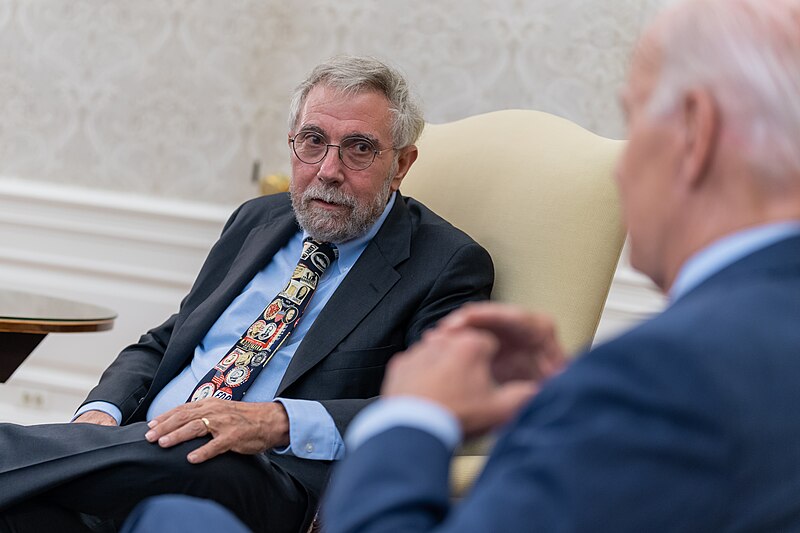
President Joe Biden meets with Paul Krugman, economist and OpEd columnist for The New York Times, Monday, August 14, 2023, in the Oval Office of the White House. (Official White House Photo by Adam Schultz)
The White House
New trade theory
Prior to Krugman's work, trade theory (see David Ricardo and Heckscher–Ohlin model) emphasized trade based on the comparative advantage of countries with very different characteristics, such as a country with a high agricultural productivity trading agricultural products for industrial products from a country with a high industrial productivity. However, in the 20th century, an ever-larger share of trade occurred between countries with similar characteristics, which is difficult to explain by comparative advantage. Krugman's explanation of trade between similar countries was proposed in a 1979 paper in the Journal of International Economics, and involves two key assumptions: that consumers prefer a diverse choice of brands, and that production favors economies of scale. Consumers' preference for diversity explains the survival of different versions of cars like Volvo and BMW. However, because of economies of scale, it is not profitable to spread the production of Volvos all over the world; instead, it is concentrated in a few factories and therefore in a few countries (or maybe just one). Krugman modeled a 'preference for diversity' by assuming a CES utility function like that in a 1977 paper by Avinash Dixit and Joseph Stiglitz. Many models of international trade now follow Krugman's lead, incorporating economies of scale in production and a preference for diversity in consumption. This way of modeling trade has come to be called New Trade Theory. Krugman's theory also took into account transportation costs, a key feature in producing the "home market effect", which would later feature in his work on the new economic geography. The home market effect "states that, ceteris paribus, the country with the larger demand for a good shall, at equilibrium, produce a more than proportionate share of that good and be a net exporter of it". The home market effect was an unexpected result, and Krugman initially questioned it, but ultimately concluded that the mathematics of the model were correct. When there are economies of scale in production, it is possible that countries may become 'locked into' disadvantageous patterns of trade. Krugman points out that although globalization has been positive on a whole, since the 1980s the process known as hyper-globalization has at least played a part in rising inequality. Nonetheless, trade remains beneficial in general, even between similar countries, because it permits firms to save on costs by producing at a larger, more efficient scale, and because it increases the range of brands available and sharpens the competition between firms. Krugman has usually been supportive of free trade and globalization. He has also been critical of industrial policy, which New Trade Theory suggests might offer nations rent-seeking advantages if "strategic industries" can be identified, saying it's not clear that such identification can be done accurately enough to matter.
Academic books (authored or coauthored)
Academic books (edited or coedited)
Academic books (edited or coedited)
Currency Crises (National Bureau of Economic Research Conference Report) (September 2000), ISBN 0-226-45462-2 Trade with Japan: Has the Door Opened Wider? (National Bureau of Economic Research Project Report) (March 1995), ISBN 0-226-45459-2 Empirical Studies of Strategic Trade Policy (National Bureau of Economic Research Project Report) (April 1994), co-edited with Alasdair Smith. ISBN 0-226-45460-6 Exchange Rate Targets and Currency Bands (October 1991), co-edited with Marcus Miller. ISBN 0-521-41533-0 Strategic Trade Policy and the New International Economics (January 1986), ISBN 0-262-11112-8
Books for a general audience
Books for a general audience
Arguing with Zombies: Economics, Politics, and the Fight for a Better Future (January 2020) ISBN 978-1324005018 End This Depression Now! (April 2012) ISBN 0-393-08877-4 A call for stimulative expansionary policy and an end to austerity The Conscience of a Liberal (October 2007) ISBN 0-393-06069-1 The Great Unraveling: Losing Our Way in the New Century (September 2003) ISBN 0-393-05850-6 A book of his The New York Times columns, many deal with the economic policies of the Bush administration or the economy in general. Fuzzy Math: The Essential Guide to the Bush Tax Plan (May 4, 2001) ISBN 0-393-05062-9 The Return of Depression Economics and the Crisis of 2008 (December 2008) ISBN 0-393-07101-4 An updated version of his previous work. The Return of Depression Economics (May 1999) ISBN 0-393-04839-X Considers the long economic stagnation of Japan through the 1990s, the Asian financial crisis, and problems in Latin America. The Return of Depression Economics and the Crisis of 2008 (December 2008) ISBN 0-393-07101-4 The Accidental Theorist and Other Dispatches from the Dismal Science (May 1998) ISBN 0-393-04638-9 Essay collection, primarily from Krugman's writing for Slate. Pop Internationalism (March 1996) ISBN 0-262-11210-8 Essay collection, covering largely the same ground as Peddling Prosperity. Peddling Prosperity: Economic Sense and Nonsense in an Age of Diminished Expectations (April 1995) ISBN 0-393-31292-5 History of economic thought from the first rumblings of revolt against Keynesian economics to the present, for the layman. The Age of Diminished Expectations: U.S. Economic Policy in the 1990s (1990) ISBN 0-262-11156-X A "briefing book" on the major policy issues around the economy. Revised and Updated, January 1994, ISBN 0-262-61092-2 Third Edition, August 1997, ISBN 0-262-11224-8
Nobel Memorial Prize in Economic Sciences
Krugman was awarded the Nobel Memorial Prize in Economic Sciences (informally the Nobel Prize in Economics), the sole recipient for 2008. This prize includes an award of about $1.4 million and was given to Krugman for his work associated with New Trade Theory and the New Economic Geography. In the words of the prize committee, "By having integrated economies of scale into explicit general equilibrium models, Paul Krugman has deepened our understanding of the determinants of trade and the location of economic activity."
Awards
1991, American Economic Association, John Bates Clark Medal. Since it was awarded to only one person, once every two years (prior to 2009), The Economist has described the Clark Medal as 'slightly harder to get than a Nobel prize'. 1992, Fellow of the American Academy of Arts and Sciences (AAAS). 1995, Adam Smith Award of the National Association for Business Economics 1998, Doctor honoris causa in Economics awarded by Free University of Berlin Freie Universität Berlin in Germany 2000, H.C. Recktenwald Prize in Economics, awarded by University of Erlangen-Nuremberg in Germany. 2002, Editor and Publisher, Columnist of the Year. 2004, Fundación Príncipe de Asturias (Spain), Prince of Asturias Awards in Social Sciences. 2004, Doctor of Humane Letters honoris causa, Haverford College 2008, Nobel Memorial Prize in Economics for Krugman's contributions to New Trade Theory. He became the twelfth John Bates Clark Medal winner to be awarded the Nobel Memorial Prize. 2010, Howland Memorial Prize, awarded by Yale University 2011, EPI Distinguished Economist Award. 2011, Gerald Loeb Award for Commentary 2012, Doctor honoris causa from the Universidade de Lisboa, Universidade Técnica de Lisboa and Universidade Nova de Lisboa 2013, Doctor of Laws, honoris causa conferred by the University of Toronto, Toronto, Canada 2014, recipient of the Literary and Historical Society (University College Dublin)'s James Joyce Award in recognition of his outstanding contribution to the economic sciences. 2014, recipient of the Green Templeton College, Oxford's Sanjaya Lall Visiting Professorship of Business and Development, Trinity Term 2014, in recognition of his outstanding international reputation in scholarship and research in the field of Development Economics and Business. 2016, Doctor of Letters, honoris causa conferred by the University of Oxford, Oxford, UK A May 2011 Hamilton College analysis of 26 politicians, journalists, and media commentators who made predictions in major newspaper columns or television news shows from September 2007 to December 2008 found that Krugman was the most accurate. Only nine of the prognosticators predicted more accurately than chance, two were significantly less accurate, and the remaining 14 were no better or worse than a coin flip. Krugman was correct in 15 out of 17 predictions, compared to 9 out of 11 for the next most accurate media figure, Maureen Dowd. Krugman was elected to the American Philosophical Society in 2011. Foreign Policy named Krugman one of its 2012 FP Top 100 Global Thinkers "for wielding his acid pen against austerity".
Notes from the source article
Cited by Wikipedia
Notes from the source article
These works are cited by the source article, in its own numbering. They are recorded as its citations, not as sources VALÉORINE has verified.
- 1.Krugman, Paul. Your questions answered. August 2025.
- 2.Bloomberg. Paul Krugman on Arguing with Zombies (Podcast). 14 February 2020.
- 3.Bloomberg. Paul Krugman on Arguing With Zombies (Podcast). 14 February 2020.
- 4.Krugman, Paul. Head Still Talking. The Conscience of a Liberal. The New York Times. May 18, 2012.
- 5.Blodget, Henry. Ladies and Gentlemen, We Have Finally Learned the Right Way to Say 'Krugman'!. Business Insider. November 22, 2014.
- 6.Paul Krugman. Encyclopædia Britannica. June 8, 2017.
- 7.W. W. Norton & Company. About Paul Krugman. krugmanonline. 2012.
- 8.The Sveriges Riksbank Prize in Economic Sciences in Memory of Alfred Nobel 2008. nobelprize.org.
- 9.London School of Economics, Centre for Economic Performance. Lionel Robbins Memorial Lectures 2009: The Return of Depression Economics. June 8, 2009.
- 10.Eastern Economic Association. Home – Eastern Economic Association.
- 11.Research Papers in Economics. Economist Rankings at IDEAS – Top 10% Authors, as of May 2016. May 2016.
- 12.Note: Krugman modeled a 'preference for diversity' by assuming a CES utility function like that in A. Dixit and J. Stiglitz (1977), 'Monopolistic competition and optimal product diversity', American Economic Review 67.
- 13.Forbes, October 13, 2008, "Paul Krugman, Nobel"
- 14.Columnist Biography: Paul Krugman. The New York Times.
- 15.Economics Professors' Favorite Economic Thinkers, Journals, and Blogs (along with Party and Policy Views).
- 16.Open Syllabus Project. opensyllabus.org.
- 17.The New York Times, "The Conscience of a Liberal." Retrieved August 6, 2009
- 18.The one-handed economist. The Economist. November 13, 2003.
- 19.Kingsbury, Kathleen. Paul Krugman retires as Times columnist. The New York Times. December 6, 2024.
- 20.Krugman, Paul. My Last Column: Finding Hope in an Age of Resentment. The New York Times. December 9, 2024.
- 21.Kaiser, Charles. Paul Krugman on Leaving the New York Times. Columbia Journalism Review. January 24, 2025.
- 22.Krugman, Paul. Paul Krugman. Substack.
- 23.Krugman, Paul. Departing the New York Times. Substack. January 28, 2025.
- 24.Krugman, Paul. North of the Border. The New York Times. March 27, 2006.
- 25.Encyclopedia of American Jewish History, Volume 1 edited by Stephen Harlan Norwood, Eunice G. Pollack p. 721
- 26.Axelrod, David. Ep. 372 — Paul Krugman. March 2, 2020.
- 27.Dunham, Chris. In Search of a Man Selling Krug. Genealogywise.com. July 14, 2009.
- 28.Krugman, Paul. [L]ater waves of immigrants were mostly looking for opportunity; although my own family (coming from Belarus and Ukraine) was fleeing violence and war. The New York Times. April 19, 2022.
- 29.Krugman, Paul. Caught my eye because I lived in Utica from age 3-8. Twitter. May 16, 2015.
- 30.Krugman, Paul. Friday Night Music: Got To Admit It's Getting Better. The New York Times. June 26, 2015.
- 31.Kitchen, Patricia. Paul Krugman, LI [Long Island] native, wins Nobel in economics. Newsday. October 13, 2008.
- 32.Interview, U.S. Economist Krugman Wins Nobel Prize in Economics "PBS, Jim Lehrer News Hour" , October 13, 2008, transcript Retrieved October 14, 2008
- 33.The New York Times, August 6, 2009, "Up Front: Paul Krugman"
- 34.Paul Krugman Biography |.
- 35.Essays on flexible exchange rates.
- 36.Paul Krugman, 2002, Rudi Dornbusch
- 37.Paul Krugman, March 11, 2008, The New York Times blog, "Economics: the final frontier"
- 38.Krugman Curriculum Vitae.
- 39.Krugman, Paul. Changes (Personal/Professional). The New York Times. February 28, 2014.
- 40."Sources of international friction and cooperation in high-technology development and trade." National Academies Press, 1996, p. 190
- 41.Paul Krugman. Paul Samuelson, RIP. The New York Times. December 13, 2009.
- 42.LSE Staff. Paul Krugman. London School of Economics and Political Science. 2023.
- 43.Nobel Prize Committee, "The Prize in Economic Sciences 2008"
- 44.Arvind Panagariya. Paul Krugman, Nobel. Forbes. October 13, 2008.
- 45.Dixit, Avinash. Monopolistic Competition and Optimum Product Diversity. American Economic Review. 67. 3. 297–308. 1977. 1831401.
- 46.Kikuchi, Toru. The Dixit-Stiglitz-Krugman Trade Model: A Geometric Note. Discussion Papers from Graduate School of Economics, Kobe University. 1006. 2010.
- 47.Rosser, J. Barkley. Monopolistic Competition and Optimum Product Diversity. Springer. 24. 2011.
- 48.Krugman, P. Trade, accumulation, and uneven development. Journal of Development Economics. 8. 2. 149–61. 1981. 10.1016/0304-3878(81)90026-2.
- 49.Does globalization lead to inequality?. Nobel Perspectives.
- 50."Bold strokes: a strong economic stylist wins the Nobel" , The Economist, October 16, 2008.
- 51.(He writes on p. xxvi of his book The Great Unraveling that "I still have the angry letter Ralph Nader sent me when I criticized his attacks on globalization.")
- 52.Strategic trade policy and the new international economics, Paul R. Krugman (ed), The MIT Press, p. 18,
- 53."Honoring Paul Krugman" Economix blog of The New York Times, Edward Glaeser, October 13, 2008.
- 54.Krugman (1999) "Was it all in Ohlin?"
- 55.Behrens, Kristian. Krugman's Papers in Regional Science: The 100 dollar bill on the sidewalk is gone and the 2008 Nobel Prize well-deserved. Papers in Regional Science. 88. 2. 467–89. 2009. 10.1111/j.1435-5957.2009.00241.x.
- 56.Krugman PR (2008), "Interview with the 2008 laureate in economics Paul Krugman" , December 6, 2008. Stockholm, Sweden.
- 57.Increasing Returns and Economic Geography - Archived copy.
- 58.Web.mit.edu. Currency Crises.
- 59.Sarno, Lucio. The Economics of Exchange Rates. Cambridge University Press. 245–64. 2002. 978-0-521-48584-5.
- 60.Craig Burnside, Martin Eichenbaum, and Sergio Rebelo (2008), "Currency crisis models" , New Palgrave Dictionary of Economics, 2nd ed.
- 61."The International Finance Multiplier", P. Krugman, October 2008
- 62."Global Economic Integration and Decoupling" , Donald L. Kohn, speech at the International Research Forum on Monetary policy, Frankfurt, Germany, 06-26-2008; from website for the Board of Governors for the Federal Reserve System. Retrieved 08-20-2009, June 26, 2008
- 63.Nayan Chanda, YaleGlobal Online, orig. from Businessworld February 8, 2008 "Decoupling Demystified"
- 64."The myth of decoupling," Sebastien Walti, February 2009
- 65."The International Finance Multiplier" , The Conscience of a Liberal (blog), 10-05-2008. Retrieved 09-20-2009
- 66.Andrew Leonard, "Krugman: 'We are all Brazilians now'", "How the World Works" , 10-07-2008
- 67."Krugman: The International Finance Multiplier", Mark Thoma, Economist's View, 10-06-2008, http://economistsview.typepad.com/economistsview/2008/10/krugman-the-int.html
- 68.O'Brien, R. The geography of finance: after the storm. Cambridge Journal of Regions, Economy and Society. 2. 245–65. 2009. 10.1093/cjres/rsp015.
- 69.Japanese fixed income markets: money, bond and interest rate derivatives, Jonathan Batten, Thomas A. Fetherston, Peter G. Szilagyi (eds.) Elsevier Science, November 30, 2006, p. 137
- 70.Ben Bernanke, "Japanese Monetary Policy: a case of self-induced paralysis?", in Japan's financial crisis and its parallels to U.S. experience, Ryōichi Mikitani, Adam Posen (ed), Institute for International Economics, October 2000 p. 157
- 71.Sumner, Scott. Some Observations on the Return of the Liquidity Trap. 2002.
- 72.Reconstructing Macroeconomics: Structuralist Proposals and Critiques of the Mainstream, Lance Taylor, Harvard University Press, p. 159: "Kregel (2000) points out that there are at least three theories of the liquidity trap in the literature – Keynes own analyses ... Hicks' [in] 1936 and 1937 ... and a view that can be attributed to Fisher in the 1930s and Paul Krugman in latter days"
- 73.Paul Krugman. Paul Krugman's Japan page. Web.mit.edu.
- 74.Krugman, Paul R. It's Baaack: Japan's Slump and the Return of the Liquidity Trap. Brookings Papers on Economic Activity. 1998. 2. 137–205. 10.2307/2534694.
- 75.Krugman, Paul (2000), "Thinking About the Liquidity Trap" , Journal of the Japanese and International Economies, v.14, no.4, Dec 2000, pp. 221–37.
- 76.Krugman, Paul. Response to Nelson and Schwartz. Journal of Monetary Economics. 55. 4. 857–860. 2008. 10.1016/j.jmoneco.2008.05.011.
- 77.Krugman, Paul (1999). "The Return of Depression Economics", pp. 70–77. W. W. Norton, New York
- 78."Japan's Trap", May 2008. http://web.mit.edu/krugman/www/japtrap.html Retrieved 08-22-2009
- 79."Further Notes on Japan's Liquidity Trap" , Paul Krugman
- 80.Restoring Japan's economic growth, Adam Posen, Petersen Institute, September 1, 1998, , p. 123 ,
- 81."What is wrong with Japan?", Nihon Keizai Shinbun, 1997 http://web.mit.edu/krugman/www/nikkei.html
- 82.Krugman, Paul. Stay the Course. The New York Times. June 15, 2009.
- 83."Some Reasons Why a New Crisis Needs a New Paradigm of Economic Thought" , Keiichiro Kobayashi, RIETI Report No.108, Research Institute of Economy, Trade & Industry (Japan), 07-31-2009
- 84.Robert Skidelsky. Keynes: The Return of the Master. Allen Lane. 47–50, 58. 2009. 978-1-84614-258-1.
- 85.Noah Smith. Die the Krugman insurgency fail?. Brad DeLong. March 21, 2012.
- 86.Henry Farrell and John Quiggin. Consensus, Dissensus and Economic Ideas: The Rise and Fall of Keynesianism During the Economic Crisis. The Center for the Study of Development Strategies. March 2012.
- 87.Cochrane, John. "How Did Paul Krugman Get It So Wrong?" , Institute of Economic Affairs, 2011.
- 88.Paul Krugman and Richard Layard. A Manifesto for Economic Sense. June 27, 2012.
- 89.David Blanchflower. David Blanchflower: Yet more nails in Osborne's economic coffin. The Independent. July 2, 2012.
- 90.Katrina vanden Heuvel. Krugman's Manifesto for Economic Common Sense. The Nation. July 9, 2012.
- 91.Stephen King (chief economist HSBC). Krugman and Layard suffer from optimism bias. Financial Times. July 9, 2012.
- 92.Krugman, Paul (2009). The Return of Depression Economics and the Crisis of 2008. New York: W.W. Norton. ISBN 0-393-07101-4.
- 93.Krugman (2009).
- 94.Krugman (2009).
- 95.Krugman (2009).
- 96.Krugman (2009).
- 97.Bernanke, Ben (2005). "The Global Saving Glut and the U.S. Current Account Deficit". Sandridge Lecture, Virginia Association of Economists.
- 98.Catherine Rampell. Paul Krugman Wins Economics Nobel. Economix.blogs.nytimes.com. October 13, 2008.
- 99.Prize Committee of the Royal Swedish Academy of Sciences, October 13, 2008, Scientific background on the Sveriges Riksbank Prize in Economic Sciences in Memory of Alfred Nobel 2008, "Trade and Geography – Economies of Scale, Differentiated Products and Transport Costs"
- 100.Avinash Dixit, The Journal of Economic Perspectives, Vol. 7, No. 2 (Spring, 1993), pp. 173–88, In Honor of Paul Krugman: Winner of the John Bates Clark Medal , Retrieved March 28, 2007.
- 101.Nabe.com. Adam Smith Award.
- 102.Mother Jones: Paul Krugman ., August 7, 2005. Retrieved March 28, 2007.
- 103.Paul Krugman , 2004. Retrieved March 28, 2007.
- 104.Haverford.edu. Citation presented by Linda Bell, Associate Professor of Economics. May 28, 2004.
- 105.Swedish Academy. Nobel Prize in Economics.
- 106.Nobel Laureate and NY Times Columnist Paul Krugman to Receive Yale Award. news.yale.edu. November 8, 2010.
- 107.EPI at 25: Honoring Paul Krugman. Economic Policy Institute. 2011-11-01.
- 108.Loeb Award Winners. UCLA Anderson School of Management. June 28, 2011.
- 109.Universidade Nova de Lisboa. Honoris Causa a Paul Krugman.
- 110.Portuguese American Journal. Paul Krugman: Doctor honoris causa by three Portuguese universities. February 28, 2012.
- 111.University of Toronto. Honorary graduate Paul Krugman. June 14, 2013.
- 112.University College Dublin. Economist Professor Paul Krugman receives James Joyce Award from UCD Literary & Historical Society. January 14, 2014.
- 113.Green Templeton College, Oxford. Welcome Professor Krugman as the Sanjaya Lall Visiting Professor of Business and Development. May 7, 2014.
- 114.College, Green Templeton. Home. Green Templeton College.
- 115.Oxford announces honorary degrees for 2016 | University of Oxford. February 25, 2016.
- 116.Hamilton College. Are Talking Heads Blowing Hot Air?. May 12, 2011.
- 117.APS Member History. search.amphilsoc.org.
- 118.The FP Top 100 Global Thinkers. Foreign Policy. November 26, 2012.
- 119.The Economist, November 13, 2003, "Paul Krugman, one-handed economist"
- 120.Powell's Books. The Great Unraveling: Losing Our Way in the New Century.
- 121.Krugman, Paul, Rolling Stone. December 14, 2006, "The Great Wealth Transfer"
- 122."Nobelpristagaren i ekonomi 2008: Paul Krugman" , speech by Paul Krugman (Retrieved December 26, 2008) 00:43 "The title of The Conscience of a Liberal ... is a reference to a book published almost 50 years ago in the United States called The Conscience of a Conservative by Barry Goldwater. That book is often taken to be the origin, the start, of a movement that ended up dominating U.S. politics that reached its first pinnacle under Ronald Reagan and then reached its full control of the U.S. government for most of the last eight years."
- 123.Michael Tomasky, The New York Review of Books, November 22, 2007, "The Partisan"
- 124.Krugman, Paul. The Conscience of a Liberal, 2007, W.W. Norton & Co. p. 182
- 125.Conscience of a Liberal, p. 102
- 126.Conscience of a Liberal, p. 108
- 127.October 17, 2007 – Krugman "On Healthcare, Tax Cuts, Social Security, the Mortgage Crisis and Alan Greenspan" , in response to Alan Greenspan's September 24 appearance with Naomi Klein on Democracy Now!
- 128."Malefactors of Megawealth" David M. Kennedy
- 129.National Public Radio. Paul Krugman's Prescription For A 'Depression'. NPR Books.
- 130.Martin Wolf. Lunch with the FT: Paul Krugman. Financial Times. May 24, 2012.
- 131.Neary, J. Peter. Putting the 'New' into New Trade Theory: Paul Krugman's Nobel Memorial Prize in Economics. Scandinavian Journal of Economics. 111. 2. 217–50. 2009. 10.1111/j.1467-9442.2009.01562.x.
- 132.Channel4.com. "China the financial nexus" – Krugman.
- 133.Princeton Weekly Bulletin, October 20, 2008, "Biography of Paul Krugman" , 98(7)
- 134.Hirsh, Michael. A Nobel-Bound Economist Punctures the CW – and Not a Few Big-Name Washington Egos. Newsweek. March 4, 1996.
- 135.New Statesman, February 16, 2004, "NS Profile – Paul Krugman"
- 136.Freshdialogues.com. Fresh Dialogues interview with Alison van Diggelen, November 2009. December 9, 2009.
- 137.Confessore, Nicholas. Comparative Advantage. The Washington Monthly. December 2002.
- 138.Freshdialogues.com. Fresh Dialogues interview with Alison van Diggelen. December 9, 2009.
- 139.(unattributed). The one-handed economist. The Economist. November 2003.
- 140.Okrent, Daniel. 13 Things I Meant to Write About but Never Did. The New York Times. May 22, 2005.
- 141.Larissa MacFarquhar. The Deflationist: How Paul Krugman found politics. The New Yorker. March 1, 2010.
- 142.Paul Krugman. Reckonings; Paying the Price. The Conscience of a Liberal. September 16, 2001.
- 143.Paul Krugman. The Years of Shame. The Conscience of a Liberal. September 11, 2011.
- 144.Tim Mak. Paul Krugman defenders attacked by conservative bloggers. Politico. September 13, 2011.
- 145.Paul Krugman. Weakened at Bernie's. The Conscience of a Liberal. January 19, 2016.
- 146.Paul Krugman. Sanders Over the Edge. The New York Times. April 8, 2016.
- 147.Leprechaun Economics and Neo-Lafferism. The New York Times. 8 November 2017.
- 148.Leprechauns of Eastern Europe. The New York Times. 4 December 2017.
- 149.Bloomberg L.P. The U.S. Has a 'Leprechaun Economy' Effect, Too. Bloomberg.com. 19 July 2017.
- 150.Housing data reveals return of 'leprechaun economics'. The Irish Times. 21 April 2017.
- 151.Paul Krugman. Yellen's New Alliance Against Leprechauns. The New York Times. June 7, 2021.
- 152.Brian O'Donovan. NYT columnist's 'leprechaun' reference criticised. RTÉ News. Raidió Teilifís Éireann. June 12, 2021.
- 153.Paul Krugman. When the Fire Comes. The New York Times. February 10, 2017.
- 154.Krugman, Paul. The Myth of Asia's Miracle. Foreign Affairs. 73. 6. 62–78. December 1994. 10.2307/20046929.
- 155.Van Den Berg, Hendrik. International Trade and Economic Growth. M.E. Sharpe. 98–105. 2006. 978-0-7656-1803-0.
- 156.Krugman, Paul. Saving Asia: It's Time To Get Radical The IMF plan not only has failed to revive Asia's troubled economies but has worsened the situation. It's now time for some painful medicine. Fortune. September 7, 1998.
- 157.Landler, Mark. Malaysia Wins Its Economic Gamble. The New York Times. September 4, 1999.
- 158.Kaplan, Ethan. Did the Malaysian Capital Controls Work?. SSRN Electronic Journal. February 2001. 1556-5068.
- 159."Capital Control Freaks: How Malaysia got away with economic heresy" , Slate, September 27, 1999. Retrieved 08-25-2009
- 160.Krugman, Paul. Malaysian Memories. The New York Times. March 4, 2010.
- 161.Krugman, Paul. The IMF and Capital Controls. The New York Times. December 4, 2012.
- 162."The Liberalization And Management Of Capital Flows: An Institutional View" November 14, 2012.
- 163.Krugman, Paul. Who Lost the U.S. Budget?. The New York Times. March 21, 2003.
- 164.Dana, Will. Voodoo Economics. Rolling Stone. March 23, 2003.
- 165.Lehrke, Dylan Lee. Krugman blasts Bush. The Daily of the University of Washington. October 9, 2003.
- 166.Krugman, Paul. Fuzzy Math Returns. The New York Times. October 7, 2001.
- 167.Krugman, Paul. Dubya's Double Dip?. The New York Times. Aug 2, 2002.
- 168.Krugman, Paul. Paul Krugman Commencement Speech?. May 21, 2016.
- 169.Krugman, Paul. Greenspan and the Bubble. The New York Times. August 29, 2005.
- 170.Krugman, Paul. Financial Crisis Should Be at Center of Election Debate. Spiegel Online. March 24, 2008.
- 171.Krugman, Paul. Taming the Beast. The New York Times. March 24, 2008.
- 172.Krugman, Paul. The Gramm connection. The New York Times. March 29, 2008.
- 173.Lerer, Lisa. McCain guru linked to subprime crisis. Politico. March 28, 2008.
- 174.Paul Krugman. "Behind the Curve" . The New York Times. March 9, 2009.
- 175.Evan Thomas, Newsweek, April 6, 2009, "Obama's Nobel Headache"
- 176.Freshdialogues.com. Fresh Dialogues interview with Alison van Diggelen, November 2009. November 13, 2009.
- 177.Paul Krugman. Taking on China. The New York Times. March 15, 2010.
- 178.Jeremy Warner. Paul Krugman, the Nobel prize winner who threatens the world. The Telegraph. March 19, 2010.
- 179.Krugman, Paul. Don't cry for Wall Street. The New York Times. April 23, 2010.
- 180.Gennaioli, Nicola. Neglected risks, financial innovation, and financial fragility. Journal of Financial Economics. 104. 3. 452–468. 2012. 10.1016/j.jfineco.2011.05.005.
- 181.Krugman, Paul. The Third Depression. The New York Times. June 28, 2010.
- 182.Why We're in a New Gilded Age by Paul Krugman. nybooks.com. 2014-05-08.
- 183.Krugman, Paul. Samuel Brittan's recipe for recovery. The New York Times. October 16, 2009.
- 184.Krugman, Paul. Why am I a Keynesian?. The New York Times Dead link. August 2018.
- 185.Krugman, Paul. The lessons of 1979–82. The New York Times. July 29, 2009.
- 186.Krugman, Paul. The freshwater backlash (boring). The New York Times. September 23, 2009.
- 187.Krugman, Paul. (2009-9-2). "How Did Economists Get It So Wrong?" . The New York Times. Retrieved October 9, 2009.
- 188.Krugman, Paul. Who You Gonna Bet On, Yet Again (Somewhat Wonkish). Conscience of a Liberal (blog). The New York Times. August 30, 2011.
- 189.Krugman, Paul. There's something about macro. MIT.
- 190.Krugman, Paul. Mr. Keynes and the Moderns. VOX (originally for Cambridge conference commemorating the 75th anniversary of the publication of The General Theory of Employment, Interest, and Money). June 21, 2011.
- 191.Krugman, Paul. Actually existing Minsky. The New York Times. May 19, 2009.
- 192.Rezende, Felipe C. Keynes's Relevance and Krugman's Economics. August 18, 2009.
- 193.Conceicao, Daniel Negreiros. Krugman's New Cross Confirms It: Job Guarantee Policies Are Needed as Macroeconomic Stabilizers. July 19, 2009.
- 194.Mitchell, Bill. Nobel prize winner sounding a trifle modern moneyish. July 18, 2009.
- 195.Krugman, Paul. Peddling Prosperity: Economic Sense and Nonsense in an Age of Diminished Expectations. W. W. Norton & Company. 10–15. 1994. 978-0393312928.
- 196.Eggertsson, Gauti B. Debt, Deleveraging, and the Liquidity Trap: A Fisher-Minsky-Koo Approach. Quarterly Journal of Economics. 127. 3. 1469–513. June 14, 2012. 10.1093/qje/qjs023.
- 197.Dale, Leigh. Economies of representation, 1790–2000: colonialism and commerce. Ashgate Publishing, Ltd. 200–01. 2007. 978-0-7546-6257-0.
- 198.Glasbeek, H. J. Wealth by stealth: corporate crime, corporate law, and the perversion of democracy. Between The Lines. 258. 2002. 978-1-896357-41-6.
- 199.Dev Gupta, Satya. The political economy of globalization. Springer. 61. 1997. 978-0-7923-9903-2.
- 200.Krugman, Paul R. Is Free Trade Passe?. The Journal of Economic Perspectives. 1. 2. 131–44. 1987. 10.1257/jep.1.2.131.
- 201.Krugman, Paul. Competitiveness: A Dangerous Obsession. March 1994.
- 202.Krugman, Paul. Opinion | Taking on China and Its Currency. The New York Times. March 14, 2010.
- 203.Paul Krugman. Trade and Trust. The New York Times. May 22, 2015.
- 204.Krugman, Paul. Opinion | when Fallacies Collide. The New York Times. March 7, 2016.
- 205.Krugman, Paul. Opinion | Making the Rust Belt Rustier. The New York Times. January 27, 2017.
- 206.Krugman, Paul. Opinion | and the Trade War Came. The New York Times. December 26, 2016.
- 207.Krugman, Paul. Opinion | Trump, Trade and Tantrums. The New York Times. October 19, 2017.
- 208.Economists on the Run. Foreign Policy. October 22, 2019.
- 209.Krugman, Paul. What Economists (Including Me) Got Wrong About Globalization. www.bloomberg.com. Bloomberg. October 10, 2019.
- 210.Krugman, Paul. Opinion | Oh! What a Lovely Trade War. The New York Times. July 3, 2017.
- 211.Krugman, Paul. Notes on Immigration. The New York Times. March 27, 2006.
- 212.Krugman, Paul. Immigration Is Great for Jobs, Actually. The New York Times. July 23, 2024.
- 213.Building a Green Economy. The New York Times. April 7, 2010.
- 214.The Bad Economics of Fossil Fuel Defenders. The New York Times. August 16, 2021.
- 215.Paul Krugman. Hope for a Green New Year. The New York Times. A18. January 1, 2019.
- 216.Krugman, Paul. Opinion Purity vs. Pragmatism, Environment vs. Health. The New York Times. 2019-04-11. 0362-4331.
- 217.Paul Krugman's 3-part test for deficit spending. Vox. December 13, 2019.
- 218.Getting real about coal and climate. Arkansas Democrat-Gazette. April 24, 2021.
- 219.Biden's plan may be our last chance to avoid climate catastrophe. The Irish Times. September 15, 2021.
- 220.Reckonings; A Rent Affair , by Paul Krugman, The New York Times, June 7, 2000
- 221.Inequality and the City , by Paul Krugman, The New York Times, November 30, 2015
- 222.Web.mit.edu. Ricardo's difficult idea. 1996.
- 223.True Blue Americans , by Paul Krugman, The New York Times, May 7, 2002
- 224.Krugman, Paul. In praise of cheap labor. Slate. March 20, 1997.
- 225.Cawthorne, Pamela. Moral Dilemmas and Factual Claims: Some Comments on Paul Krugman's Defense of Cheap Labor. Review of Social Economy. 59. 4. 455–466. 2001. 10.1080/00346760110081571.
- 226.Book review of Living Wage: What It Is and Why We Need It Paul Krugman, Washington Monthly, September 1, 1998
- 227.Driving Under the Influence , by Paul Krugman, The New York Times, June 25, 2000
- 228.A Failed Mission , by Paul Krugman, The New York Times, February 4, 2003
- 229.Paul Krugman. The Texas Unmiracle. The New York Times. Aug 14, 2011.
- 230.Reckonings; Pursuing Happiness , by Paul Krugman, The New York Times, March 29, 2000
- 231.Reckonings; Blessed Are the Weak , by Paul Krugman, The New York Times, May 3, 2000
- 232.Kaufman, S. Salon July 9, 2016.
- 233.Krugman, Paul. Republicans and Race. The New York Times. November 19, 2007.
- 234.Krugman, Paul. The Town Hall Mob. The New York Times. August 7, 2009.
- 235.Amponsah, William. The Conscience of a Liberal: Book Review. Savannah Daily News. December 3, 2007.
- 236.Parini, Jay. Review: The Conscience of a Liberal. The Guardian. March 22, 2008.
- 237.Incidents From My Career , by Paul Krugman, Princeton University Press, Retrieved December 10, 2008
- 238.Krugman, Paul. Gordon the Unlucky. The New York Times. June 7, 2009.
- 239.Sparrow, Andrew. Thirty new facts about Gordon Brown from Anthony Seldon's book. The Guardian. December 24, 2010.
- 240.Krugman, Paul. Gordon Does Good. The New York Times. October 12, 2008.
- 241.Krugman, Paul. Trump's Deadly Narcissism. The New York Times. 2017-09-29.
- 242.Krugman, Paul. Making America Backward Again. Rolling Stone. 2025-06-08.
- 243.Krugman, Paul. Opinion Here Comes the Trump Slump. The New York Times. 2019-10-03. 0362-4331.
- 244.Paul Krugman: The Economic Fallout. The New York Times. November 9, 2016.
- 245.Forbes. Paul Krugman Is Overly Gloomy - Trump's Election Is Not Going To Cause A Permanent Global Recession. Tim Worstall. 10 November 2016.
- 246.Krugman, Paul. The Long Haul. The New York Times. 2016-11-11.
- 247.The Independent. Donald Trump has given Paul Krugman a 'Fake News Award' – but did the economist really get it so wrong?. Sean O'Grady. 18 January 2018.
- 248.Krugman, Paul. Russia Is a Potemkin Superpower. The New York Times. 28 February 2022.
- 249.Krugman, Paul. Things to Come. The New York Times. March 18, 2003.
- 250.Greider, William. Why Was Paul Krugman So Wrong?. The Nation. April 1, 2013.
- 251.Krugman, Paul. The Crisis of Zionism. The New York Times. April 20, 2012.
- 252.Krugman, Paul. What if This Is Our Last Real Election?. The New York Times. May 30, 2024.
- 253.Krugman, Paul. ECONOMICS Why most economists' predictions are wrong. Red Herring via Internet Archive. June 10, 1998.
- 254.Krugman, Paul. ECONOMICS Why most economists' predictions are wrong. Red Herring issue 55 via issuu eBook of print edition. June 1998.
- 255.McArdle, Megan. Predictions are Hard, Especially About the Future. The Atlantic. December 23, 2010.
- 256.Did Paul Krugman Say the Internet's Effect on the World Economy Would Be 'No Greater Than the Fax Machine's'?. Snopes.com. June 7, 2018.
- 257.Yarow, Jay. Paul Krugman Responds To All The People Throwing Around His Old Internet Quote. Business Insider. 2013-12-30.
- 258.Adam Smith Hates Bitcoin. April 12, 2013.
- 259.Krugman, Paul. Golden Cyberfetters. The New York Times. September 7, 2011.
- 260.Frank, Jacqui. PAUL KRUGMAN: Bitcoin is a more obvious bubble than housing was. Business Insider.
- 261.Krugman, Paul. Does ChatGPT Mean Robots Are Coming For the Skilled Jobs?. The New York Times. December 6, 2022.
- 262.Nasar, Sylvia. Three Whiz Kid Economists of the 90's, Pragmatists All. The New York Times. October 27, 1991.
- 263.Robin L. Bergman.
- 264.Macmillan Learning. Robin Wells.
- 265.Krugman, Paul. About my son (blog post). The New York Times. December 19, 2007.
- 266.MacFarquhar, Larissa. THE DEFLATIONIST: How Paul Krugman found politics. The New Yorker. March 1, 2010.
- 267.Krugman, Paul. Inequality and the City. The New York Times. November 30, 2015.
- 268.Krugman, Paul. Changes (Personal/Professional) (blog post). The New York Times. February 28, 2014.
- 269.The Graduate Center, CUNY. Noted Economist Paul Krugman to Join Graduate Center Faculty in 2015. February 28, 2014.
- 270.Krugman, Paul. David Frum, AEI, Heritage And Health Care (blog post). The New York Times. March 25, 2010.
- 271.Clark, Andrew. What's Left of the Left. New York (magazine). April 22, 2011.
Bibliography printed in the source article · 1
- Paul Krugman, "The American Way of Economic War: Is Washington Overusing Its Most Powerful Weapons?" (review of Henry Farrell and Abraham Newman, Underground Empire: How America Weaponized the World Economy, Henry Holt, 2023, 288 pp.), Foreign Affairs, vol. 103, no. 1 (January/February 2024), pp. 150–156. "The [U.S.] dollar is one of the few currencies that almost all major banks will accept, and... the most widely used... As a result, the dollar is the currency that many companies must use... to do international business." (p. 150.) "[L]ocal banks facilitating that trade... normally... buy U.S. dollars and then use dollars to buy [another local currency]. To do so, however, the banks must have access to the U.S. financial system and... follow rules laid out by Washington." (pp. 151–152.) "But there is another, lesser-known reason why the [U.S.] commands overwhelming economic power. Most of the world's fiber-optic cables, which carry data and messages around the planet, travel through the United States." (p. 152.) "[T]he U.S. government has installed 'splitters': prisms that divide the beams of light carrying information into two streams. One... goes on to the intended recipients, ... the other goes to the National Security Agency, which then uses high-powered computation to analyze the data. As a result, the [U.S.] can monitor almost all international communication." (p. 154) This has allowed the U.S. "to effectively cut Iran out of the world financial system... Iran's economy stagnated... Eventually, Tehran agreed to cut back its nuclear programs in exchange for relief." (pp. 153–154.) "[A] few years ago, American officials... were in a panic about [the Chinese company] Huawei... which... seemed poised to supply 5G equipment to much of the planet [thereby possibly] giv[ing] China the power to eavesdrop on the rest of the world – just as the [U.S.] has done.... The [U.S.] learned that Huawei had been dealing surreptitiously with Iran – and therefore violating U.S. sanctions. Then, it... used its special access to information on international bank data to [show] that [Huawei]'s chief financial officer, Meng Wanzhou (... the founder's daughter), had committed bank fraud by falsely telling the British financial services company HSBC that her company was not doing business with Iran. Canadian authorities, acting on a U.S. request, arrested her... in December 2018. After... almost three years under house arrest... Meng... was allowed to return to China... But by [then] the prospects for Chinese dominance of 5G had vanished..." (pp. 154–155.) Farrell and Newman, writes Krugman, "are worried about the possibility of [U.S. Underground Empire] overreach. [I]f the [U.S.] weaponizes the dollar against too many countries, they might... band together and adopt alternative methods of international payment. If countries become deeply worried about U.S. spying, they could lay fiber-optic cables that bypass the [U.S.]. And if Washington puts too many restrictions on American exports, foreign firms might turn away from U.S. technology." (p. 155.)
References
Citations
References
Each reference names the institution holding it, so a reader may go to the document itself.
reference work
Secondary witnessreference work
Secondary witness
The Encyclopedia exists whether or not anything is for sale. Corrections are recorded rather than overwritten, and every version of this record is kept. Published 14 August 2026.
Elsewhere in Books
38,991 published records in this field, each with its sources named.
- Paul KenisAuthor
- Paul KingsnorthAuthor
- Paul KlebnikovAuthor
- Paul KrugerAuthor
- Paul KurtzAuthor
- Paul KuusbergAuthor
- Paul L. MaierAuthor
- Paul LacroixAuthor
Best supported in this field
For owners
Own a work by Paul Krugman?
A specialist will read what you send and tell you what the house can establish, what it cannot, and whether the object is suited to sale. There is no charge and no obligation. The object stays with you throughout; nothing is shipped to us unless it is arranged in writing beforehand.