
parallel rulers
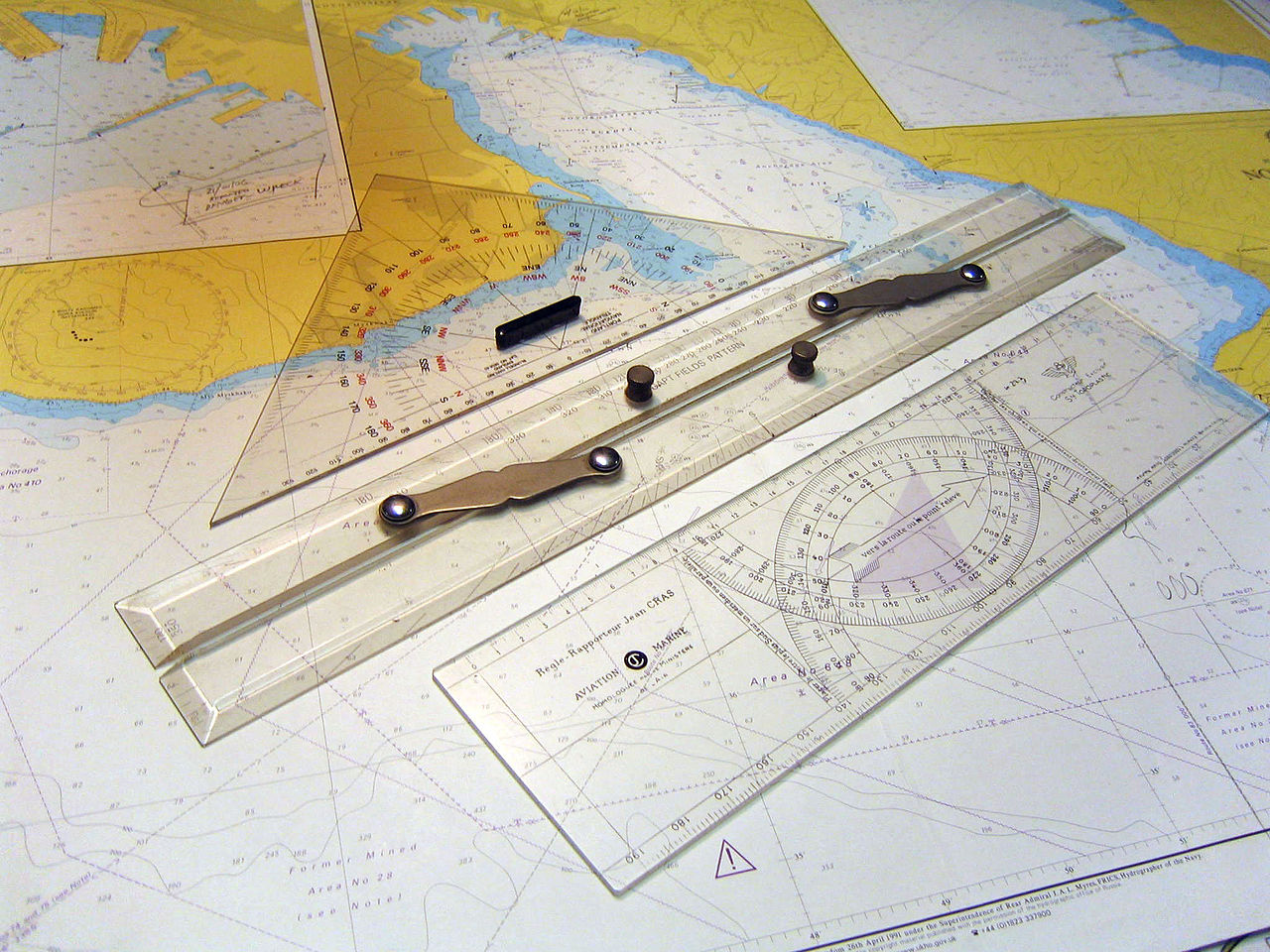
Illustration — Parallel rule in plastic with aluminum arms lying on a cutting mat Parallel rulers are a drafting instrument used by navigators to draw parallel lines on charts. The tool consists of two straightedges joined by two arms which allow them to move closer or further away while always remaining parallel to each other.
parallel rulers
Clipper · CC BY-SA 3.0
- Field
- navigational instrument · ruler
VALÉORINE Encyclopedia
VALÉORINE documentary reading
Documentary summary
Illustration — Parallel rule in plastic with aluminum arms lying on a cutting mat Parallel rulers are a drafting instrument used by navigators to draw parallel lines on charts. The tool consists of two straightedges joined by two arms which allow them to move closer or further away while always remaining parallel to each other.
Admitted source layer · organised and presented by VALÉORINE
Note VALÉORINE
No house-authored Note is published until its assertions and sources pass the VALÉORINE evidence contract. The documentary article remains available in full while that enrichment is being consolidated.
Documentary enrichment in progress · no unsupported statement published
Reference Check
Propose documentary evidence for parallel rulers. A contribution is never written directly as fact: identity, source, rights and evidence gates still decide.
Sign in to contribute
World of VALÉORINE
Documentary connections
Only confirmed graph relationships appear here. Images are shown only when their identity and reuse rights both pass the documentary gate.

Documentary evidence
Evidence Panel
not yet certified
- Identity
- resolved
- Independent source families
- 0
- Admitted assertions
- 0
- Open conflicts
- 0
Authority files
wikidata · Q2051620 · wikipedia · Parallel rulers
In this article
History
History
The parallel ruler was invented at about 1584 by Fabrizio Mordente, as well as by Taqi al-Din who died in 1585. However it was not in common use (at least in Europe) until the 18th century. • Illustration — Captain Field's Improved Parallel Rule In the 19th century a retired sea captain, Captain William Andrew Field improved the design by adding a protractor-style scale to the upper edge of one rule, and compass points to the opposing edge, which made reading bearings easier. Examples exist of boxwood, ivory or ebony, usually with brass hinges. The instrument usually had two links, but longer models sometimes had three, and sometimes the links were scissored. Another variation is the "roller" model which included a cylindrical roller for ease of use.

Captain Field's Improved Parallel Rule, design c. 1854. Date for this model probably late 19th/early 20th century.
Rodhullandemu

Chart BA 4022 with parallel ruler and divider
BoH
Chronology
Dated record
Chronology
The full dated record · 2 entries
1584
parallel rulers first recorded.
1584
parallel rulers began in 1584.
Primary material
Documents and archives
reference work
- “Parallel rulers”, English Wikipedia, consulted as further reading
Reputable secondary · Wikipedia
authority record
- Wikidata, structured authority record Q2051620: parallel rulers
Unverified · Wikidata
Citations
References
Each reference names the institution holding it, so a reader may go to the document itself.
reference work
Partially resolvedauthority record
Unverified
The Encyclopedia exists whether or not anything is for sale. Corrections are recorded rather than overwritten, and every version of this record is kept. Published 14 August 2026.
Elsewhere in Scientific instruments
736 published records in this field, each with its sources named.
- Palomar Testbed InterferometerTerminology
- Pan-STARRS1Terminology
- Pan-STARRS2Terminology
- PancamTerminology
- Particle counterTerminology
- Pascal's calculatorTerminology
- perfect rulerTerminology
- Phall-O-MeterTerminology
Best supported in this field
For owners
Own an object connected with parallel rulers?
A specialist will read what you send and tell you what the house can establish, what it cannot, and whether the object is suited to sale. There is no charge and no obligation. The object stays with you throughout; nothing is shipped to us unless it is arranged in writing beforehand.