
Owen Bradley
William Owen Bradley (October 21, 1915 – January 7, 1998) was an American musician, bandleader and record producer who, along with Chet Atkins, Bob Ferguson, Bill Porter, and Don Law, was a chief architect of the 1950s and 60s Nashville sound in country music and rockabilly. Bradley started with piano at a young age, and began performing professionally as a teenager. At age 20, he joined WSM (AM) as an arranger and musician, and by 1942 had become the station's musical director.
Also recorded as William Owen Bradley
Owen Bradley

Ellen · originally posted to Flickr as Owen Bradley's studio · CC BY 2.0
- Name
- Owen Bradley
- Birth Name
- William Owen Bradley
- Born
- 21 October 1915
- Birthplace
- Westmoreland, Tennessee, U.S.
- Died
- 7 January 1998
- Place of death
- Nashville, Tennessee, U.S.
- Occupation
- * Musician
- Full name
- William Owen Bradley.
- Nationality
- United States.
- Fields
- country music.
- Honours
- Grammy Trustees Award.
VALÉORINE Encyclopedia
VALÉORINE documentary reading
Documentary summary
William Owen Bradley (October 21, 1915 – January 7, 1998) was an American musician, bandleader and record producer who, along with Chet Atkins, Bob Ferguson, Bill Porter, and Don Law, was a chief architect of the 1950s and 60s Nashville sound in country music and rockabilly. Bradley started with piano at a young age, and began performing professionally as a teenager. At age 20, he joined WSM (AM) as an arranger and musician, and by 1942 had become the station's musical director.
Admitted source layer · organised and presented by VALÉORINE
Note VALÉORINE
Owen Bradley (1915–1998) was an American bandleader, musician and record producer, among other activities. Born William Owen Bradley in Westmoreland, the bandleader died in Nashville.
Genres include country music. Owen Bradley received Grammy Trustees Award.
Composed from admitted, traceable facts · 27 September 2026
VALÉORINE
Reference Check
Propose documentary evidence for Owen Bradley. A contribution is never written directly as fact: identity, source, rights and evidence gates still decide.
Sign in to contribute
World of VALÉORINE
Documentary connections
Only confirmed graph relationships appear here. Images are shown only when their identity and reuse rights both pass the documentary gate.
Documentary evidence
Documentary basis
Authority files
wikidata · Q2042598 · wikipedia · Owen Bradley
In this article
Biography
Biography
At the same time, Bradley led a dance band that enjoyed popularity in local society circles. In 1947, Bradley was hired by the head of Decca Records' country music division, Paul Cohen, to assist with recording sessions and later establish the label's operations in Nashville. In 1954, Bradley established Bradley Studios, later commonly known as the Quonset Hut Studio, which was the first music industry-related business in what is now known as Music Row, and helping establish Nashville as a recording industry center. In 1958, Bradley became vice president of Decca's Nashville division. This period marked the beginning of the Nashville sound, a movement that aimed to broaden country music's appeal by incorporating pop elements. Bradley's work extended to producing records for artists like Patsy Cline and Loretta Lynn, playing a key role in their career successes. Bradley sold Bradley Studios to Columbia Records in 1962, and two years later established Bradley's Barn, a new recording studio that continued to attract a range of recording artists. He was inducted into the Country Music Hall of Fame in 1974, reflecting his impact on the industry. Bradley's later years saw him working on selected projects, including k.d. lang's Shadowland album. Bradley's contributions have been recognized with various honors, including the dedication of a public park and a bronze likeness in Nashville. His legacy in the music industry is marked by his role in shaping the Nashville sound and influence on several generations of musicians.

Owen Bradley's Quonset Hut Studio console
Cliff · Flickr: Country Music Hall of Fame
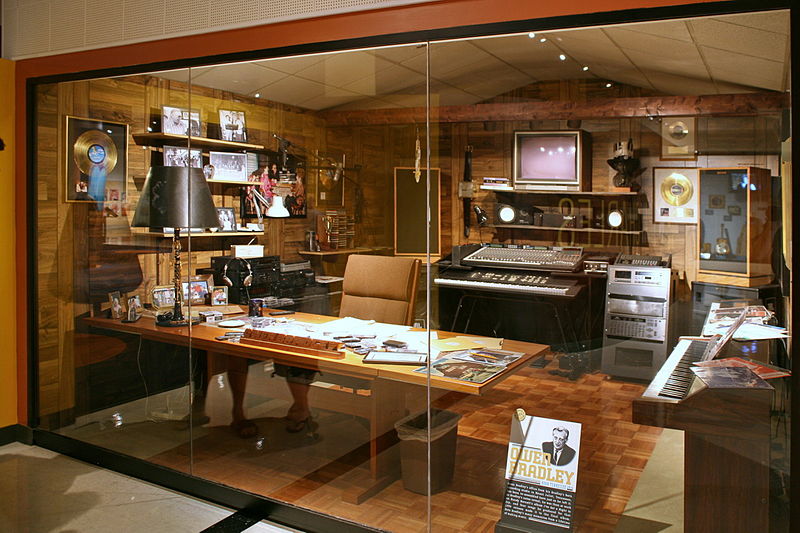
Owen Bradley's final studio
Cliff · Flickr: Country Music Hall of Fame
Key facts
Key facts
• Name — Owen Bradley • Birth Name — William Owen Bradley • Born — 21 October 1915 • Birthplace — Westmoreland, Tennessee, U.S. • Died — 7 January 1998 • Place of death — Nashville, Tennessee, U.S. • Instrument — Piano • Genre — Country • Occupation — * Musician • record producer • recording studio founder • songwriter • radio director • radio and TV producer • arranger • Years Active — 1935–1980 • Label — Decca Records • Past Member Of — * Ernest Tubb • Chet Atkins • Bob Ferguson • Burl Ives • Red Foley • Kitty Wells • Patsy Cline • Brenda Lee • Loretta Lynn • Conway Twitty • Moon Mullican • Paul Cohen
Early life
Early life
Bradley was born in Westmoreland, Tennessee on October 21, 1915, and grew up in Nashville, Tennessee. His father was Vernon Bradley, and his mother was Letha Maie Owen. By the time he was fifteen he had learned to play several instruments and was playing piano in local nightclubs and roadhouses.
Career
Career
In 1935 at the age of 20, Bradley got a job at radio station WSM, home of the Grand Ole Opry, where he worked as a musician and arranger. In 1942, he became WSM's musical director, and was also the leader of a sought-after dance band that played society parties all over Nashville. That same year Bradley co-wrote Roy Acuff's hit "Night Train to Memphis". His involvement with his dance band continued until 1964, though in the intervening decades, his work as a producer would far overshadow his career as a performer and band leader. In 1947, Bradley was hired by the head of Decca Records' country music division, Paul Cohen. Bradley worked as a music arranger and songwriter during the Castle Studio recording sessions of some of the biggest talents of the day, including Ernest Tubb, Burl Ives, Red Foley and Kitty Wells. He produced both Foley's 1950 hit "Chattanoogie Shoe Shine Boy" and Wells' 1952 hit "It Wasn't God Who Made Honky Tonk Angels", along with hits by Bill Monroe and Webb Pierce. Noting Bradley's studio skills, Cohen later utilized Bradley to open Decca's Nashville offices. In the early 1950s, Owen and his brother Harold, seeking to capitalize on the rising popularity of television, experimented with assembling a production studio, eventually establishing a studio near 21st Avenue South in the Hillsborough Village area, where they produced industrial films for Genesco and others. When Cohen told Bradley that he was considering moving Decca's country headquarters to Dallas, where Jim Beck had a recording studio, Bradley offered to build a new Nashville studio. • Illustration — Owen Bradley's Quonset Hut Studio console In 1954, Bradley and his brother purchased a house at 804 16th Avenue South in Nashville for $7500 and remodeled it to create Music City Recording, the first recording studio in what would become Music Row. They bought an Army surplus Quonset hut and attached it to the back of the house to use as a sound stage for filming musical performances, and changed the studios' name to Bradleys' Film & Recording Studios in 1957, though it was commonly referred to as the "Quonset hut studio." The Bradleys produced several Country Style, USA film programs in the Quonset hut studio, but the demand for recording music in the Quonset hut (which was much larger than the house's basement studio) eventually overtook the Bradley's film production business, Bradley's studio was an instant success, recording hits by several Decca artists as well as hits for Capitol, Columbia, MGM, and other record labels. The studios' success spurred RCA Victor to build its RCA Studio B, and a handful of other record labels and music publishers soon followed, setting up shop on what would eventually become known as Music Row. In 1958, Bradley succeeded Cohen as head of Decca's Nashville division, and began pioneering what would become the "Nashville Sound".
The Nashville sound
The Nashville sound
Country music had long been looked on as unsophisticated and folksy, and was largely confined to listeners in the less affluent small towns of the American South and Appalachia. In the late 1950s, Bradley's home base of Nashville was positioning itself to be a center of the recording industry, and not just the traditional home of the Grand Ole Opry. Developed with the contributions of Owen Bradley's crew of hand-picked musicians, including Harold Bradley, Grady Martin, Bob Moore, Hank Garland and Buddy Harman, known collectively as Nashville's "A-Team". The success of Bradley and his contemporaries infused hokey melodies with more refined lyrics, and blended them with a refined pop music sensibility to create the "Nashville Sound", known later as "countrypolitan". Light, easy listening piano (as popularized by Floyd Cramer) replaced the clinky honky-tonk piano (ironically, one of the artists Bradley would record in the 1950s was honky tonk blues singer pianist, Moon Mullican - the Mullican sessions produced by Bradley were experimental in that they merged Moon's original blues style with the emerging Nashville Sound stylings). Lush string sections took the place of the mountain fiddle sound; steel guitars and smooth backing vocals rounded out the mix. Regarding the Nashville sound, Bradley stated, "Now we've cut out the fiddle and steel guitar and added choruses to country music. But it can't stop there. It always has to keep developing to keep fresh."
Starmaker
Starmaker
The singers Bradley produced made unprecedented headway into radio, and artists such as Kitty Wells, Patsy Cline, Brenda Lee, Loretta Lynn, Lenny Dee, and Conway Twitty became household names. Rock and Roll singers such as Buddy Holly and Gene Vincent also recorded with Bradley in his Nashville studio. Bradley often tried to reinvent older country hitmakers; as previously mentioned, he tried to update Moon Mullican's sound and produced one of Moon's best performances "Early Morning Blues" where the blues and the Nashville sound complement each other surprisingly well. Also, he produced Bill Monroe in both bluegrass and decidedly non-bluegrass settings (Monroe's covers of Jimmie Rodgers' "Caroline Sunshine Girl" and Moon Mullican's "Mighty Pretty Waltz", for example, feature a standard country band rather than bluegrass). Many older artists recognized they needed to change as they saw former pure honky tonk singer, Jim Reeves, blend his own style with the newer styles with great success. However, not everyone was as successful as Reeves or Patsy Cline in these transformations. In addition to his production, Bradley released a handful of instrumentals under his own name, including the minor 1958 hit "Big Guitar".
Bradley's Barn studio
Bradley's Barn studio
• Illustration — Owen Bradley's final studio Bradley sold The Quonset Hut Studio to Columbia Records and bought a farm outside of Nashville in Mount Juliet, Tennessee in 1961, converting a barn into a demo studio which he named Bradley's Barn. Within a few years, Bradley's Barn became a popular recording venue in country music circles. The Beau Brummels paid tribute to the studio, through titling their 1968 album Bradley's Barn. The studio burned to the ground in 1980, but Bradley rebuilt it within a few years in the same location.
Identity
Identity
Owen Bradley is recorded as record producer, songwriter, musician and bandleader.
Life and career
Dated record
Life and career
The full dated record · 1 entries
1998
Owen Bradley died at Nashville.
Places
Named by the record
Places
Only places the record itself states, plotted where the house gazetteer settles their coordinates. Nothing is inferred from a name or a nationality.
Westmoreland.
Birth place
Nashville.
Death place
Legacy
Owen Bradley is part of what is known as "The First Family of Music Row." His younger brother and business partner Harold Bradley became one of the world's most recorded session guitarists, and served as longtime president of the Nashville chapter of the American Federation of Musicians. Owen's daughter Patsy worked over 40 years with BMI, eventually as assistant vice president of writer/publisher administration. His son Jerry worked for his Forest Hills Music music publishing company before becoming head of RCA Records' Nashville office in 1973, succeeding Chet Atkins. In his later career, he was head of the Opryland Music Group during its return to prominence following Gaylord Entertainment's acquisition of the Acuff-Rose Music catalog. Jerry's wife, Connie Bradley, worked with ASCAP's Nashville office for more than 30 years beginning in the mid-1970s, eventually as Senior Vice President. Jerry’s son, Clay Bradley, currently serves as the Vice President of Creative at BMI (Variety, 2020) (Source). His two grandchildren, John Owen Bradley and Lillian Grace Bradley, work in the music industry and have reopened Bradley’s Barn as of 2025. (MusicRow, 2024; MusicRow, 2025) (Source 1, Source 2).
Later years and honors
Owen Bradley was inducted in 1974 to the Country Music Hall of Fame. He also achieved the distinction of having produced records for more fellow Hall of Fame members (six) than anyone else except Paul Cohen who produced nine. He retired from production in the early 1980s, but continued to work on selected projects. Canadian artist k.d. lang chose Bradley to produce her acclaimed 1988 album, Shadowland. He died on January 7, 1998, in Nashville. At the time of his death, he and Harold were producing the album I've Got A Right To Cry for Mandy Barnett, who is best known for her portrayal of Patsy Cline in the original Nashville production of the stage play, Always... Patsy Cline. His production of Cline's hits such as "Crazy", "I Fall to Pieces" and "Walkin' After Midnight" remain standards of the country music genre. It is his work with Cline and Loretta Lynn for which he is best known, and when the biopics Coal Miner's Daughter and Sweet Dreams were filmed, Bradley was chosen to direct their soundtracks. In 1997, the Metro Parks Authority in Nashville dedicated a small public park between 16th Avenue South and Division Street to Owen Bradley, where his bronze likeness sits at a bronze piano. Owen Bradley Park is at the northern end of Music Row. Bradley also has a section of roadway named after him where Bradley's Barn once stood in Mt. Juliet, Tennessee, on Benders Ferry Road. Bradley was inducted into the Musicians Hall of Fame and Museum upon receiving the 2019 Producer Award.
Literature
Scholarly footprint
A count of publications is evidence of attention, not of standing, and is given here only as a measure.
Notes from the source article
Cited by Wikipedia
Notes from the source article
These works are cited by the source article, in its own numbering. They are recorded as its citations, not as sources VALÉORINE has verified.
- 1.https://www.brittanica.com/biography/Owen-Bradley
- 2.Stark, Phyllis. Q&A: Mike Curb. Billboard. 24. 19 November 2005.
- 3.Kosser, Michael. How Nashville Became Music City, U.S.A.: A History Of Music Row. Backbeat Books. 12. 2006. 978-1-49306-512-7.
- 4.Colin Larkin. The Guinness Who's Who of Country Music. Guinness Publishing. 46/7. 1993. 0-85112-726-6.
- 5.Oxford University Press. The Encyclopedia of Country Music. 50–51. 1998. 978-0-19-517608-7.
- 6.Coe, Tyler Mahan. The Nashville Sound. Cocaine & Rhinestones. May 4, 2021.
- 7.Owen Bradley. Country Music Hall of Fame. 1974.
- 8.Kosser, Michael. How Nashville Became Music City, U.S.A.: 50 Years of Music Row. Hal Leonard. 6–7. 2006. 9780634098062.
- 9.Hoobler, James A. A Guide to Historic Nashville, Tennessee. The History Press. 105. 2008. 9781596294042.
- 10.Kosser, Michael. How Nashville Became Music City, U.S.A.: 50 Years of Music Row. Hal Leonard. 11–12. 2006. 9780634098062.
- 11.Sanders, Daryl. That Thin, Wild Mercury Sound: Dylan, Nashville, and the Making of Blonde on Blonde. Chicago Review Press. 99–100. 2020. 978-1-61373-550-3.
- 12.Cooper, Peter. History Lesson: Nashville's Music Milestones from the Bradleys to the Outlaws and Beyond. Mix. 1 May 2008.
- 13.Owen Bradley Heads Decca C&W Division. Billboard. 21 April 1958.
- 14.Coe, Tyler Mahan. The Nashville A Team. Cocaine & Rhinestones. May 18, 2021.
- 15.Du Noyer, Paul. The Illustrated Encyclopedia of Music. Flame Tree Publishing. 14. 2003. 1-904041-96-5.
- 16.Oh boy: Why Buddy Holly still matters today. The Independent. January 23, 2009.
- 17.Carpenter, Cecil. Gene Vincent Biography. Rockabillyhall.com.
- 18.Obituary: Owen Bradley. The Independent. 22 October 2011.
- 19.Always.Patsy Cline.
- 20.Country Music Hall of Fame and Museum. Owen Bradley. Country Music Hall of Fame and Mu.
- 21.Cantrell, LB. Country Music Hall Of Famer Jerry Bradley Passes. Music Row. July 17, 2023.
- 22.The Bradley Family Honored with Applause Award. Belmont University. April 25, 2019.
Bibliography printed in the source article · 2
- Oermann, Robert K. (1998). "Owen Bradley" In The Encyclopedia of Country Music. Paul Kingsbury, Ed. New York: Oxford University Press. pp. 50–51.
- Richliano, James Adam (2002). "Angels We Have Heard: The Christmas Song Stories." Star Of Bethlehem Books, Chatham, New York. (Includes interviews with Bradley and chapters on Bradley's involvement in the making of "Jingle Bell Rock", "Rockin' Around the Christmas Tree", and "A Holly Jolly Christmas").
References
Citations
References
Each reference names the institution holding it, so a reader may go to the document itself.
reference work
Wikidata, structured authority record Q2042598: Owen BradleyWikimedia Foundation
Secondary witnessreference work
Secondary witness
The Encyclopedia exists whether or not anything is for sale. Corrections are recorded rather than overwritten, and every version of this record is kept. Published 16 August 2026.
Elsewhere in Music memorabilia
42,866 published records in this field, each with its sources named.
- Ovide MusinPerson
- Ovidiu LipanPerson
- OVO SoundOrganisation
- Ovum RecordingsOrganisation
- Owen HalePerson
- Owen MorrisPerson
- Owen PallettPerson
- Owen PaulPerson
Best supported in this field
For owners
Own a work by Owen Bradley?
A specialist will read what you send and tell you what the house can establish, what it cannot, and whether the object is suited to sale. There is no charge and no obligation. The object stays with you throughout; nothing is shipped to us unless it is arranged in writing beforehand.