
Đông Sơn drum
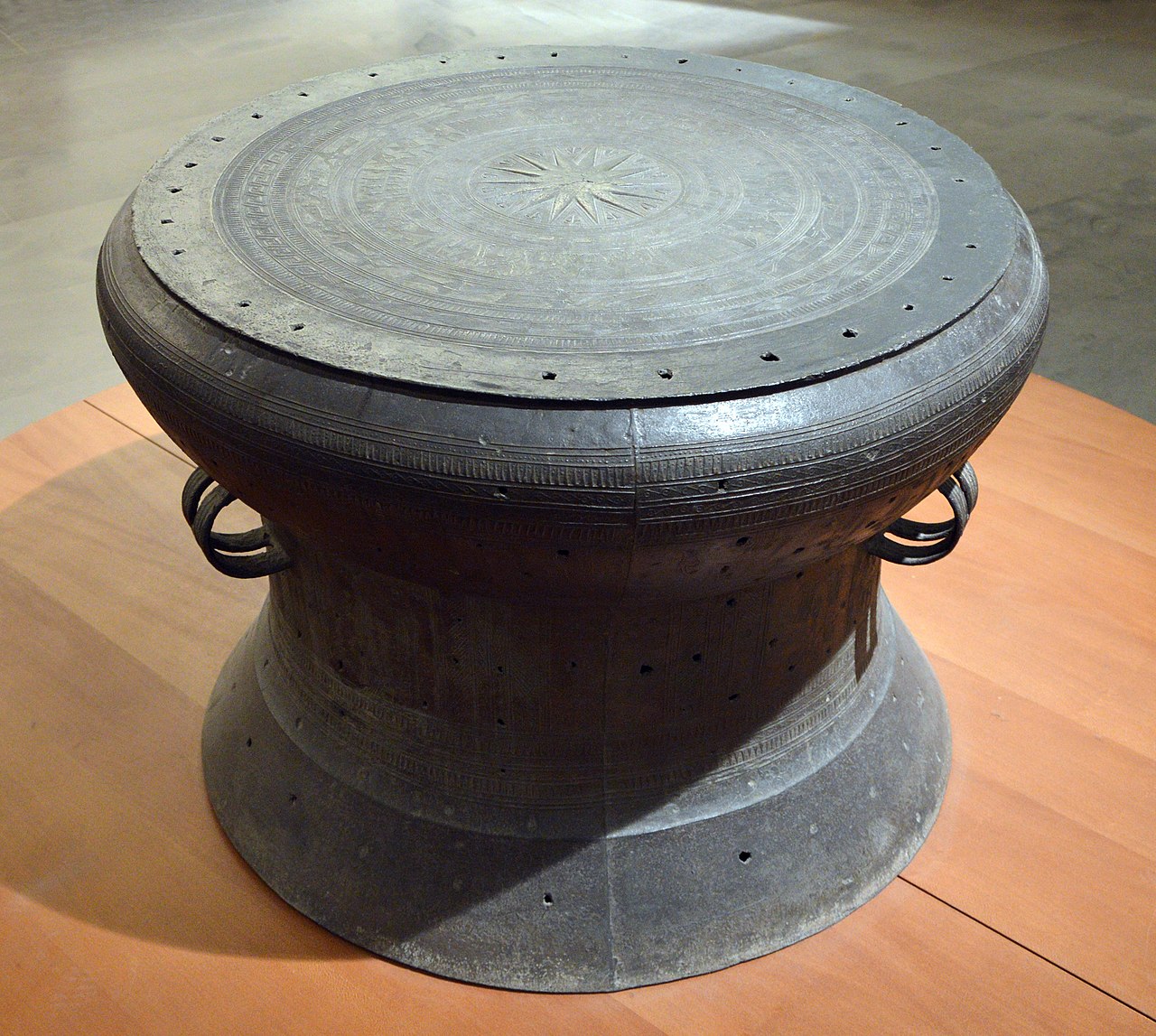
Illustration — Drum from Sông Đà, Vietnam. Đông Sơn II culture. Mid-1st millennium BCE. A Đông Sơn drum (also called Heger Type I drum) is a type of ancient bronze drum created by the Đông Sơn culture that existed in the Red River Delta. The drums were produced from about 600 BCE or earlier until the third century CE; they are one of the culture's most astounding examples of ancient metalworking.
Also recorded as Dong Son drum
Đông Sơn drum
Public domain
- Field
- bronze drum
- Region
- Đông Sơn drum is situated in Vietnam.
VALÉORINE Encyclopedia
VALÉORINE documentary reading
Documentary summary
Illustration — Drum from Sông Đà, Vietnam. Đông Sơn II culture. Mid-1st millennium BCE. A Đông Sơn drum (also called Heger Type I drum) is a type of ancient bronze drum created by the Đông Sơn culture that existed in the Red River Delta. The drums were produced from about 600 BCE or earlier until the third century CE; they are one of the culture's most astounding examples of ancient metalworking.
Admitted source layer · organised and presented by VALÉORINE
Note VALÉORINE
No house-authored Note is published until its assertions and sources pass the VALÉORINE evidence contract. The documentary article remains available in full while that enrichment is being consolidated.
Documentary enrichment in progress · no unsupported statement published
Reference Check
Propose documentary evidence for Đông Sơn drum. A contribution is never written directly as fact: identity, source, rights and evidence gates still decide.
Sign in to contribute
World of VALÉORINE
Documentary connections
Only confirmed graph relationships appear here. Images are shown only when their identity and reuse rights both pass the documentary gate.

Documentary evidence
Evidence Panel
original value insufficient · checked 25 September 2026
- Identity
- resolved
- Independent source families
- 0
- Admitted assertions
- 0
- Open conflicts
- 0
Authority files
wikidata · Q1078822 · wikipedia · Dong Son drum
In this article
History
History
The drums, cast in bronze using the lost-wax casting method are up to a meter in height and weigh up to 100 kg. Đông Sơn drums were apparently both musical instruments and objects of worship. They are decorated with geometric patterns, scenes of daily life, agriculture, war, animals and birds, and boats. The latter alludes to the importance of trade to the culture in which they were made, and the drums themselves became objects of trade and heirlooms. One of the recurring pattern is the Lạc bird found in the second outer ring and also in the symbolism of Mo (religion). More than 200 have been found, across an area from eastern Indonesia to Vietnam and parts of Southern China. The display on the surface of the Đông Sơn drums are often depicted across many cultural institutes of Vietnam, one being displayed in Vietnam parliamentary office during some of Vietnam's ASEAN summits.
• Illustration — Sites of Đông Sơn type drum findings According to ancient history, bronze drums were first mentioned in Shi Ben and Book of the Later Han which said Ma Yuan melted the bronze drums seized from the Lạc Việt in Jiaozhi to make bronze horses. Bronze drums were venerated as cult objects in ancient Vietnam. Excavated bronze drums were worshipped as Thần Đồng Cổ (bronze drum god) in several temples such as the Đông Cổ Temple and the Cao Sơn Temple. Ngoc Lu drum was found in 1893 in Hà Nam Province. Đông Sơn drums along with bronzewares were excavated in 1924 in Đông Sơn village, Thanh Hóa province, Vietnam. In 1902, a collection of 165 large bronze drums was published by F. Heger, who subdivided them into a classification of four types. Chinese archaeologist classified Heger I drums into bigger and heavier Yue drums including the Đông Sơn drums, and the Dian drums, into eight subtypes. The discovery of Đông Sơn drums in New Guinea, is seen as proof of trade connections – spanning at least the past thousand years – between this region and the societies of Java and China.
Appearances
Appearances
• Illustration — Image on the Ngọc Lũ bronze drum's surface, Vietnam The drums have a symmetrical appearance with three parts: • the barrel (upper body) • the head (top part) • the leg (bottom part) The patterns on drums bear a realistic style and show stilted houses, dancing people, people pounding rice, beating drums and sailing, together with animal and birds. The scenes depict daily life of ancient Việt and reflect the artistic talent and mind. The drums were used as musical instruments in festivals, such as prayers for rain, for good harvest and rituals, such as weddings and funerals, as well as command in army. They were also used as funerary objects and symbol of power of tribe leaders.
Classification
Classification
The Heger 1 drums of the Đông Sơn culture were classified and divided into five groups by the Vietnamese scholar Pham Huy Thong in 1990, a division that implied a chronological succession. The earliest, group A, comprises a set of large and intricated decorated drums. Group B consists of a smaller drums which almost universally have a group of waterbirds in flight as their key motif on the tympanum and the mantle designs. Group C has a central panel on the tympanum made up of a row of plumed warriors placed inside another panel of waterbirds in flight. Toads line the tympanum's edge while the mantle was decorated with either patterns involving boats or geometric patterns.
Ngọc Lũ
Ngọc Lũ
• Illustration — Ngọc Lũ bronze drum's surface, Vietnam The Ngọc Lũ drum is regarded as the most important of the Đông Sơn drums. The drum was accidentally discovered in 1893 in Hà Nam Province, southeast of Hanoi, rather than during a planned expedition. In contrast to most other drums of the Dong Son, the drumhead bears three concentric panels depicting animals or humans interleaved with bands of geometric or circular patterns. The innermost panel appears to be a self-referencing depiction, as it is decorated with pictures of humans who appear to be performing a ceremony involving the drums themselves. Other musical instruments and rice growing and harvesting activities are also shown. The two outer panels are decorated with scenes of deer, hornbills and crane egrets.
Hoàng Hạ
Hoàng Hạ
• Illustration — Hoàng Ha bronze drum's surface, Vietnam The Hoàng Hạ drum is a notable Đông Sơn drum. It was discovered in Hòa Bình Province in 1937 near the village of Hoàng Ha, with an outer panel of crane egrets and an inner panel which shows a procession similar to that described in the Ngọc Lũ drum, the most famous of the Đông Sơn drums. It depicts four feathered men are depicted walking in a line, brandishing spears, with two musicians in tow. A person is depicted standing under the eaves of a house, beating a drum while the rice fields are unattended, allowing a bird to eat the rice that was intended for threshing. The boats depicted on the mantle of the drum are very similar, with an analogous cleft prow, archer standing on raised platform and a drum. However, the drum is different from the Ngọc Lũ drum in that the animal is absent.
Cổ Loa
Cổ Loa
• Illustration — Cổ Loa drum's surface, Vietnam The Cổ Loa drum is a notable specimen showing a procession similar to that described in the Ngọc Lũ drum. The drum only has two warriors with spears, in contrast to that of the Ngọc Lũ drum. Another difference is that the ensemble of percussionists consists of three drummers, with one drum lying under the eaves of the house. Meanwhile, an extra person is depicted in the rice threshing process. The person has long hair and is winnowing grain into a bowl. The percussion ensemble is also depicted differently in that the drummers are not all drumming in synchronisation. Two of the drummers are depicted making contact with the drum, while the other two drummers have their batons in the raised position.
Sông Đà
Sông Đà
The Sông Đà drum is a notable specimen discovered in Ha Son Binh in the 19th century. The drum shows a procession similar to that described in the Ngọc Lũ drum. This drum varies in that it depicts four sets of men in procession with feathered headgear, rather than two. Also, each set comprises three or four people none of whom appear to be armed. The posture of the men was interpreted as that they were participating in a dance rather than a military ceremony. In this drum, only one pair of people are depicted as threshing rice, and there is no cymbal player. However, the general motifs, such as the boats on the mantle, remain in place.
Others
Others
The Quang Xuong drum from Thanh Hóa Province is another specimen, which is believed to be possibly later in origin. However, the drum is smaller and the images are harder to interpret. Large drums found in northern Vietnam were generally in the minority, as most drums have simple decorations with fewer representations of people. The Ban Thom drum has only an inner panel with four houses and plumed humans standing alone or in couples.
Places
Named by the record
Places
Only places the record itself states, plotted where the house gazetteer settles their coordinates. Nothing is inferred from a name or a nationality.
Đông Sơn drum is situated in Vietnam.
Country
Đông Sơn drum is associated with Vietnam.
Country
Primary material
Documents and archives
reference work
- “Dong Son drum”, English Wikipedia, consulted as further reading
Reputable secondary · Wikipedia
authority record
- Wikidata, structured authority record Q1078822: Đông Sơn drum
Unverified · Wikidata
Notes from the source article
Cited by Wikipedia
Notes from the source article
These works are cited by the source article, in its own numbering. They are recorded as its citations, not as sources VALÉORINE has verified.
- 1.Himanshu Prabha Ray. The Archaeology of Seafaring in Ancient South Asia. Cambridge University Press. 121. 14 Aug 2003. 9780521011099.
- 2.Heidhues, Mary Somers. Southeast Asia: A Concise History. Thames and Hudson. 19–20. 2000.
- 3.VietnamPlus. Thủ tướng dự Hội nghị cấp cao ASEAN-Australia thường niên lần thứ nhất Chính trị Vietnam+ (VietnamPlus). 2021-10-27.
- 4.Bảo tàng lịch sử Quốc gia.
- 5.Tạ Đức, Cao Sơn, Bronze Drums, Nationalism and History – le Minh Khai's SEAsian History Blog (And More!).
- 6.Diamond, Jared. Guns, Germs, and Steel – The Fate of Human Societies. W. W. Norton & Co. 307. 1997. 0-393-03891-2.
- 7.Higham, p. 124.
- 8.Higham, p. 126.
- 9.Higham, p. 127.
- 10.Higham, p. 128.
References
Citations
References
Each reference names the institution holding it, so a reader may go to the document itself.
reference work
Partially resolvedauthority record
Unverified
The Encyclopedia exists whether or not anything is for sale. Corrections are recorded rather than overwritten, and every version of this record is kept. Published 14 August 2026.
Elsewhere in Collectables
20,755 published records in this field, each with its sources named.
- Donald Healey Motor CompanyOrganisation
- Donald LandWork
- Donald Trump's Real Estate TycoonWork
- Donald's Alphabet ChaseWork
- Dongfeng Liuzhou Motor CompanyOrganisation
- Dongfeng Motor CorporationOrganisation
- Dongfeng StellantisOrganisation
- DoninvestOrganisation
Best supported in this field
For owners
Own an object connected with Đông Sơn drum?
A specialist will read what you send and tell you what the house can establish, what it cannot, and whether the object is suited to sale. There is no charge and no obligation. The object stays with you throughout; nothing is shipped to us unless it is arranged in writing beforehand.