
Olivuccio di Ciccarello
Illustration — Works of Mercy (To bury the dead), Vatican Museums. Little is known of his life. He was a native of Camerino and was active from 1388 until his death.
Also recorded as Olivuccio di Ciccarello da Camerino · Olivuccio di Ceccarello · Aliguzio di Ciccarello · Olivuccio di Ceccarello da Camerino
Olivuccio di Ciccarello
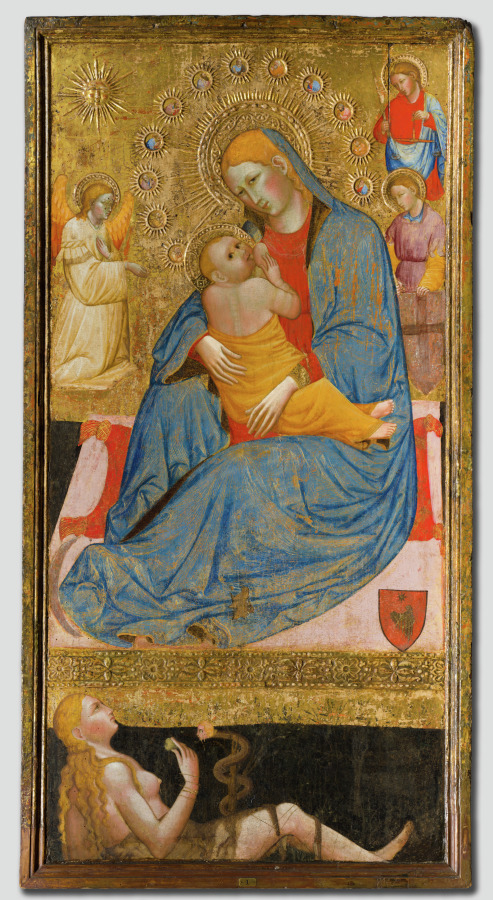
Olivuccio di Ciccarello · The Cleveland Museum of Art · Holden Collection · CC0
- Born
- 1365 · Camerino.
- Died
- 1439 · Ancona.
- Occupation
- painter
- Languages
- Italian
VALÉORINE Encyclopedia
VALÉORINE documentary reading
Documentary summary
Illustration — Works of Mercy (To bury the dead), Vatican Museums. Little is known of his life. He was a native of Camerino and was active from 1388 until his death.
Admitted source layer · organised and presented by VALÉORINE
Note VALÉORINE
Olivuccio di Ciccarello (1365–1439) was a painter. Born in Camerino, the painter died in Ancona.
Languages used include Italian. Works by Olivuccio di Ciccarello are held at Art Institute of Chicago, Cleveland Museum of Art and Fitzwilliam Museum, among others.
Composed from admitted, traceable facts · 26 September 2026
VALÉORINE
Reference Check
Propose documentary evidence for Olivuccio di Ciccarello. A contribution is never written directly as fact: identity, source, rights and evidence gates still decide.
Sign in to contribute
Documentary evidence
Documentary basis
Authority files
wikidata · Q1094527 · wikipedia · Olivuccio di Ciccarello
In this article
Carlo da Camerino
Carlo da Camerino
In 2002 works formerly attributed to an obscure painter named Carlo da Camerino were re-attributed to Olivuccio di Ciccarello as it had become clear Carlo da Camerino had never existed. He worked at Ancona, where he was the most important painter of the gothic painting school.
Carlo da Camerino was the name given by an Italian art historian to identify an Italian painter who was presumed to have been active in the Marche region around the turn of the 15th century. A painted Crucifix, signed and dated in 1396, made for the church of San Michele Arcangelo in Macerata Feltria was attributed to this artist as well as other works in the Marche region. • Illustration — Crucifix, now attributed to Olivuccio di Ciccarello Research published in 2002 made clear that the name 'Carlo da Camerino' was based on a misreading of the inscription on the Crucifix in the church of San Michele Arcangelo, which reads as follows: ALV......DECI..CARELLU DA CAMERINO PIN... The art historian Cesare Brandi interpreted in 1935 the inscription as the signature of its author:................CAROLLU DA CAMERINO PINXIT From that moment the hypothesis of the existence of a painter of the Marche region by the name Carlo da Camerino was formed and subsequently many works were attributed to this artist including a Madonna with Child in Mondavio, dating from the year 1400. In 2002, on the occasion of an exhibition on the Quattrocento in Camerino, the art historian Matteo Mazzalupi re-interpreted the inscription as: ALVUCCIU DE CICCARELLU DA CAMERINO PINXIT thus assigning the painting to Olivuccio di Ciccarello of Camerino. As a result, in 2002, all works attributed formerly to Carlo da Camerino have been re-attributed to Ciccarello, which suggests a unanimous agreement among art historians regarding the re-interpretation and attribution.
Works
Works
His works have undergone a remarkable dispersion, and are now exhibited in museums in various countries: in Italy: (Ancona, Macerata Feltria, Urbino, Rome, Bergamo and Milan), in other European countries" (Strasbourg, Cambridge, Stockholm, Zagreb) and in America: (Baltimore, Cleveland, Santiago).
Selected works
Selected works
• Illustration — The Madonna of Humility with the Temptation of Eve • St. Francis of Assisi, Strasbourg, Musée des Beaux-Arts • Beheading of St. John the Baptist, Santiago, from Ancona, Misericordia church. • Crucifixion, Zagreb, Grossmayer Gallery, already generally attributed to the "School of Ancona" • Coronation of the Virgin, Stockholm, National Museum • Nine angels and two saints (first board), Cambridge, Fitzwilliam Museum • Nine angels and two saints (second board), Cambridge, Fitzwilliam Museum • Madonna of Humility, three archangels, twelve apostles, and the temptation of Eve, Cleveland, Cleveland Museum of Art • Triptych: Madonna nursing the Child with Saints, Taft Museum, Cincinnati • Triptych, Walters Art Museum, Baltimore • Madonna and Child • St. Peter and St. John the Baptist • St. Paul and St. Francis • Works of Mercy, (six panels), tempera, (1410–1420), Vatican Museums originally from Ancona, Misericordia church • Madonna and Child, (tempera), Civic Museum and Pinacoteca, in Mondavio, Province of Pesaro and Urbino. (1400) • Crucifix, Church of St. Michael the Archangel, Macerata Feltria, Province of Pesaro and Urbino. (1396) • Dormitio Virginis, (tempera) 113x170 cm, Civic Art Gallery, Ancona. (15th century) • Madonna dell'Umiltà e angeli, (tempera) 73x51 cm, Civic Art Gallery, Ancona. (15th century) • Circumcision, (tempera), Civic Art Gallery, Ancona. (15th century) • Crowned Virgin (fresco fragment), Ancona, Civic Art Gallery • Our Lady of Mercy with a holy martyr, (1410–1420), Ancona, Diocesan Museum • Blessed Filippo from Todi, Ancona, Diocesan Museum • St. Primiano bishop blessing and donors, Ancona, Diocesan Museum • Enthroned Madonna nursing the Child, with customer, Ancona, Diocesan Museum • St. James of Galicia, Ancona, Diocesan Museum
Places
Named by the record
Places
Only places the record itself states, plotted where the house gazetteer settles their coordinates. Nothing is inferred from a name or a nationality.
Camerino.
Birth place
Ancona.
Death place
Notes from the source article
Cited by Wikipedia
Notes from the source article
These works are cited by the source article, in its own numbering. They are recorded as its citations, not as sources VALÉORINE has verified.
- 1.ROWLEY, Neville «Comment exposer son Quattrocento ? La régionalisation de l’histoire de l’art, limite ou chance pour la discipline ?», Recueil de textes issus de la Journée d’étude franco-italienne Actualité des recherches en Histoire d'Art. France-Italie, MSH Alpes, 2008; p. 8
- 2.Encyclopedia Treccani, short biography.
- 3.MAZZALUPI, Matteo: «Carlo da Camerino, il pittore inesistente», L’Appennino camerte, LXXXII, n.20, 18 de mayo de 2002, p. 5.
- 4.ROWLEY, Neville «Comment exposer son Quattrocento ? La régionalisation de l’histoire de l’art, limite ou chance pour la discipline ?», Recueil de textes issus de la Journée d’étude franco-italienne Actualité des recherches en Histoire d'Art. France-Italie, MSH Alpes, 2008; p. 8
- 5.Giovanni Venturi, La croce dipinta di Macerata Feltria: luoghi e vicende di un’opera d’arte del XIV secolo fra le più straordinarie delle Marche, p. 1
- 6.Paolo da Poggetto, Fioritura tardogotica nelle Marche, Electa editrice, 1998.
- 7.Taft in 10 | Taft Museum of Art.
Bibliography printed in the source article · 3
- Pietro Zampetti, Pittura nelle Marche (Painting in the Marches), Ist vol., Nardini Editore, Florence 1988
- Andrea De Marchi e Matteo Mazzalupi, Pittori ad Ancona nel Quattrocento (Painters in Ancona in the Fifteenth Century), Federico Motta Editore, Milan 2008
- Andrea De Marchi, Pittori a Camerino nel Quattrocento (Painters in Camerino in the Fifteenth Century). Federico Motta Editore, Milan 2008, 2002
References
Citations
References
Each reference names the institution holding it, so a reader may go to the document itself.
reference work
Secondary witnessreference work
Secondary witness
The Encyclopedia exists whether or not anything is for sale. Corrections are recorded rather than overwritten, and every version of this record is kept. Published 17 August 2026.
Elsewhere in Paintings
19,183 published records in this field, each with its sources named.
- Oliver SmithArtist
- Olivia SerresArtist
- Olivier DebréArtist
- Olivier MegatonArtist
- Olle ZetterquistArtist
- Olof ArboreliusArtist
- Olof AreniusArtist
- Olof HermelinArtist
Best supported in this field
For owners
Own a work by Olivuccio di Ciccarello?
A specialist will read what you send and tell you what the house can establish, what it cannot, and whether the object is suited to sale. There is no charge and no obligation. The object stays with you throughout; nothing is shipped to us unless it is arranged in writing beforehand.